
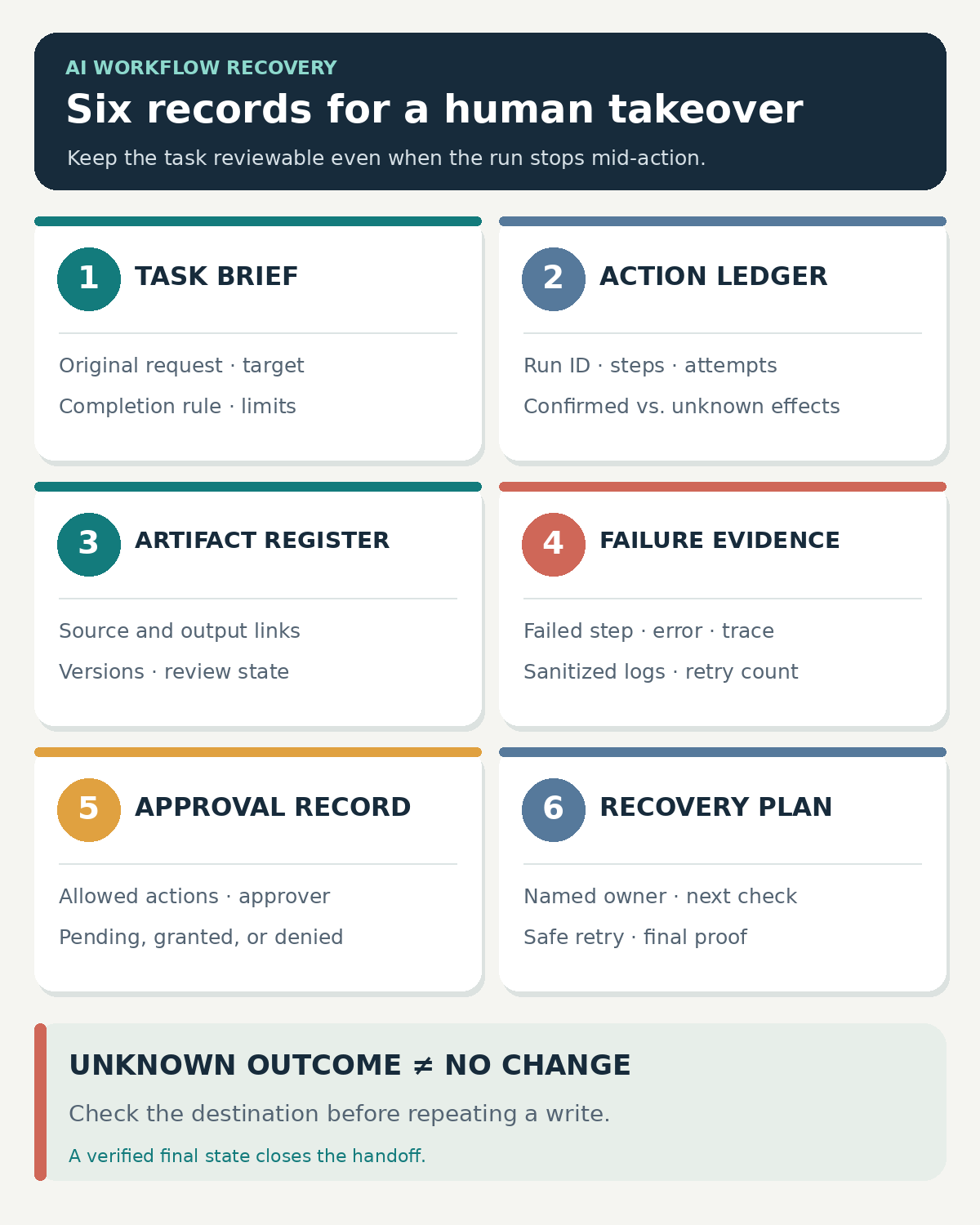
An AI workflow can fail after it has saved a file, changed a record, or requested an action in another app. The error tells you the run stopped. It may not tell you whether the last action reached its destination. The person taking over needs handoff records that show the intended result, the steps actually completed, what exists now, what failed, who may decide, and how to resume safely.
These six records can be sections of one ticket rather than six separate documents. Give the task a stable identifier and keep links to the underlying evidence. A polished chat summary alone cannot establish that a tool call succeeded or that a destination record exists. The distinction matters most in AI task automation that can act across systems.
1. The Task Brief and Completion Rule
The first record says what the person or system asked the AI to accomplish. Include the original request, the correct customer, project, or document, the relevant source material, the deadline if one exists, and the limits of the task. Then state what would count as done in terms someone can check in the destination system.
“Prepare a response” is too vague if the job was to draft a reply for review but never send it. “Create a draft reply in case 842, using the current returns policy; leave it unsent for a support lead” tells the reviewer both the target and the boundary. Use a real case identifier in an actual workflow; this number is illustrative.
Record any required format, quality check, or acceptance condition. If the task depends on a particular policy or document version, link the approved version instead of relying on a model’s recollection. The reviewer needs this record to determine whether the remaining work still serves the original request, especially when the AI produced a fluent but incomplete answer.
2. The Run and Action Ledger
The second record reconstructs the sequence. Store a stable job or run ID, the trigger, timestamps with a time zone, relevant workflow and tool versions, each attempted action, its returned result, and any retries. For consequential changes, record the identity or service account that made the call and the destination’s returned object ID.
Use distinct states: planned, requested, acknowledged, verified, failed, and outcome unknown. “Requested” means the AI or orchestration layer asked a tool to act. “Verified” means the expected change was found in the destination. A timeout after a write may leave the outcome unknown even if the workflow reports failure. Do not silently turn that state into “nothing happened.”
For example, a workflow might read a customer case, create a draft reply, and then time out while updating the CRM. The ledger should preserve the confirmed draft ID, the CRM request ID, and the missing response. This lets the reviewer check the CRM before repeating the update. It also separates a model decision from an external system action.
3. The Artifact and Source Register
The third record tells the reviewer where the work and its inputs actually live. List source documents, retrieved records, generated files, saved drafts, destination objects, and their versions or timestamps. Mark each artifact as provisional, checked, approved, or superseded. Include access instructions for an authorized reviewer, along with the person or team that owns a restricted file.
A file name in a chat message is weak evidence. A stable document link, storage object ID, or CMS draft ID is more useful. If a save request timed out and no ID was returned, write “ID unknown; check destination by job reference” rather than inventing a location. Preserve an independent copy of work that exists only in a temporary workspace when the workflow permits it.
Keep the original material distinguishable from AI output. In a customer-support workflow, the receiving person may need both the customer’s message and the AI’s proposed reply, along with the conversation and actions already attempted. That is also a useful check when evaluating human handoff records in AI support. Share only the data the assigned reviewer needs.
4. The Failure Evidence Record
The fourth record identifies the exact point at which the workflow lost confidence. Capture the failed step, observed error or validation result, time, attempt number, trace or correlation ID, and a link to the relevant logs. Add the actual input and output fields necessary to diagnose the issue, with secrets and unrelated personal data removed. If a screenshot helps, it must show the real system state rather than an illustrative mock-up.
An error code is an observation; a root cause is a conclusion that may still need investigation. “CRM update timed out after the request was sent” is more honest than “the CRM rejected the update” when no response arrived. Note whether the issue appears to involve missing input, a model choice, a permission check, a tool failure, or an external service, but label unconfirmed explanations as hypotheses.
For instrumented agent workflows, OpenAI’s tracing documentation describes records of model calls, tool calls, handoffs, and guardrails. The handoff should point to the relevant trace while retaining the business outcome check in the destination app. Protect the trace itself: logs can contain customer information, document excerpts, or credentials, so restrict access, redact where appropriate, and apply a retention policy.
5. The Approval and Authority Record
The fifth record shows what the AI was permitted to do and which decisions belong to a person. Include the applicable policy or instruction version, the actions requiring approval, the named approver or role, and the state of each decision: pending, approved, rejected, expired, or not requested. If approval was granted, retain what was approved, by whom, when, and for which exact action or amount.
Do not infer permission from silence or from the fact that an AI prepared a plausible recommendation. A draft can exist without authority to send it. An approved refund of one amount is not permission to change the amount or recipient after approval. If the failed task involved an unexpected external change, flag containment and access review for the appropriate owner before resuming.
This record makes the human role operational rather than ceremonial. The NIST AI Risk Management Framework calls for documented human oversight, clear responsibilities, and procedures for response and recovery. The specific approval thresholds remain a matter for the organization and the risk of the action.
6. The Recovery Owner and Next-Action Record
The final record assigns the unresolved work to a named person or queue. State the immediate check, the deadline or priority, the escalation contact, and the condition under which the task may be retried, corrected, rolled back, or closed. Tell the reviewer what to verify before changing anything and what proof will mark the task complete.
If a write timed out, the first action is usually to inspect the destination for the intended result using the job reference or returned request ID. If the result exists, reconcile it with the ledger and continue from that point. If it does not, retry only under a documented safe method, such as an idempotency key where the destination supports one, or a manual duplicate check. Do not assume every integration makes repeat writes safe.
The record should also say who will notify an affected customer or colleague if the original task missed a deadline or made a visible change. A useful non-AI fallback gives the person access to the original material, a way to correct the result, and a clear exception route. Close the case with the verified final state, not simply with “retried.”
The Six Handoff Records in One Example
The following is an illustrative record for a draft-only customer reply workflow. It describes no actual run or test.
| Record | Entry a reviewer could use |
|---|---|
| Task brief | Draft a reply in the specified support case for lead review; do not send it. Check the current returns policy. |
| Action ledger | Case read and draft created; CRM status update requested; response timed out. Preserve the run and request IDs. |
| Artifacts | Link the original customer message, policy version, saved draft ID, and any CRM record found during reconciliation. |
| Failure evidence | Timestamp, timeout, attempt count, trace link, and sanitized request details. CRM write outcome remains unknown. |
| Authority | Lead approval required before sending. No send approval recorded. |
| Recovery | Assigned lead checks the CRM for the intended status, corrects or resumes the update if safe, reviews the draft, and records the final state. |
<figure><img src=”ai-task-failure-handoff-infographic-4×5.png” alt=”Six cards show the task brief, action ledger, artifact register, failure evidence, approval record, and recovery plan needed for a human takeover.” width=”1200″ height=”1500″><figcaption>The six records form one practical recovery packet; verify an uncertain external action before repeating it.</figcaption></figure>
For a smaller workflow, the same fields may fit in one screen. For a sensitive or regulated action, the evidence and approval trail may need more detail. What matters is that the receiving person can distinguish confirmed facts from proposed actions and unknown outcomes.
Make the Failure Recoverable
Good handoff records let a human answer three questions before pressing retry: What was supposed to happen? What changed already? What is safe to do next? Design the workflow to preserve those answers at each checkpoint, including when the AI cannot produce a final message. A failed run then becomes a bounded task someone can investigate and finish, rather than an invitation to repeat an uncertain action.