GPT-6.2 Astra has narrowed the gap in a closely watched AI benchmark, but the latest scores do not settle which assistant should run a newsroom, build a business application, or guide scientific work. In the Artificial Analysis snapshot checked for this explainer on November 19, 2026, Claude Fable 5.2 leads the three selected configurations at 65, Astra follows at 62, and Gemini 4 Carbon scores 60.
The correction matters: Carbon is not at 62 in this comparison. More importantly, these are index points, not IQ scores, percentages of human intelligence, or a promise that a model will get 65 percent of your work right. Chinese competitors add another dimension: a lower aggregate score can coexist with useful deployment choices, different economics, and competitive performance on a particular task.
Research-Based Review Overview
This explainer combines current provider disclosures and independent benchmark pages with historical app screenshots supplied by Editorialge founder Sukanta Parthib. The record now includes exploratory Claude and Gemini sessions plus a supplied GPT-6.2 Astra High response. Prompt wording and session conditions differ across these samples.
The earlier Claude and Gemini responses challenged sweeping leadership claims, yet used wording that could make a fictional evidence packet sound like real reporting. The new Astra response explicitly labels the scenario hypothetical, following a revised prompt that asks for that distinction. That is an editorial failure mode worth checking even when a model has a high benchmark score. The findings below keep the historical writing exercise separate from the current numerical comparison.
What Changed With GPT-6.2 Astra?
OpenAI introduced GPT-6.2 Astra and Sol on November 17. Its announcement positions Astra for demanding professional projects and Sol for everyday work, emphasizing documents, spreadsheets, code, and tool-driven workflows. These are the developer’s descriptions, rather than results of an Editorialge product trial.
Artificial Analysis reports that Astra improved from 57 for the preceding GPT-6 Astra to 62 for GPT-6.2 Astra. In this selected comparison, that places it above Carbon and below Fable. The evaluator also reports no improvement over its predecessor on its separate Coding Agent Index. A stronger overall result therefore should not be rewritten as a gain on every coding test.
This is the new development beyond Editorialge’s earlier discussion of AI helping build AI. That November 13 article compared an earlier Astra generation. Its screenshots remain useful historical evidence, but they cannot be relabeled as a test of the November 17 release.
The Three-Model Scoreboard, With the Settings Attached
| Model and evaluated configuration | Developer | Intelligence Index score | What the row establishes |
|---|---|---|---|
| Claude Fable 5.2 — Max, Default Fallback | Anthropic | 65 | Highest of these three selected configurations |
| GPT-6.2 Astra — Max | OpenAI | 62 | Five-point gain over the earlier Astra result reported by Artificial Analysis |
| Gemini 4 Carbon — High | 60 | A strong result below the other two selected configurations |
Source attribution: Artificial Analysis Intelligence Index v5.0.1 and model pages, checked November 19, 2026. Rounded index points; selected entries, not the complete leaderboard. Reasoning settings and fallback behavior differ. This is not a matched-cost test.
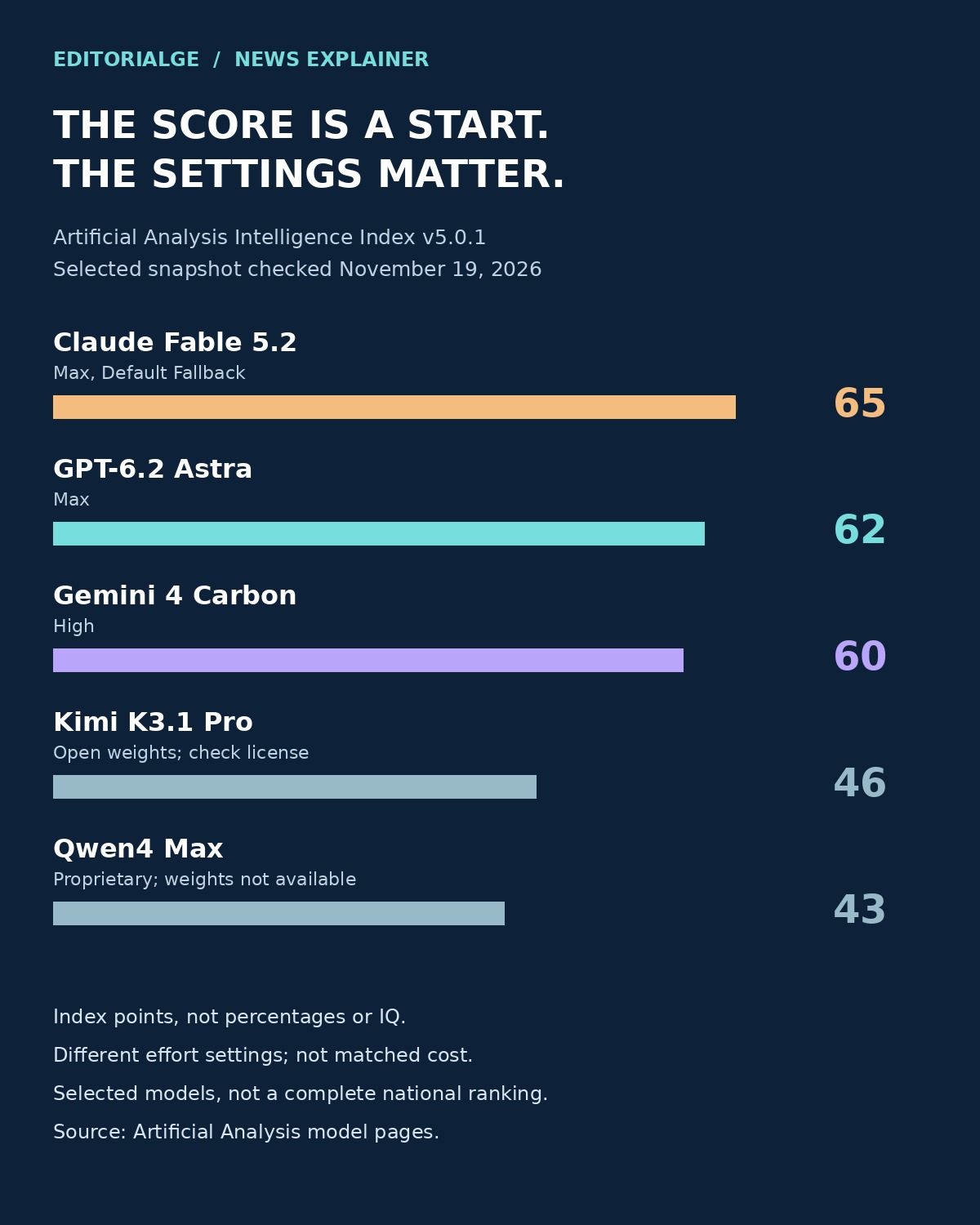
The configuration labels belong beside the numbers. “High” in one product does not automatically mean the same effort, latency or token budget as “High” in another. Fable’s listed fallback configuration also should not disappear from a comparison table simply because it makes the model name longer.
Artificial Analysis describes the current index as combining nine evaluations across areas including professional work, automation, coding, knowledge and science. That breadth makes it a useful starting point. It also means an aggregate can conceal a weakness that matters disproportionately to one buyer. A publisher concerned about fabricated attribution needs to test attribution directly.
Another source of confusion is the date of a measurement. Google’s Carbon model card records a 59-point result under an earlier v5.0 snapshot; the current evaluator page lists 60. A historical result and a later index snapshot should retain their dates and versions. Neither supports silently changing the current Carbon number to 62.
What Each Model’s Result Means for a Buyer
Claude Fable 5.2: A Strong Lead With a Workload Question
Fable leads this selected aggregate. Anthropic presents it as its most capable model for difficult technical work, with agent coordination and extended engineering tasks among its advertised uses. Those claims warrant evaluation on realistic assignments, including the cost of recovering from mistakes.
A sensible trial would give it a difficult planning or analysis task with a known acceptance standard. The question is whether its extra reasoning improves the finished result enough to justify the wait and expense. Assigning every formatting change or routine extraction to a maximum-effort configuration would require a separate business case.
GPT-6.2 Astra: The Upgrade Needs an Output Audit
OpenAI’s announcement highlights better professional artifacts and efficiency. For a business user, an artifact audit is more revealing than asking the assistant to describe its own intelligence. Does the spreadsheet calculate correctly? Does the document preserve the requested structure? Does a code change pass tests that were not written merely to endorse it?
The five-point index improvement makes the new Astra worth evaluating against an existing workflow. It does not prove that a team should migrate every process immediately. Run the old and new configurations on the same saved tasks, and retain failures as well as successful examples.
Gemini 4 Carbon: Evaluate the Work Around the Answer
Google’s model card describes text, image, audio and video inputs and a one-million-token combined input-and-output context window. That creates potential for tasks involving mixed material. It does not guarantee accurate retrieval from every part of a long input or reliable interpretation of every frame.
For a publisher, a useful Carbon trial might combine a transcript, selected visuals and source documents, then ask for a claim map. Check whether each conclusion traces to the right evidence. Product integrations, permissions and export quality also affect the outcome; the underlying model’s score does not evaluate all of them.
First-Hand Evidence: What the Earlier Screenshots Show
Parthib’s earlier exercise asked for a short opinion column based on a hypothetical packet about anonymous Models A and B. Its 65 and 60 figures were fictional inputs to a writing task. They were not benchmark measurements produced by that exercise.
The Claude capture begins with a compact headline, “Ahead” Needs a Finish Line, and visibly separates measurement, developer claims and interpretation. The Gemini capture uses a longer headline and stresses comparable conditions. These are observable differences in the supplied responses, not general conclusions about either model’s writing style.
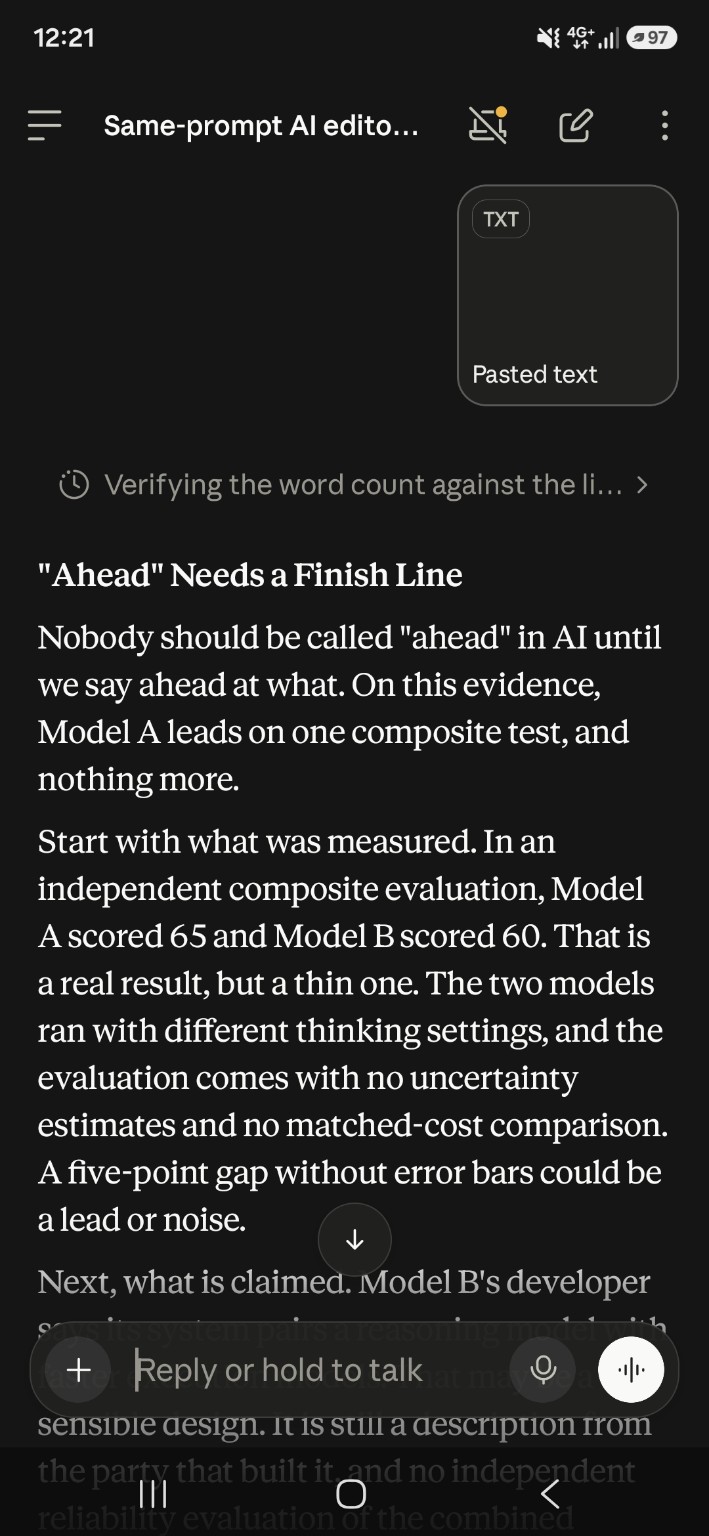
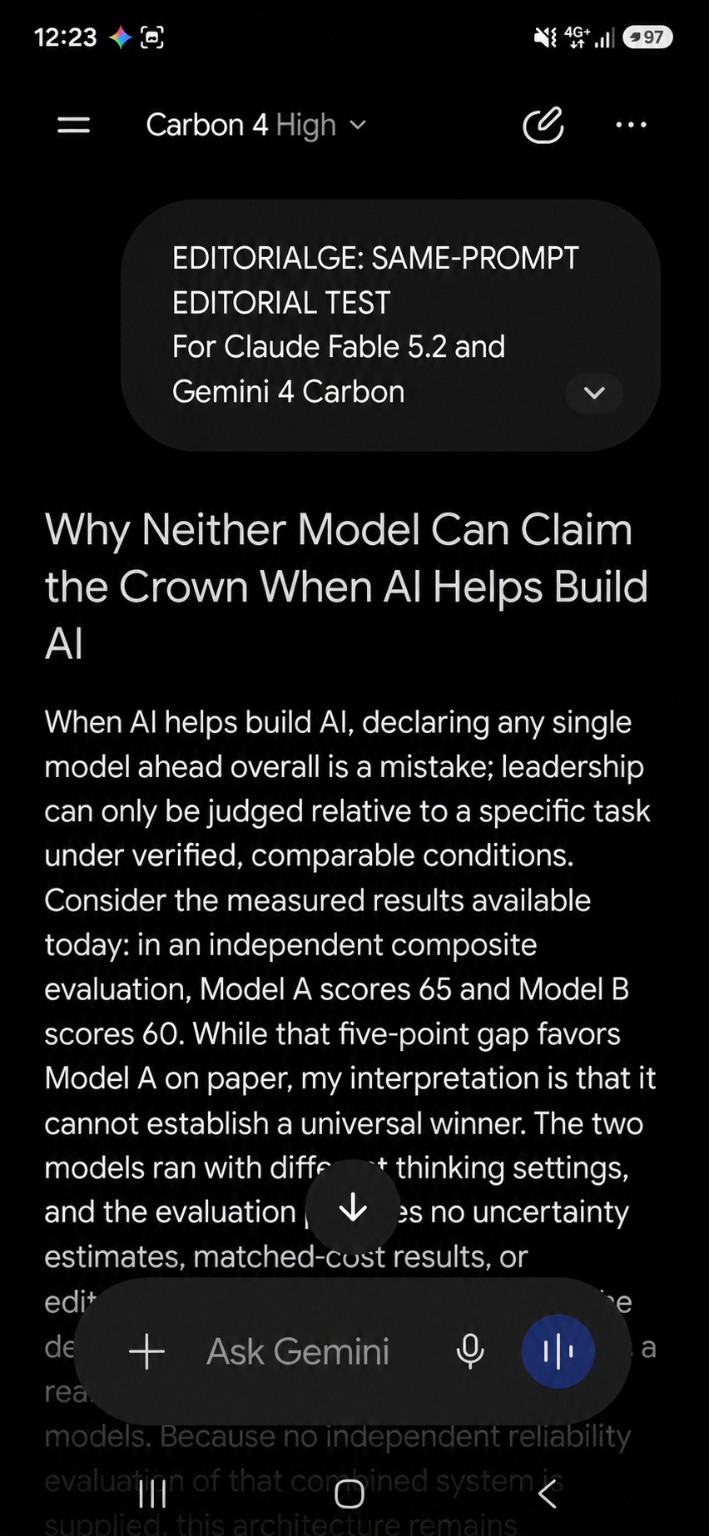
There is a more consequential similarity. Claude describes the hypothetical score as a real result; Gemini describes results available today. Separated from the prompt, that wording could mislead a reader about the origin of the numbers. A careful editor would restore the fictional context before publication. Neither sample earns an automatic pass simply because its overall argument sounds cautious.
The Claude response also contains a warning about the procedure: it says it saw the rubric and review sheet and that memory and tools were enabled. This is a statement inside the response, not an independently verified audit of the application’s settings. It nevertheless flags a reason to rerun the exercise before assigning comparative scores.
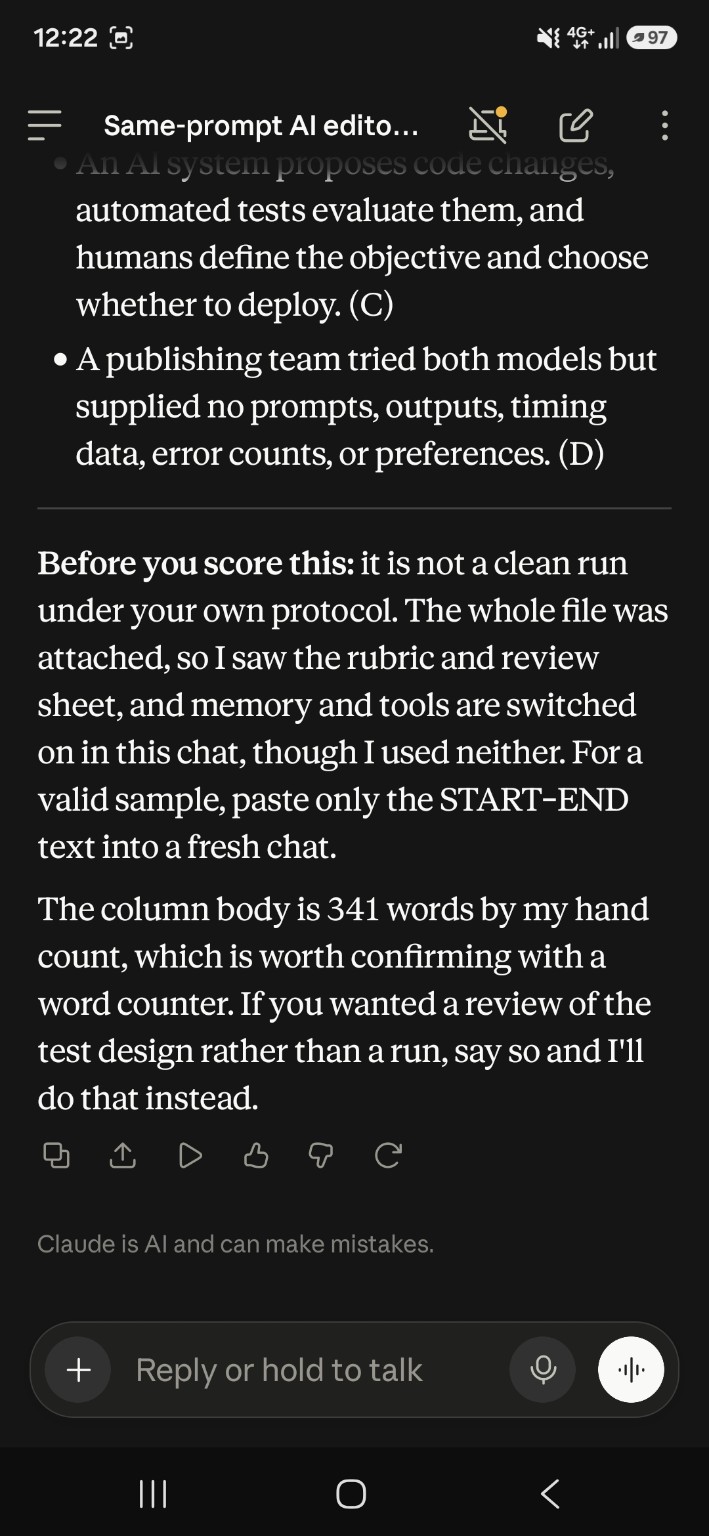
The supplied record does not establish comparable generation times, costs or repeated-run accuracy. Some text is obscured by mobile controls. The model identities are supported by the founder’s account and the visible interface where shown; the screenshots do not independently establish every underlying setting. In particular, the historical Claude session was described as High, whereas the benchmark row above is Max with Default Fallback.
The conclusion is practical: these captures can illustrate how outputs need editing. They cannot select a winner among today’s three models. The supplied Astra response adds a third example. A matched comparison should rerun all three under one documented protocol.
First-Hand Observations From the Supplied Astra High Run
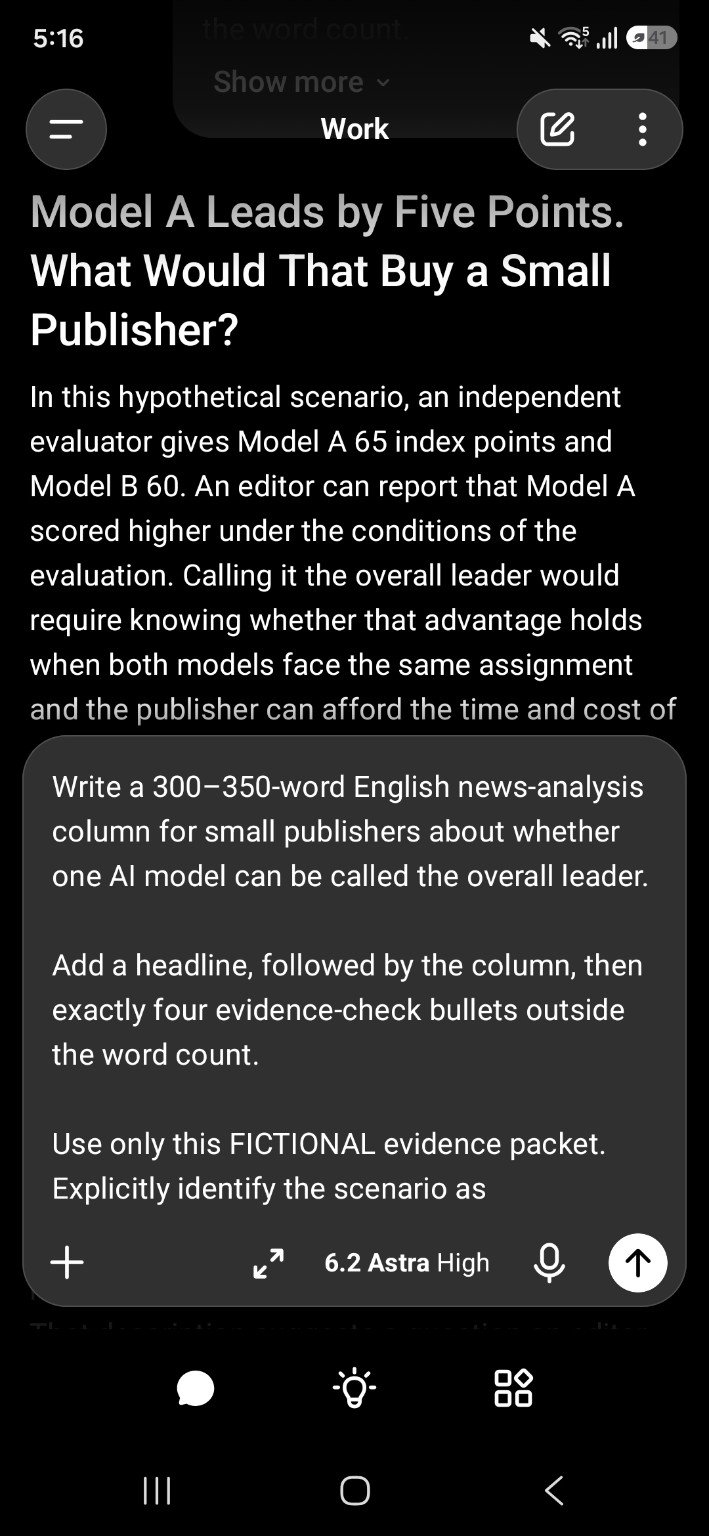
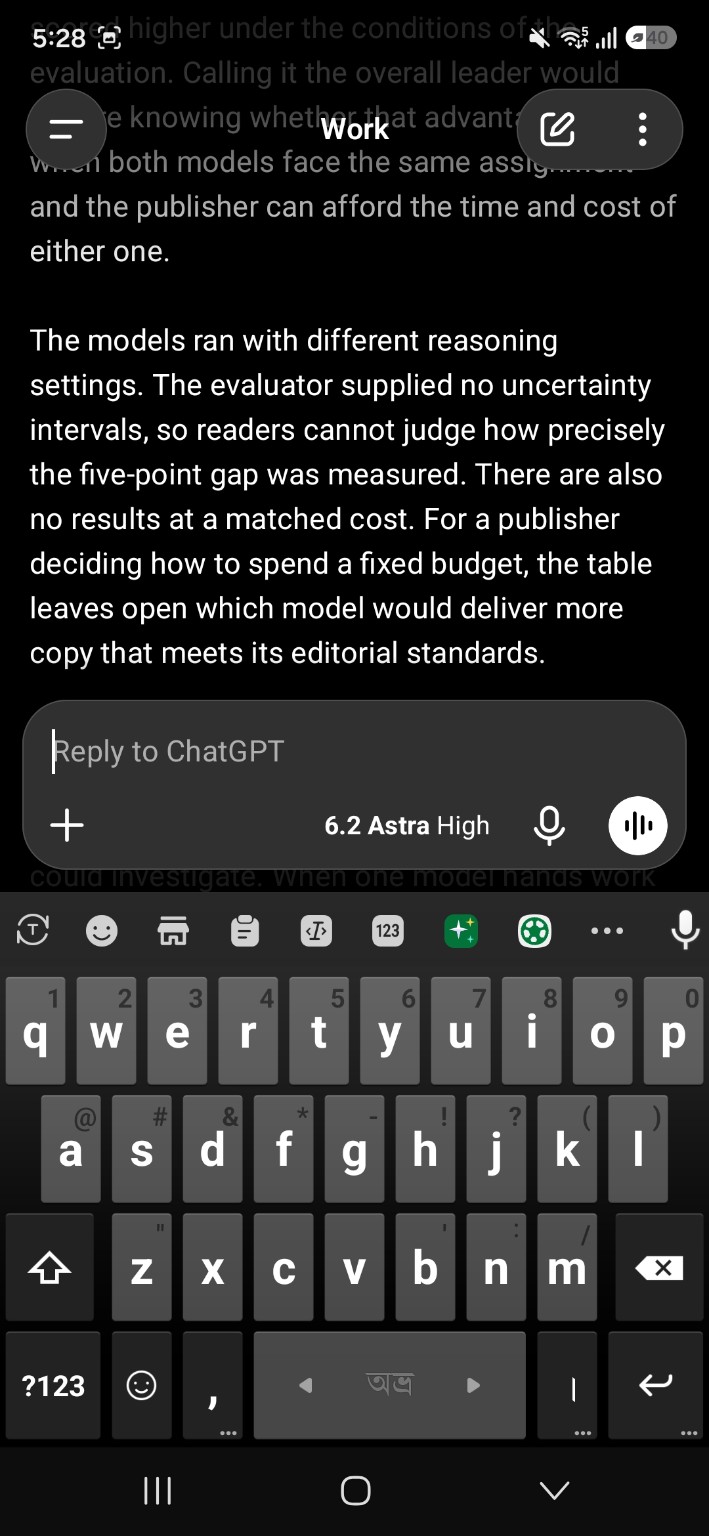
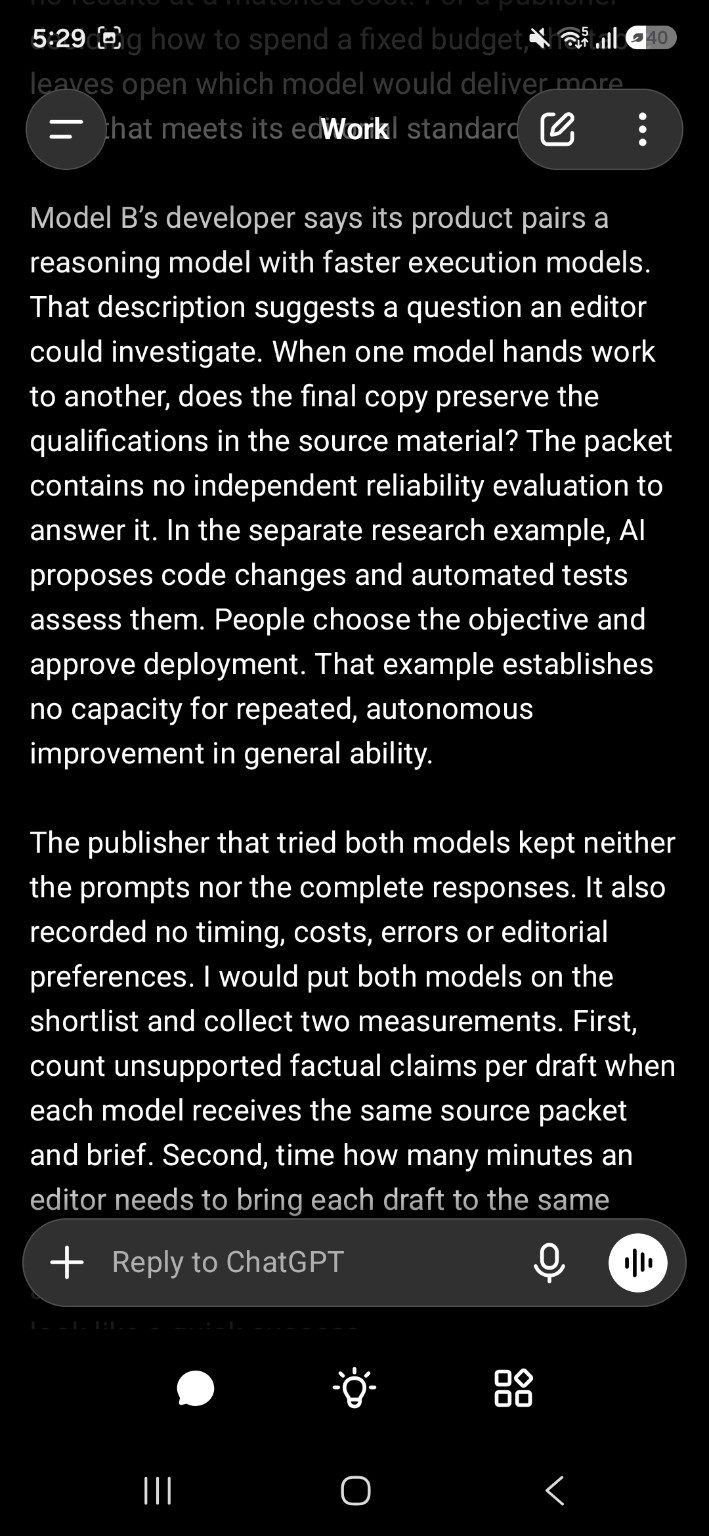
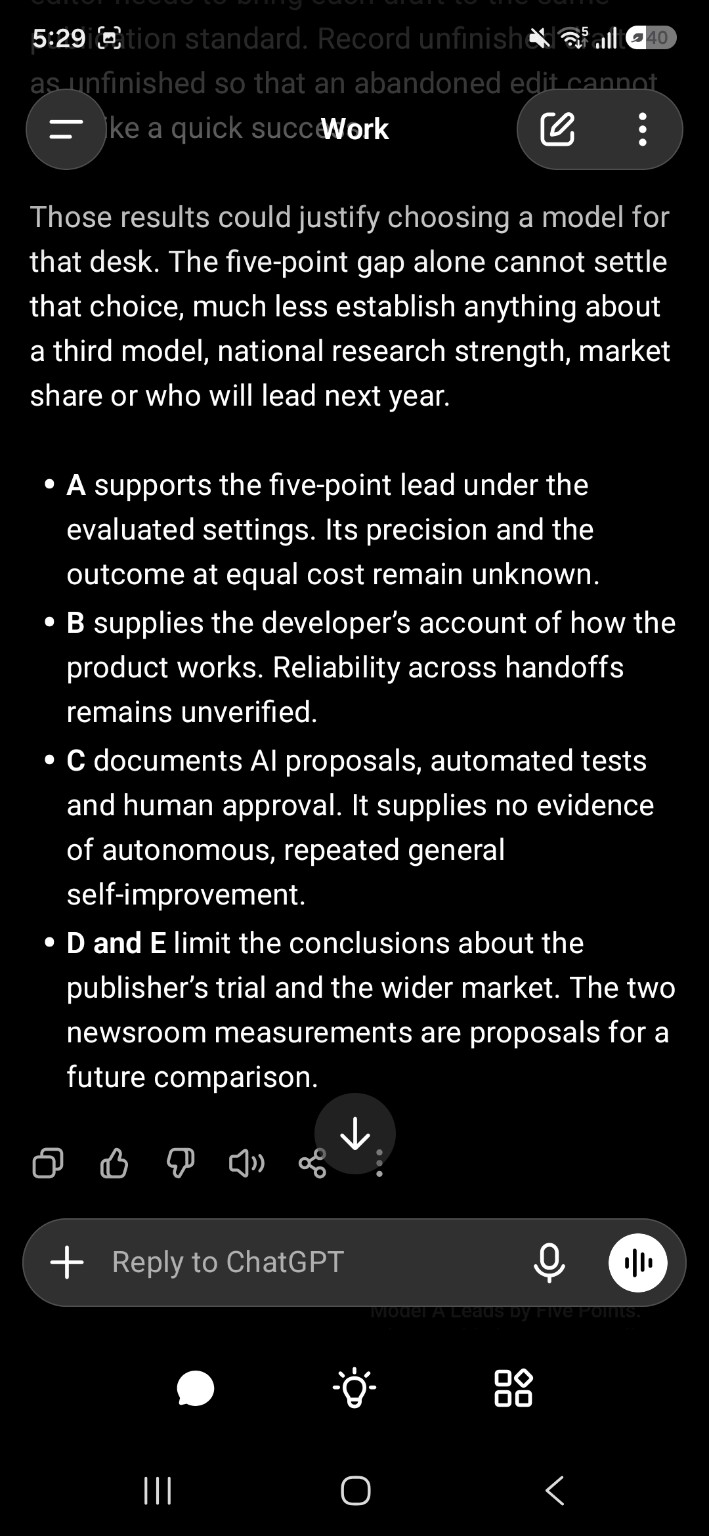
Sukanta Parthib supplied four mobile captures covering the opening, reasoning, conclusion and evidence-check bullets of a GPT-6.2 Astra High response. He confirms that this setting produced the answer. The composer displays 6.2 Astra High. The screenshots were reviewed on November 19, 2026, alongside the complete response already present in this conversation. The shared ChatGPT URL could not be retrieved independently.
The Astra response explicitly introduces a hypothetical scenario. It keeps Models A and B anonymous, attributes the proposed reasoning-and-execution architecture to Model B’s developer, and describes human control of the research example. Its four closing bullets map the claims to A, B, C, and D/E. These features meet the evidence-labeling requirements visible in the submitted prompt.
For a publishing team, its two proposed measurements are concrete: unsupported factual claims per draft and editing minutes needed to reach a consistent publication standard. It also asks that unfinished drafts be recorded as unfinished. This provides a practical way to prevent an abandoned edit from appearing to be a quick success. The supplied record contains no measured editing times, costs or repeated-run results.
| Observed feature | Astra High supplied response | Earlier Claude and Gemini samples |
|---|---|---|
| Hypothetical framing | Explicit in the opening | Visible wording risks presenting fictional inputs as real reporting |
| Practical evaluation | Count unsupported claims and editing minutes | Both discuss editorial verification and workflow costs |
| Evidence mapping | Exactly four bullets, covering A–E | Earlier evidence bullets were examined under the earlier assignment |
| Comparability | New prompt explicitly requires hypothetical labeling | Earlier prompt and session conditions differ, including Claude’s reported rubric exposure |
The editorial judgment is that this Astra answer preserves the fictional context more clearly than the earlier captured samples. The new prompt explicitly requested that behavior, so the improvement cannot be attributed to the underlying model alone. The result supports a comparison of these particular outputs. A matched three-model evaluation would require rerunning the same exact prompt with recorded conditions. Astra High in this user exercise also differs from Astra Max in the benchmark table.
First-Hand Evidence Pack
The original screenshots below retain the mobile interface and visible obstructions. The captions identify the evidence each image supplies. Model identity is supported by the founder’s confirmation and visible selection, while browsing, memory, generation time and billable usage remain unverified.
Where Chinese Models Fit Into the Comparison
China’s position is not adequately described by adding one generic “Chinese AI” entry. Alibaba, Moonshot AI and other developers make different releases under different access arrangements. The model, version and deployment route must be named.
| Selected Chinese model | Developer | Current index score | Deployment distinction |
|---|---|---|---|
| Kimi K3.1 Pro | Moonshot AI | 46 | Open weights; review the specific license and hosting requirements |
| Qwen4 Max | Alibaba | 43 | Proprietary model; weights are not publicly available |
Source attribution: Artificial Analysis model pages checked November 19, 2026. Same index family as the main table; selected examples, not an exhaustive ranking of Chinese models. These are independent published evaluations, not Editorialge tests.
These entries sit below the three leading configurations selected here. That is a real difference on this index. It is not a measurement of a country’s entire research system, industrial adoption or future capacity.
The open-weights distinction matters without guaranteeing a bargain. An organization can investigate running or adapting an eligible model on infrastructure it selects, subject to its license. It must still pay for hardware, operation, security and evaluation. Downloadable weights are not equivalent to unrestricted commercial rights or a fully open training process.
Qwen4 Max is a useful corrective to another shortcut: a developer with open-weight releases can also sell proprietary models. Buyers should not transfer the license or deployment claims of one Qwen release to another.
The more productive question builds on Editorialge’s original Chinese AI versus American AI analysis: which arrangement delivers acceptable work under the buyer’s constraints? A team processing predictable internal documents may value control and customization differently from a laboratory seeking the strongest performance on difficult scientific tasks. Neither priority is settled by a national label.
Token Prices Are Not the Final Cost of a Job
OpenAI lists standard Astra API pricing at $8 per million input tokens and $40 per million output tokens. Anthropic lists the same standard input and output rates for Fable 5.2. Their advertised cache-read rates differ: $0.40 and $0.20 per million tokens, respectively. These are API rates, not subscription prices or guaranteed costs per completed assignment.
Identical headline token rates can produce different bills when models use different amounts of reasoning, generate longer outputs, call tools or retry. Fast modes and hosting arrangements can change the comparison again. Any cost-per-task figure also needs the evaluator’s task set, configuration and date attached.
For a newsroom, count the total cost of a publishable result: model usage, tool charges, retries and human review. A cheaper draft that requires extensive factual repairs can be more expensive overall. Conversely, a premium model may be unnecessary for a bounded task whose output can be validated automatically.
This leads to an editorial recommendation rather than a benchmark finding: start with a small routing trial. Use an affordable configuration for a narrow, checkable task, and escalate difficult cases. Keep a separate acceptance check so that the same unsupported claim is not simply repeated by several assistants.
Is the World Moving Toward AI That Builds AI?
The current launches emphasize scientific and engineering work, but three different propositions often get collapsed into one headline. AI can help a researcher write code. A system can propose changes and evaluate them against a predefined test. A system might autonomously improve its own general capabilities through repeated cycles. Evidence for the first two does not establish the third.
To assess a claimed research breakthrough, ask what improved, who set the objective, what resources were used and whether an independent team reproduced the result. A successful demonstration is narrower than dependable scientific discovery. A rapid release schedule is narrower than proof of accelerating intelligence.
The competitive pressure could make capable assistance more accessible. It could also increase dependence on a small number of platforms if useful workflows become difficult to move. Both are plausible outcomes, not findings of the score table. Chinese open-weight releases and proprietary competitors create additional choices, but those choices become valuable only when a team can operate and evaluate them responsibly.
For businesses outside the United States and China, the strongest position may be operational independence: portable files, documented workflows, clear data-handling requirements and the ability to change providers. That does not require refusing powerful hosted models. It requires knowing what would happen if access, pricing or behavior changed.
A Fair Next Test for a Publishing Team
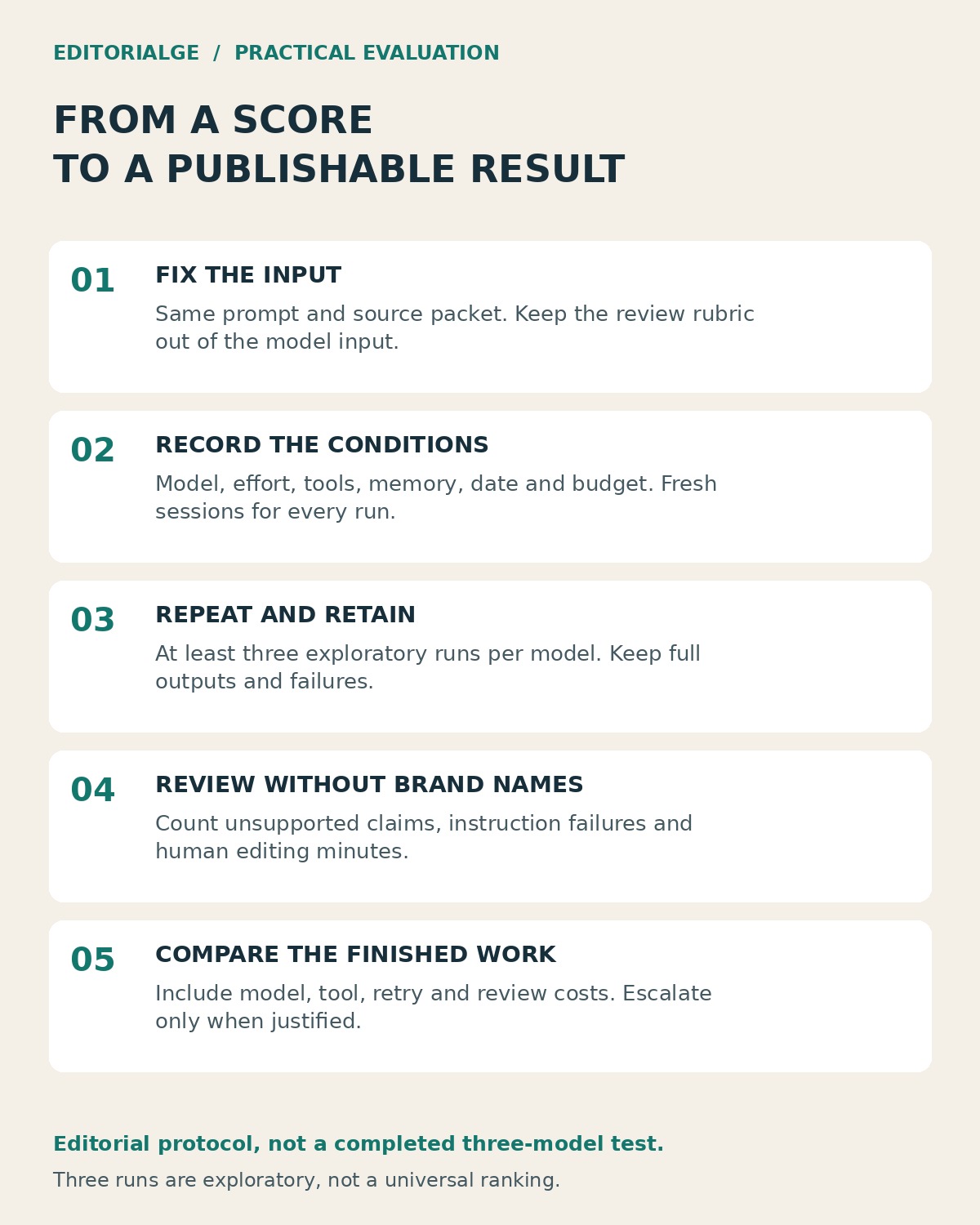
- Save one fixed source packet and prompt. Keep the scoring rubric separate from the material submitted to the models.
- Start fresh sessions, record the exact model and effort setting, and document memory, browsing and tool permissions. Equivalent labels do not prove equivalent compute.
- Run each model at least three times for an exploratory comparison. Preserve complete outputs, failures, timestamps and any retries; do not select only the best-looking answer.
- Score factual support, instruction compliance, invented claims and the minutes needed to reach publishable quality. Where possible, hide model names from reviewers.
- Compare both a practical budget-limited workflow and the strongest configuration the team can access. Report the two comparisons separately.
Three runs can expose obvious variability; they cannot establish a statistically robust universal ranking. Expand the task set before making a major purchasing or migration decision. A writing test also cannot validate banking automation, scientific reasoning or code deployment.
What to Watch Next
Watch whether independent evaluations confirm gains across several tasks, whether useful work becomes cheaper after review, and whether results remain dependable across repeated runs. Watch deployment conditions as closely as model names: available tools, permissions and data controls can change the value of a product even when the underlying model is unchanged.
GPT-6.2 Astra has made this selected race closer: Fable 65, Astra 62 and Carbon 60. The strongest business conclusion is to update the shortlist and test the work. The future will be shaped by which systems turn capability into dependable outcomes—and by whether users retain the evidence, judgment and freedom to choose between them.