
Material composition tells a shopper what a product contains. “Environmental benefit” describes an advantage, such as less packaging waste or lower greenhouse gas emissions. A product description can establish the first without establishing the second. “Contains recycled polyester” and “better for the planet” ask the evidence to do very different jobs.
That distinction matters when a supplier sends a specification sheet and a copywriter turns it into a sales page. A percentage becomes “sustainable.” A plant-derived ingredient becomes “biodegradable.” A change to the shipping box becomes a claim about the product inside it. Each extra step can introduce a promise the original document never supported.
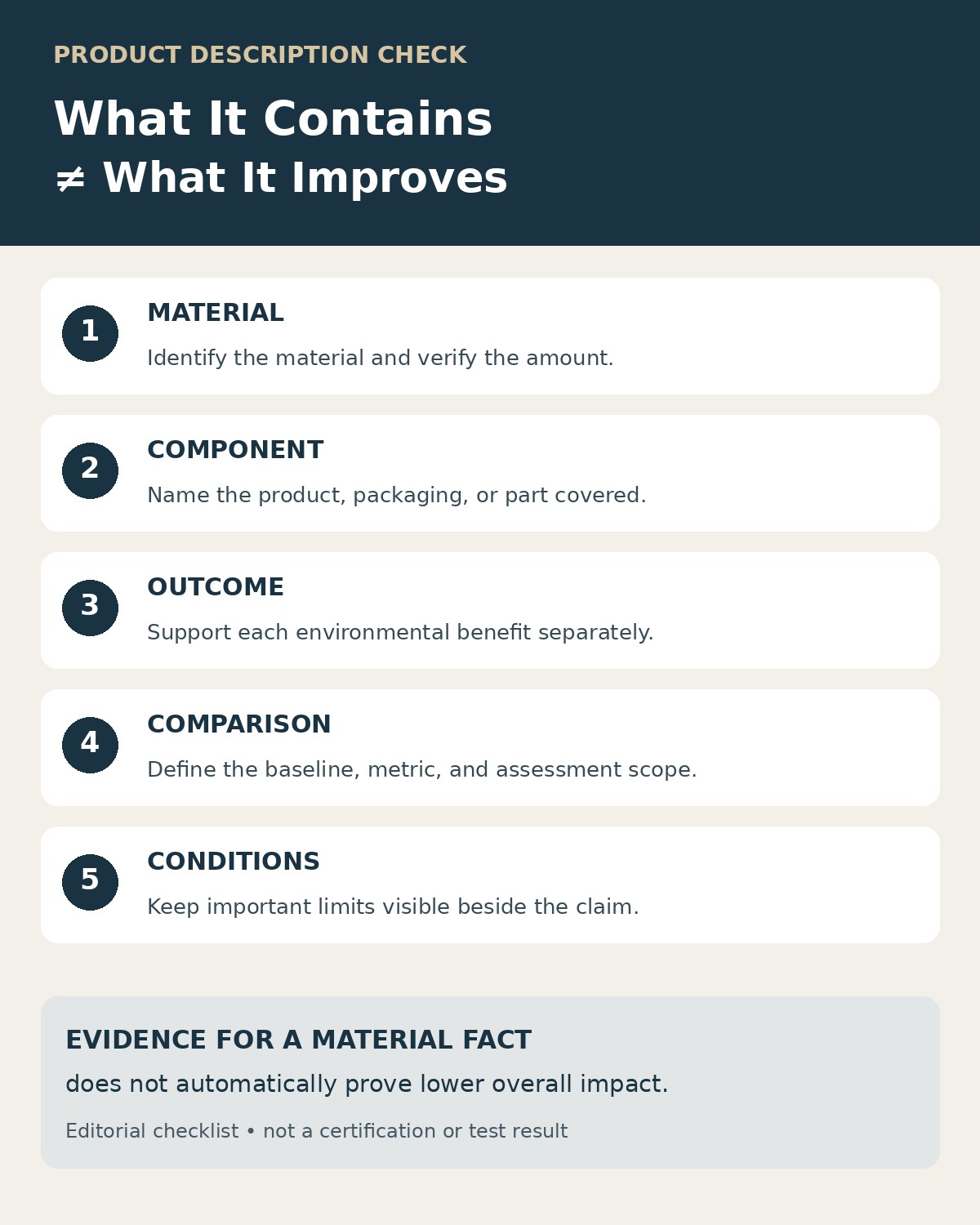
The practical approach is to state the verified material fact precisely, then assess any environmental benefit as a separate claim. Shoppers should be able to see what the statement covers, what it means, and which conditions matter.
Research-Based Review Overview
This guide compares U.S. Federal Trade Commission guidance, UK Competition and Markets Authority guidance, and an actual U.S. enforcement case. The recurring issue is a mismatch between the scope of the evidence and the impression created by the description.
A narrow, documented material statement gives a writer something useful to say. It does not automatically support a claim about the whole product’s environmental performance. Clear wording also has to survive the headline, product badge, image, and collection page around it.
Research method: The sample descriptions below are illustrative rewrites, not tested products or preapproved legal wording. U.S. and UK guidance are identified separately; product-specific labeling requirements and local rules still need checking for the market where an item is sold.
What Material Composition Actually Tells a Customer
A composition statement identifies the materials in an item or component. It may specify a proportion, a source characteristic, or both. “Outer fabric: 60% recycled polyester and 40% virgin polyester” is more informative than “made with recycled materials,” provided those percentages are supported.
The missing detail is often the denominator. Does “60% recycled” describe all the material in the finished bag, only its outer fabric, or only the polyester portion of a blend? Those statements are not interchangeable.
Consider a hypothetical fabric containing 60% polyester and 40% cotton. If half of the polyester is recycled, the recycled polyester represents 30% of the fabric by weight, assuming all percentages use that same basis. Describing the fabric as “50% recycled” would change what the calculation means.
Keep three questions together when editing:
- Which material is being described?
- Which part of the product does the statement cover?
- How was the percentage calculated and verified?
A composition claim also needs evidence. Depending on the material and claim, useful records may include a current specification, purchase and production records, appropriate testing, or relevant certification documents. A generic brochure about a supplier’s capabilities does not identify what went into a particular item.
Why an Environmental Benefit Needs Its Own Evidence
An environmental claim goes beyond identifying ingredients or components. It describes an outcome or advantage. That outcome may concern emissions, water use, waste, or a particular disposal route. These are different questions, and success on one does not establish success on all of them.
The FTC’s Green Guides summary advises against broad, unqualified descriptions such as “green” or “eco-friendly.” It also explains that a specific attribute does not justify an overall benefit claim without considering relevant trade-offs.
For an editor, the useful follow-up is “What changed compared with what?” A carbon comparison needs an identified comparison product and a defined assessment boundary. A packaging-weight comparison needs the old and new packaging specifications. A claim about disposal needs evidence about the actual item and the conditions under which it can be processed.
The UK CMA’s Green Claims Code likewise asks businesses to consider the full life cycle. That does not mean every factual sentence needs a lengthy life-cycle assessment. It means a claim about one stage should not leave shoppers with a misleading impression about the whole product.
| Type of statement | Question it answers | What to check before using it |
|---|---|---|
| Material composition | What is it made from? | Material identity, amount, component, and supporting records |
| Material sourcing | Where or how was the material obtained? | Traceability, scope, and any relevant certification conditions |
| Comparative benefit | What impact is lower, and against which alternative? | Comparable function, baseline, metric, method, and boundaries |
| Disposal claim | What can happen after use? | Product suitability, required preparation, facilities, and access |
A seller can have sound evidence for one row and insufficient evidence for another. The description should reflect that difference.
A Real Case: Bamboo Descriptions at Kohl’s and Walmart
In May 2022, the U.S. Department of Justice announced that Kohl’s and Walmart had agreed to civil penalties of $2.5 million and $3 million, respectively, to resolve allegations involving textile descriptions and environmental claims.
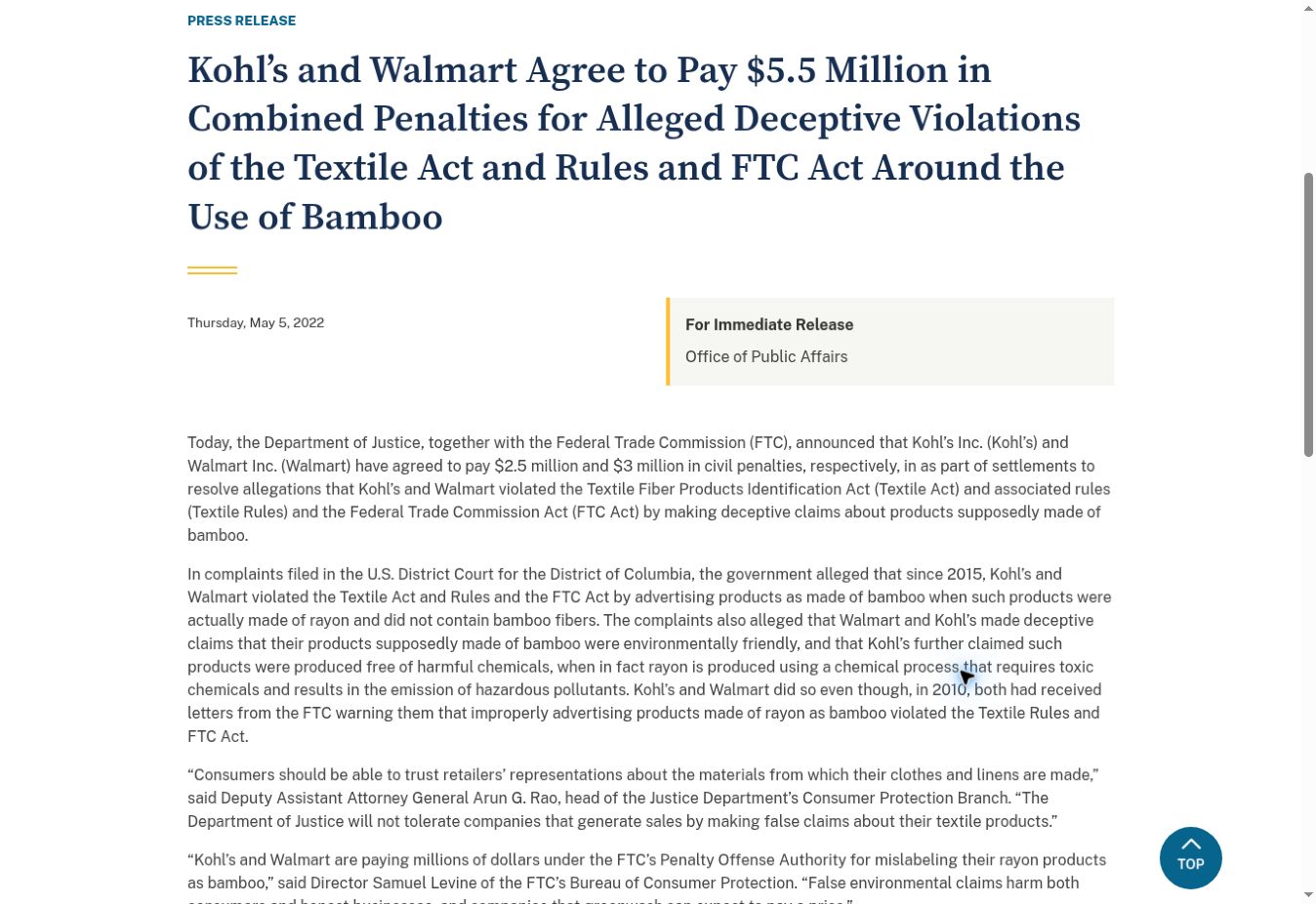
According to the Justice Department’s settlement announcement, products advertised as bamboo were actually rayon and did not contain bamboo fibers. The complaints also challenged environmental claims; the announcement described chemical processing and hazardous emissions associated with producing rayon.
The stipulated orders barred misleading or unsupported claims about bamboo composition and environmental benefits from bamboo sourcing. This was a documented enforcement matter, not a test conducted for this article.
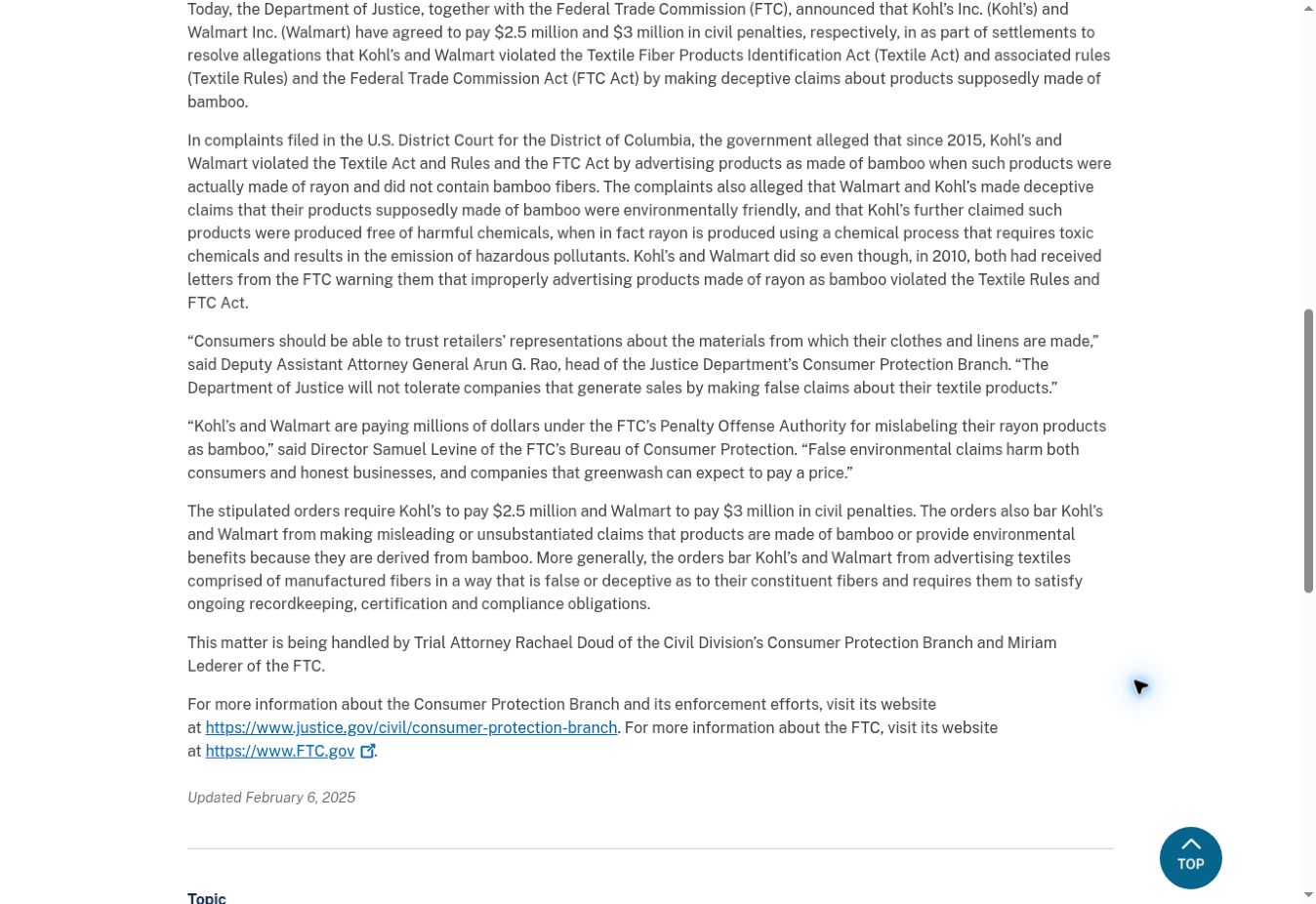
The editorial lesson has two parts. First, name the material in the finished product accurately. A plant used as a feedstock does not necessarily describe the resulting fiber. Second, evaluate the claimed environmental advantage independently. Even an accurate statement about a raw material’s origin does not establish the impact of turning it into a finished product.
How to Rewrite Claims Without Adding Unsupported Promises
The examples below show how to narrow a description to the available evidence. Every percentage and product specification is hypothetical. Use a rewrite only when the actual product records support it, and check the complete presentation before publication.
| Draft wording | What is missing | More precise direction |
|---|---|---|
| “An eco-friendly backpack made from recycled plastic.” | The affected component, proportion, and evidence for the broad benefit | “Outer fabric: 60% recycled polyester and 40% virgin polyester. Lining: virgin polyester.” |
| “Sustainable packaging.” | The actual change and what it covers | “The shipping carton contains 80% recycled paper fiber by weight.” |
| “Plant-based, so it naturally biodegrades.” | Evidence connecting material origin to breakdown under specified conditions | State the verified feedstock information separately; omit the breakdown claim until supported. |
| “30% greener than before.” | A defined environmental metric and comparison | Identify the measured change, such as packaging mass, with a named previous version and calculation. |
| “Made with certified materials.” | Scheme, eligible component, and certificate scope | Name the relevant scheme and component only when the product and claim qualify. |
Notice that a more precise sentence may sound less dramatic. It can still help the customer decide. Someone comparing two backpacks may care about the shell material, lining, weight, repair options, and pocket layout. There is no need to turn every useful specification into an environmental promise.
Keep the Product and Its Packaging Separate
A recycled shipping carton does not make the contents recycled. Put packaging information under a clear packaging label, and keep it out of product-material fields used by shopping feeds.
For a hypothetical notebook, a description might say: “Pages: 100% recycled paper. Cover: coated paperboard.” It should not shorten that to “100% recycled notebook” unless the evidence and overall presentation support the broader statement. The cover, binding, and other components may change the meaning.
Treat Recycled and Recyclable as Different Claims
Recycled content concerns material already used in making the item. Recyclability concerns what can happen after the customer finishes with it. Neither proves the other.
The FTC guidance addresses recycling access as well as the item itself. A recycling symbol or technically recyclable material is not enough to settle what a consumer can do with the finished package. Check the relevant collection and processing route, then provide the appropriate qualifications and instructions.
Do Not Turn Plant Origin Into a Disposal Instruction
“Plant-derived,” “biodegradable,” and “compostable” describe different attributes. The FTC guidance treats compostability as a claim requiring evidence about breakdown and the conditions involved, including qualifications where home composting or facility availability is limited.
For a product page, the useful information is operational: which disposal route applies, which parts qualify, and what the customer must do. A botanical image cannot communicate those conditions.
Build a Description From the Evidence You Actually Have
Start with a short claim record before polishing the sales copy. The following is a practical editorial workflow, not a certification system.
1. Attach the Evidence to the Exact Item
Record the product identifier, variant, supplier, specification date, and relevant batch or version. A black fabric and a printed fabric may come from different sources. A supplier change may invalidate wording that was accurate for the previous production run.
Keep the proposed sentence beside the supporting document. That makes it easier for another editor to see whether the document supports the words, rather than merely discussing a similar material.
The CMA’s January 2026 supply-chain guidance emphasizes verification processes and current evidence. Passing a supplier’s language directly into a retail listing does not remove the need to check it.
2. Split the Sentence Into Its Claims
Take a hypothetical line: “Our recycled cotton tote reduces waste and is better for the planet.” It contains a material claim, a waste claim, and a broad environmental comparison.
Review each separately. If the file establishes only the fabric composition, retain the supported composition statement and remove the other promises. Asking a copywriter to “make it sound greener” cannot fill the evidence gap.
For a useful drafting exercise, place every environmental adjective in a temporary review column. Keep it only if someone can explain its meaning in this context and identify the evidence behind it.
3. Make Comparisons Reproducible
Suppose a hypothetical shipping carton falls from 100 grams to 80 grams while serving the same packaging function. That is a 20% reduction in carton mass. It is not, by itself, a measured 20% reduction in carbon emissions or total waste across the product’s life.
A precise description could identify the carton-weight reduction and the previous carton version. Before claiming a wider benefit, examine the evidence for that wider outcome. For example, a lighter carton’s protective performance matters if the proposed claim concerns the overall impact of delivering an undamaged item.
For a modeled carbon benefit, ask the analyst for the comparison, unit of function, included stages, important assumptions, and uncertainty. Write the result at the level those findings support. Do not turn an estimate for material production into a claim about manufacturing, delivery, use, and disposal combined.
4. Put Important Limits Beside the Claim
Review the page on mobile. If the headline says “recycled backpack,” but the explanation that only the outer fabric qualifies is buried in an accordion, the customer may leave with the wrong impression.
The CMA’s fashion guidance stresses clear fabric descriptions and prominent explanations. Apply the same editorial care to collection names, filters, image overlays, and search-result snippets. A detailed composition tab cannot reliably correct a contradictory title shown elsewhere.
The broader pattern also appears in greenwashing in skincare: environmental language can influence the impression of a product beyond the underlying ingredient information. For any category, review what the entire page communicates.
5. Assign an Owner and a Review Trigger
A claim record needs someone responsible for updating it. Set review triggers such as a supplier substitution, specification change, new comparison model, or change in the supporting certification’s status.
Include marketplace listings and advertising templates in that process. Editing the main product page while an old claim continues in shopping ads leaves the correction incomplete. Keep the previous version and approval date so the team can identify where stale language may still be running.
A Short Approval Check for Product Teams
Before approving the description, have someone outside the drafting process read only what the shopper sees. Ask them to explain the claim in their own words. If their interpretation is broader than the evidence, revise the presentation.
Then check five practical points:
- The material name and percentage match current records for this item.
- The product, packaging, or component covered is obvious.
- Any claimed advantage has its own supporting evidence and a clear comparison where needed.
- Important conditions are visible beside the claim.
- The title, imagery, filters, advertisements, and detailed description tell a consistent story.
This is an editorial quality check, not a substitute for technical substantiation or any required legal review. Its value is catching the point where accurate source information becomes overstated sales copy.
Keep the Claim Within the Evidence
Material composition is a useful starting point for a product description. Tell customers what the item contains, identify the relevant component, and make percentages understandable. When the evidence supports a specific environmental benefit, explain that benefit with its scope and conditions.
A precise description can be persuasive without promising more than the records establish. The best final check is simple: can the next editor trace each meaningful claim back to evidence for this exact product?