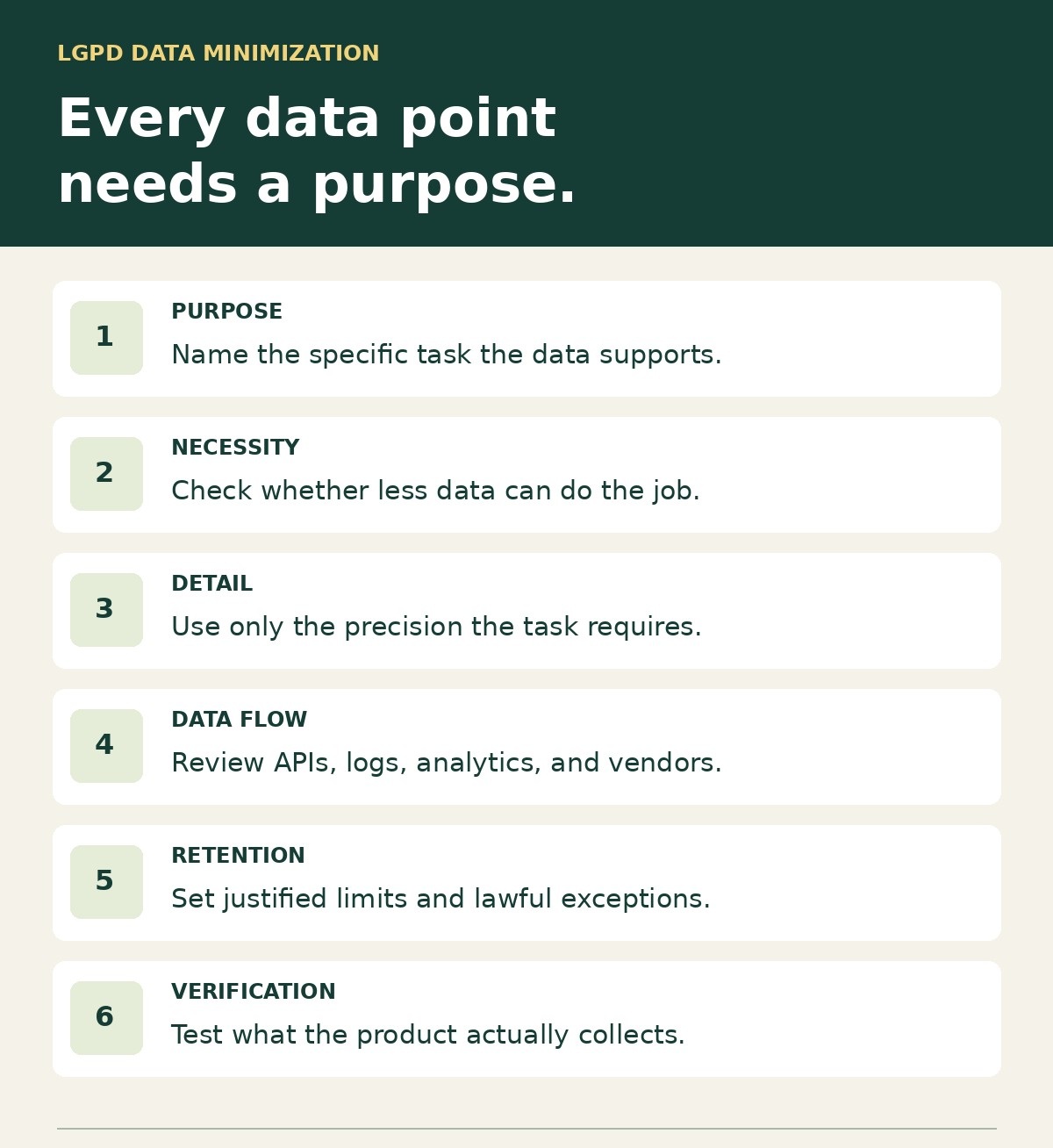
LGPD data minimization means limiting personal data processing to what is necessary for a specific, legitimate purpose. For a product team, that affects which fields appear in a form, what an analytics event contains, which vendors receive information, and when stored records should be removed. The practical question is whether the feature can achieve its purpose with less personal data or a less intrusive design.
Consider an email newsletter that asks for a subscriber’s full birth date, phone number, and home address. Each additional request needs an explanation tied to an actual purpose. Making those fields optional, adding a consent checkbox, or encrypting the database does not settle whether the processing is necessary.
What LGPD Data Minimization Actually Requires
Brazil’s Lei Geral de Proteção de Dados Pessoais, or LGPD, addresses this through the principle of necessity in Article 6, III. It requires processing to remain within the minimum needed for its purposes, using data that are relevant, proportionate, and not excessive.
The principle works alongside purpose and adequacy. A team needs to identify why it processes information, check that the processing fits the stated purpose and context, and justify its scope. A vague ambition to “improve the experience” gives designers little basis for deciding which information belongs in a feature.
The LGPD’s statutory text also defines processing broadly. Collection, access, storage, use, and sharing all fall within its reach. Removing a question from a signup screen therefore leaves work unfinished if an integration still gathers the same information behind the scenes.
LGPD can apply to organizations outside Brazil when Article 3’s territorial conditions are met, subject to the law’s scope and exceptions. Hosting a product abroad does not, by itself, remove the need to assess its application.
The examples below are practical design patterns, not automatic compliance approvals. A product’s legal basis, sector-specific duties, and actual data flows still need assessment by its privacy and legal teams.
Start With the Purpose, Then Design the Field
Before adding an input, write down what the product needs to accomplish. “Send a delivery update” is more useful than “customer engagement” because the team can test which information supports that action.
Ask whether an existing communication channel will do. If email already delivers the update reliably, requiring a phone number needs a separate justification. If customers can choose SMS updates, introduce the number field at that point and explain its use.
This approach also changes the timing of collection. A visitor browsing products does not have the same information needs as a customer requesting delivery. Collecting an address when delivery is requested can reduce unnecessary collection from people who never reach checkout.
The following examples illustrate questions to resolve, rather than universal rules for every service:
| Product decision | A design worth challenging | A narrower option to evaluate |
|---|---|---|
| Newsletter subscription | Require address, phone number, and birth date | Request the email address and only justified preferences |
| Store finder | Request continuous precise location | Let users enter a city or postal code; offer limited location access if useful. |
| Account setup | Collect every possible billing field before a purchase | Request relevant billing information when the transaction requires it. |
| Team invitation | Upload the user’s entire address book | Let the user enter selected recipients or share an invitation link. |
| Support request | Ask for a full identity document by default | Start with a proportionate verification method matched to the request. |
| Product analytics | Send complete form contents with every event | Define an approved set of event properties that answers the measurement question. |
A narrower option must still work safely. Account recovery may require stronger verification than an ordinary support question. Billing may involve legal requirements. The design task is to identify those requirements precisely, rather than apply the most intrusive workflow to every user.
Consent Does Not Make Excessive Collection Necessary
LGPD has several legal bases for processing. Consent is one; it is not a general exemption from the law’s principles. A checkbox cannot turn unrelated information into data necessary for a stated purpose.
An optional feature can have its own legitimate purpose. If someone requests an SMS reminder, processing a phone number may be appropriate for that feature. The team must still assess the legal basis, explanation, sharing, and retention. “Optional” describes the interface; it does not complete the analysis.
Legitimate interest also needs more than a business preference. Article 10, paragraph 1, limits processing on that basis to personal data strictly necessary for the intended purpose. ANPD’s guidance organizes its balancing test around purpose, necessity, and balancing with safeguards. That legal basis does not apply to sensitive personal data.
For product planning, separate the core service from additional marketing, personalization, and research uses. Give each use a specific assessment instead of treating account creation as permission for everything the roadmap might eventually include.
Follow the Data Beyond the Screen
A clean interface can conceal a large amount of collection. An analytics library might capture page addresses containing identifiers. An error-reporting tool might receive request bodies. A support integration might copy information into another system with a different retention setting.
Review what leaves the device and what the server records. For each integration, identify the properties sent, their purpose, the recipient, and whether they remain necessary. Changing the visible form is only one part of that review.
Analytics Should Answer a Defined Question
Suppose the team wants to know which checkout step produces validation errors. An illustrative event might record the step name, error category, and application version. The customer’s name, address, or message text may add no value to that question.
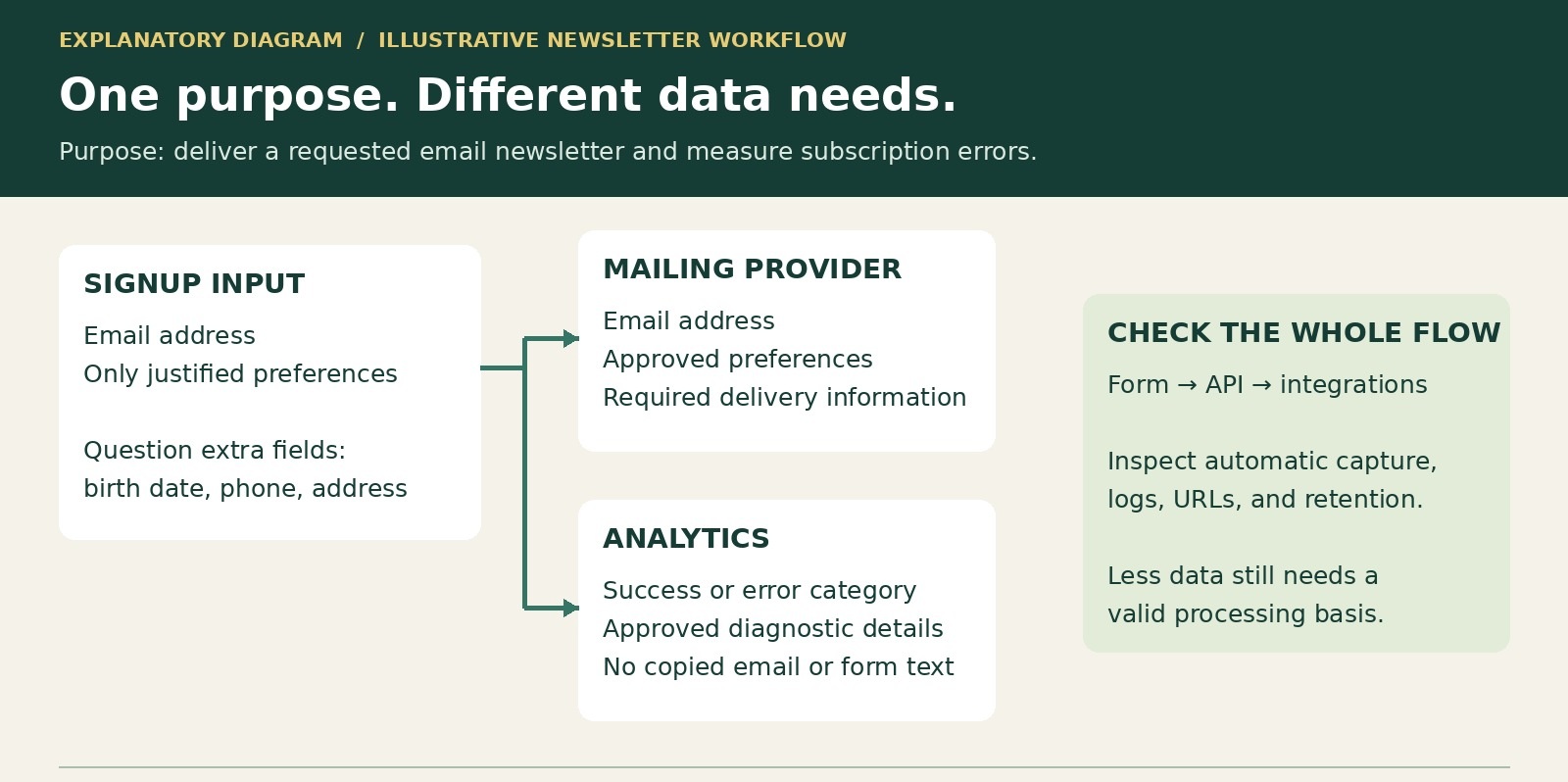
Specify the permitted properties before implementation. Where possible, send an error code instead of the user’s actual input. Check URL parameters, automatic capture, and session-recording settings rather than assuming that a vendor’s defaults match your needs.
These controls reduce collection; they do not determine the legal basis by themselves. Assess whether identifiers or combinations of properties still relate to an identifiable person.
ANPD’s cookie guidance distinguishes functionality essential to the requested service from nonessential uses such as behavioral tracking. It also recommends leaving consent-based cookies disabled by default and making rejection and preference management accessible. A tracker is not essential simply because its reports are useful to the business.
Support, Logs, and AI Features Need the Same Review
Free-text fields can collect information that a team never intended to request. Add a short instruction explaining what belongs in the field, and avoid asking people to paste passwords, payment details, or identity documents into a general support message.
For logs, choose the information needed to diagnose a problem and protect the service. Review full request bodies, authentication tokens, and unrestricted user-generated text. Keep necessary security records under a justified policy rather than deleting them indiscriminately in the name of minimization.
An AI summarization feature creates another data flow to inspect. If the task requires one approved document, do not automatically attach the customer’s entire account history. Check what the provider receives and retains, including whether content is used for another purpose. Calling a feature “AI-powered” supplies no independent justification for broader collection.
Retention Is a Product Requirement
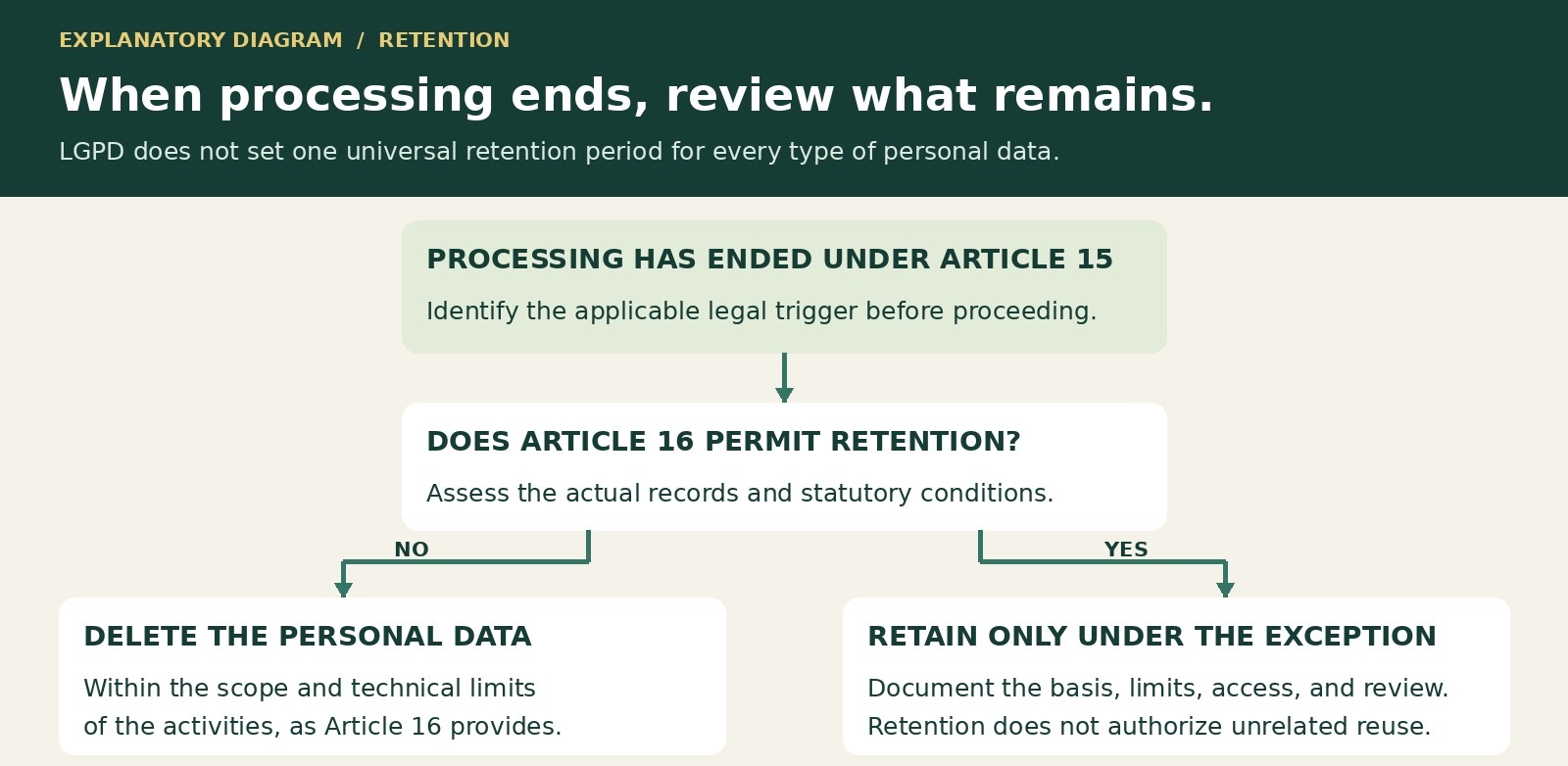
The necessity question continues after collection. A record may be justified during an active task and excessive once that task ends.
Articles 15 and 16 address the end of processing and subsequent deletion, subject to the statutory conditions and permitted retention exceptions. ANPD’s FAQ explains that LGPD does not establish one universal retention period: the circumstances and purpose matter. There is no general “LGPD requires 30 days” rule for every product database.
Assign each data category a retention rule, an owner, and an event that starts the relevant clock. A temporary upload, an account profile, and a legally required transaction record may need different treatment. Keeping a record for a legal obligation does not automatically justify continuing to use it for unrelated marketing.
Account deletion also needs an implementation plan. Review copies in operational databases, analytics systems, support tools, exports, and backups. Document how retained exceptions and backup expiration work and how restoration avoids quietly reintroducing data that should no longer be in active use. These are implementation considerations, not a blanket exemption for backup copies.
Make the user-facing explanation match the actual process. If specific records must remain, explain the relevant scope and reason rather than promising that every byte disappears immediately.
Pseudonymous Data Can Still Be Personal Data
Replacing an email address with an identifier can reduce direct exposure. It does not necessarily make the record anonymous. If the organization can reconnect that identifier to a person, the data still need to be assessed as personal data.
Article 12 addresses anonymized data and the possibility of reversing anonymization using the organization’s own means or reasonable efforts. A hash, an internal account ID, or an “anonymous” label in a dashboard is not proof that this standard has been met.
Aggregation can help answer some product questions with less individual detail, but check whether small groups or combinations of attributes reveal people. Review the output and the underlying data separately. Collecting identifiable records first and displaying only a total later still involves personal-data processing along the way.
For broader context, Editorialge’s guide to the core principles of internet privacy laws explains related concepts. An LGPD assessment should still use the Brazilian statute and applicable guidance, rather than assume another jurisdiction’s rules are interchangeable.
Make the Design Review Specific Enough to Test
Turn the privacy discussion into acceptance criteria that designers, engineers, and QA can check. For an illustrative newsletter feature, those criteria might include:
- The form requests only an email address and any separately justified preferences.
- The API accepts only approved fields and handles unexpected input without retaining it unnecessarily.
- Analytics records subscription success or an error category without copying the email address into the event.
- The mailing provider receives only the information required for the approved workflow.
- Retention and unsubscribe handling follow a documented policy, including any narrowly justified suppression record needed to avoid unwanted re-enrollment.
- The privacy explanation accurately describes the resulting processing.
Test the behavior, not just the mockup. Inspect network requests, stored records, and vendor settings. A field removed from the design can survive in an old API, database export, or integration.
LGPD also makes design-stage protection relevant directly: Article 46, paragraph 2, requires the specified security measures from product or service conception through execution. Security controls protect the data you need; necessity analysis helps decide which data should be processed at all.
LGPD data minimization becomes practical when every data element has a defensible purpose, a proportionate level of detail, and a justified lifecycle. Start with one feature, trace its actual data flows, and remove collection or reuse the team cannot explain. Then carry that decision into the interface, backend, integrations, and retention rules.