To audit and optimize existing content for AI Overviews and AEO, start with the pages that already answer valuable customer questions. Check whether those pages can be accessed and indexed, identify missing or outdated answers, add verifiable evidence, and measure visibility alongside useful visits and conversions. A clearer paragraph helps; a reliable, complete answer gives the reader a reason to trust it.
An older article can contain good advice and still fail someone arriving with a specific question. The answer may sit below a long introduction. A screenshot may show a retired interface. A comparison may omit the condition that changes the recommendation. An effective audit finds those problems before it starts rewriting sentences.
This guide gives editors, site owners, and small marketing teams a repeatable workflow for improving existing URLs. SEO covers search discovery and performance; answer engine optimization (AEO) emphasizes useful answers; generative engine optimization (GEO) focuses on visibility and representation in generated responses. These are overlapping editorial goals, not three separate certifications.
The GEO research indexed by Princeton University introduced a framework and benchmark for studying visibility in generated answers. Its reported effects varied across domains. That supports testing a defined approach in context; it does not supply a universal promise for a current commercial search engine.
My Firsthand Overview: What the Audit Revealed
I began by opening Editorialge’s existing FAQ page for AEO and checking the information delivered in the browser. I recorded one main H1, a canonical pointing to the same article, index/follow metadata, and five FAQ subheadings. Those observations gave me a concrete starting point: preserve the page’s useful structure and investigate whether its answers address the audience’s actual decisions.
My most useful finding was the distinction between checking a page and measuring its search performance. I could inspect the headings and metadata directly; verifying Google’s selected canonical or a change in AI citations requires different evidence. That is why I recommend recording each finding with its source and scope before deciding what to rewrite.
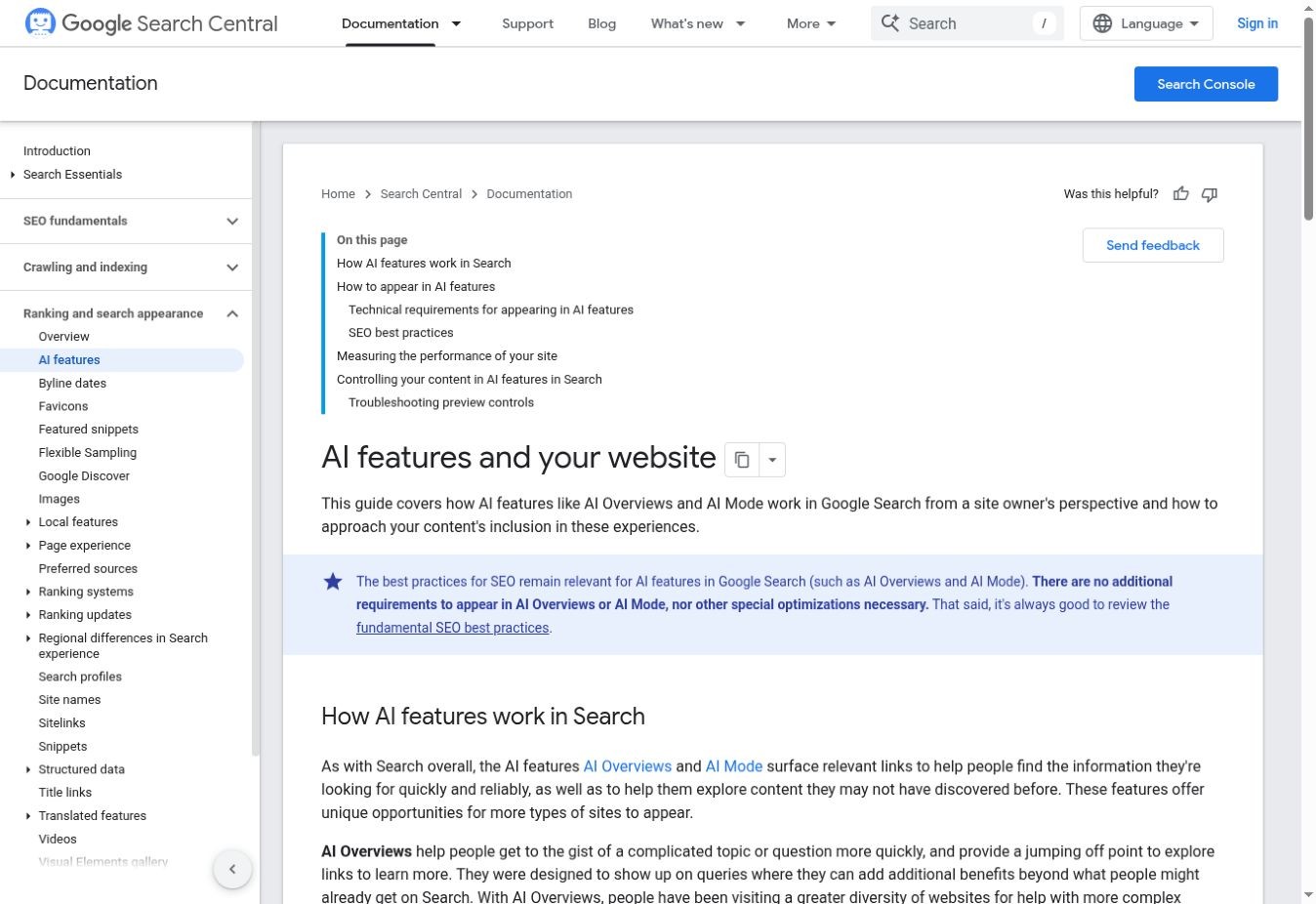
I also compared Google’s AI-features guidance with its newer reporting announcement. The older page described combined Web reporting, while the announcement documented dedicated generative AI visibility views. My takeaway is to audit the freshness of the measurement instructions alongside the content itself: an otherwise useful guide can send readers to an incomplete reporting workflow.
What a Useful AI Content Audit Should Produce
The output is a short, prioritized change list for each URL. An editor should be able to explain what is wrong, what evidence supports the finding, what will change, and how the team will judge the result. A generic “AI readiness” score does not supply that explanation.
| Audit layer | Question to answer | Useful evidence |
|---|---|---|
| Technical eligibility | Can the relevant system retrieve and use the page? | Indexing checks, rendered text, canonical and preview controls |
| Answer quality | Does the page resolve the actual question? | A direct answer, conditions, examples and next steps |
| Evidence and trust | Can readers check the important claims? | Original observations, credible sources and accurate attribution |
| Business value | Does the visit help the reader and the organization? | Qualified inquiries, useful downloads or other defined outcomes |
| Maintenance | Who will notice when the answer becomes wrong? | An owner, change log and review trigger |
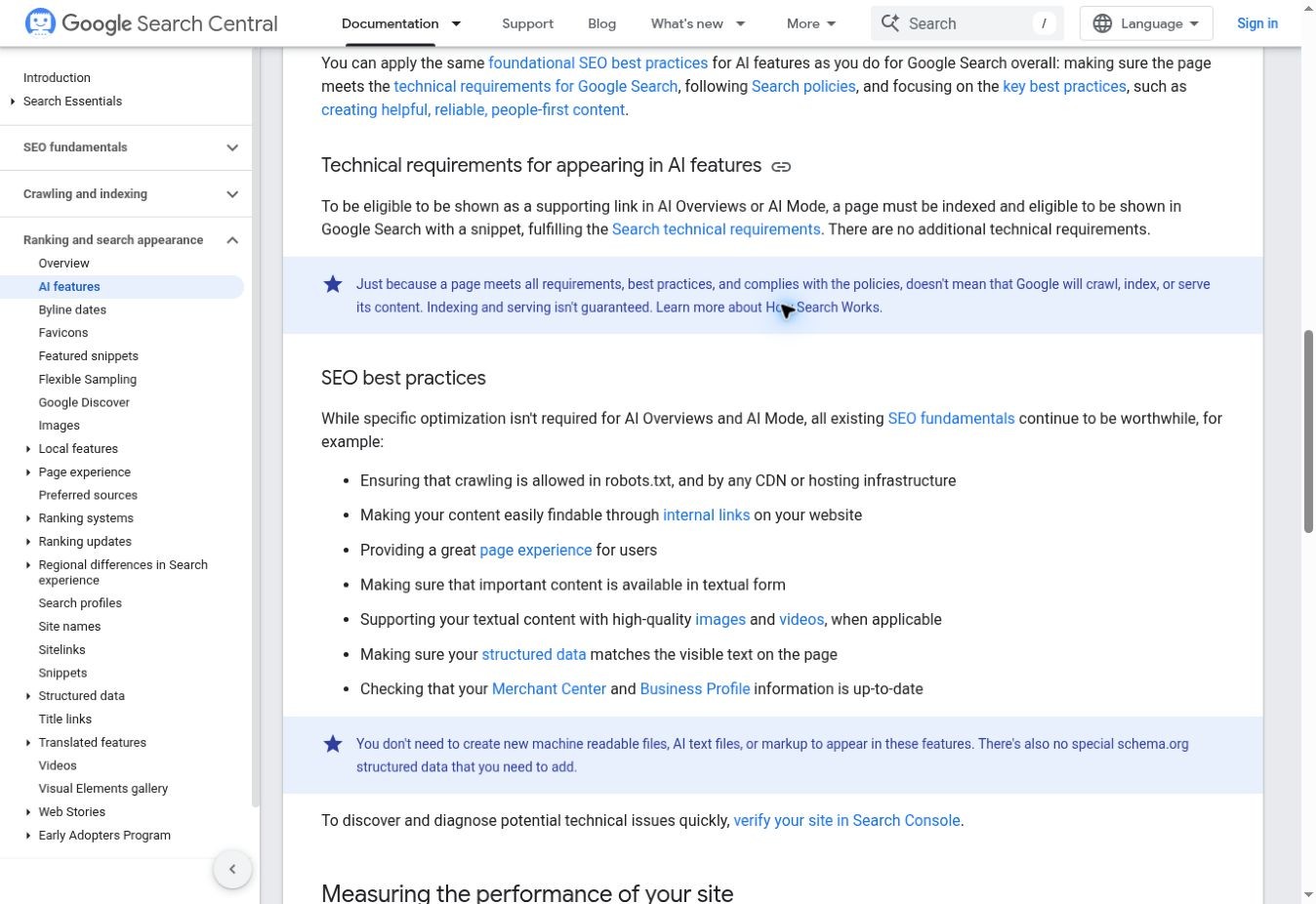
Google’s public guidance says that ordinary SEO foundations still apply to AI Overviews and AI Mode, with no additional special eligibility requirements. Treat claims about mandatory “AI schema,” fixed answer lengths, or a guaranteed citation formula cautiously. The practical work is making information accessible, useful, and supportable.
1. Choose a Small, Valuable Pilot
Start with a manageable group, such as ten existing articles serving one audience. That is a practical pilot size, not a search-engine recommendation. Mixing a technical tutorial, a breaking news report, and an evergreen buying guide makes it harder to decide what a useful result looks like.
Prioritize pages with clear business relevance, existing search demand, and a repairable weakness. A guide receiving impressions but answering the wrong stage of a buying decision deserves attention. So does a frequently used support article whose screenshots no longer match the interface.
Keep three lists: pages to improve now, pages that need specialist review, and pages to leave alone. Do not interpret low traffic as an automatic deletion instruction. A niche troubleshooting page may help a small number of customers avoid a serious problem.
Record the URL, intended reader, primary question, current purpose, owner, last substantive review, and proposed action. Add available performance data with its date range and source. Where access is missing, write “not available,” rather than entering zero.
A Simple Prioritization Rule
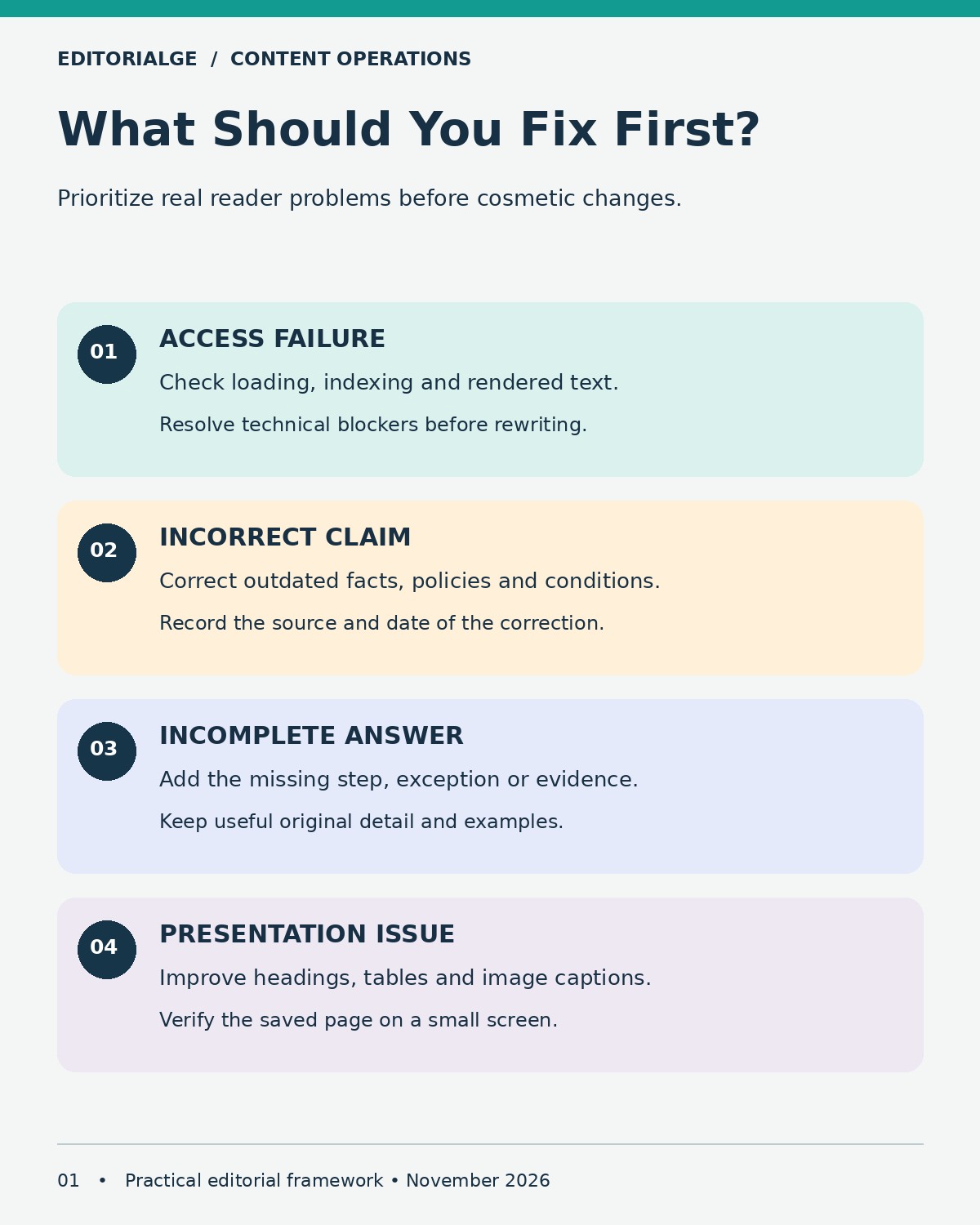
Place factual errors and access failures first. Next, address important questions that the page only partially answers. Save cosmetic formatting changes for later. A visually attractive answer with incorrect refund conditions is a worse result than a plain but accurate one.
For a larger backlog, label business importance and evidence gap as high, medium, or low, then estimate the work required. Avoid presenting this internal prioritization as a Google ranking factor. Its job is to help a team decide what to do on Tuesday morning.
2. Save the Baseline Before Editing
Export or record the current article, title, meta description, headings, internal links, and images. Save the previous version so an editor can compare changes or restore a damaged section. Capture the actual page, not just the text in a writing document: templates and mobile layouts can change what readers see.
Choose a consistent observation window. Comparing the latest 28 days with the preceding 28 days can be a useful starting point, provided you account for seasonality, incomplete reporting days, campaign changes, and low volumes. For seasonal pages, a comparable prior-year period may tell a different story.
Keep a small prompt sample for each topic. Include a definition question, a practical how-to, a comparison, and a question involving a meaningful constraint. Record the exact wording, engine, date, location or language where known, and whether an AI answer appeared.
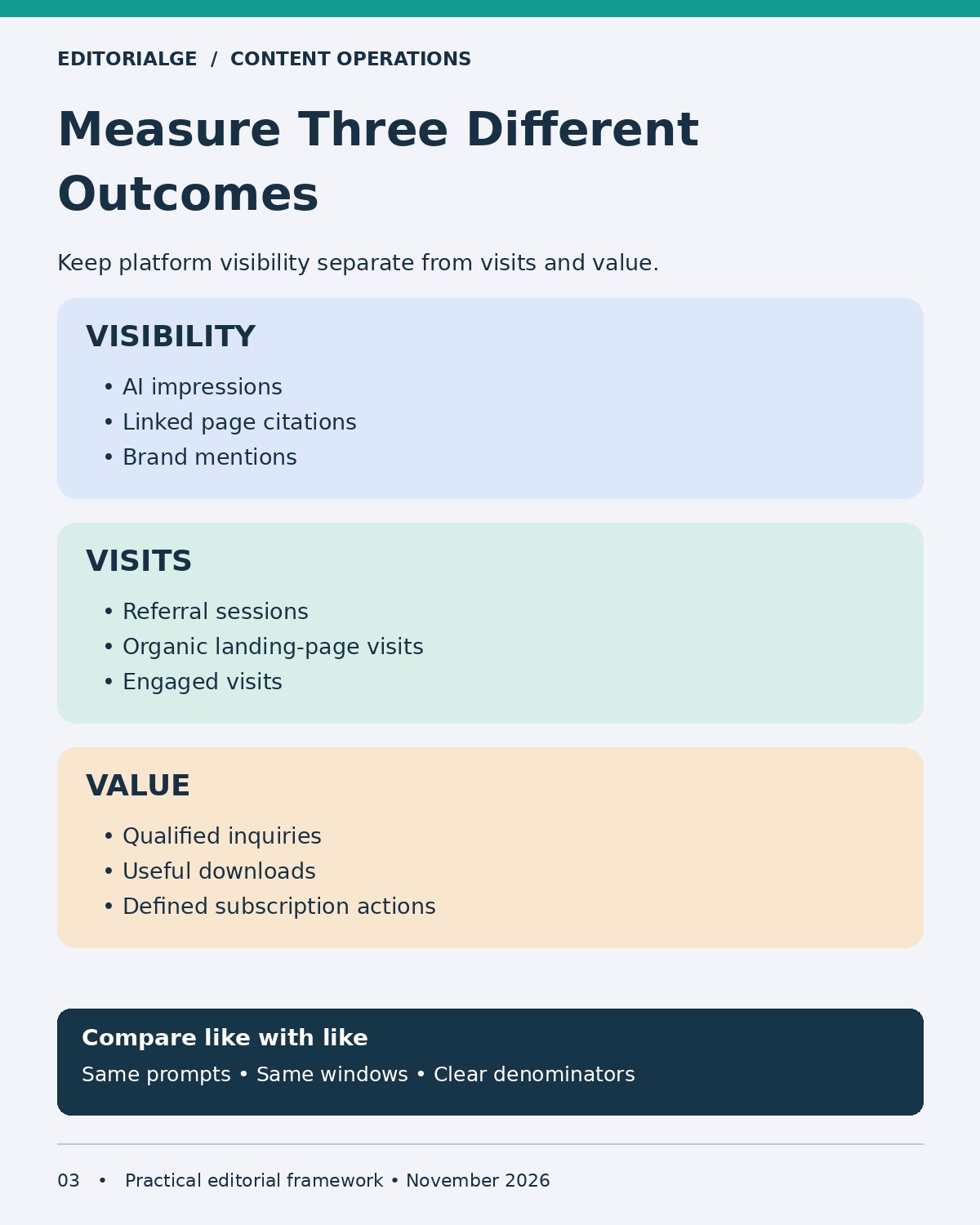
A brand mention, a linked citation to your URL, an impression, and a visit are different observations. Mark them separately. If an answer engine names the company without linking to the audited page, that does not count as a page citation.
3. Check Access, Indexing, and the Rendered Page
Begin with the page itself. Confirm that the intended URL loads, displays the main answer, and does not require a login for content meant to be public. Check the canonical URL, robots directives, and any accidental staging restrictions. Look for conflicting settings across the CMS, SEO plugin, server, and content delivery network.
Google’s eligibility guidance says a supporting page must be indexed and eligible for a search snippet. A browser showing an index directive does not prove Google has indexed it. Where authorized access exists, use URL Inspection to investigate the indexed version, selected canonical, and relevant retrieval or rendering problems.
Read the actual rendered answer on a phone-sized screen. Check whether essential text appears only in an image, whether a comparison table requires awkward scrolling, and whether an overlay hides the instructions. Give important visual information an equivalent textual explanation.
Review access controls by system and purpose. Search crawling, search snippets, and model training are not interchangeable activities. Do not remove every restriction simply because an auditing tool labels a blocked bot as an error. The site owner’s content-use policy remains part of the decision.
When a technical check fails, give the developer a reproducible observation: affected URL, observed behavior, time, expected behavior, and screenshot or saved output. “Improve crawlability” is too vague to become a reliable fix.
4. Map the Reader’s Question and Its Follow-Ups
Write the page’s core question in one sentence. Then ask what someone needs to know before acting on the answer. For a content audit guide, the follow-ups include which pages to choose, what to preserve, how to verify claims, when to merge pages, and what to measure afterward.
Use real support questions, sales objections, site-search queries, and search-performance queries when available. Those inputs reflect your audience more closely than a generic list generated from a keyword. Do not upload confidential customer conversations to an unapproved service to obtain that list.
Assign each useful question a home. Some belong in the main explanation; others deserve a short FAQ; a genuinely separate task may require another article. Avoid turning every wording variant into a competing URL.
The Editorialge guide to building an FAQ page for AEO offers a useful companion for identifying customer questions. In this audit, the more important decision is whether the existing page actually resolves them.
5. Rewrite the Answer, Then Add the Conditions
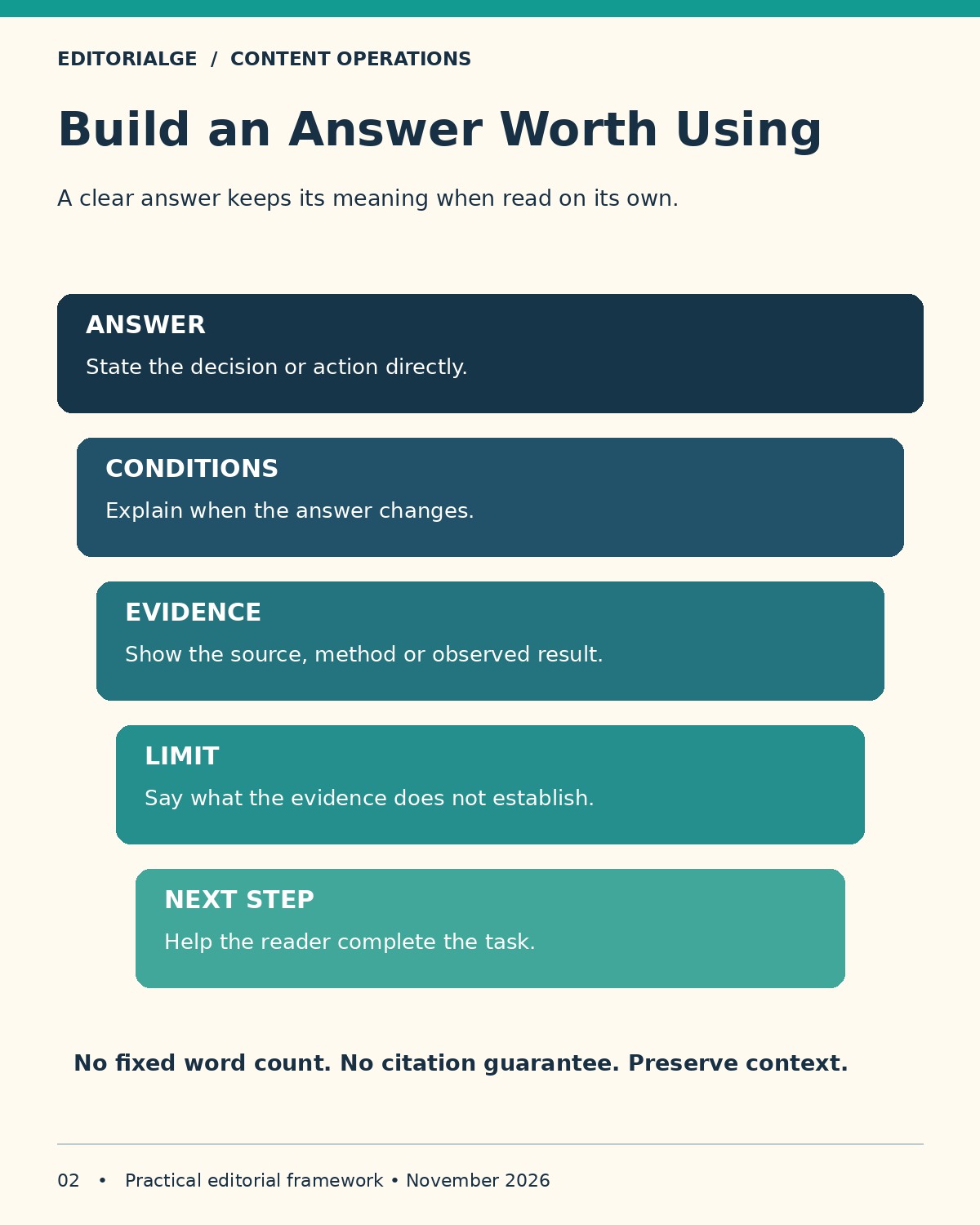
Place the direct answer near the relevant heading. Follow it with the exception, prerequisite, or tradeoff that changes what the reader should do. A concise answer should remain true when someone reads it independently of the rest of the article.
Consider this deliberately hypothetical example:
| Weak answer | More useful replacement |
|---|---|
| Update your content regularly to get better AI visibility. | Review a page when its facts, product interface, policy, or audience needs change. Correct the affected sections, record what changed, and compare relevant performance after the update. Editing alone does not guarantee an AI citation. |
The replacement identifies the trigger, the action, and the limit. It gives a reader something to do. There is no need to force it into a universal 40-word or 60-word template.
Use descriptive headings that match the questions being answered. Explain ambiguous abbreviations on first use. Give comparisons a consistent basis: the same market, date, plan type, task, or definition. If two options cannot be compared fairly, explain the difference rather than filling every table cell with a superficial score.
Preserve depth that helps someone complete the task. Removing every example to make a page “AI-friendly” can leave it too shallow for the human who clicks through.
6. Add Evidence That Matches the Claim
Separate what a source says from what was actually observed. A documentation screenshot supports a statement about the documentation. A completed export supports a statement about that export. Neither proves a long-term productivity gain or a search-ranking improvement.
For each important claim, keep an internal record of the source, checked date, relevant version or market, and limitation. When the guide describes a workflow, retain the input, steps, output, and failed steps. Screenshots should show the setting or result that matters, with a small annotation directing attention to it.
Make captions useful. Explain what the reader is seeing, why the highlighted area matters, and whether it is an original test capture or official documentation. A pricing screenshot needs its billing context; an interface screenshot needs the tested task. Remove private account details before sharing evidence.
E-E-A-T refers to experience, expertise, authoritativeness, and trustworthiness. Google’s helpful-content guidance discusses who created the content, how it was produced, and why it exists. An honest method and relevant evidence help readers assess credibility; an invented first-person anecdote undermines it.
My Firsthand Observations and Evidence
I recorded the following results while inspecting the FAQ article in the browser. Keeping the observed value beside its interpretation helped me avoid treating a page setting as evidence of a search outcome. I would use the same record when reviewing another existing URL.
| Observed item | Finding on November 16, 2026 | What it does not prove |
|---|---|---|
| Main heading | One H1: “10 Questions Your FAQ Page Should Answer for AEO” | That one H1 causes higher rankings |
| Canonical | Points to the same FAQ article URL | That Google selected this canonical |
| Robots metadata | Index/follow with permissive snippet settings | That the URL is indexed or cited |
| Question coverage | Five FAQ subheadings, including schema and answer length | That every customer question is covered |
Based on these observations, I would retain the existing structure and compare the questions with real reader needs before adding more FAQs. My next check would be the page’s query and conversion data: that would help distinguish a missing answer from a discoverability or audience-fit problem. The evidence above records the page as inspected, providing a baseline for that follow-up.
7. Resolve Overlap Without Losing Useful Pages
Compare pages serving the same intent. Two articles can share a topic while doing different jobs: one explains AEO, while another walks through auditing an existing URL. Those can coexist if their scope and internal links make the distinction clear.
Where two pages genuinely duplicate the same task, select the stronger destination based on useful content, audience fit, existing performance, and relevant links. Combine the material that deserves to survive. Have the responsible editor approve any redirect or removal; changing an existing URL affects bookmarks, links, reporting, and readers.
Keep a redirect map and update internal links after an approved consolidation. Do not send unrelated retired articles to the homepage merely to avoid a missing-page response. A replacement should address the original reader’s need.
Use related articles as meaningful next steps. Editorialge’s overview of AEO tactics for AI citations expands the broader topic; the audit should still produce specific changes for the page under review.
8. Validate Structured Data and Publication Details
Check that structured data describes what readers can actually see. Confirm the article title, author, dates, and any other supplied properties against the page. Do not invent review ratings or label general editorial advice as a tested product review.
A validator can identify certain syntax and eligibility issues. A passing result is not proof that the claims are correct or that a search feature will appear. Treat validation as one technical check within the wider audit.
Review the byline, author profile, and methodology together. Identify who performed the checks, connect important observations to their evidence, and record any specialist review the subject requires. This lets readers understand the basis of the advice.
Update the visible revision date when the content has substantively changed, and keep a short change log. Replacing a year in the headline while leaving old instructions underneath is not maintenance.
9. Measure AI Visibility and Reader Outcomes Separately
As checked for this guide, Google’s June 2026 announcement describes dedicated generative AI performance views, with an August 31 note stating worldwide rollout. The announced dimensions include impressions, pages, countries, devices for Search, and dates. Older guidance that mentions only combined Web reporting should not be your sole measurement reference.
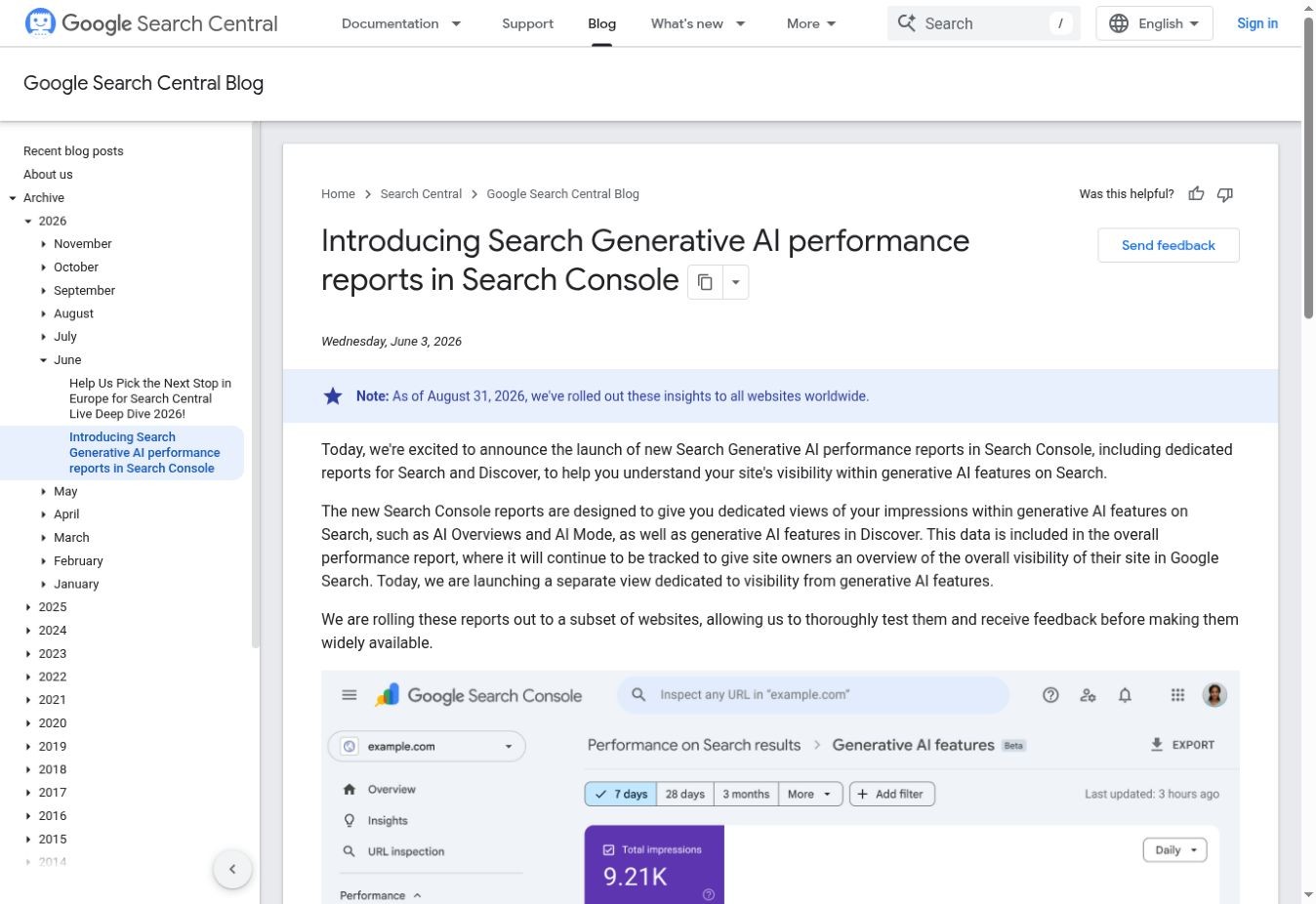
Open the reports available in your verified property and record their actual labels, definitions, and coverage. The screenshot here shows Google’s announcement, not Editorialge’s private dashboard. Do not infer an AI-specific click or conversion metric from an impressions report.
Bing’s public AI Performance documentation describes citation reporting and grounding-query information across supported experiences. Keep those measurements separate from Google’s: different platforms and metric definitions do not form a single comparable visibility score.
Track three layers: whether the page appears, whether people visit, and whether the visit accomplishes something useful. For a service business, that might be a qualified inquiry. For a publisher, it might be a meaningful subscription action. Define the event before comparing results.
Reuters has reported the disagreement between Google and publishers over AI search traffic. That tension is a reason to measure your own outcomes, rather than assume either more AI exposure or fewer clicks tells the entire business story.
A Small Experiment You Can Interpret
Select a related group of pages for updates and retain a reasonably similar comparison group where practical. Save the baseline, record the changes, and avoid changing titles, layout, conversion offers, and site navigation simultaneously if you want to understand the contribution of the content work.
For a manual prompt sample, report the denominator. If your URL appears in 6 of 20 recorded responses, that is a 30% citation rate within that sample. It is not 30% of all searches, all users, or the market. This calculation is illustrative; it is not a result measured for Editorialge.
Repeat the same prompts under comparable conditions and retain the answers. Record “no AI answer shown” separately from “AI answer shown without our citation.” Changing the denominator between checks can make an unchanged result look like progress.
Review after a period appropriate to traffic volume and crawl activity. A 28-day follow-up is an operational checkpoint, not a promised time to rank. Look for sustained patterns, and investigate seasonality, competing updates, and platform changes before assigning cause.
10. Turn the Audit Into a Maintenance Routine
Give each approved change one owner and a clear completion condition. “Replace the obsolete export screenshot and verify the current output” is actionable. “Improve E-E-A-T” is not sufficient instruction for an editor.
Use event-based reviews as well as calendar reviews. A product redesign, policy change, broken integration, new report, or repeated reader complaint should trigger a targeted update. Stable explanatory material may need less frequent intervention.
Close the task only after checking the saved page: headings, mobile reading order, links, images, captions, metadata, and any new structured data. Keep unresolved technical and editorial issues visible. A draft saved successfully is a production checkpoint, not evidence of publication or human approval.
Common Questions About Auditing for Answer Engines
Do I Need to Rewrite Every Existing Article?
No. Start with high-value pages that have a defined weakness. Preserve accurate explanations, original evidence, and useful examples. Rewriting already effective material without a reason creates work and can introduce errors.
Does Adding an FAQ Guarantee AI Overview Visibility?
No. Add questions when they resolve a real information gap. An FAQ repeated from the main article may add little. Neither a question heading nor schema supplies a citation guarantee.
Should I Add an llms.txt File First?
Google’s AI-features guidance does not require a new AI text file for eligibility. Start with access, accuracy, and useful answers. Evaluate any additional file against the requirements of the specific system you intend to support.
Can an AI Tool Perform the Entire Audit?
It can help group questions, compare versions, flag inconsistencies, and draft improvements. Someone still needs to verify consequential claims, confirm permissions, inspect actual outputs, and approve changes. A fluent recommendation is not evidence that a tool inspected your analytics or tested your product.
What Should I Do When Citations Rise but Visits Do Not?
Check the citation source and metric definition first, then examine referral traffic and useful actions. The answer may satisfy the query without a click. Consider whether the page offers a worthwhile next step, such as original data or a practical worksheet, without withholding the core answer.
Audit and Optimize Existing Content for AI Overviews and AEO With Evidence
To audit and optimize existing content for AI Overviews and AEO, start with a reader problem and finish with a verified improvement to an existing page. Preserve useful material, correct weak claims, make the answer easier to understand, and document the change. Measure visibility, visits, and outcomes as separate signals.
Choose one important URL, save its baseline, and fix its most consequential gap. That gives the next audit a concrete starting point—and gives the reader a better answer today, whether or not an answer engine cites it tomorrow.