

You want to learn crypto, but every article seems written for insiders, and you worry one wrong click could cost real money. Interactive crypto education helps you learn faster than reading alone, because you practice instead of just watching.
Practice trades with fake money, coding tasks you run in your browser, and quizzes that grade you right away all let you make mistakes when they cost nothing. The best tool depends on your goal.
If you want to invest more safely, start with the basics, then quizzes and risk drills, with practice trading last. If you want to build crypto apps, use coding tasks and build a set of real projects.
Below, you will see how big the knowledge gap really is and what these platforms include. You will also get a side-by-side look at popular options, what they cost in time and money, what they can’t teach you, and a clear first step for each goal.
Why Crypto Education Matters: The Knowledge Gap in Numbers
Many people buy crypto before they understand it. Surveys from Pew Research Center and the FINRA Investor Education Foundation show how wide that gap is.
Many people use crypto, but few trust it
In a 2023 Pew survey, 17% of U.S. adults said they had ever invested in, traded, or used a cryptocurrency. That is close to one in six people. Use is higher in some groups. In the same survey, 42% of men ages 18 to 29 said they had used crypto, compared with 17% of women that age.
Trust is low across the board. In that 2023 survey, 63% of Americans had little or no confidence that today’s ways to invest in, trade, or use crypto are reliable and safe. Just 5% were extremely or very confident.
Crypto investors often miss the basics
The FINRA Investor Education Foundation gave crypto investors a short five-question quiz. In reporting from December 2022, they scored just 26.6% on average. This figure comes from a news summary of the study, not from the study page itself.
The questions covered how a coin is issued, how you turn it into U.S. dollars, how it is taxed, and how deals can be open to fraud. Those are not expert topics. They are the basics you need before you put money in.
Where people learn matters too. In the same reporting, 48% of crypto investors got market news from friends, family, or coworkers, compared with 35% of stock investors. About 25% used social media.
What the results do and don’t show
In a 2022 Pew survey, 46% of U.S. adults who had used crypto such as bitcoin or ether said their investments did worse than they expected.
That number does not prove that weak knowledge caused the losses. Prices can fall for anyone, even experts. Still, it shows that many people went in with hopes that did not match what happened.
A tip from a friend can’t teach you how a crypto wallet works or how to spot a scam. You need the basics of blockchain, private keys, stablecoins, and decentralized finance (DeFi) before you risk real money. That is the gap good education needs to close.
What Interactive Crypto Learning Platforms Actually Include
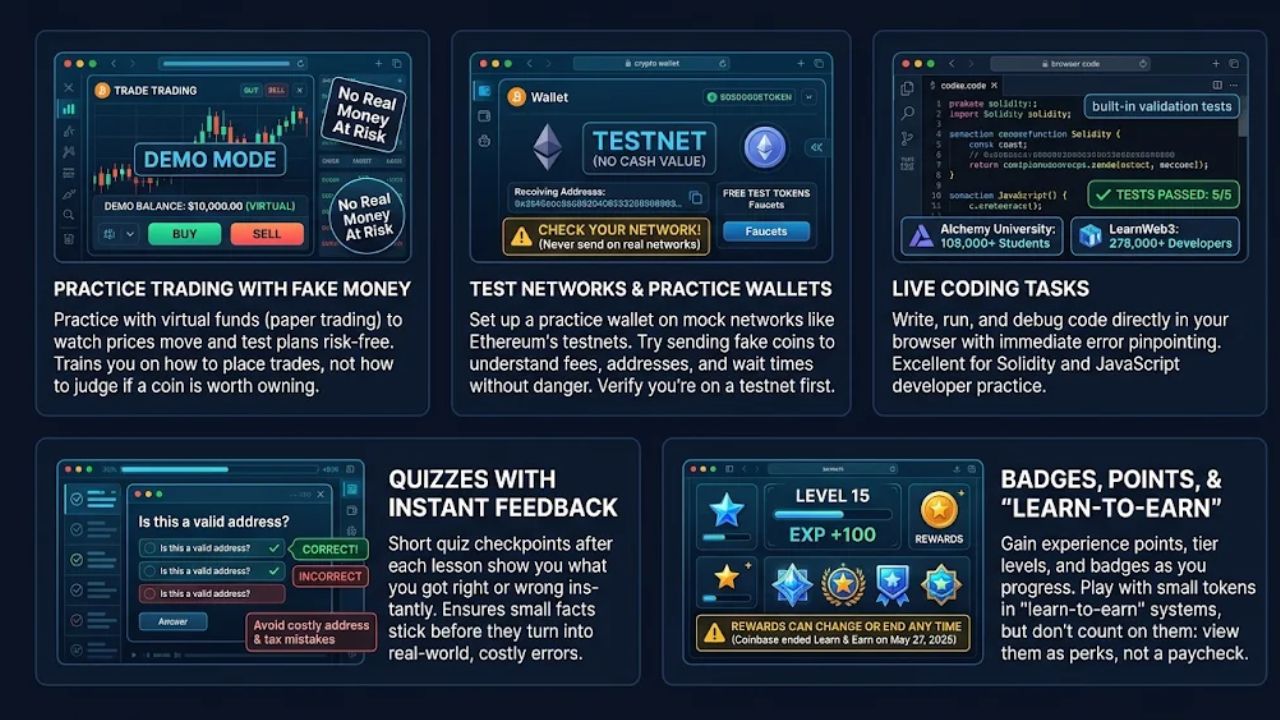
“Interactive” means you do something, and the platform responds. Here are the main tools you will see.
Practice trading with fake money
Some apps let you trade with virtual funds. This is often called paper trading or a demo mode.
You buy and sell, watch prices move, and see how your choices play out. No real money is at risk.
This tool helps investors test a plan, such as how much to buy and when to sell. But it teaches you how to place trades, not how to judge whether a coin is worth owning. Treat it as one step, not the whole lesson.
Test networks and practice wallets
Blockchains such as Ethereum have test networks. These copy the real network, but the coins on them have no cash value.
You can set up a practice wallet, get free test tokens, and send them to another address. You learn how fees, addresses, and wait times work without any risk to your savings.
Always check that you are on a test network before you send anything. A real wallet and a test wallet can look almost the same.
Live coding tasks
Developer platforms give you a code editor in the browser. You write code, run it, and see right away whether it works.
Some offer free, code-heavy tracks in JavaScript and Solidity, the language used for Ethereum smart contracts. Built-in tests tell you which part of your code failed, so you can fix it on the spot.
These platforms reach a lot of people. Alchemy University reports 108,000 students. LearnWeb3 has a community of 278,000 developers.
Quizzes with instant feedback
Short quizzes after each lesson tell you right away whether you got it. If you miss a question, you learn the right answer while the topic is still fresh.
This matters for crypto because small facts carry big risks. Mixing up a wallet address or not knowing how a coin is taxed can cost you.
Badges, points, and learn-to-earn rewards
Many platforms add game features. You earn points, badges, or levels as you finish lessons. Some “learn-to-earn” programs have handed out small amounts of tokens for finishing quizzes.
Don’t pick a platform for the rewards. Coinbase ended its Learn and Earn program on May 27, 2025.
Rewards can change or end at any time. Treat them as a perk, not a paycheck.
How Interactive Learning Improves Crypto Education
Reading gives you facts. Practice shows you whether you can use them. Each tool gives you a clear signal you can see.
- Quizzes show your errors. A wrong answer on a quiz is a gap you now know about. You can fix it before it costs you money.
- Code tests show what broke. When a test fails, you see the exact line that needs work. Watching a video never tells you that.
- Practice money lets you fail safely. With fake funds, a bad trade is a lesson, not a loss.
- Doing makes hard words clear. Terms like “gas fees” or “seed phrase” make more sense once you see them in action.
- A course gives you an order to follow. A tip from a friend is one fact with no context. A structured course walks you through the basics step by step, with checks along the way.
- Projects show applied work. Every coding task you finish can become part of a portfolio that others can look at and test.
Practice exercises for investors
Here are three drills that teach safer habits, not just how to click “buy.”
- Seed phrase scam quiz: Say a message asks for your 12 or 24 recovery words to “fix” your account. A good quiz asks what you should do, and the right answer is never to share them. Repeat drills like this until the answer is automatic.
- Practice Bitcoin transfer: On a test network, send a small amount of test coins from one practice wallet to another. Copy the address, check the first and last few characters, and watch the transfer confirm.
- Position-sizing drill: For example, decide that no single buy in your practice account can be more than a small slice of your total. Then watch what happens to that slice when prices drop sharply.
Practice exercises for builders
Say your first task is a small Solidity contract that stores a number. You write a function to change it, run the tests, and one fails because anyone can change the number.
The feedback tells you right away what broke. You add a check so only the owner can make changes, run the tests again, and they pass.
Next, you deploy the contract to a test network using free test tokens. Now you have a live project you can share and build on.
A plain-language DeFi exercise
DeFi lending can sound like magic. A simple exercise makes it clear.
Say you lock up some Ether as collateral to borrow a stablecoin. A good lesson asks you to find the price where the system would sell your collateral to pay back the loan. This is called liquidation.
Then the lesson drops the Ether price step by step. You see how close you came to losing your collateral, and why borrowing less gives you more room.
What practice tools can’t teach you?
Fake money has one big limit. It removes the fear and stress of real losses. Losing $500 of play money feels nothing like losing $500 of your savings.
So treat practice as a first step, not the last one. When you move to real money, start small, use only what you can afford to lose, and set clear rules for when you will sell.
Practice tools also can’t vet a project for you. You still have to check who runs a coin, how it makes money, and whether the offer sounds too good to be true.
And finishing a course does not make you job-ready on its own. It gives you skills and proof of effort. Employers still judge your actual work.
Popular Interactive Crypto Learning Platforms Compared
A comparison by Spark says crypto education has split into two tracks. One teaches Bitcoin protocol basics. The other focuses on smart contract development on ethereum and other chains.
The same comparison says Bitcoin education is more scattered than ethereum education. No single “bootcamp” covers all of it. Ethereum learners have more all-in-one paths to pick from.
Here is how some well-known options compare, based on the figures available.
| Platform or course | Track | Best for | Known time or cost | Check before you start |
| Saylor University, “Bitcoin for Everybody” | Bitcoin basics | Beginners and investors | 12 hours | Price and whether it has quizzes |
| Alchemy University | Smart contract developer | New builders | Not listed here | Price, coding tasks, and needed skills |
| LearnWeb3 | Smart contract developer | Builders who like learning with others | Not listed here | Price and recent forum activity |
| Cyfrin Updraft | Smart contract developer | Builders aiming for smart contract jobs | 96+ hours of video and written content | Price and certificate fees |
| BerkeleyX (on edX) | Professional certificate | Learners who want a university-backed course | Not listed here | Free audit vs. paid certificate |
| MIT executive education | Two-month executive program | Professionals with a budget | $3,850 | Dates and hands-on parts |
A note on size: Alchemy University reports 108,000 students, LearnWeb3 has 278,000 developers, and BerkeleyX has more than 150,000 certificate holders. These numbers show reach, not quality.
Prices change, so check each site before you sign up. Big sites like Coursera and edX also list crypto and blockchain courses from many schools, and some let you audit for free.
Reading the table
Time is the cost most people forget. A 12-hour course fits into a few weekends.
Cyfrin Updraft has more than 96 hours of content. That counts only video and reading time. Coding the projects yourself will add more, so plan for months if you study a few hours a week.
A big community does not prove you will get fast help. Before you join, look at the forum or chat and see how recently people got answers.
What about practice trading apps?
None of the courses above is a trading app. If you want paper trading, check whether an exchange or app you already use has a demo mode with fake funds.
Keep its limits in mind. Demo trades often fill instantly at a clean price, with no stress and sometimes no fees, so real trades can feel very different.
How to Choose the Right Platform for Your Goal
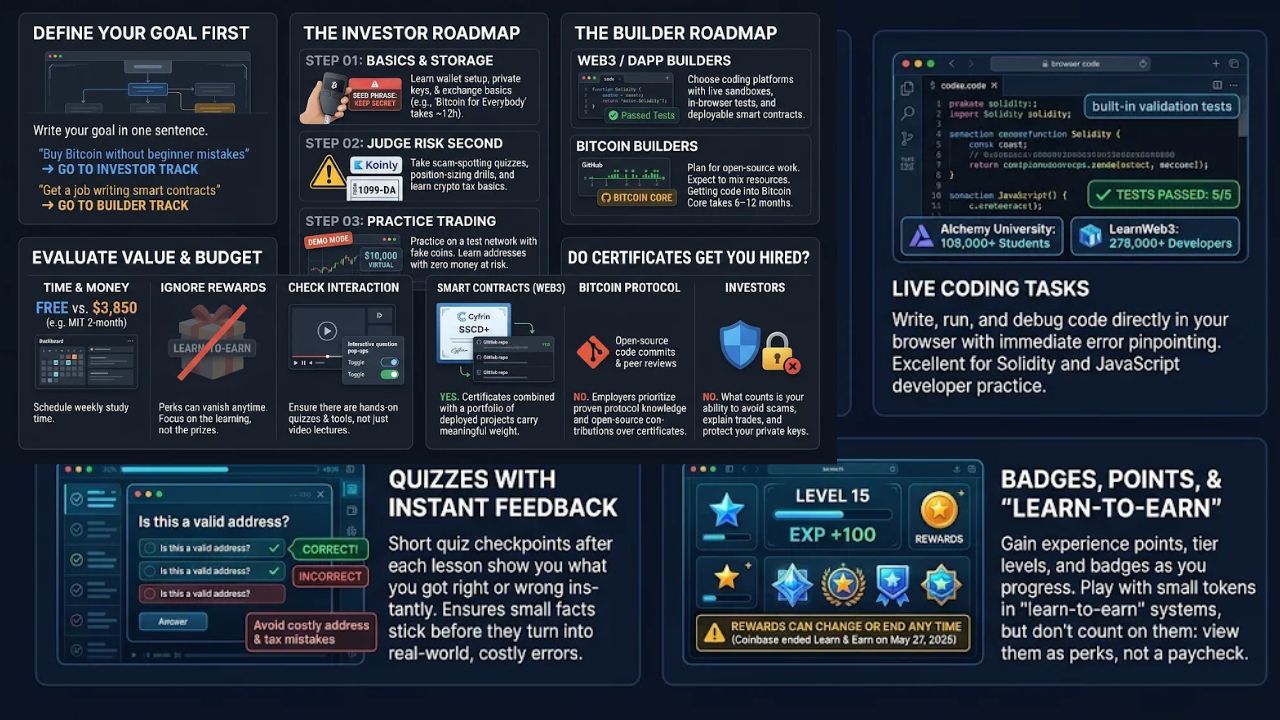
Follow these steps to match a platform to what you want.
- Name your goal in one sentence: For example, you might want to buy bitcoin without beginner mistakes. Or you might want a job writing smart contracts. Your goal decides your track.
- Investors: learn the basics and safe storage first: Pick a short course on how bitcoin, wallets, and exchanges work. A course like “Bitcoin for Everybody” takes about 12 hours. Learn how private keys and seed phrases protect your coins.
- Investors: practice judging risk second: Take scam-spotting quizzes and do the position-sizing drill. Learn the tax basics too. Tools such as Koinly can help you see how your trades are taxed and get ready for Form 1099-DA reporting.
- Investors: add practice trading third, if you want it: It is optional. Use it to test your rules, and send test coins on a test network so you learn how addresses work with nothing at stake.
- Builders: pick a coding platform. Look for coding tasks in Solidity and JavaScript, built-in tests, and projects you deploy yourself to a test network.
- Bitcoin builders: plan for open-source work. Bitcoin protocol work runs on public, shared code. Getting production code into Bitcoin Core typically takes 6 to 12 months, according to Spark. Since Bitcoin learning is scattered, expect to mix several resources.
- Set your time and money budget: Free and low-cost courses are fine for most beginners. Paid programs can cost real money, like MIT’s $3,850 two-month program. Pick a weekly study time you can actually keep.
- Ignore the rewards when you decide: Learn-to-earn perks can vanish. Choose the platform that teaches you best, not the one that pays the most tokens.
- Check that it is truly interactive: Before you commit, try a free lesson. If it is only videos with no quizzes, code tasks, or practice tools, keep looking.
Do certificates help you get hired?
It depends on the track. Spark’s comparison says that for smart contract developer jobs, Cyfrin’s SSCD+ certification and a portfolio of deployed projects carry meaningful weight.
For Bitcoin protocol roles, the same source says employers value open-source work and proven protocol knowledge over certificates.
These are signals, not promises. A certificate or portfolio can help you get noticed, but it does not guarantee a job.
For investors, a certificate matters less. What counts is whether you can explain a trade, protect your private keys, and avoid scams.
Where to Start Your Interactive Crypto Education
Interactive tools work because they make you use what you learn. Here are two simple routes.
If you want to invest more safely
First step: Take a short Bitcoin basics course such as Saylor University’s “Bitcoin for Everybody.” It takes about 12 hours. Check the site for the current price.
Then: Do the seed phrase quiz, a test-network transfer, and the position-sizing drill. Add paper trading only after that.
Main limit: None of this can tell you which coin to buy or make losses feel less painful. When you move to real money, start small.
If you want to build smart contracts
First step: Pick one developer platform, such as Cyfrin Updraft or Alchemy University, and finish its first project. Cyfrin Updraft has more than 96 hours of content, so expect months of steady work. Check each site for current prices.
Then: Deploy your project to a test network, save the code, and start your portfolio.
Main limit: A course alone does not make you job-ready. Finish projects rather than collect half-watched videos.
Whatever path you pick, choose the platform for what it teaches, not for its rewards. Your skills will last longer than any token.
Frequently Asked Questions About Interactive Crypto Education
1. What is an interactive learning platform for crypto?
It is a website or app like Coinbase Learn where you complete quizzes, simulate trades, and practice with virtual funds. You learn faster by trying tasks yourself instead of just reading.
2. How does fintech help people learn about crypto?
Financial technology (fintech) powers apps that let you practice trades with paper money, so you never risk real cash. These platforms track your progress and recommend lessons based on your skill level.
3. Can I learn about Fidelity crypto and the Fidelity Digital Dollar on these platforms?
Yes, many courses cover Fidelity Crypto and explain how major financial firms are exploring digital dollar projects. You can also study stablecoins, which maintain a one-to-one value with the US dollar.
4. Who teaches crypto on these platforms?
Educators like Alex Genadinik create beginner-friendly crypto courses for people just starting out. Look for courses with recent reviews and high ratings before you enroll.