History is rarely just a collection of dates on a calendar; it is a continuous, living narrative of human ambition, tragedy, innovation, and resilience. November 15 is a date that has repeatedly served as a stage for monumental shifts in global dynamics. From the birth of visionary artists and scientific pioneers to the dramatic conclusions of wartime campaigns and political assassinations, this day holds a mirror to the complexities of the human experience.
Whether you are a student of history, a cultural enthusiast, or someone simply curious about the events that share your birthday, understanding what happened on November 15 offers a fascinating glimpse into how our modern world was shaped.
The Bangalee Sphere
The Indian subcontinent has a rich, layered history that stretches back millennia, and November 15 has hosted several pivotal moments that altered the social and political fabric of the region.
The Execution of Mahatma Gandhi’s Assassins (1949)
On November 15, 1949, Nathuram Godse and Narayan Apte were executed by hanging at the Ambala jail. Godse, a Hindu nationalist, had assassinated Mahatma Gandhi on January 30, 1948, fundamentally due to his opposition to Gandhi’s accommodation of India’s Muslims during the painful Partition. This execution was a defining moment for the newly independent nation. It forced a young India to confront the rising tide of political extremism and solidified the secular, democratic mandate that leaders like Jawaharlal Nehru were fighting to establish. The trial and subsequent execution remain a profound chapter in South Asian history, representing the deep ideological divides that characterized the post-colonial era.
Breaking Legal Boundaries: Cornelia Sorabji
Born on this day in 1866, Cornelia Sorabji became a trailblazer for women’s rights in India. She was the first female graduate of Bombay University and the first woman to study law at Oxford University. Returning to India, she became the first female advocate in the country. Her most significant contribution was her work as a legal advisor to the purdahnashins—women who were forbidden by social custom to communicate with the outside male world. Because they could not speak to male lawyers, they were often defrauded of their property. Sorabji navigated the complex colonial and traditional legal systems to protect the rights of these vulnerable women, setting foundational precedents for gender equality in South Asian jurisprudence.
The Legacy of Soumitra Chatterjee
On November 15, 2020, the Bengali cultural world lost one of its brightest luminaries, Soumitra Chatterjee. An actor, poet, and playwright, Chatterjee is best remembered for his historic 14-film collaboration with the legendary director Satyajit Ray. From his debut as the iconic character Apu in Apur Sansar (1959) to his role as the quintessential Bengali detective Feluda, Chatterjee’s passing marked the end of the golden era of Bengali parallel cinema. His death was mourned globally, recognizing his contribution to elevating regional cinema to the global stage.
International Observances & Holidays
Global observances on this date range from declarations of sovereignty to ancient rites of passage for children.
Palestine Independence Day
On November 15, 1988, the Palestinian National Council, at the urging of PLO chairman Yasser Arafat, issued a formal declaration of independence for a state of Palestine. Interestingly, this declaration did not take place in the Levant; it was proclaimed in exile in Algiers, Algeria. The document designated East Jerusalem as the capital. Today, this declaration is recognized by approximately 70% of United Nations member states, making November 15 a critical day of national identity, resilience, and diplomatic history for the Palestinian people.
Proclamation of the Republic (Brazil)
On this day in 1889, Brazil underwent a massive political transformation. A military coup d’état led by Marshal Deodoro da Fonseca overthrew Emperor Dom Pedro II, ending the Empire of Brazil and establishing the First Brazilian Republic. Today, November 15 is a national public holiday in Brazil, complete with military parades and civic celebrations.
Shichi-Go-San (Japan)
Translating literally to “Seven-Five-Three,” this traditional Japanese rite of passage is celebrated annually on November 15. It is dedicated to the growth and well-being of young children—specifically three- and seven-year-old girls, and five-year-old boys. Families visit shrines dressed in traditional kimonos to pray for the continued health of their children, a practice that dates back to the Heian period when child mortality rates were high, and reaching these specific ages was considered a major milestone.
Global History
Beyond South Asia, November 15 has been the backdrop for technological leaps, the devastation of war, and the formation of modern international diplomacy.
United States: Sherman’s March and Rock-and-Roll
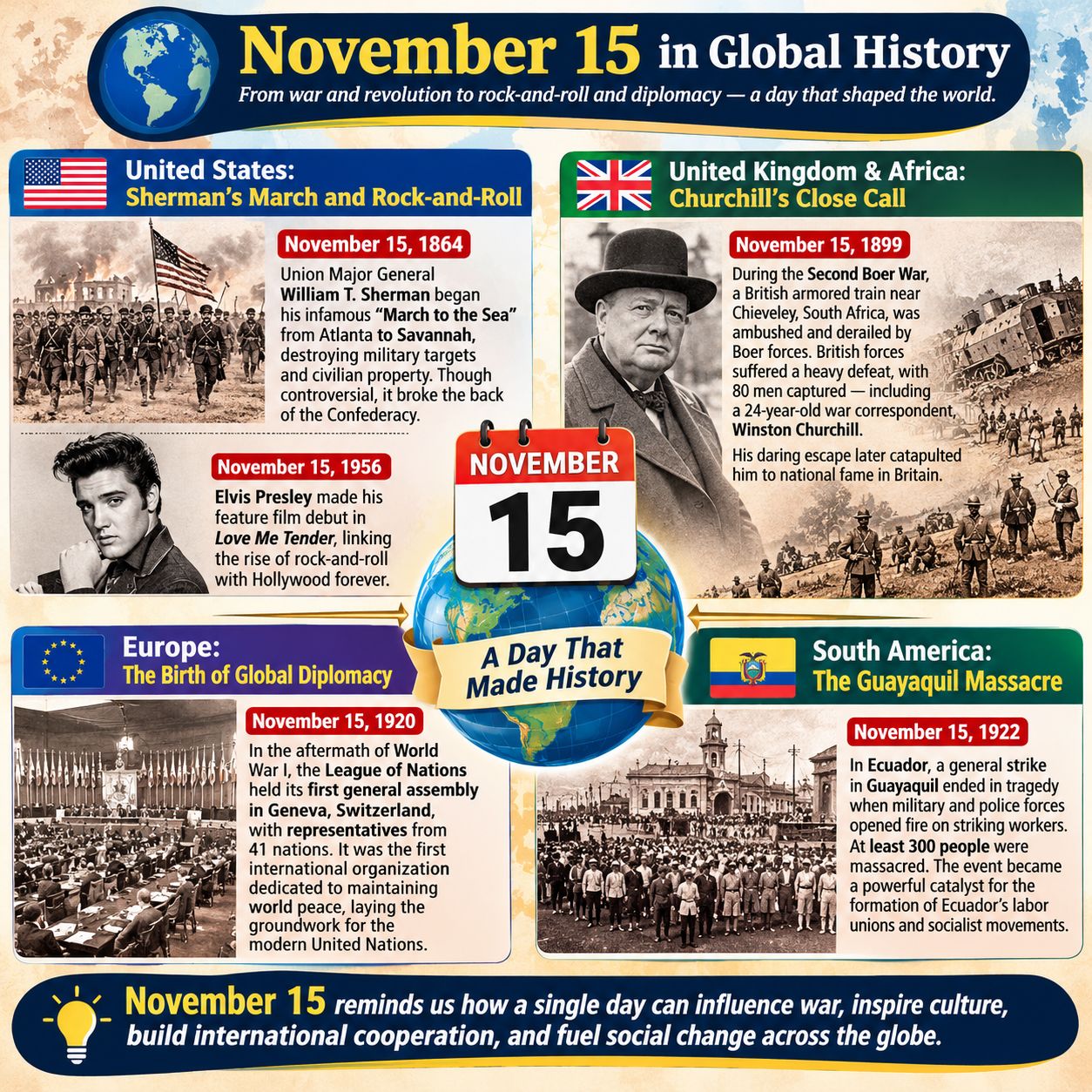
On November 15, 1864, Union Major General William T. Sherman began his infamous “March to the Sea” during the American Civil War. Leaving the captured city of Atlanta in flames, Sherman’s troops marched toward Savannah, Georgia, employing a “scorched-earth” policy. They destroyed military targets as well as industry, infrastructure, and civilian property. While controversial and devastating to the Southern economy, this psychological and physical warfare broke the back of the Confederacy, arguably shortening the war.
Nearly a century later, on November 15, 1956, American culture shifted again when Elvis Presley made his feature film debut in Love Me Tender. Originally titled The Reno Brothers, the film was hastily renamed to capitalize on Presley’s skyrocketing hit song. This moment permanently married the exploding youth culture of rock-and-roll with Hollywood, changing the entertainment industry forever.
United Kingdom & Africa: Churchill’s Close Call
During the Second Boer War, on November 15, 1899, a British armored train traveling near Chieveley, South Africa, was ambushed and derailed by Boer forces. The British suffered a heavy defeat, with 80 men captured. Among the prisoners was a 24-year-old civilian war correspondent working for The Morning Post—Winston Churchill. His subsequent daring escape from a prison camp in Pretoria catapulted him to national fame in Britain, launching the political career of the man who would eventually lead his country through World War II.
Europe: The Birth of Global Diplomacy
In the aftermath of the unprecedented carnage of World War I, the international community sought a way to prevent such a catastrophe from ever happening again. On November 15, 1920, the League of Nations held its very first general assembly in Geneva, Switzerland. Representing 41 nations, it was the first international organization fundamentally dedicated to maintaining world peace. Though it ultimately failed to prevent World War II, it laid the vital geopolitical groundwork for the modern United Nations.
South America: The Guayaquil Massacre
In Ecuador, November 15 represents a dark but transformative day for labor rights. In 1922, a general strike in the port city of Guayaquil ended in tragedy when military and police forces opened fire on the striking workers. At least 300 people were massacred. The event sent shockwaves throughout South America, acting as a powerful catalyst for the formation of Ecuador’s organized labor unions and socialist political movements.
Notable Births & Deaths (Global)
History is driven by the individuals who dare to think differently, lead bravely, or create passionately. This date has welcomed—and bidden farewell to—some of the most influential figures in global history.
Famous Birthdays
“Did You Know?” Trivia
To add some historical flavor to your next dinner table conversation, here are a few lesser-known facts about November 15:
-
The Journalist Who Became Prime Minister: When Winston Churchill was captured on November 15, 1899, he wasn’t carrying a rifle; he was carrying a pen. He was acting as a civilian war correspondent. The fame he garnered from his subsequent prison escape directly funded his first successful run for Parliament just a year later.
-
First Drafts of Hollywood: Elvis Presley’s debut film, Love Me Tender, was not originally a vehicle for the singer. It was a standard post-Civil War drama. When test audiences went wild for Presley’s musical numbers, the studio scrambled to add more songs, changed the title, and even altered the film’s tragic ending to appease his frantic teenage fanbase.
-
The Artificial Heart Milestone: On November 15, 1984, “Baby Fae,” an American infant born with a fatal heart defect, passed away. Just weeks prior, she had made medical history by becoming the first infant subject of a xenotransplant procedure, receiving the heart of a baboon to keep her alive. Though she did not survive, the procedure offered unprecedented insights into infant heart transplants.
Quote of the Day
“Never doubt that a small group of thoughtful, committed citizens can change the world; indeed, it’s the only thing that ever has.” — Margaret Mead (Trailblazing American cultural anthropologist, who passed away on this day in 1978)
Final Thoughts
From the scorched earth of the American Civil War to the birth of abstract artistic movements and the formulation of the laws that govern the stars, November 15 serves as a microcosm of human history. It is a day marked by both the tragic consequences of political divides—such as the Guayaquil massacre and the execution of Gandhi’s assassins—and the hopeful pursuit of global unity through the inaugural meeting of the League of Nations.
As we look back at the famous figures born and lost on this day, we are reminded that history is actively shaped by the individuals who dare to challenge the status quo. Recognizing these anniversaries does more than just satisfy our curiosity; it roots us in the ongoing story of civilization.