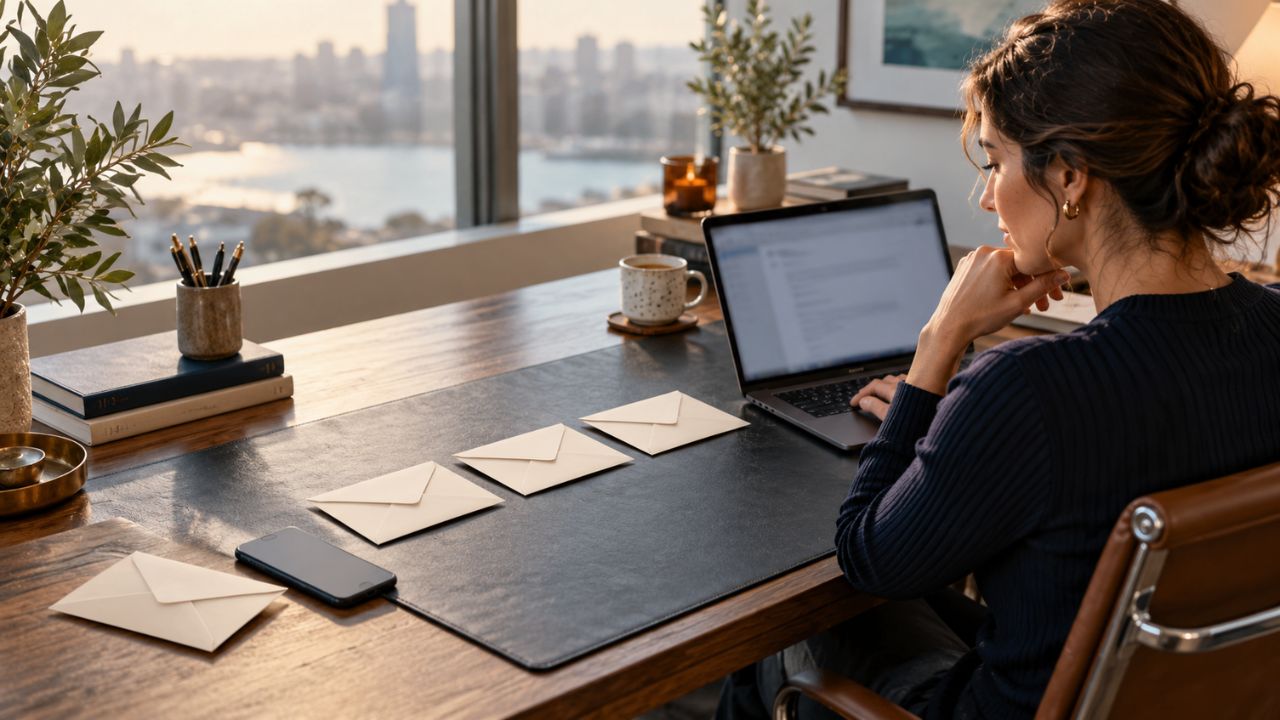

Every productivity app promises to put life in order. Most of them disappear the moment the screen goes dark. That is why the best wall planners still deserve a place in our homes, offices, classrooms, and studios. A deadline displayed beside the desk is harder to ignore than one buried inside a calendar app. A project mapped across a whiteboard can also be understood without unlocking a phone, finding the right workspace, or checking whether everyone has access.
The NeuYear Monday First Large Wall Calendar is my best overall recommendation for long-range planning. The U Brands Gold Metal Frame Calendar Board is better for reusable monthly scheduling, while the Quartet Brilliance Glass Board is the strongest choice for unrestricted thinking and frequent use.
Analog tools do not replace digital calendars. Apps still handle reminders, recurring events, remote collaboration, and searchable records better. Physical planners win when visibility, shared awareness, tactile organization, or distraction-free thinking matters more.
This guide is based on current product specifications, warranties, availability, manufacturer information, and credible independent commentary. Prices and availability were checked on October 20, 2026, and may change.
The Best Wall Planners and Analog Tools at a Glance
| Product | Best for | Format | Main drawback |
| NeuYear Monday First Large Wall Calendar | Overall wall planning | 27 × 39-inch annual planner | Must be replaced each year |
| U Brands Gold Metal Frame Calendar Board | Reusable monthly planning | 23 × 17-inch magnetic board | Limited writing space per day |
| Quartet Combination Calendar Board | Family command centers | Calendar, corkboard, and magnetic surface | Intended for occasional use |
| Quartet Brilliance Glass Board | Premium home offices | 36 × 24-inch magnetic glass board | Heavy and needs stronger magnets |
| Post-it Dry Erase Surface | Large custom whiteboard walls | Peel-and-stick dry-erase film | Nonmagnetic |
| Quartet Anywhere Surface | Temporary workspaces | Repositionable dry-erase sheet | No tray and limited durability |
| PMXBOARD Magnetic Kanban Kit | Co-located teams | 42 × 23-inch workflow board | Expensive |
| Post-it Super Sticky Easel Pad | Workshops and brainstorming | 25 × 30-inch paper pad | Consumable |
| mcSquares Reusable Stickies | Reusable task cards | 4 × 4-inch wet-erase notes | Needs a smooth surface |
| Ugmonk Analog Daily Focus Kit | Daily priorities | Desktop card system | Premium price |
| Time Timer Original 12 | Visual timeboxing | 60-minute visual timer | Cannot time periods over one hour |
| IKEA SKÅDIS Pegboard | Modular planning stations | Pegboard with movable accessories | Does not replace a planner |
1. NeuYear Monday First Large Wall Calendar
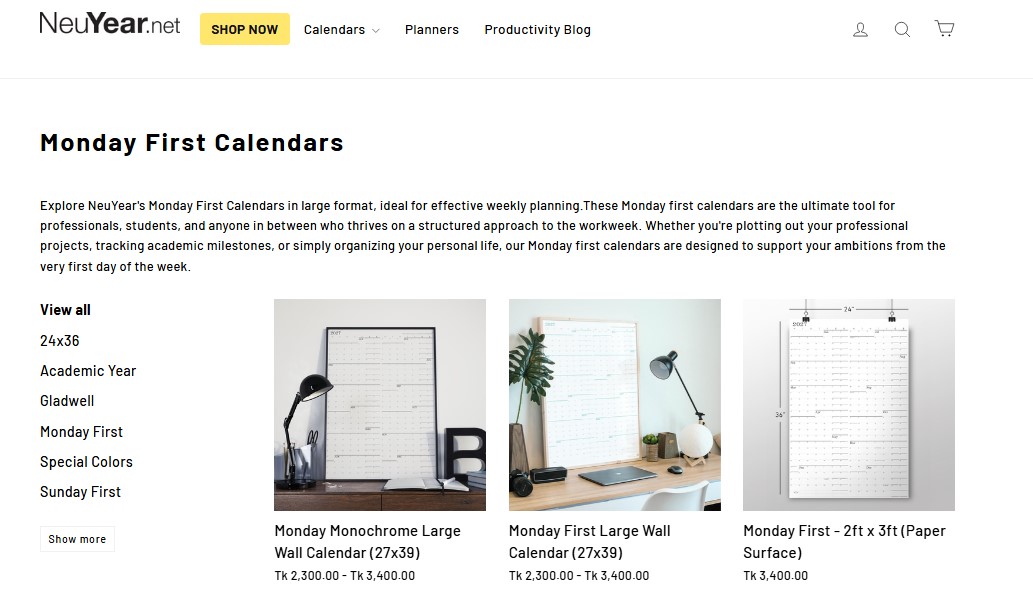
The NeuYear Monday First Large Wall Calendar is built for people who need to see the entire year as one connected timeline.
Its 27 × 39-inch layout displays weeks continuously rather than breaking them apart at the end of each month. A project beginning in late March and finishing in early April therefore appears as one uninterrupted block of time.
The calendar is printed in horizontal and vertical orientations, one on each side. Buyers can choose between a paper edition and a laminated dry-erase version. Current editions include 2026 and 2027 calendars.
Its Monday-first structure also makes sense for editorial schedules, academic terms, marketing campaigns, product launches, and office projects. The five-day working week stays together, while Saturday and Sunday sit side by side.
This is not the planner for recording lengthy appointment details. Its strength is perspective. It shows how deadlines overlap, where the year becomes crowded, and how little space may exist between one major commitment and the next.
The size demands a substantial section of wall. It is also dated, so even the reusable laminated surface needs to be replaced when the year ends.
2. U Brands Gold Metal Frame Dry-Erase Calendar Board
An annual calendar shows the shape of the year. A monthly board gives each day enough room to become useful.
The U Brands calendar measures 23 × 17 inches and uses a magnetic painted-steel surface. Its undated grid can be erased and reset every month. A dry-erase marker with a built-in eraser, a magnet, a clip, and mounting hardware are included.
The gold metal frame makes it feel less institutional than a standard office whiteboard. It can sit comfortably in a home office, kitchen, study area, or creative studio.
This is a practical choice for appointments, publishing dates, bill reminders, school activities, and household responsibilities. The magnetic surface can also hold a temporary note or document beside the schedule.
The main limitation is space. Once a 23-inch board is divided into a full month, each daily cell becomes relatively small. It works well for brief reminders such as “invoice due” or “dentist at 3,” but not for detailed daily agendas.
Painted steel can also show wear sooner than premium glass or porcelain if it is written on and erased continuously.
3. Quartet Magnetic Combination Calendar Board
A family planning wall has to manage more than dates. It may also need to hold school notices, shopping lists, appointment cards, permission slips, and the small pieces of paper that otherwise disappear.
Quartet’s Combination Calendar Board places an undated five-week monthly grid beside a natural cork section. The dry-erase area is magnetic, and the 17 × 23-inch board comes with a marker and magnets.
That mixed design is more useful than a calendar alone. The monthly grid can show the family schedule, magnets can secure temporary notes, and the cork area can hold paper documents that need attention.
Its compact size suits a kitchen, entryway, student room, or small office. It will not dominate the wall, but that also means the calendar and cork sections are both fairly limited.
Quartet categorizes the board for occasional use. I would choose it for a household or lightly used workspace, not for a team that writes and erases information throughout the day.
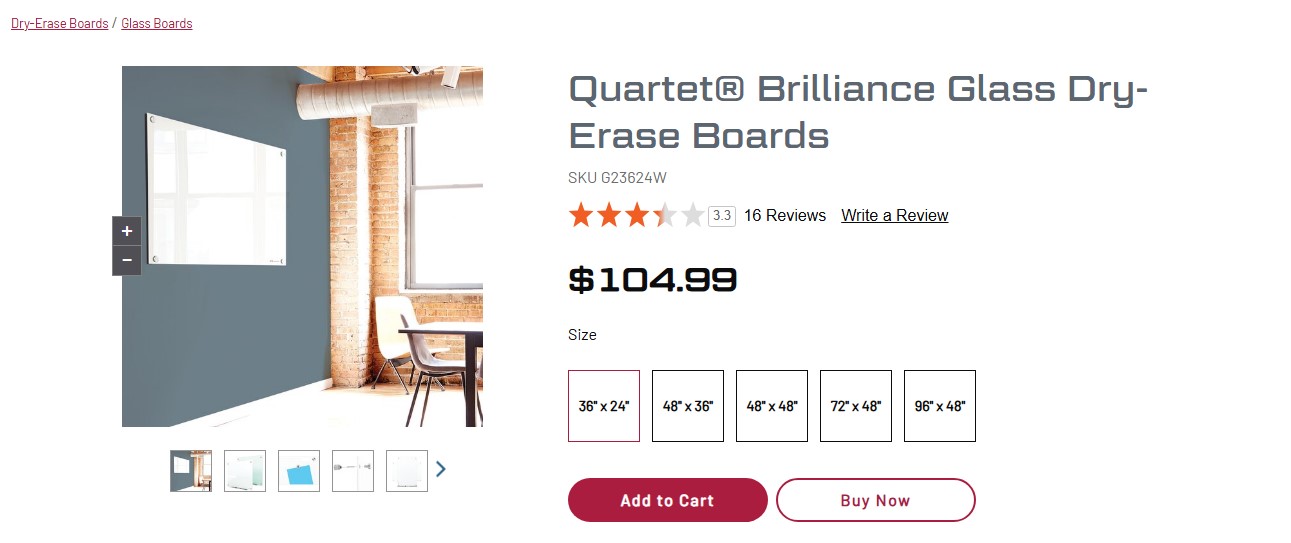
4. Quartet Brilliance Glass Dry-Erase Board
The Quartet Brilliance is the strongest conventional whiteboard in this selection for a permanent home office, studio, or meeting room.
Its 36 × 24-inch writing area is made from nonabsorbent tempered glass. The true-white background provides better contrast than the greenish tint found in some glass boards. It is also designed to resist stains and ghosting and carries a 25-year limited warranty.
Mounting hardware, an accessory tray, a marker, and two high-power magnets are included. The board is also GREENGUARD Gold certified.
A blank surface gives it more flexibility than a printed planner. It can become a weekly schedule on Monday, a mind map on Tuesday, and a project board for the rest of the month.
That flexibility comes with practical demands. The board weighs approximately 20 pounds and needs suitable wall anchors. Its glass surface also weakens ordinary magnets, so high-power magnets designed for glass boards are the safer option.
Room lighting matters too. A poorly positioned glass board may reflect windows or overhead lights, making sections harder to read from a distance.
5. Post-it Dry Erase Surface
A framed board is not always the best use of a long or unusually shaped wall. Post-it Dry Erase Surface turns an existing smooth area into a writing space without adding a heavy frame.
The peel-and-stick material can be cut to fit. Sizes range from smaller 3 × 2-foot sheets to rolls measuring as much as 50 × 4 feet. It can also be used to cover an old whiteboard or chalkboard instead of replacing the entire structure.
This is particularly useful for a long editorial pipeline, classroom activity wall, production schedule, or project map. The surface can be divided into custom sections without being restricted by a factory-printed grid.
It is not magnetic, and installing a large sheet requires care. A dusty wall or rushed alignment can produce bubbles, wrinkles, or lifting edges.
Treat it as an installed surface rather than something that will be moved repeatedly. Measure twice, clean the wall, and ask another person to help with larger sheets.
6. Quartet Anywhere Repositionable Dry-Erase Surface
The Quartet Anywhere surface is a better fit when the workspace is temporary.
Its self-adhesive material can be cut to size, removed, and repositioned without tools. It comes in several sizes, including 36 × 24, 48 × 36, and 72 × 48 inches.
This makes it useful in a rented office, dormitory, temporary classroom, workshop venue, or project room that changes regularly. It is also easier to transport than a framed board.
The surface is nonmagnetic and does not include a marker tray. It is intended for occasional rather than intensive use.
The manufacturer describes it as removable without residue or wall damage, but no adhesive product is risk-free on every painted surface. Old paint, moisture, wall texture, or previous repairs can change the result. Test a discreet area before covering a large section of wall.
7. PMXBOARD Magnetic Kanban Board Kit
A basic Kanban board can be created with tape and sticky notes. The PMXBOARD kit is for teams that want something more durable and structured.
The 42 × 23-inch magnetic board comes with 84 magnetic task, detail, blocker, headline, and status pieces. Markers, cleaning supplies, and installation accessories are also included.
The magnetic cards can be moved between workflow stages without curling, tearing, or creating piles of discarded paper. A production, operations, or product team can see what is waiting, active, blocked, or completed from across the room.
That visibility is the main reason to buy it. The board turns workload into a shared physical object rather than another tab in project-management software.
The listed price was around $318 during research, making it one of the most expensive products here. It is also most useful when the team regularly works in the same room. Remote colleagues cannot see it unless someone duplicates every change online.
For a stable, co-located team, that cost may be justifiable. For an individual user, a blank magnetic board and reusable cards will be more sensible.
8. Post-it Super Sticky Easel Pad Recycled
A whiteboard asks everyone to work around one fixed surface. An easel pad lets a group separate ideas, move them, compare them, and keep the useful pages after the session.
Each Post-it Super Sticky Easel Pad measures 25 × 30 inches and contains 30 adhesive-backed sheets. The paper is made from 100% recycled material and is designed to resist marker bleed-through.
The pages can be attached to walls without tape or pins. In a workshop, one sheet might hold customer problems, another proposed solutions, and a third the group’s final priorities. The pages can then be rearranged to show how the discussion developed.
The pad also travels more easily than a framed board and fits most standard easels.
Its weakness is obvious: the sheets are consumable. They may be saved after a session, but they cannot be erased and reused. Adhesion may also vary on dusty, damp, or heavily textured walls.
9. mcSquares Reusable Stickies
Paper sticky notes are easy to use, but they curl, fall, and eventually become waste. mcSquares Stickies turn the same basic idea into small reusable cards.
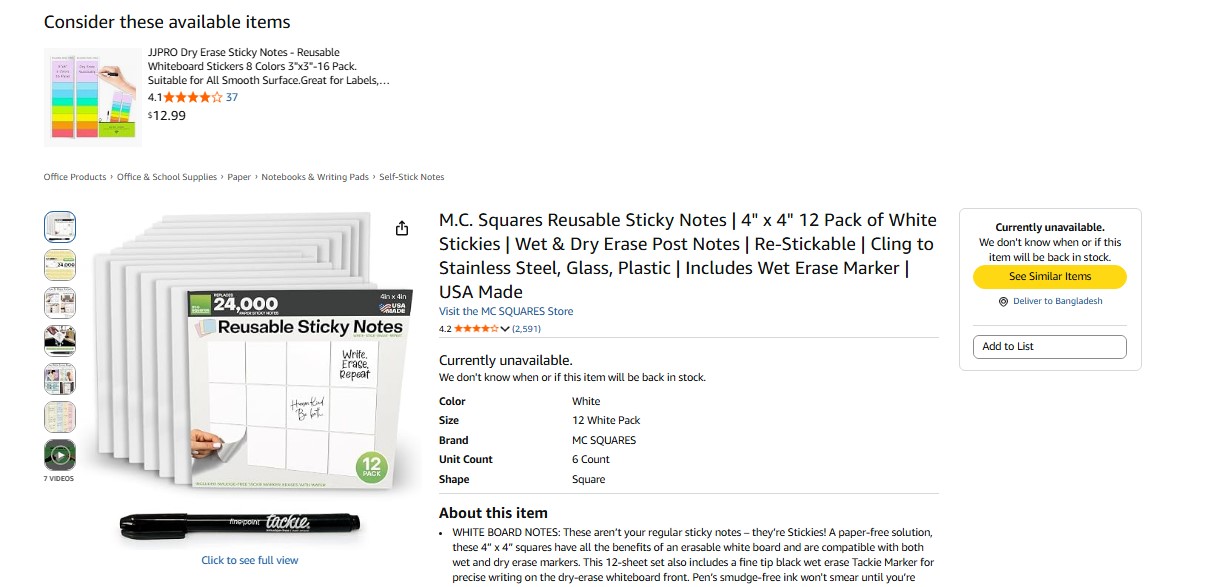
Each note measures 4 × 4 inches and uses a micro-suction backing rather than conventional glue. The backing works best on smooth, nonporous surfaces such as glass, mirrors, whiteboards, plastic, stainless steel, and finished cabinets.
The accompanying wet-erase markers help prevent writing from smearing when the cards are handled. A damp cloth or tissue is needed when it is time to erase them.
These cards suit personal Kanban boards, lesson plans, storyboards, content outlines, and any task that benefits from moving ideas around physically.
The company says each card can be reused up to 2,000 times. That figure should be treated as a manufacturer claim, not a guaranteed lifespan in every setting.
Their greatest limitation is surface compatibility. They are not dependable on rough, porous, or heavily textured walls. Use them on glass or an existing whiteboard for the best result.
10. Ugmonk Analog Daily Focus Kit
Most wall planners help us record more. Ugmonk’s Analog system tries to make us choose less.
The walnut Daily Focus Kit includes 30 Today cards, two Next cards, one Someday card, a divider, and a wooden holder. The 3 × 5-inch cards use heavy uncoated paper and have a dot-grid pattern on the reverse.
The small format creates a useful limit. A card cannot hold an endless list without becoming unreadable. That pushes the user to select a realistic group of priorities and move everything else into “Next” or “Someday.”
It is an attractive system, but the method does not depend on a premium wooden holder. Ordinary index cards and a simple box can reproduce much of the workflow. The walnut kit was listed at $69 during research, and replacement cards create an additional cost.
This is best understood as a design-led focus tool. It is not a calendar, and it will not organize an entire project. It helps answer one smaller but important question: what deserves attention today?
11. Time Timer Original 12
A planner can show what needs to be done without helping us begin. The Time Timer Original 12 addresses that problem by making the passage of time visible.
The 12-inch timer represents the remaining portion of a session as a colored disk that gradually disappears. It can measure periods of up to 60 minutes and operates without a distracting ticking sound. An optional alert can signal when the time ends.
The timer includes a magnetic back, foldable feet, a wall-hanging option, and a dry-erase activity card. It requires two AA batteries, which are not included.
This can be useful for focused work sessions, classroom activities, meetings, household routines, or helping children understand how much time remains. Unlike a phone timer, it does not invite the user into messages, news, or social media.
Its limitation is the one-hour maximum. Longer tasks need to be divided into separate work blocks.
12. IKEA SKÅDIS Pegboard
The IKEA SKÅDIS is not a planner. It earns its place because it can make an entire analog planning setup easier to maintain.
The pegboard can hold markers, task cards, paperwork, cables, headphones, envelopes, and other objects that accumulate around a workspace. Clips, hooks, shelves, and containers can be moved as the setup changes.
IKEA offers several sizes. The 22 × 22-inch board works beside a monthly calendar or whiteboard, while the larger 30 × 22-inch combination provides more room and includes selected accessories.
A clip can hold documents related to the week’s priorities. A container can keep the correct markers near the board. A shelf can support a timer or daily focus cards.
The mounting rail is included, but suitable wall screws and anchors are sold separately. Accessory costs can also accumulate quickly.
SKÅDIS will not replace a calendar. It works best as the supporting layer that keeps the rest of the planning system usable.
Why Analog Tools Still Work
I do not think analog tools win because paper is more authentic or because technology has failed. They win because physical information occupies space. A closed app disappears. A wall planner remains visible.
Research on cognitive offloading supports the value of external reminders. Recording information outside the mind can reduce the burden placed on memory. Experiments on prospective memory have also found that strategically placed reminders can improve the likelihood of remembering an intended action.
One controlled study comparing paper notebooks with mobile devices found that participants using paper entered schedules faster and showed advantages on some later memory measures. That does not prove handwriting is always superior. It does suggest that the physical form and location of information can influence how we process and retrieve it.
The everyday advantages are easier to see:
- A wall planner remains visible without sending a notification.
- A whiteboard gives an unfinished idea room to change.
- Physical cards can be grouped and moved spatially.
- Everyone in a room can see the same plan.
- Writing does not expose us to incoming messages.
- A shared board can start a conversation without another meeting.
These strengths are most valuable when the people using the system regularly share the same physical space.
How to Prevent Whiteboard Ghosting
Use markers designed for the board’s surface. Permanent, wet-erase, and dry-erase markers can look surprisingly similar when stored together.
Erase ordinary dry-erase writing regularly instead of leaving it untouched for months. Remove loose marker dust with a clean microfiber cloth and use a board-safe cleaner when normal erasing stops working.
Avoid abrasive pads and harsh household chemicals unless the manufacturer specifically permits them. They can damage the coating even when the surface initially appears unaffected.
For adhesive whiteboard films, keep the wall clean and avoid repeatedly lifting the edges. Test both the marker and the adhesive on a small area before committing to a full installation.
Frequently Asked Questions on the Best Wall Planners, Whiteboards, and Analog Tools
What is the best wall planner for most people?
The NeuYear Monday First Large Wall Calendar is the best option for people who need to see an entire year at once. Its continuous weekly layout makes project overlap and busy periods easier to recognize. If your planning happens one month at a time, the U Brands Dry-Erase Calendar Board will be more practical.
Are wall planners better than calendar apps?
They are better at being seen. A wall planner stays in the room, while an app disappears when the screen closes. Apps remain better for alerts, recurring events, remote access, and search. The most dependable approach is usually digital for storage and analog for visibility.
What type of whiteboard lasts the longest?
Porcelain and tempered-glass boards generally last longer than melamine or basic painted-steel boards. Glass resists staining well, while porcelain is particularly suitable for heavy classroom or office use. The best choice depends on whether you value appearance, magnetism, weight, or price most.
How large should a wall planner be?
The right size depends on reading distance and the amount of information you need to record. A compact monthly board may work beside a desk, while a year-at-a-glance planner should be large enough to read from several feet away. Tape the proposed dimensions onto the wall before buying.