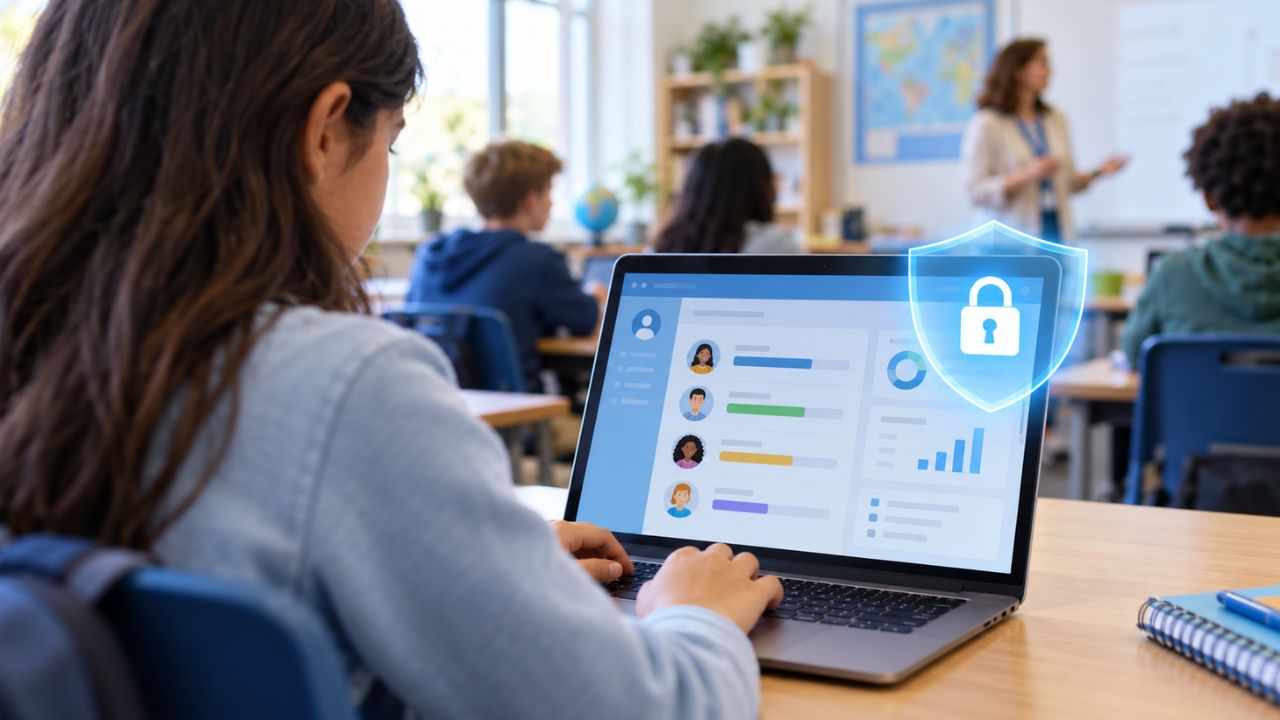
Student data privacy rules help edtech companies protect learners’ personal information by limiting what they collect, explaining how they use it, securing it, and deleting it when it is no longer needed. These safeguards matter because a learning platform may handle more than grades.
It can also store activity records, device details, progress, or messages. The right practices depend on the service and the countries where it operates. U.S. laws such as FERPA and COPPA, the EU’s GDPR, and the UK Children’s Code may apply in different circumstances. Here are ten practical rules edtech teams can use to build privacy into their products and school relationships.
10 Student Data Privacy Rules to Put Into Practice
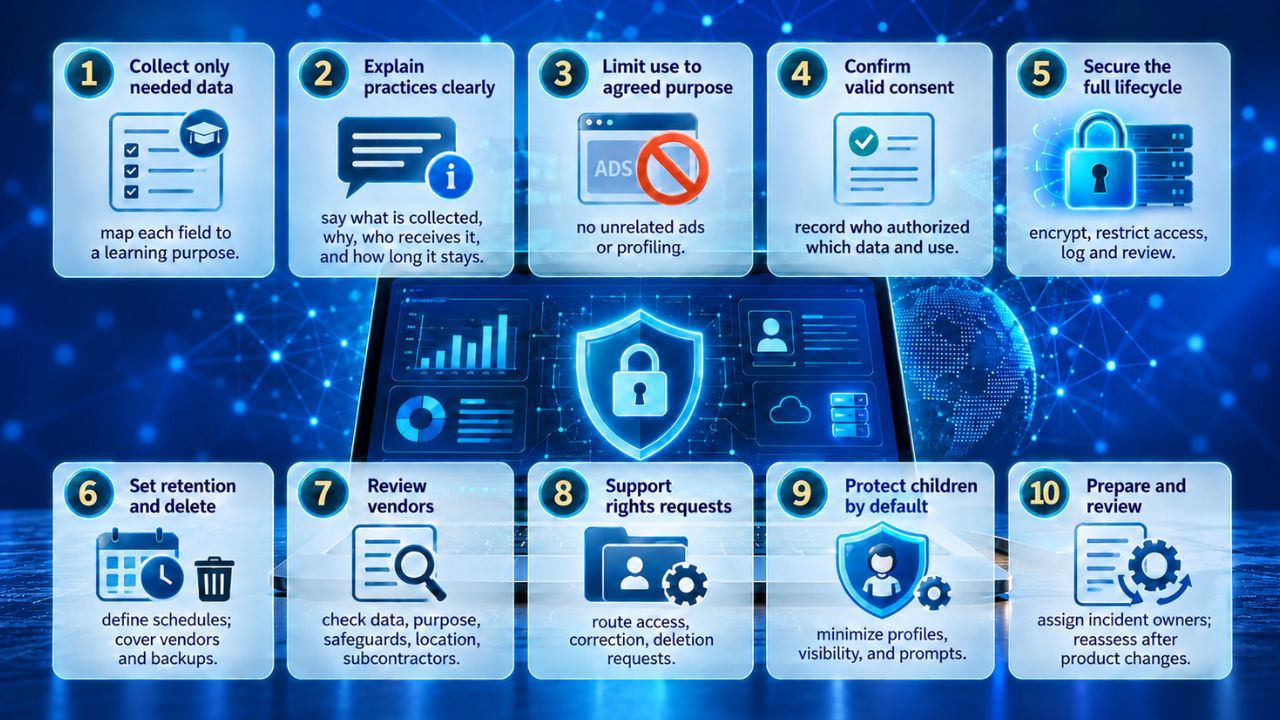
Implementing robust student data privacy rules is essential for edtech companies to build trust, comply with legal frameworks like COPPA and FERPA, and safeguard sensitive learner information. Prioritizing transparency, secure encryption, and strict data minimization ensures a safe digital learning environment for everyone.
1. Collect only what the service needs
Before adding a data field, ask what educational purpose it serves. A reading app may need a student’s answers and progress to tailor practice. It may not need precise location data or access to the student’s contacts.
Collecting information “just in case” creates extra work: the company must secure it, explain it, retain it appropriately, and eventually delete it. It can also make a school’s privacy review harder.
Map each field to a product function. If the team cannot explain why the service needs it, leave it out. This is among the most practical student data privacy rules to apply before development work begins.
2. Explain data practices in plain language
A privacy notice should help students, families, and school staff understand what the service does. Explain what information is collected, why it is used, who receives it, how long it is kept, and how to raise a concern.
Be specific about features. If an app records audio for a speaking exercise, say so. If teachers can review individual answers, make that clear. If another company hosts information or provides analytics, explain its role in understandable terms.
Update the notice when a feature changes what data is collected or how it is used. Clear communication is part of student data privacy rules, not a task to leave until launch.
3. Use student data only for the agreed purpose
A school’s decision to use a learning platform does not give its provider permission to use student information for any business purpose. Data collected to deliver lessons or assess progress should not quietly become advertising material or a source of unrelated behavioral profiles.
The U.S. Department of Education says a provider relying on FERPA’s school official exception must perform a school function, remain under the school’s direct control regarding education records, and use information only for the purpose for which it was disclosed. FTC guidance limits school authorization under COPPA to collection for an educational purpose—not unrelated commercial uses such as advertising.
Put purpose limits in contracts and enforce them through product controls. A promise in a sales document is weak protection if the software still uses student data for another purpose. This student data privacy rule should be visible in both the agreement and the product’s actual behavior.
4. Treat consent as a specific legal question
Consent requirements depend on the child’s age, the service, the country, and who decides how data will be used. In some school settings, a school may authorize collection for a defined educational service. That does not automatically cover a direct-to-consumer app or uses beyond the school’s instructions.
Under COPPA, schools may act on parents’ behalf in certain educational contexts, but that authorization does not extend to unrelated commercial purposes. GDPR has separate conditions for children’s consent to information society services, and the relevant age threshold can vary by EU member state.
Before launching a feature, record who authorized the processing, what they were told, and which data and purposes were covered. A checkbox alone cannot settle every consent question. Review this student data privacy rule with qualified counsel for each relevant market.
5. Secure information throughout its lifecycle
Security should cover the app, databases, employee accounts, integrations, backups, and staff devices. Use appropriate access controls, encryption, secure development practices, and routine vulnerability management to reduce the risk of unauthorized access.
Access should match job responsibilities. A support agent may need to troubleshoot an account, but not browse unrelated student records. Administrative access should be limited, logged, and reviewed. Development teams should use synthetic or properly de-identified data for testing where practical.
No control removes every risk. A useful standard is to make unauthorized access harder, easier to detect, and faster to contain. Those are the outcomes these student data privacy rules should support.
6. Set retention periods and delete data when it is no longer needed
Keeping information indefinitely increases the amount that could be exposed or misused, including after a school relationship ends. Set retention periods for different data types. Account records, learning activity, support tickets, and audit logs may not need the same schedule.
Explain the policy to school customers and make sure deletion covers the systems and vendors holding the information. Backups may follow a separate documented process before deleted data expires fully.
Contracts should spell out what happens when an agreement ends: whether data is returned, deleted, or retained for a limited legal reason. Include this student data privacy rule before a school has to ask what will happen to its records.
7. Review vendors and integrations before sharing data
An edtech platform may send information to cloud hosts, analytics services, video tools, identity providers, or other subprocessors. Each connection adds another organization and set of practices to review.
Keep an up-to-date list of vendors that handle student information. Before adding one, check what data it receives, why it needs it, how it protects the data, where it processes it, and whether it uses subcontractors. Put suitable privacy and security terms in place, then revisit the relationship when the service changes.
Schools need a clear account of these arrangements. “We may share data with partners” does not tell them enough to assess the risk. Effective student data privacy rules make the data flow visible.
8. Make rights requests workable
Depending on the law and service, students, parents, or schools may have rights to review, correct, delete, or restrict access to information. Make the request process easy to find and route each request to someone who can act on it.
Verify the requester’s identity without gathering unnecessary information. Establish how the company will coordinate with a school when it maintains records on that school’s behalf. Train support teams to recognize a privacy request instead of treating it as an ordinary technical issue.
Test the process periodically. Confirm that requests reach the right person and can be handled within applicable deadlines. Without a workable process, student data privacy rules are difficult for students and families to use.
9. Design for children’s needs and privacy
Children may not understand the consequences of every setting, and they often cannot choose whether their school adopts a tool. Build privacy protections into the default experience rather than relying on students or teachers to find them.
Consider what classmates can see, whether profiles reveal personal details, and whether communication features are necessary for the learning activity. Use age-appropriate explanations and avoid prompts that pressure students to share more than the lesson requires.
The UK Information Commissioner’s Children’s Code sets standards for online services likely to be accessed by children. Its guidance says edtech providers may be in scope depending on their role in deciding why and how children’s information is processed.
Default settings affect every student using a service. That makes thoughtful design one of the less visible, but most consequential, student data privacy rules.
10. Prepare for incidents and review practices regularly
Decide in advance who investigates an incident, who contacts affected schools, how evidence is preserved, and who determines whether legal notification duties apply. Keep customer contact details current so the response plan can be used when needed.
Review the product when it changes. New analytics, AI features, integrations, or sharing options can alter privacy risks even if the service’s main purpose stays the same. Revisit the data map, notices, contracts, and risk assessment before launch.
Assign owners and record decisions. Regular reviews help teams apply student data privacy rules as the product and its markets change.
Final Thoughts
Start with a simple data map: what the service collects, why it needs each item, who can access it, which vendors receive it, and when it is deleted. Compare that map with the privacy notice and school contracts. The gaps usually point to the work that matters most.
Address unnecessary collection, broad access, unclear vendor use, and missing deletion processes first. Assign someone to each change and review the system when the product or its markets change. For edtech companies, student data privacy rules are part of building a learning service that schools and families can trust.
Frequently Asked Questions (FAQs) About Student Data Privacy Rules
Do FERPA and COPPA apply to every edtech company?
No. Their application depends on the service, the information involved, and the provider’s relationship with a school. A company should assess each product and market with qualified legal advice.
Can a school consent to any data use by an edtech provider?
No. FTC guidance limits school authorization under COPPA to collection for an educational purpose. FERPA’s school official exception also has conditions, including limits on the provider’s use of education records.
When should a company review its privacy practices?
Review them before launching a feature, adding a vendor, entering a new market, or changing how student information is used. Regular reviews can also reveal gaps before a school or family has to report them.