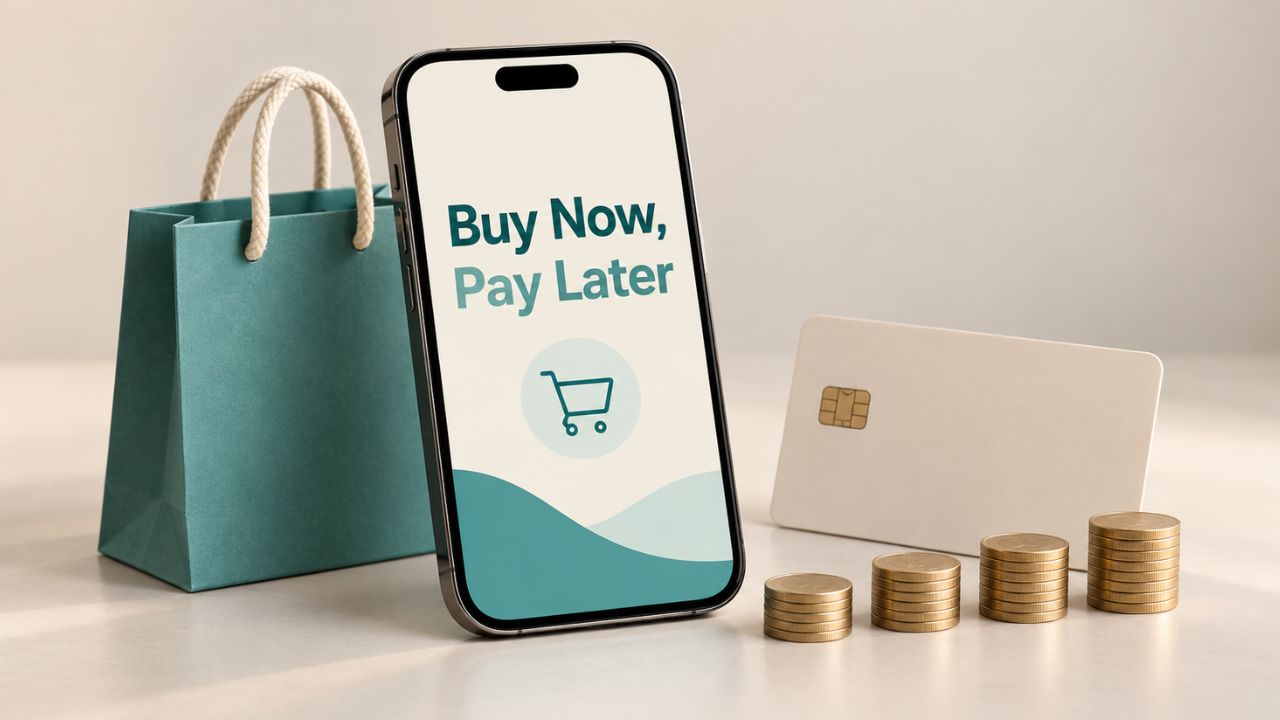
A shopper chooses “pay in four” at checkout and receives an approval decision within moments. That quick exchange depends on several systems working together. The Buy Now Pay Later technology architecture links the merchant’s store, a payment gateway or platform, the BNPL provider’s decision systems, and the services that collect later installments.
The setup varies by provider, product, and country. Providers may assess a short pay-in-four plan differently from longer-term financing, and merchants can connect directly to a provider or use a payment platform. Still, most transactions follow the same broad path: the provider receives checkout information, assesses the application, returns a decision, and manages the loan after purchase.
The main systems in a BNPL transaction
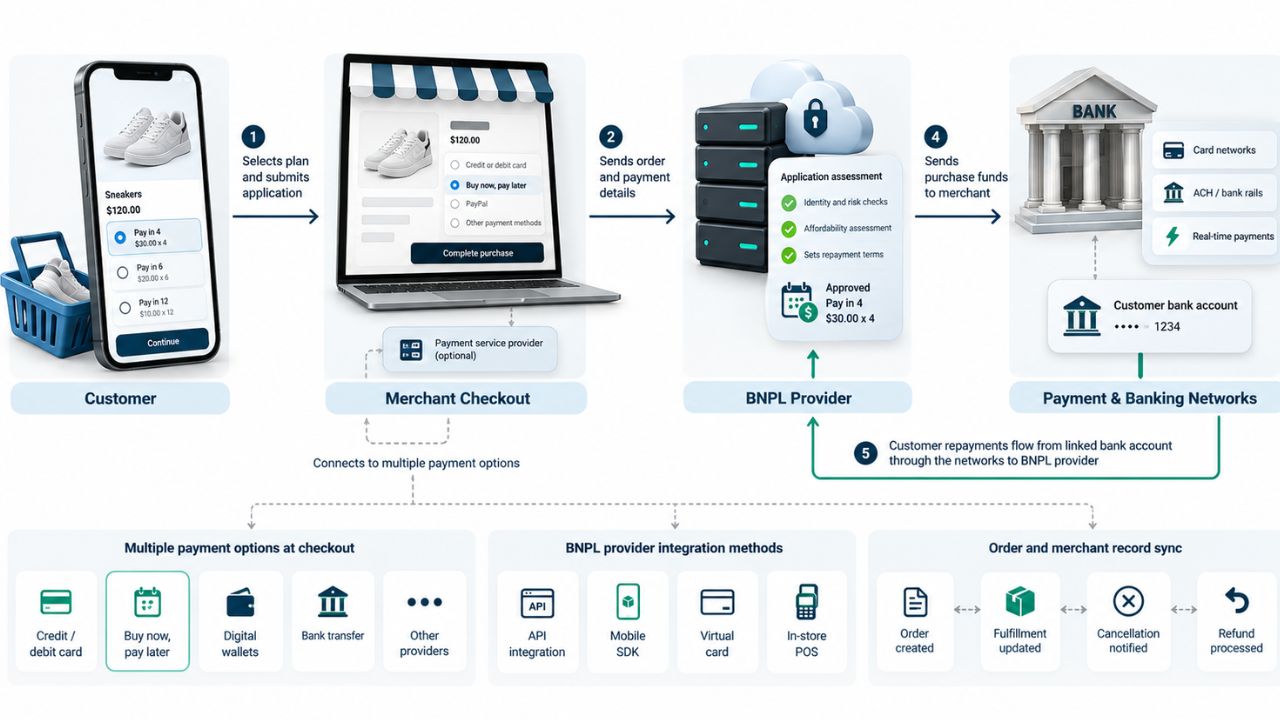
A typical online purchase involves four parties:
- The customer selects a plan and provides the information needed to apply.
- The merchant’s checkout sends order and payment details to the provider, directly or through a payment service provider.
- The BNPL provider assesses the application, sets the terms, and services the loan.
- Payment and banking networks move funds between the provider, merchant, and customer’s repayment account.
These roles can overlap. An e-commerce platform may connect a merchant to several payment options; a provider may offer direct application programming interface (API) integrations, mobile software development kits, virtual cards, or in-store workflows. Affirm’s documentation, for example, describes direct API, virtual card, and point-of-sale options.
The shopper sees one button. The merchant’s systems must keep the order, payment, fulfillment, cancellation, and refund records consistent. That coordination is a central part of Buy Now Pay Later technology architecture.
What happens when a shopper selects BNPL
Imagine a shopper buying a $200 item. The checkout sends details such as the order amount, currency, basket information, and a transaction identifier to the provider. The shopper may also need to submit identity and payment details. The exact fields depend on the provider and product.
The provider evaluates the application and returns a decision. It may approve, decline, or request another step, such as identity verification. If the customer accepts the terms, the provider confirms the financing and returns a transaction reference.
The merchant should confirm the purchase through a server-to-server request. A browser redirect alone is not reliable proof of payment: the customer might close the tab or lose connection before the process finishes. The merchant’s backend should verify the final transaction status before fulfillment. Affirm’s developer guide, for example, instructs merchants to complete a confirmed purchase with a server-side request.
This is where Buy Now Pay Later technology architecture has a practical consequence: the checkout screen can look complete while the merchant’s system still needs to confirm what happened.
How real-time underwriting makes a decision
Underwriting is the process of deciding whether to offer financing for a purchase and on what terms. A provider may assess each transaction separately, so approval for one purchase does not guarantee approval for the next.
A decision system may consider application and identity details, the purchase amount, repayment history with that provider, and transaction or device risk signals. Where permitted, it may also use information from outside sources. Providers combine signals under their own policies; there is not necessarily one score or one credit-bureau check.
The phrase “instant credit scoring API” can make the process sound simpler than it is. Several rules and models may contribute to a decision, and the mix differs by product and jurisdiction. In the United States, the Consumer Financial Protection Bureau says most BNPL loans do not require a hard credit inquiry, while some other online installment loans do. Customers should check their specific loan terms to understand what checks apply and whether repayment activity may be reported.
Buy Now Pay Later technology architecture must balance a quick response with enough identity and risk checks to make a responsible decision.
Why BNPL providers check for fraud
Credit risk and fraud risk are related, but they are not the same. A customer may be creditworthy while a particular transaction looks suspicious. A fraudster might also use stolen personal information to apply for financing.
BNPL fraud detection systems can look for mismatches or unusual patterns: inconsistent identity details, unexpected transaction frequency, suspicious device signals, or an order that differs sharply from previous activity. The provider may ask for more verification or decline the application.
There is a trade-off. Tight controls can block legitimate shoppers; weak controls can expose the provider, merchant, or customer to unauthorized transactions. The exact checks are provider-specific, so merchants should not assume every service screens transactions the same way.
Credential handling matters too. Private API keys should stay on the merchant’s server, away from browser code. Affirm’s documentation distinguishes public keys, which can be used in client environments, from private keys that should remain confidential on the server.
Authorization, capture, and merchant settlement
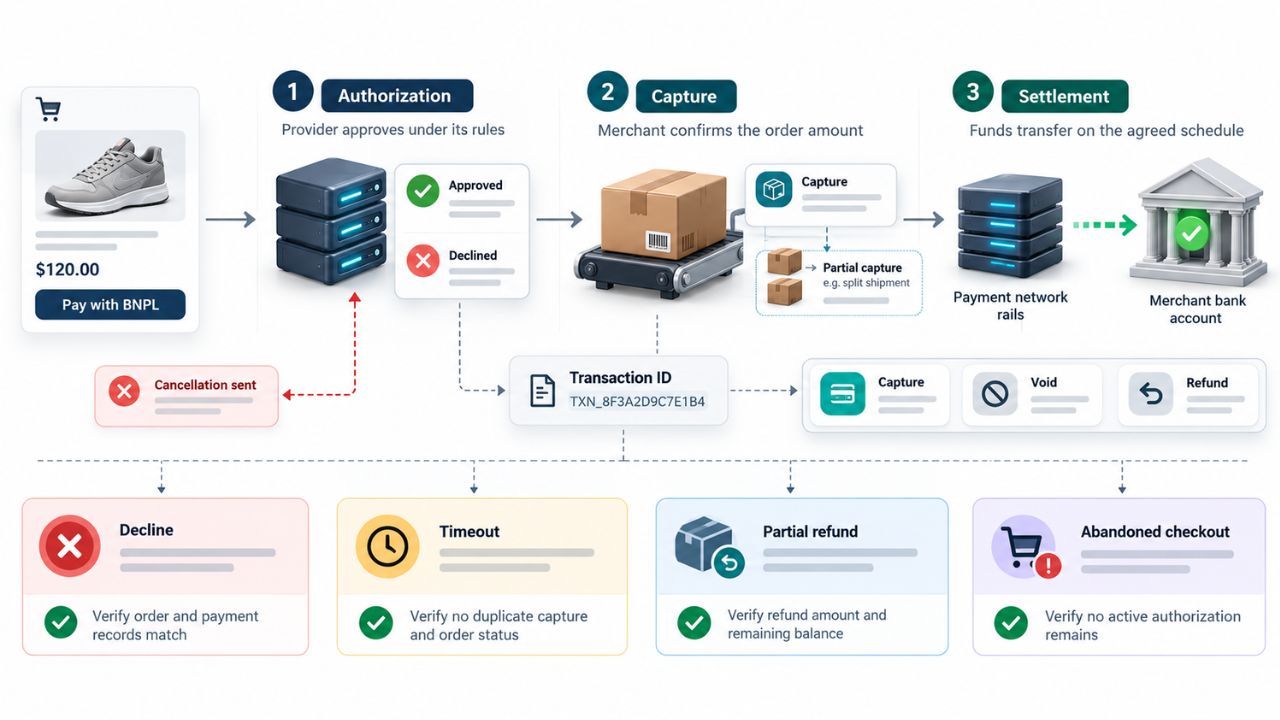
Approval does not always mean every payment step is complete. Payment systems commonly distinguish among:
- Authorization: the transaction is approved under the provider’s rules.
- Capture: the merchant confirms the amount associated with the order, often when goods are ready to ship or a service is delivered.
- Settlement: funds are transferred to the merchant under the provider’s agreement and schedule.
The details depend on the integration and merchant contract. Some transactions are captured in full; others may support partial capture or align capture with fulfillment. Cancellations and refunds also need to follow the correct transaction workflow.
The merchant settlement workflow needs to be planned alongside checkout. If the merchant cancels an order but the provider never receives the cancellation, their records can diverge. A transaction ID links the order to later actions such as capture, void, or refund. Affirm’s documentation describes these actions and notes that settlement arrangements depend on the integration.
Test more than a successful approval. Declines, timeouts, partial refunds, and abandoned checkouts reveal whether the order and payment systems stay in sync. Buy Now Pay Later technology architecture is only dependable when those less tidy cases are handled too.
How repayments are scheduled and managed
After purchase, the provider creates a repayment schedule and tells the customer when payments are due. A common pay-in-four plan splits the balance into four installments, but the first payment may be due at checkout or later. Longer-term plans can have different schedules and pricing. The CFPB describes BNPL as typically a four-payment loan, while noting that products and terms vary.
The provider records the balance, due dates, payment method, and loan status. It sends reminders, attempts scheduled collections, and records whether each installment succeeds. If a payment fails, retry rules and fees depend on the provider’s terms.
Autopay can simplify repayment, but a failed debit still needs attention. The CFPB says many BNPL loans do not charge interest, while many providers charge late fees for missed payments. Customers should check the terms for their specific loan.
Returns add another step. A merchant’s return confirmation does not necessarily update the BNPL balance immediately; the provider must receive and process the refund. Customers should check both the merchant’s confirmation and their BNPL account until the balance reflects the adjustment. This post-purchase servicing is another job handled by Buy Now Pay Later technology architecture.
The role of APIs, webhooks, and payment platforms
The API connects the merchant’s software to the provider. It can create a checkout session, send order details, confirm a purchase, and initiate actions such as capture or refund.
Webhooks notify the merchant when transaction events occur. They help update order status without the merchant repeatedly asking the provider for changes. But the same webhook can arrive more than once. Stripe’s documentation recommends tracking processed event identifiers so a duplicate does not trigger the same action again.
A merchant can build a direct integration or use a payment service provider or e-commerce platform that supports BNPL. Direct integration gives more control but requires more engineering and maintenance. A platform connection is often simpler, though available features depend on what the platform supports.
The browser can display the checkout experience; the backend should verify the transaction before fulfillment. Before launch, teams should test approvals, declines, capture, refunds, and error handling in the provider’s test environment.
What changes across countries and products
There is no single global BNPL system. Providers differ in underwriting, repayment plans, credit reporting, late-payment policies, and settlement terms. Local rules can also affect disclosures, eligibility checks, and how a product is regulated.
The loan itself matters. A short pay-in-four plan is not necessarily assessed or serviced like longer-term financing. Customers should read the terms shown for their specific plan. Merchants entering a new market should confirm provider availability, currencies, payment methods, and local requirements instead of assuming an existing integration will behave identically. These differences shape Buy Now Pay Later technology architecture as much as the software does.
What the technology can—and cannot—tell you
A fast approval does not make a transaction risk-free or the loan invisible. The provider is still assessing an application, creating a repayment obligation, and managing collections.
Credit records may not show every active BNPL plan. A January 2025 CFPB study noted that BNPL loans had typically not been reported to US nationwide consumer reporting companies in volumes sufficient to measure patterns such as borrowing across multiple providers. Reporting practices can change, so borrowers should not assume one provider can see every plan they have elsewhere.
For merchants, the useful standard is straightforward: treat BNPL as a credit and transaction lifecycle, not just another checkout button. Keep payment and order states synchronized, protect credentials, handle duplicate events safely, and make refunds traceable. That is what makes Buy Now Pay Later technology architecture reliable in everyday transactions.
Final Thoughts
Buy Now Pay Later technology architecture connects checkout software, underwriting, fraud screening, transaction processing, loan servicing, and settlement. Customers should check the payment dates, fees, and return process before accepting a plan. Merchants and developers should test the full transaction lifecycle and confirm provider status before acting on an order.
Frequently Asked Questions (FAQs) About Buy Now Pay Later technology architecture
Does BNPL approval guarantee that a future purchase will be approved?
No. Providers may assess each application and purchase separately.
Is every BNPL decision based on a credit-bureau score?
No. Providers may use multiple signals and rules, and their approach varies by product and country. Check the terms to see what credit inquiry or reporting practices apply.
What should a merchant test before launching BNPL?
Test declines, timeouts, duplicate webhook events, cancellations, and partial or full refunds—not only successful approvals. Confirm that the merchant’s order status matches the provider’s transaction status.