

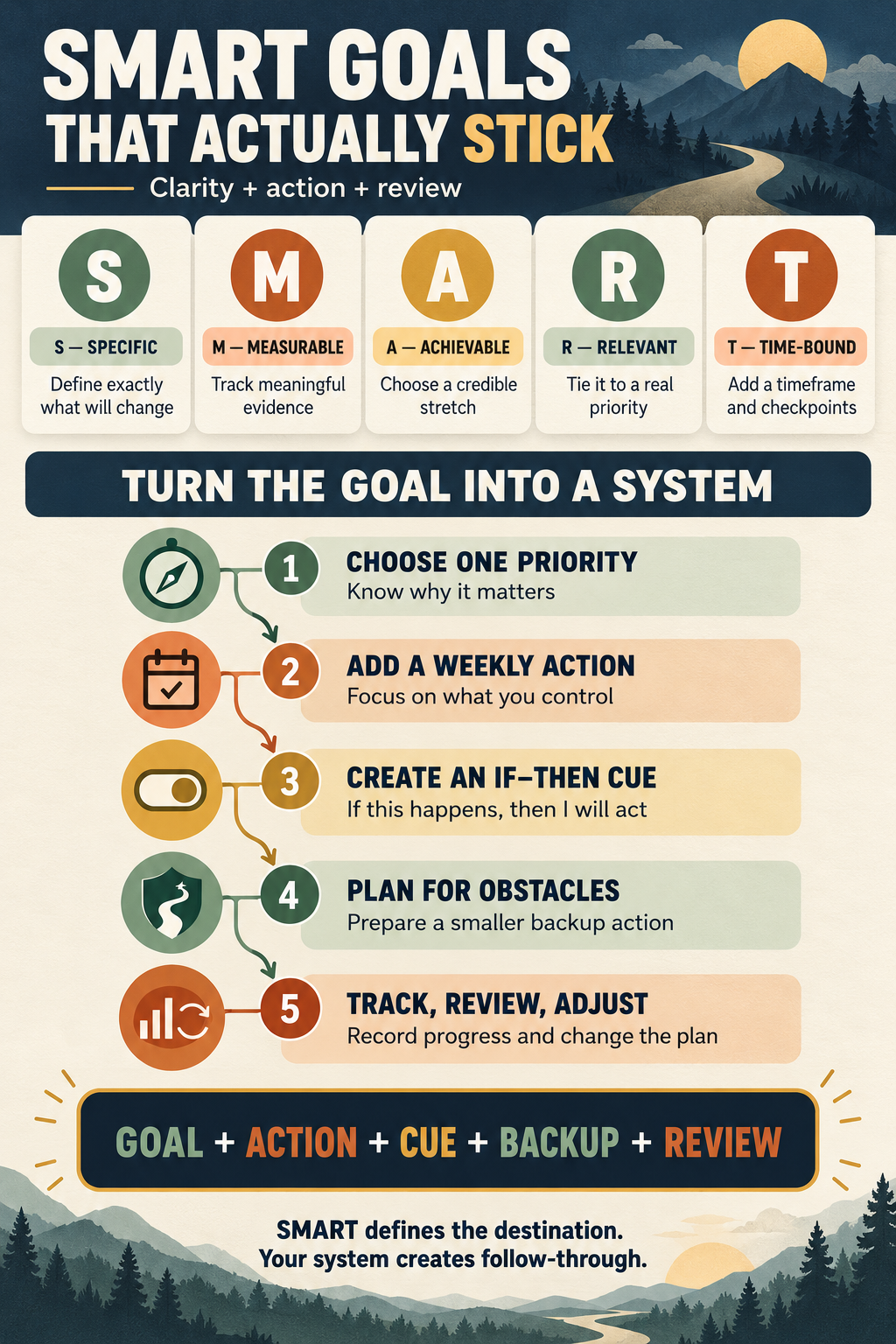
How to set SMART goals that you will actually follow through on? To set SMART goals, define a clear outcome, connect it to a meaningful reason, and give it a realistic timeframe. Then build an execution plan around it. Decide what action you will repeat, when you will do it, how you will measure progress, and what you will do when the original plan becomes impossible. SMART creates clarity. The action system creates follow-through.
Most goals do not fail on the day we set them. They fail on an ordinary Wednesday when work runs late, energy disappears, and the plan no longer fits the day.
“Exercise more” sounds sensible. “Save money” sounds responsible. “Finish my course” sounds achievable. Yet none of these statements tells us what to do next, when to begin, or how to recover after missing a day.
That is where SMART goals can help. They turn a hopeful intention into a defined target. But the familiar five-letter framework is only the beginning.
SMART Goals Improve Clarity, Not Consistency
Management consultant George T. Doran introduced the SMART framework in 1981. His original version stood for Specific, Measurable, Assignable, Realistic, and Time-related.
The modern personal goal-setting version usually means:
- Specific
- Measurable
- Achievable
- Relevant
- Time-bound
SMART began as a way to improve the quality of management objectives. It was not presented as a complete system for motivation, habits, or behavior change.
Doran also acknowledged that not every objective had to satisfy all five criteria. Some valuable goals resist simple numerical measurement. Forcing a number onto everything can make a goal look precise while weakening its real purpose.
I think of SMART as an editing test for a goal. It can expose vague language and unrealistic expectations. It cannot create time, commitment, resources, or a workable routine.
That part still belongs to us.
What Each Part of a SMART Goal Should Accomplish
| Element | Question to ask | Practical meaning |
| Specific | What exactly am I trying to change? | Define the outcome or behavior clearly enough to identify the next action. |
| Measurable | What evidence will show progress? | Choose a meaningful number, milestone, frequency, or quality standard. |
| Achievable | Is this credible with my present resources? | Consider your baseline, time, skills, money, support, and constraints. |
| Relevant | Why does this deserve attention now? | Connect the goal to a genuine value, need, or priority. |
| Time-bound | When will I act, review, and finish? | Set a timeframe, checkpoints, and the first scheduled action. |
Consider three versions of the same intention.
Vague intention: “I want to write more.”
SMART goal: “I will draft 20,000 words of my manuscript within ten weeks.”
Execution-ready goal: “I will draft 20,000 words within ten weeks by writing 500 words every Tuesday, Thursday, and Saturday at 7:00 a.m. If I cannot complete 500 words, I will work for at least 15 minutes. I will record completed sessions weekly and review my total word count every second Sunday.”
The SMART version provides direction. The execution-ready version tells the writer how to behave when motivation is no longer doing the work.
Choose the Right Type of Goal
SMART is not equally suitable for every situation. Before writing the statement, decide what kind of goal you need.
Outcome goals define the destination
An outcome goal describes the result you want.
You might want to save $1,200, complete a certificate, publish a portfolio, improve a test score, or finish a manuscript.
Outcomes provide direction. The problem is that some outcomes depend partly on forces beyond our control. You can submit an excellent job application, for example, but you cannot decide whether an employer hires you.
Process goals define the repeatable action
A process goal focuses on behavior you can control.
Instead of making “get hired” your only measure of success, you could decide to submit five carefully tailored applications each week and contact two relevant people in your professional network.
The outcome still matters. The process gives you something useful to do today.
Learning goals suit unfamiliar work
A specific performance target may be premature when the task is complicated or new.
If you are using unfamiliar software, launching a new campaign, or managing a type of project you have never handled before, you may not know what a reasonable performance target looks like.
A learning goal may be more useful: “Over the next two weeks, I will test three approaches, document the results, and identify which one deserves a longer trial.”
This creates structure without pretending that you already know the correct answer.
Open goals create room to explore
An open goal asks what may be possible before fixing a demanding target. Someone new to running might begin with:
“For the next four weeks, I will see how consistently I can complete two comfortable sessions per week.”
Once the person understands the time, effort, and recovery involved, a more specific target can be set. This approach can be useful for beginners, creative work, and uncertain situations where no reliable baseline exists.
Choose a Goal Worth the Trade-Off
A relevant goal is not merely one that sounds beneficial. Most worthwhile goals compete with other worthwhile goals.
Learning a language requires time. Building a side business needs attention. Training for an event affects evenings, weekends, meals, and sleep. Saving more money may require reducing another expense.
Before committing, ask:
- Would I still want this if nobody else knew about it?
- What personal value or practical problem does it serve?
- What will receive less time, money, or attention because of it?
- Does it conflict with another priority?
- Is this the right goal for this stage of my life?
Goals connected to genuine interests and personal values tend to receive more sustained effort than goals pursued mainly through guilt, comparison, or pressure.
This does not mean every part of the work must be enjoyable. It means the reason for doing it should feel like your own.
Start With Your Actual Baseline
A target cannot be judged properly without a starting point. A goal of reading 50 books in a year means something different to a person who already reads four books every month than it does to someone who has not finished a book in two years.
Before choosing a target, examine recent reality:
- How often are you performing the behavior now?
- How much time is genuinely available?
- What has prevented progress before?
- Which skills or resources are missing?
- What would a meaningful but manageable improvement look like?
A baseline protects you from setting a target so easy that it changes nothing. It also protects you from choosing a dramatic target based on hope rather than capacity. “Achievable” should not mean effortless. It should mean challenging but credible.
Pair the Outcome With a Controllable Action
The outcome tells you where you want to go. The process tells you what to do next.
Keep both in the plan.
Outcome: Complete two portfolio case studies within 12 weeks.
Process: Work on one case study for 45 minutes every Tuesday and Thursday evening.
This distinction becomes particularly important when progress stalls. You may still value the outcome even if the first process was unsuitable.
A failed method does not automatically mean the goal was wrong. The schedule, workload, cue, or measurement system may need to change.
Useful process actions might include:
- Walking for 20 minutes four days per week
- Contacting five qualified prospects every Tuesday
- Studying for 25 minutes on Monday, Wednesday, and Friday
- Transferring a fixed amount on each payday
- Writing 500 words three mornings per week
- Requesting feedback after each project milestone
The action should be small enough to repeat and substantial enough to influence the result. If starting it requires a fresh debate with yourself every day, it is still too vague.
Give the Action a Precise Cue
Wanting to act later is not the same as knowing when action will begin. One of the most practical techniques in goal research is the if-then plan:
If [a specific situation occurs], then I will [perform a specific action].
For example:
- If I finish lunch on Monday, Wednesday, or Friday, I will study for 25 minutes at my desk.
- If my salary reaches my account, I will transfer $100 to my emergency fund.
- If I make my morning coffee, I will review ten vocabulary cards.
- If it is 7:00 p.m. on Tuesday, I will open my project file and work for 30 minutes.
The cue can be a time, place, existing routine, or event. It needs to be precise enough to notice. “Whenever I have time” is not a cue. It is an invitation to postpone.
Plan for the Obstacle You Can Already See
Many goals fail because the plan assumes that every week will be normal. It will not. Meetings run late. Children become ill. Energy drops. Travel disrupts routines. A task takes longer than expected. A good plan makes room for these predictable interruptions.
Write a backup if-then statement:
- If my meeting consumes the study period, I will complete a ten-minute review after dinner.
- If I cannot reach the gym, I will use my prepared home routine.
- If this month’s income is unusually low, I will make the minimum transfer and review the amount on Sunday.
- If I miss a writing morning, I will resume at the next scheduled session rather than doubling the workload.
A backup plan should preserve continuity. It does not need to produce the same result as the full session.
The purpose is not to lower the standard permanently. It is to prevent one difficult day from becoming complete abandonment.
Make the Desired Action Easier to Start
Motivation receives too much credit. Environment receives too little.
If you must find your notes, choose a topic, charge your laptop, and clear a workspace before a 25-minute study session, the session has already become harder than necessary.
Reduce the steps between the cue and the action:
- Place exercise clothes where you can see them.
- Leave the document open at the next section.
- Prepare study materials the night before.
- Automate regular savings transfers.
- Remove distracting apps from the home screen.
- Keep your phone outside the room during focused work.
- Decide the next action before ending the current session.
It also helps when the activity provides some immediate satisfaction. A distant reward may matter, but it often feels abstract during today’s effort.
You might listen to a favorite audiobook only while walking, use an enjoyable workspace for study, or mark completed sessions on a visible calendar. The reward does not need to be expensive or dramatic. It only needs to make repetition more appealing.
Track One Leading and One Lagging Measure
A measurable goal needs the right measures. A leading measure records the action expected to create progress. A lagging measure records the result that follows.
| Goal | Leading measure | Lagging measure |
| Build savings | Transfers completed | Account balance |
| Improve exam performance | Study sessions completed | Practice-test scores |
| Finish a manuscript | Writing sessions or words drafted | Completed draft |
| Increase sales | Qualified outreach completed | Conversions or revenue |
| Improve exercise consistency | Planned sessions completed | Endurance or performance change |
A large analysis of 138 studies involving nearly 20,000 people found that monitoring progress improved goal attainment. The effect was stronger when people recorded their progress or reported it to someone else.
Tracking can still become excessive. If you spend more time designing the tracker than doing the work, the tracker has become another form of avoidance.
A simple weekly record is usually enough:
- What did I plan?
- What did I complete?
- What changed?
- What interfered?
- What should I adjust next week?
Add Review Dates, Not Just a Deadline
A deadline tells you when the goal period ends. A review tells you what to do with the information collected along the way. “Finish by the end of the year” creates no daily behavior by itself. A deadline becomes useful when it is connected to scheduled actions and intermediate checkpoints.
At each review, choose one of three responses.
Continue
The plan is producing progress at a reasonable cost. Keep it.
Change
The goal still matters, but the method, schedule, target, measurement, or timeline needs adjustment.
Stop
The goal is no longer valuable, feasible, safe, or compatible with a more important responsibility.
Stopping an unsuitable goal is not automatically a failure. Continuing an irrelevant or excessively costly goal can waste more effort than leaving it.
Persistence matters when the destination remains worthwhile. Flexibility matters when reality changes.
A Complete SMART Goal Template
Use this template to connect the destination with the work required to reach it:
By [timeframe], I will move [meaningful measure] from [current baseline] to [target], measured by [method], because [personal reason]. Each [day or week], I will complete [controllable action] at [time and place]. If [likely obstacle] occurs, I will [backup action]. I will review [leading measure] and [lagging measure] every [interval] and adjust the plan when necessary.
The statement is longer than a traditional SMART goal. That is intentional. It contains the information needed to act.
Tell Fewer People and Report to the Right One
Publicly announcing a goal can feel productive before any work has been completed. In some situations, receiving recognition for the identity — writer, entrepreneur, runner, future graduate — can reduce the urgency to perform the behavior.
Accountability can still help. The distinction lies between announcing an ambition and reporting evidence. Instead of telling a large audience what you intend to become, report completed actions to one appropriate person:
- “I completed all three study sessions.”
- “I made the planned transfer.”
- “I drafted the first section.”
- “I missed two sessions, and this is how I changed the schedule.”
Announce less. Report more.
Recover Without Turning One Lapse Into a Pattern
The worst response to a missed target is often an emotional overcorrection. Do not double every future session, punish yourself, or rebuild the entire system after one difficult week. Use a short reset.
- Record what happened: Identify the practical cause without turning it into a judgment about your character.
- Resume at the next planned opportunity: Do not wait for Monday, next month, or another symbolic fresh start.
- Use the minimum version when necessary: Ten minutes of study can preserve continuity when the full session is genuinely impossible.
- Look for repetition: One disruption may be random. The same disruption every week is information.
- Change the system: Move the cue, reduce friction, revise the workload, or replace an unrealistic timeline.
Self-compassion does not mean pretending that the lapse did not matter. It means responding in a way that makes useful action more likely. Research has found that a compassionate response to failure can increase the motivation to improve rather than weaken it.
Clarity Gets You Started, but the System Brings You Back
A strong SMART goal removes ambiguity. That matters. But eventually, the goal must leave the notebook and enter the calendar.
The most dependable version includes more than a target and a date. It has a controllable action, a precise cue, a response to predictable obstacles, a simple record of progress, and a regular review.
Motivation will rise and fall. Schedules will break. Some plans will prove unrealistic. The goal does not need to make you perfect. It needs to make the next useful action easier to see, easier to begin, and easier to repeat.
Frequently Asked Questions on How to Set SMART Goals
Do SMART goals really work?
SMART can improve clarity, but the framework alone does not guarantee success. Follow-through also depends on motivation, resources, action planning, environmental cues, progress monitoring, and the ability to adjust.
Does every goal need a numerical target?
No. Progress can be measured through completion, frequency, milestones, observable evidence, or a defined quality standard. A number should clarify the goal, not distort its purpose.
How many SMART goals should I set at once?
There is no correct number for everyone. In practice, one primary change goal is easier to protect than several competing priorities. If you choose multiple goals, check whether they require the same time, energy, or money.
What if I do not know what an achievable target is?
Begin with an open or learning goal. Observe your baseline for several weeks, test a manageable process, and use the results to set a better-informed target.
Is it acceptable to change a goal after setting it?
Yes. Adjusting the method, target, or timeline after receiving new information is responsible planning. The important question is whether the change improves the plan or merely helps you avoid necessary effort.