
Every date on the calendar holds a mirror to the past, reflecting the triumphs, tragedies, and transformative moments of human civilization. October 20 is certainly no exception. From paradigm-shifting territorial acquisitions in North America to the onset of massive geopolitical conflicts in the high Himalayas, this day has routinely served as a crucible for world history. Furthermore, it marks the birth of literary geniuses, groundbreaking scientists, and political stalwarts, alongside the untimely departure of iconic figures who shaped our modern culture.
In this comprehensive, in-depth report, we dive into the archives of time to explore the major milestones that occurred on October 20.
The Bangalee Sphere
The Indian subcontinent, encompassing modern-day India, Bangladesh, and Pakistan, is a region of immense historical density. October 20 has witnessed significant colonial shifts, border conflicts, and tragic natural disasters that have collectively molded the region’s contemporary identity.
Historical Events:
-
1962 (The Sino-Indian War Begins): On October 20, 1962, years of simmering border disputes culminated in open warfare as the Chinese People’s Liberation Army mounted a massive, coordinated attack along the Himalayan borders. Chinese forces pushed Indian troops back across both the North-East Frontier Agency (NEFA, modern-day Arunachal Pradesh) and the high-altitude desert of Ladakh (Aksai Chin). This conflict profoundly altered India’s military strategy and geopolitical alliances during the Cold War era.
-
1947 (The First Indo-Pakistani War): Just months after the violent partition of the subcontinent, the very first battle between the newly independent nations of India and Pakistan broke out on this day. The conflict over the princely state of Jammu and Kashmir set the stage for decades of territorial disputes that remain central to South Asian politics today.
-
1991 (The Uttarkashi Earthquake): Tragedy struck the Himalayan foothills when a devastating earthquake, registering between 6.1 and 7.1 in magnitude, rocked Uttarkashi and three northern districts of Uttar Pradesh. The catastrophic seismic event claimed the lives of over 1,600 people, flattened countless rural homes, and severely damaged local infrastructure, serving as a grim reminder of the region’s deep tectonic vulnerabilities.
-
1774 (The Regulating Act in Effect): The British Parliament introduced the New Regulating Act, fundamentally overhauling how the East India Company governed its territories. This abolished the localized company government and established a centralized, British-backed administration in Calcutta, laying the bureaucratic groundwork for the British Raj.
Famous Births:
-
Siddhartha Shankar Ray (Born 1920): An influential Indian lawyer and politician who served as the Chief Minister of West Bengal. His tenure was marked by the turbulent Naxalite movement and the political complexities of the 1970s.
-
Navjot Singh Sidhu (Born 1963): A famously aggressive Indian opening batsman born in Patiala, who later transitioned into a prominent career in television broadcasting and state politics.
-
Gunturu Seshendra Sarma (Born 1927): A celebrated Indian poet and literary critic who contributed immensely to Telugu literature, blending classical aesthetics with modern philosophical thought.
Famous Deaths:
-
B. S. Guha (Died 1961): A famous human scientist and physical anthropologist who conducted pioneering research on the racial ethnology of the Indian subcontinent.
-
Pandit Kalyandas Mahaprasad (Died 1991): A deeply revered traditional Kathak dancer who dedicated his life to preserving and teaching this classical North Indian dance form.
International Observances & Holidays
October 20 serves as a designated day for several critical global awareness campaigns, bridging the gap between healthcare, culinary arts, and data science.
-
World Statistics Day: Celebrated globally every five years (such as in 2020 and 2025), this United Nations-designated day recognizes the critical importance of reliable data and statistics. In a world increasingly driven by information, accurate statistics are the backbone of sustainable global policy, public health monitoring, and economic forecasting.
-
World Osteoporosis Day: Organized to raise global healthcare awareness, this day is aimed at the prevention, diagnosis, and treatment of osteoporosis and metabolic bone disease. Millions around the world suffer from bone fragility, and this day serves as an educational touchpoint for preventative nutrition and medical care.
-
International Chefs Day: A day dedicated to celebrating the culinary arts globally. Professional chefs use this day to educate children about healthy eating habits, pass down essential culinary knowledge, and celebrate the cultural diversity of global cuisine.
-
National Chicken and Waffles Day (United States): On a lighter note, October 20 celebrates a beloved staple of American soul food, recognizing the culinary fusion of sweet and savory that originated in the jazz clubs of Harlem.
Global History
History is not made in a vacuum. On October 20, sweeping political declarations, architectural triumphs, and monumental treaties reshaped the borders and cultures of the modern world.
United States:
-
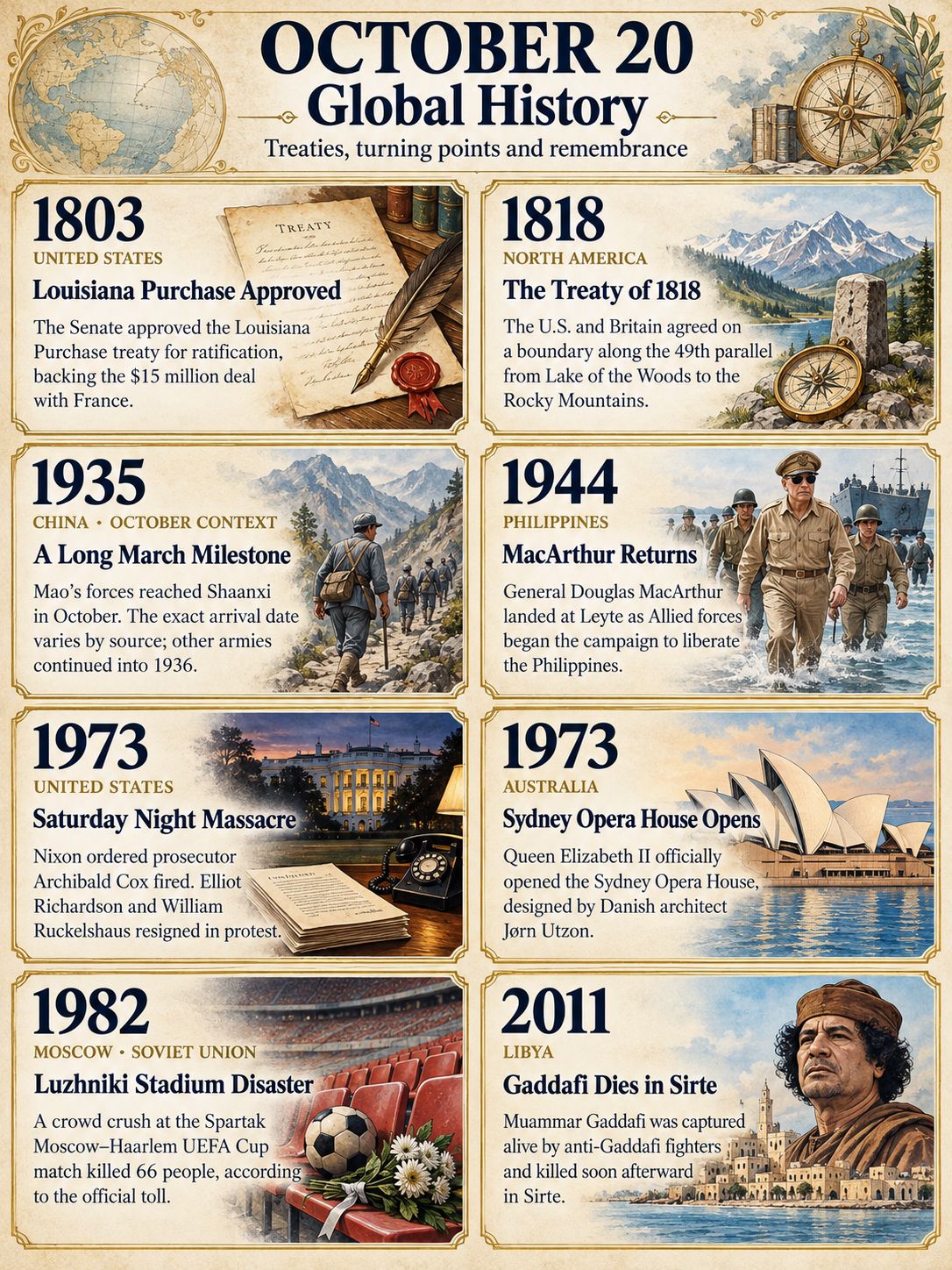
1803 (The Louisiana Purchase Ratification): The U.S. Senate formally ratified the Louisiana Purchase treaty with Napoleon Bonaparte’s France. For a mere $15 million, the United States acquired 828,000 square miles of territory west of the Mississippi River. This stroke of diplomacy effectively doubled the size of the young nation overnight, securing control of the vital port of New Orleans and paving the way for westward expansion.
-
1973 (The Saturday Night Massacre): At the height of the Watergate scandal, the American public watched a constitutional crisis unfold in real-time. President Richard Nixon ordered the firing of independent special prosecutor Archibald Cox. In protest, Attorney General Elliot Richardson and his deputy, William Ruckelshaus, both dramatically resigned. The event severely damaged Nixon’s political standing and accelerated the impeachment process.
Russia:
-
1982 (The Luzhniki Disaster): In one of the darkest days in European sports history, a deadly stampede occurred during a UEFA Cup match between FC Spartak Moscow and the Dutch club HFC Haarlem at the Luzhniki Stadium in Moscow. Official Soviet reports initially downplayed the incident, but it was later revealed that dozens of fans—mostly young teenagers—were crushed to death in an icy stairwell, exposing severe flaws in Soviet event management.
China:
-
1935 (The Conclusion of the Long March): While exact historical dating varies by region, late October marks the general conclusion of the grueling, 6,000-mile military retreat undertaken by the Red Army of the Communist Party of China. Surviving treacherous terrain and constant attacks from Nationalist forces, the march cemented Mao Zedong’s undisputed leadership and forged the ideological core of the modern Chinese state.
United Kingdom & Australia:
-
1973 (The Sydney Opera House Opens): In a dazzling display of architectural achievement and Commonwealth ties, Queen Elizabeth II officially opened the Sydney Opera House. Designed by Danish architect Jørn Utzon, the building’s iconic, sail-like shells instantly became a global symbol of modern Australia and later earned a designation as a UNESCO World Heritage site.
Canada:
-
1818 (The 49th Parallel Border): The Treaty of 1818 was signed between the United States and the United Kingdom (representing Canada). This crucial diplomatic agreement permanently established the U.S.-Canadian border along the 49th parallel from the Lake of the Woods to the Rocky Mountains, peacefully resolving long-standing territorial disputes.
Rest of the World:
-
1944 (The Philippines): Fulfilling a promise he made after fleeing the Japanese advance three years prior, U.S. General Douglas MacArthur famously waded ashore at Leyte, declaring, “I have returned.” This marked the beginning of the Allied campaign to liberate the Philippines during World War II.
-
2011 (Libya): Deposed Libyan dictator Muammar Gaddafi was captured and killed by rebel forces in his hometown of Sirte, definitively ending his 42-year autocratic rule and closing a violent chapter in the Arab Spring uprisings.
Notable Births & Deaths (Global)
October 20 has welcomed the birth of remarkable visionaries across science, politics, and the arts, while also marking the passing of individuals who left indelible marks on history.
Famous Birthdays on October 20
| Name | Year | Nationality | Legacy / Key Contribution |
| Arthur Rimbaud | 1854 | French | A brilliant, transgressive poet whose surrealist works heavily influenced modern literature and art. |
| John Dewey | 1859 | American | A pioneering psychologist and educational philosopher who became the primary voice of progressive education. |
| Bela Lugosi | 1882 | Hungarian-American | Legendary actor who defined the horror genre with his iconic, immortal portrayal of Count Dracula. |
| James Chadwick | 1891 | English | Nobel Prize-winning physicist whose monumental discovery of the neutron revolutionized atomic science. |
| Mickey Mantle | 1931 | American | Hall of Fame baseball player and cultural icon who defined the post-war golden era of the New York Yankees. |
| Tom Petty | 1950 | American | Heartlanders rock legend and prolific singer-songwriter behind timeless hits like “Free Fallin'” and “American Girl”. |
| Kamala Harris | 1964 | American | The 49th Vice President of the United States; the first female, African American, and South Asian American in the role. |
| Snoop Dogg | 1971 | American | West Coast rap pioneer and pop-culture mogul whose laid-back flow helped define 1990s hip-hop. |
Notable Deaths on October 20
| Name | Year | Nationality | Legacy / Key Contribution |
| Anne Sullivan | 1936 | American | The remarkably patient and innovative educator who famously broke through to the deaf and blind Helen Keller. |
| Herbert Hoover | 1964 | American | The 31st President of the U.S., a brilliant engineer whose presidency was ultimately overwhelmed by the Great Depression. |
| Ronnie Van Zant & Steve Gaines | 1977 | American | The lead vocalist and guitarist of the legendary Southern rock band Lynyrd Skynyrd, tragically killed in a plane crash in Mississippi. |
| Paul Dirac | 1984 | English | Nobel Prize laureate and theoretical physicist who laid the foundational mathematics for quantum mechanics. |
| Burt Lancaster | 1994 | American | Oscar-winning Hollywood actor known for his athletic physique and starring roles in classics like From Here to Eternity. |
| Óscar de la Renta | 2014 | Dominican | Legendary fashion designer whose elegant creations dressed generations of First Ladies and Hollywood royalty. |
“Did You Know?” Trivia
To add a layer of fascination to your historical knowledge, here are three lesser-known, yet incredibly compelling facts related to October 20:
-
A Strategic “Cold” (1962): At the absolute height of the Cuban Missile Crisis on October 20, 1962, President John F. Kennedy secretly met with top advisors to plan a naval blockade of Cuba. To hide the severe geopolitical tension from the press and Soviet spies, the White House fabricated a story, telling reporters that the President was merely canceling public appearances due to an “upper respiratory infection” or a cold.
-
The Flop That Changed the Olympics (1968): American athlete Dick Fosbury won Olympic gold in Mexico City on October 20 by using a revolutionary, back-first high jump technique. The athletic establishment initially mocked his style, but the “Fosbury Flop” was so mechanically superior that it permanently changed how the sport is performed globally.
-
The Birth of a Cryptozoology Legend (1967): The most famous—and highly debated—piece of evidence in the search for “Bigfoot” was recorded on this exact day. Roger Patterson and Robert Gimlin filmed what appeared to be a large, hairy, bipedal creature walking through the woods of Bluff Creek in Northern California. The Patterson-Gimlin film remains a cornerstone of American folklore.
Final Thoughts
Reflecting on the events of October 20 provides us with a profound understanding of how quickly the world can change. In a single day across different eras, empires expanded their territories, artists gave the world stunning architectural and musical masterpieces, and scientists unlocked the microscopic secrets of the atom. It is a day marked equally by geopolitical strife in the Himalayas and the triumph of the human spirit in overcoming immense obstacles.
Understanding history is not just about memorizing dates; it is about grasping the continuum of human experience. The figures born on this day utilized their time to reshape poetry, atomic theory, and political landscapes, leaving legacies that outlive their mortal years.