
Citability in AI search is what makes a page useful as a named source in an AI-generated answer. A page can appear in search results and still go uncited when an answer tool responds to a reader’s question. Its main point may be hard to find, its evidence may be thin, or another page may answer that question more precisely.
Publishers can improve those conditions. They can make a page accessible, explain a subject clearly, show where its facts came from, and offer information readers cannot get from a dozen interchangeable summaries. They cannot tell an AI system which page to cite. That distinction matters because citability is a practical publishing goal, not a guaranteed result or a score assigned by Google.
What does citability actually mean?
A citable page contains information that an answer system can discover, understand, use, and attribute to its source. The term is often used in discussions of AI search and generative engine optimization, or GEO. It describes a useful property of content, rather than an official ranking factor.
Several outcomes are easy to mix up:
| Outcome | What it means |
| Discoverable | A search system can find and process the page. |
| Selected | The system considers the page while preparing an answer. |
| Cited | A link or source reference to the page appears in the answer. |
| Used | A fact, explanation, comparison, or procedure from the page helps shape the answer. |
| Visited | A reader follows a link to the page. |
These outcomes do not always arrive together. An answer might display a source without drawing much substance from it. It might mention a brand without citing that brand’s website. A citation might never lead to a visit. That is why counting links in AI answers tells only part of the story.
Citability also has an editorial meaning. If a reader opens the source, can they find the statement the AI answer attributes to it? If the answer says a study found a particular result, does the page identify the study, its date, and what was measured? A visible citation is less useful when it fails that basic check.
How does a page become an AI search source?
AI search systems do not all work the same way. Google says its AI features use existing Search systems to retrieve relevant pages, and they may run several related searches to answer one complex question. ChatGPT can search the web for current information and may show citations when it does. Bing reports which pages from a site are displayed as sources across supported AI experiences.
For a publisher, the process has three practical stages. First, the page must be available to the relevant search system. Next, its content must match a question the system is trying to answer. Finally, the system must choose to display that page as a source. An editor can improve the page at the first two stages. The final selection remains the platform’s decision.
Traditional SEO still belongs in this process. A page that search systems cannot crawl or index has a basic discovery problem. Strong rankings can help a page be found, but a ranking position is not itself an AI citation. Likewise, a neatly formatted paragraph cannot compensate for inaccurate or generic information.
How to engineer more citable content
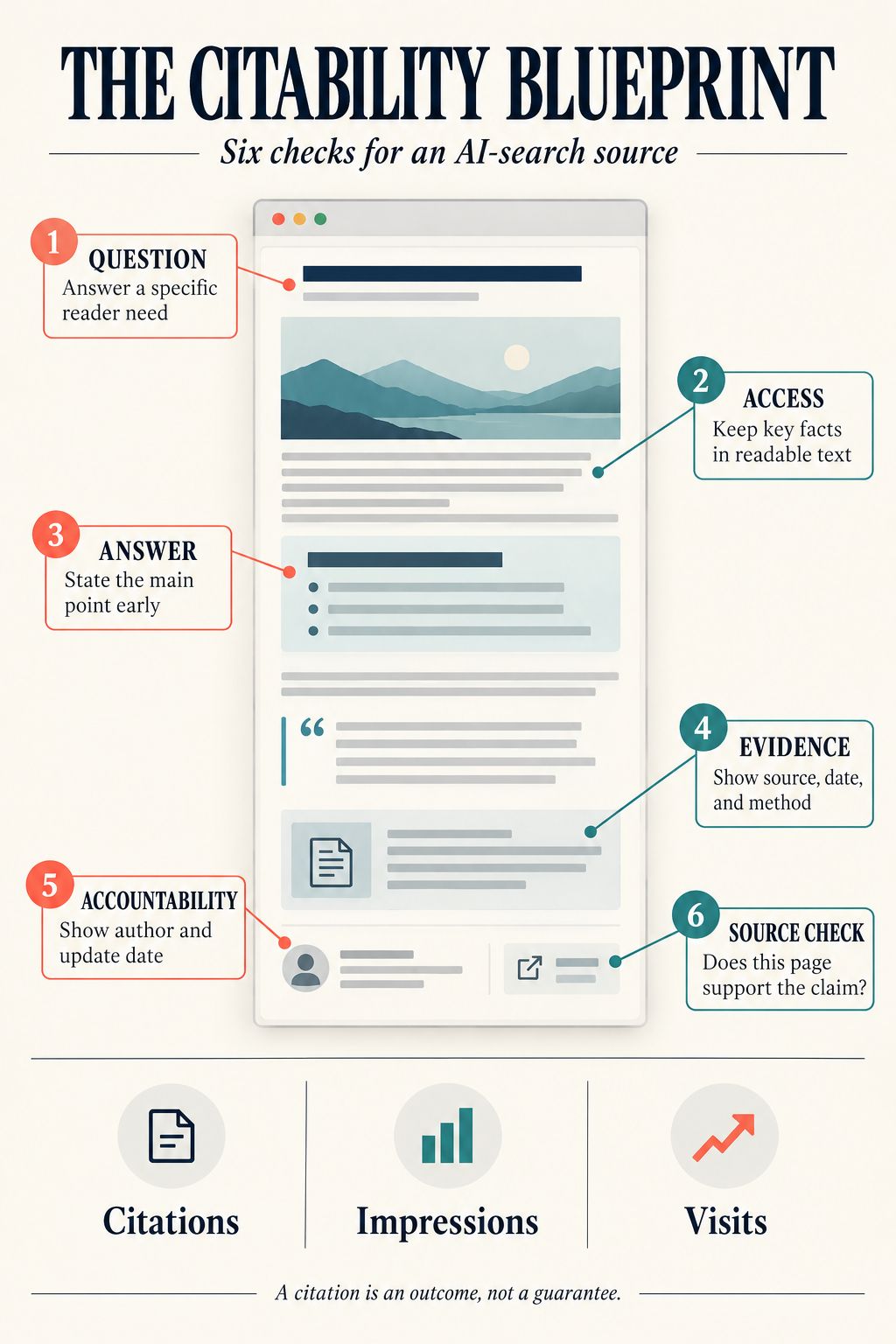
Making content more citable starts with the question your reader needs answered. Put a clear answer where it is easy to find, support important claims with evidence someone can check, and make sure search systems can access the page. The steps below show how to strengthen each part while keeping the article useful to the people who read it.
1. Start with a question worth answering
Before changing headings or markup, decide what the reader needs to know. A search such as “what is citability?” calls for a definition. “How do I measure AI citations?” calls for a method. “Does schema improve AI citations?” calls for a careful explanation of what schema does and what it cannot promise.
Map the main question and a few closely related questions to one useful page. If a subtopic deserves its own detailed treatment, give it a separate page for the reader’s sake. Publishing many thin articles that repeat the same answer under slightly different titles makes it harder to offer anything distinctive.
This is especially useful for complex questions. A reader may ask how to improve AI visibility but also need to understand crawl access, original evidence, and measurement. Covering those connected needs gives the page a coherent purpose. It does not require repeating every possible variation of the target keyword.
2. Make the page accessible
Check that the important page returns normally, can be crawled, and is eligible for indexing. Look for unintended blocks in robots.txt, restrictive snippet settings, conflicting canonical signals, and important answers that appear only inside an image or an interface a crawler may struggle to process. Give the page sensible internal links so people and search systems can find it.
Platform settings deserve a separate check. Google requires a supporting page in AI Overviews or AI Mode to be indexed and eligible for a Search snippet. Site owners can also manage inclusion in Google’s generative AI features through Search Console. For ChatGPT search, OpenAI advises allowing OAI-SearchBot and ensuring the site or its content delivery network permits the bot’s published IP addresses.
These checks establish eligibility. They do not guarantee an appearance in an answer. A publisher may also have good reasons to restrict access, so crawler permissions should be an intentional editorial and business decision.
3. Give the answer early, then explain it
Readers should not have to pass through a long discussion of “the changing digital landscape” before reaching the definition they came for. State the answer plainly near the start. Then give the context, limitations, examples, and steps that make it worth reading the full page.
The same principle works within sections. A heading such as “How do you measure citation frequency?” should lead to an actual method. A reader should be able to understand a key paragraph without searching several earlier sections for the subject of “it” or “this.”
Use a list when order matters and a table when exact comparisons matter. Keep normal prose where an explanation needs nuance. There is no required paragraph length or magic number of words that makes a page citable. Rewriting an entire article as tiny question-and-answer blocks can leave readers with fragments instead of understanding.
4. Make claims easy to verify
Specific evidence gives an answer something useful to draw on. If you use a statistic, identify its original source, date, population, and measure. If you compare products or services, explain the criteria and when you checked them. If you report your own test, say what you tested and what you observed, including the limits of that test.
Original reporting can be particularly valuable here. An interview with a qualified person, an examined public dataset, a documented experiment, or a carefully reported case gives a publisher information that cannot be copied from a generic summary. Firsthand experience can also add useful detail when the author actually has it. None of these should be invented to give a page an appearance of authority.
Adding quotations and statistics for their own sake is a poor substitute for evidence. The number has to answer the question, and the quotation must be accurate and properly attributed. A precise account of what is known, what is uncertain, and how the information was obtained is more useful than a page crowded with impressive-looking figures.
5. Show who stands behind the page
A clear byline, relevant author information, and an accurate publication or update date help readers judge the material. So does a short explanation of how a review, analysis, or dataset was produced. For a news publisher, corrections and substantive updates should be visible and honest.
Freshness depends on the subject. A definition may remain useful for years. A guide to an AI product’s controls or a search platform’s reporting features can become outdated quickly. Review the parts that change; do not simply replace the date at the top of the article and call it updated.
Keep names and claims consistent across the article, its title, captions, and any structured data. Article markup can help describe a page to search systems, but there is no special schema type that guarantees a place in an AI answer.
6. Write for the person who checks the source
An AI citation is an invitation to inspect the page. Give that reader a reason to stay. Put the relevant detail where the heading promises it, define unfamiliar terms, label tables clearly, and make important facts available as text even when an image or chart illustrates them.
Consider this weak explanation: “AI tools prefer authoritative, optimized content.” It sounds confident but does not tell an editor what to examine.
A more useful instruction is: “For each AI answer you audit, record the question, the platform, the date, the displayed source URL, and whether the linked page supports the statement beside it.” The reader can carry out that task and see what the result means. That is the kind of specificity worth publishing, whether or not an AI system later cites the passage.

How can you tell whether the work is helping?
Start with the reports the platforms actually provide. Google’s Generative AI performance report in Search Console shows impressions for a site’s pages in AI Overviews and AI Mode, with views by page, date, country, and device. An impression records that a link was shown in a supported feature. It is not a count of accurately supported claims or a count of visits.
Bing Webmaster Tools’ AI Performance report provides displayed citation counts, cited pages, trends, and a sample of the grounding queries associated with citations across supported experiences. A high count does not reveal how prominently a page appeared or how much of the answer relied on it. Some additional topic-level views are still labeled beta, so their estimates are better used to find questions worth investigating than as a precise ledger.
ChatGPT search referrals can show that someone reached your site, but they cannot capture every instance in which a page was displayed and nobody clicked. To inspect what the answers themselves say, maintain a manageable set of questions your audience really asks. Run and record them separately on the platforms you care about. Save the exact wording, date, location or language context, cited URLs, and whether the citations support the claims.
For that controlled set, an observed citation frequency is the share of recorded answers that cite your site. State the number of answers tested alongside the percentage. Repeat the review: the same question can produce different answers and sources on different runs. Compare like with like before crediting one edit for a change. Finally, look at visits and valuable reader actions separately. Citations, impressions, traffic, and outcomes measure different things.
Common citability advice that deserves skepticism
Be wary of anyone promising a fixed citation lift from a template. Research has shown that changes to evidence and presentation can improve visibility in particular experiments. Those results do not establish a universal gain for every site, topic, or platform.
An llms.txt file is not a requirement for Google Search or its generative AI features. FAQ markup is not a shortcut into AI answers. Neither keyword repetition nor a fixed number of short paragraphs can turn weak reporting into a dependable source. Google’s guidance remains centered on accessible, helpful, original content and established SEO practices.
The goal is also broader than accumulating source links. A page succeeds when it answers a real question accurately, lets readers inspect the evidence, earns appropriate attribution, and serves people who choose to visit. Citability starts with that editorial work. The citation, when it comes, is a result you measure rather than a promise you write into the page.
Frequently Asked Questions About Citability
What is citability in AI search?
Citability is a page’s ability to serve as a useful, credible source for an AI-generated answer. A citable page makes its key information easy to find, understand, and verify. Citability is not an official score, and even a strong source may not be cited for every relevant question.
How can I make my content more citable?
Start with a specific question and answer it clearly near the top of the relevant section. Support important claims with evidence, explain where your information comes from, and add original examples or firsthand insight when you have them. Make sure search systems can access the page. These steps improve its usefulness as a source, though none guarantees a citation.
Does ranking well on Google guarantee an AI citation?
No. A high ranking makes a page visible in traditional search, but an AI answer may select different sources to support a particular response. The page still needs to address the question clearly and offer information the system can use.
Will FAQ schema or an llms.txt file make AI tools cite my page?
Neither guarantees citations. Google says its AI features do not require special schema and do not use llms.txt. Structured data can still help with eligible search features when it accurately describes visible content. Write FAQs because they answer readers’ questions, not as a shortcut to AI mentions.
How can I measure whether AI tools cite my website?
Use Bing Webmaster Tools’ AI Performance report to review cited pages. Google Search Console can show appearances in AI search features, but those impressions are not a complete citation count. For other tools, check a consistent set of relevant questions over time and record which pages they cite. Track referral visits separately to see whether those mentions bring readers to your site.