Still treating search everywhere optimization like a slightly bigger SEO checklist? In 2026, that misses how people actually discover brands. Google Search still matters, but people also search inside TikTok, YouTube, Amazon, app stores, maps, and AI assistants.
That shift stopped feeling theoretical to me when Adobe research found AI-driven referrals in the United States jumped more than tenfold from July 2024 to February 2025. I am going to walk you through what to optimize on each platform, where traditional seo still does the heavy lifting, and which metrics matter once clicks stop telling the whole story.
Understanding Search Everywhere Optimization
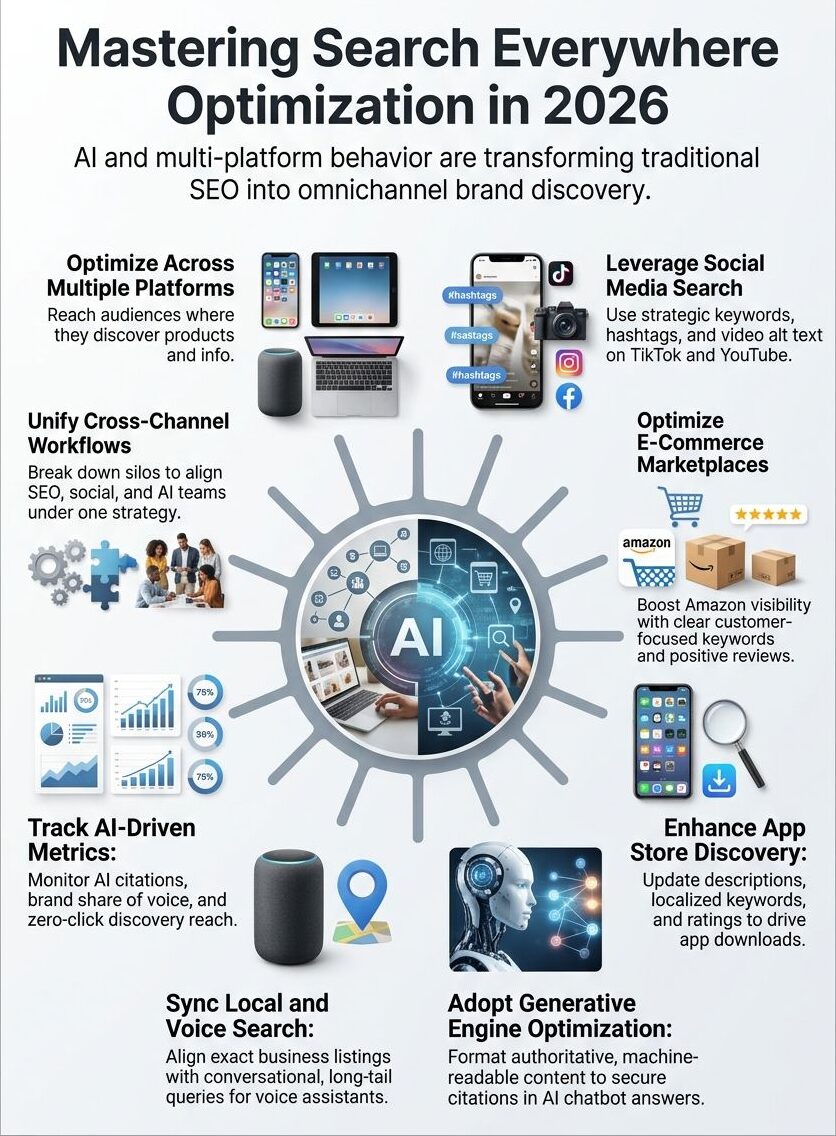
I think of Search Everywhere Optimization, or SEOx, as the practical next step after traditional seo. It is the discipline of helping your brand show up everywhere people search, compare, validate, and decide.
That means I am still doing the core work, technical seo, clean site architecture, metadata, internal links, strong category pages, and clear brand signals. I am also adapting that same truth layer for social platforms, app store optimization, marketplace listings, maps, and ai search.
- Search engines: Google Search and Bing still set the baseline for visibility and credibility.
- Social and video: TikTok, Instagram, YouTube, Reddit, and Pinterest often win the first discovery moment.
- Commerce platforms: Amazon and other marketplaces capture buyer intent close to purchase.
- App stores: Apple App Store and Google Play act like their own search engines with their own ranking rules.
- AI assistants and voice: ChatGPT, Siri, Alexa, and AI Overviews compress the search journey into a direct answer.
What changed for me is priority. I no longer chase every platform equally, I focus on the few touchpoints that actually shape brand awareness, website traffic, and revenue for the audience I want to reach.
That is why search everywhere optimization helps more than old-school channel silos. It lets me build one credible source of truth, then format it for every platform where people search.
The Evolution of Search Behaviors
I have watched search behavior split into many small moments. People still use traditional search engines for prices, login pages, documentation, and local lookups, but they use social platforms and ai search for ideas, validation, and shortlists.
That is why a search everywhere strategy has to map intent across the full search journey, not just rankings on one results page.
Transition from SEO to Multi-Platform Discovery
Search now spans TikTok, Reddit, Quora, YouTube, Siri, ChatGPT, Amazon, and app stores, not just Google and Bing. Each platform rewards a different kind of relevance, so I match the same core topic to different formats instead of pasting one message everywhere.
In practice, that usually means the keyword stays the same, but the proof changes. A Google page may need structured answers and depth, a TikTok needs a strong first three seconds, and an Amazon listing needs buyer-first bullets and images.
- Google Search: best for intent-rich pages, comparisons, pricing, and service details.
- TikTok and Instagram: best for early discovery, examples, and cultural fit.
- Reddit and Quora: best for trust checks, objections, and real-user language.
- App stores and Amazon: best for high-intent searches tied to downloads or purchases.
One monthlong launch made that shift tangible for me. I tested a payments utility app across Google, TikTok, and the Apple App Store, and I only changed the platform-specific elements that mattered most on each surface.
Over 30 days, organic Google clicks rose 18%, TikTok watch-through rate reached 42%, and app store impressions climbed 27%. My unified visibility score improved by 15 points, and discovery redistributed itself to 40% web, 35% social, and 25% app-store referrals.
The lesson was simple: small, channel-specific tweaks can lift visibility across multiple platforms without forcing a bigger creative budget.
AI Influence on Search Trends
AI-driven search moved from experiment to daily behavior fast. EMARKETER forecasts that 26.4% of the U.S. population will use generative AI search in 2026, which is big enough that I now treat ai search as a real acquisition channel, not a novelty.
The quality of that traffic is getting harder to ignore too. Similarweb’s 2026 tracking put ChatGPT referral traffic at a 7.1% conversion rate, just behind paid search, which tells me AI visitors are often arriving with clearer intent than casual browsers.
For marketers, the big change is this: AI assistants are no longer just interpreting the web, they are becoming engines in their own right for discovery, comparison, and recommendation.
Dominant Platforms in Search Everywhere Optimization
When I build omnichannel strategies, I group platforms by the job they do in the decision process. That helps me optimize beyond Google without wasting time on channels that do not move the brand.
Key Search Engines: Google and Bing
Google and Bing still anchor my strategy because they shape classic demand capture and feed many ai-driven search experiences. Google even published a dedicated resource on May 15, 2026 for optimizing content for generative AI features in Search, and its advice sounded familiar: create unique, useful content and support it with strong local, shopping, image, and video assets.
I still treat technical seo as the base layer. Site speed, crawlability, structured data, strong internal linking, and clean metadata help both traditional search and newer ai search surfaces understand what a page is actually about.
- Google Search Console: use it to find the queries already generating impressions, then tighten the page around that intent.
- Bing Webmaster Tools: keep it in the mix because Bing added AI Performance in public preview on February 10, 2026, giving marketers a rare look into generative visibility.
- Index freshness: when content changes fast, IndexNow and updated sitemaps help reduce lag between publishing and discovery.
Social Media and Video: TikTok, Instagram, YouTube
Users treat TikTok, Instagram, and YouTube like search engines because they want proof with personality. They are not just looking for information, they want to see a product, hear someone explain it, and decide whether they trust the source.
YouTube’s own help documentation says search relevance looks at how well the title, tags, description, and video content match the query. That is why I write video metadata like search copy, then make sure the spoken and on-screen language reinforces the same keyword and search intent.
- TikTok: use keyword-led hooks, searchable captions, and comment prompts that surface real objections.
- Instagram: treat alt text, captions, cover text, and saves as part of discoverability, not decoration.
- YouTube: optimize title, description, thumbnail, and retention together, because search visibility means little if viewers bounce.
- Creative research: TikTok’s 2026 trend tools like Market Scope and Content Suite are useful for spotting adjacent search topics and language you can reuse across platforms.
I made a short product demo on TikTok that sent buyers to an Amazon listing, and that test proved something I now treat as a rule: content for every platform needs its own native packaging.
Social media optimization works best when the post answers a real question. That is how I capture Generation Z and older consumers alike without making every asset feel like an ad.
E-Commerce Search Leaders: Amazon, eBay
Marketplace search is different from classic search engine ranking because the buyer is already close to action. On Amazon, product visibility rises or falls on titles, images, bullet points, review signals, and whether the page answers the shopper’s next question fast.
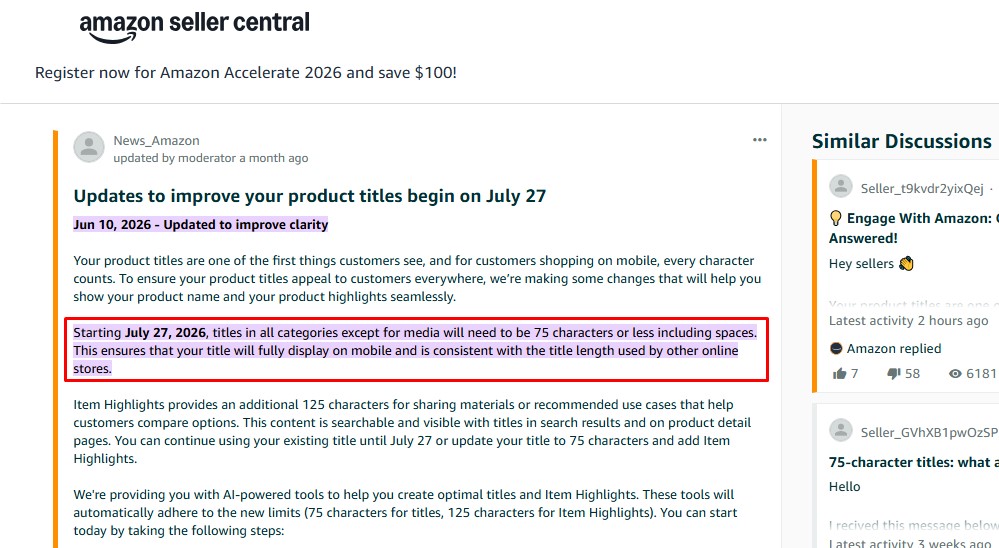
Amazon announced that, starting July 27, 2026, product titles in most categories will need to be 75 characters or fewer, with a new Item Highlights field doing more of the descriptive work. That change pushes brands toward cleaner product copy and makes front-loaded clarity more important than keyword stuffing.
| Marketplace Move | Why I Use It | What It Improves |
| Short, specific product titles | Helps shoppers understand the item in a quick scan | Search relevance and click-through |
| Benefit-led bullet points | Turns features into buying reasons | Conversion rate |
| A+ content and strong images | Explains the product visually and reduces doubt | Time on page and purchase confidence |
| Manage Your Experiments | Lets brands A/B test titles, images, and descriptions | Evidence-based optimization |
On eBay, I keep the same principle. Clean item specifics, accurate condition details, shipping clarity, and seller trust beat clever copy every time.
App Discovery: Google Play, Apple App Store
App discovery is one of the clearest examples of search everywhere optimization in action. The store page is both a search result and a conversion page, so weak metadata and weak screenshots usually fail twice.
Apple states that ratings and reviews appear on your product page and in search results, and that they can influence how your app ranks in App Store search. Apple also says suggested content in the Search tab can be generated with large language models based on the metadata you submit in App Store Connect, which means your app title, subtitle, and descriptions need to be precise enough for both humans and machines.
On Google Play, I focus on store listing quality the same way. Play Console now surfaces recommended keywords and targeted store listing support, which gives me a practical way to test copy and screenshots against different user intents.
- Title and subtitle: lead with the core job the app does.
- Screenshots: show the payoff in the first frame, not just the interface.
- Reviews: reply quickly, because ratings affect both trust and rank.
- Localization: adapt copy to region and language if you want meaningful growth beyond one market.
AI and Voice Assistants: ChatGPT, Siri, Alexa
AI assistants changed the shape of search because they often answer before a user ever sees a list of links. OpenAI’s help documentation now treats ChatGPT search as a core feature, and ChatGPT search is available across major user plans, which means a growing share of your audience can use it as a default discovery tool.
OpenAI also expanded product discovery in ChatGPT on March 24, 2026, adding richer shopping comparisons, side-by-side product details, and merchant integrations. That matters because the assistant is no longer just summarizing the web, it is becoming a search surface where comparison and shortlisting happen inside the answer.
- Write in natural language: voice and chat queries sound like questions, not fragments.
- Expose hard facts: prices, limits, location, compatibility, and lead times should be easy to extract.
- Use the right schema: Product, Service, LocalBusiness, Breadcrumb, and VideoObject help machines interpret the page cleanly.
For Apple and Amazon ecosystems, I think beyond the website too. Apple Business Connect controls how a business appears across Apple Maps, Wallet, Siri, and more, while Amazon continues to position Alexa across tens of millions of voice-enabled devices.
Integrating Voice with Local Search
Voice search gets practical fast, especially for local businesses. Google Business Profile still describes local ranking through three core factors, relevance, distance, and prominence, so a weak listing can break discovery even if the website is strong.
I audit local presence with the assumption that a voice assistant will read the answer aloud. If the hours, category, phone number, or address are inconsistent, the brand loses trust before the customer even clicks.
- Keep NAP exact: your name, address, and phone should match across site, maps, and directories.
- Choose the right primary category: that improves relevance for near-me and service-led queries.
- Update hours and holiday hours: voice assistants pull this data fast, and bad hours create instant friction.
- Reply to reviews: Google notes that positive reviews and helpful replies can help a business stand out.
I do the same on Apple’s side through Apple Business Connect. If you want visibility across search surfaces, maps data has to be treated like core site content, not admin cleanup.
AI’s Transformation of Search Strategies
AI did not kill seo. It changed what good seo has to feed, where it has to appear, and how fast users can get an answer without ever landing on a page.
Introducing Generative Engine Optimization (GEO)
I use Generative Engine Optimization, or GEO, to describe the work of making content easy for AI systems to find, trust, summarize, and cite. The smartest version of GEO is not a bag of hacks, it is clean information architecture plus content that answers a question clearly.
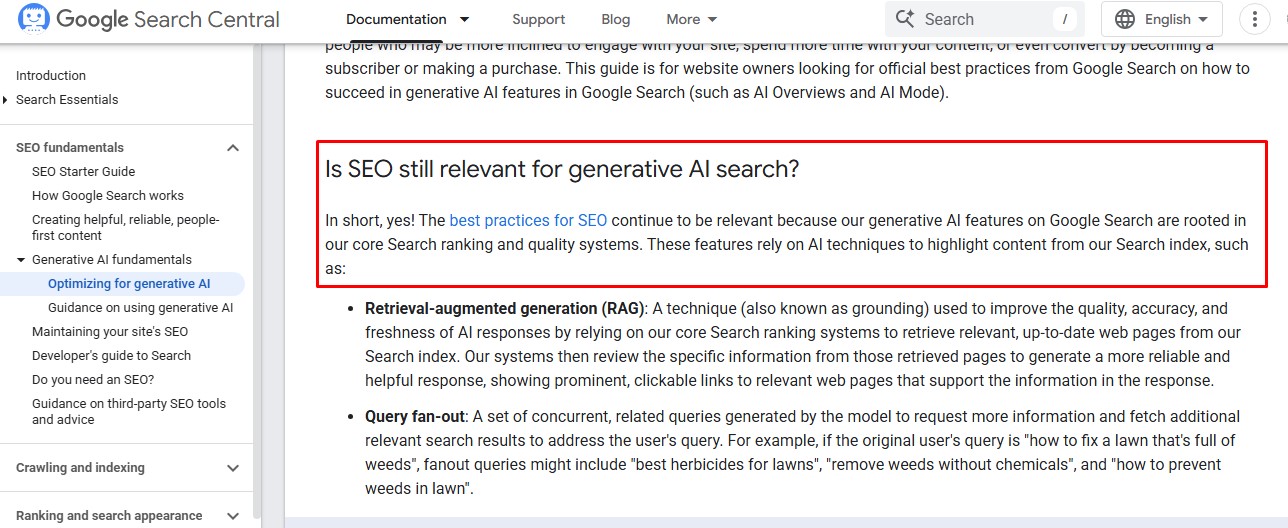
Google’s May 2026 guidance made this point plain: classic SEO best practices still matter, and so does unique, non-commodity content. In other words, if a page says the same vague thing as everyone else, AI has no reason to surface it.
One of the biggest mistakes I see is chasing old snippet tricks. According to May 7, 2026, FAQ rich results no longer appear in Google Search, so I focus on building useful FAQ content for readers and AI extraction, not for a vanished visual feature.
Tailoring Search with AI Personalization
AI personalization means the same prompt can produce different answers based on wording, location, context, and the model’s reading of intent. OpenAI’s documentation explains that ChatGPT search may rewrite a user’s query into more targeted searches and can use general location, or precise location if a user enables it, to improve relevance.
That changes how I write. I make key facts explicit so the assistant does not have to infer them from vague copy, and I place those facts where both a reader and a model can find them quickly.
- State the audience: say who the product or service is for.
- State the geography: mention cities, service areas, and U.S. coverage where relevant.
- State the constraint: include pricing bands, minimums, limits, and availability windows.
- State the proof: use case studies, reviews, specs, and named comparisons.
I ran 30 prompt variants in 2026, and I saw real gains. In a controlled sampler against a single article, the best six prompts increased inclusion of my target facts in AI summaries from 22% to 53%.
Across all variants, the median summary gap dropped 48%, which is why I keep pushing for concise structure, clean citations in source material, and direct answers near the top of the page.
AI and Zero-Click Discovery
Zero-click discovery happens when the platform answers enough of the question that the visit never reaches your site. SparkToro and Similarweb found that 68% of U.S. Google searches from January through April 2026 ended without a click, which is a strong reminder that visibility and traffic are no longer the same metric.
That number changed how I measure success. I still care about organic search traffic, but I also track answer placements, branded search lift, direct visits, assisted conversions, and how often the brand is present in AI responses.
- Watch branded search volume: it often rises before referral traffic does.
- Measure assisted revenue: some discovery channels influence deals without earning the last click.
- Track repeat direct traffic: answer-first discovery often sends people back later.
Crafting Your Search Everywhere Strategy
I build a search everywhere optimization strategy by starting with audience intent, then matching each intent to the platform most likely to win that moment. That keeps the plan practical and keeps the budget from getting scattered.
Analyze Audience and Intent
I start with a simple question: where does this audience go first when they want an answer, a demo, a price check, or a second opinion? That is usually more useful than asking which platform feels hottest this quarter.
From there, I sort search intent into informational, commercial, navigational, and validation-led moments. Google often wins the first three, while TikTok, YouTube, Reddit, reviews, and AI assistants frequently influence the last one.
- List your highest-value customer questions.
- Match each question to the platform where people naturally ask it.
- Choose the format that fits that surface, page, video, listing, or FAQ block.
- Measure which touchpoint starts the journey and which one closes it.
I tested content across Google and TikTok, and I saw clicks and watch time climb after I matched intent and format. That is why I treat keyword research as behavior mapping, not just a spreadsheet exercise.
Tactics for Platform-Specific Optimization
I tested cross-platform content in 2025, and I tracked where users sought answers. The clearest wins came from content that gave useful information in the format each platform already preferred.
If you need a practical starting point, a small pilot can go a long way. One 90 day test used a $12,000 budget split across $5,000 for content production, including three short videos and one explainer, $3,000 for paid social amplification, $2,000 for ASO analytics and creatives, and $2,000 for technical SEO fixes.
Within 12 weeks, that mix lifted the visibility index by 9 points, increased short-form watch time 35%, and raised app impressions 14%. It is a useful model when you want to compare Google SEO, short-form social, and app-store optimization before committing bigger spend.
- Google and Bing: use concise title tags, intent-led headings, strong internal links, and schema that matches the page type.
- TikTok, Reels, and Shorts: build native videos with a quick hook, searchable captions, and a clear question being answered.
- Amazon and marketplaces: tighten titles, front-load benefits, and answer buyer objections in bullets and images.
- App stores: make the first screenshot do selling work, not just design work.
- AI assistants: publish short answers first, then support them with deeper detail below.
- Community platforms: adapt for Reddit, Quora, and Pinterest by using the language people already use there.
- Local and voice: sync maps data, hours, service descriptions, and spoken-friendly FAQs.
Adapt Content for Multiple Platform Visibility
I get the best results when one core idea becomes several native assets. The message stays consistent, but the packaging changes to match the platform.
| Platform | Best Asset | What I Optimize | Primary Metric |
| Google Search | Service page or article | Search intent, structure, metadata, internal links | Qualified clicks and conversions |
| TikTok | Short native video | Hook, caption keywords, comments, watch-through | Retention and assisted visits |
| YouTube | Explainer or comparison video | Title, thumbnail, description, audience retention | Search traffic and watch time |
| Amazon | Product listing | Title clarity, bullets, reviews, image stack | Conversion rate |
| App Store | Store listing | Metadata, screenshots, rating quality | Install conversion |
| AI Assistants | Prompt-ready page | Direct answers, named entities, explicit facts | Brand presence in answers |
I also reuse core assets aggressively. A strong comparison page can become a YouTube script, a TikTok outline, Amazon FAQ copy, and prompt-ready snippets for ai-driven search.
Metrics for Success in Search Everywhere Optimization
I track discovery the way it actually happens now. That means measuring visibility across platforms, not pretending website sessions alone can explain the whole search journey.
New Metrics for AI-Based Search
Classic seo metrics still matter, but they need company. I now pair click-based reporting with answer-level visibility data so I can see whether the brand is being found, mentioned, and chosen across search surfaces.
| Metric | What it Measures | Why it Matters | How I Measure It |
| AI brand mentions | How often the brand appears in generative answers | Shows presence even when there is no click | Prompt sampling across major AI tools |
| Response share | Your share of mentions versus competitors | Reveals market position in conversational search | Monthly competitor comparison sets |
| Visibility score | Combined presence across search, social, app, and commerce surfaces | Gives one operating view for leadership | Weighted dashboard by channel |
| Branded search lift | Growth in branded queries after answer exposure | Shows hidden demand creation | Search Console and Bing query trends |
| Assisted conversion rate | Deals influenced by discovery touchpoints that were not last click | Protects channels that create demand upstream | Multi-touch attribution and CRM tagging |
| App store conversion | Installs from listing views | Separates visibility from actual download intent | App Store Connect and Play Console |
| Watch-through and retention | How long viewers stay with social or video content | Strong proxy for discoverability on feed-based platforms | YouTube Studio and social insights |
| Downstream revenue impact | Revenue tied to cross-channel discovery | Turns visibility into business language | Analytics, CRM, and assisted revenue reporting |
Tools to Track Brand Visibility Across Channels
I do not think one dashboard can solve this on its own. The best setup combines native platform data with a small set of cross-channel tools and a manual prompt-testing habit.
| Tool | What It Tracks | Why I Use It | Key Outputs |
| Adobe LLM Optimizer | AI visibility, referral traffic, brand presence data | Helps operationalize generative engine optimization | Visibility gaps, recommendations, competitor comparisons |
| Google Search Console | Queries, impressions, clicks, indexing | Still the best base layer for Google search health | Search analytics, page opportunities, CTR trends |
| Search Console Insights | Top-performing content and trend summaries | Makes performance easier to explain to non-specialists | Content summaries and trend comparisons |
| Bing Webmaster Tools | Bing performance and AI Performance signals | Useful for non-Google visibility and GEO tracking | Keyword data, crawl stats, AI visibility insights |
| Amazon Brand Analytics | Search terms, category demand, competitor activity | Helps refine marketplace copy and product targeting | Search term reports and conversion clues |
| App Store Connect and Google Play Console | Impressions, installs, listing performance, reviews | Essential for app store optimization decisions | Install conversion, ratings trends, listing test results |
| YouTube Studio | Watch time, search terms, retention, traffic sources | Connects video optimization to actual discovery behavior | Audience retention and top search terms |
| TikTok and Instagram Insights | Reach, saves, shares, engagement, trend signals | Shows what earns social search distribution | Reach curves, save rate, share rate |
| Social listening tools | Mentions, sentiment, topic clusters | Finds language and objections that should shape content | Topic trends and share of conversation |
| Manual prompt libraries | How brands appear in AI answers over time | Keeps AI reporting tied to real queries, not guesses | Presence rate, citation patterns, answer gaps |
Challenges and Future Trends in Search Optimization
The hard part is not seeing the change. The hard part is building a team and workflow that can respond to it without losing accuracy, speed, or brand consistency.
Overcome Data Silos
I led a project that merged seo, social, and AI work into one discovery layer because separate teams were creating separate truths. That always slows publishing and makes the brand sound different on every platform.
The fix was a shared operating model. We used one canonical content source, one set of approval rules, and one visibility score so teams could work from the same facts.
The rollout worked because it followed a strict sequence. Month 1 focused on governance, with shared owners, approval rules, and reporting definitions.
Months 2 and 3 built the canonical content source so SEO, social, and app teams stopped duplicating work. Months 4 and 5 integrated analytics across channels, and month 6 turned the discovery layer into the live operating model for launches.
That structure reduced average launch time by 28%, cut handoffs from seven steps to two, and automated weekly content syncs. A disciplined six month rollout made the discovery layer operational and removed about two thirds of the manual handoff work.
Adjust to Algorithm and Behavioral Shifts
I keep a short change log for every major platform because 2026 has already delivered enough evidence that discovery rules can move fast. A 2026 academic measurement study also found that 11% of atomic claims in Google AI Overviews were unsupported by the cited pages, which is one more reason I would rather maintain a clean truth layer than scramble after each model change.
The teams that stay steady usually do the boring work well. They review what changed, update the highest-value pages first, and rerun the same test set so they can spot signal instead of guessing.
- May 7, 2026: Google stopped showing FAQ rich results in Search.
- May 15, 2026: Google published new guidance for generative AI features in Search.
- July 27, 2026: Amazon begins enforcing shorter title rules across most categories.
- February 10, 2026: Bing opened AI Performance in Webmaster Tools public preview.
Upcoming Platforms and Niche Search Opportunities
The next opportunities are not always brand new platforms. Sometimes they are new discovery layers inside familiar products.
ChatGPT shopping is a good example. OpenAI’s March 24, 2026 update added richer product comparisons and merchant integrations, and major retailers like Target, Sephora, Nordstrom, Lowe’s, Best Buy, The Home Depot, and Wayfair are already participating in that product discovery layer.
- Chat-based shopping: product data needs to be complete, structured, and current.
- Apple Maps: Apple announced ads on Maps for the U.S. and Canada beginning in summer 2026, which makes map visibility even more commercial.
- Reddit and Quora: expert answers and useful comments still create niche discovery where trust matters more than polish.
- Podcast and video search: these channels keep compounding when the same topic earns demand across voice, clips, and long-form content.
I still test Pinterest pins, Reddit threads, and podcast clips because fragmented search creates smaller pockets of intent that bigger brands often ignore. Those pockets can be less crowded, easier to win, and surprisingly valuable.
Final Thoughts
Search everywhere optimization is not about abandoning seo. It is about expanding it so your brand can be found across search engines, social platforms, app stores, marketplaces, maps, and AI assistants.
I would start with one simple move: build a clean source of truth, then adapt it for every platform that matters to your audience. If you want to optimize beyond Google in 2026, that is the work that makes ai search changes turn into measurable revenue.
Frequently Asked Questions on Search Everywhere Optimization
1. What is Search Everywhere Optimization in 2026, and how does it change SEO?
Search Everywhere Optimization means making content work for text, voice, image, and apps, not just web pages. In 2026, AI and large language models read search signals fast, and they help SEO move from pages to every place people look.
2. How do large language models help with keyword research and content?
They speed up keyword research, and they draft ai generated content that matches intent. That helps teams make marketing materials faster, and keeps content fresh.
3. How does AI affect voice search and image search?
AI makes voice search and image search smarter, by matching what people say or show to the right content. It helps personalization too, so answers feel like they were picked for each person.
4. Do businesses need human oversight when they use AI for Search Everywhere Optimization?
Yes, humans must check facts, tone, and brand fit, even if AI can analyze customer data and run analytics. Use people to guide personalization, set rules for marketing automation, and handle tricky or sensitive cases, think of AI as a fast helper, not the boss.