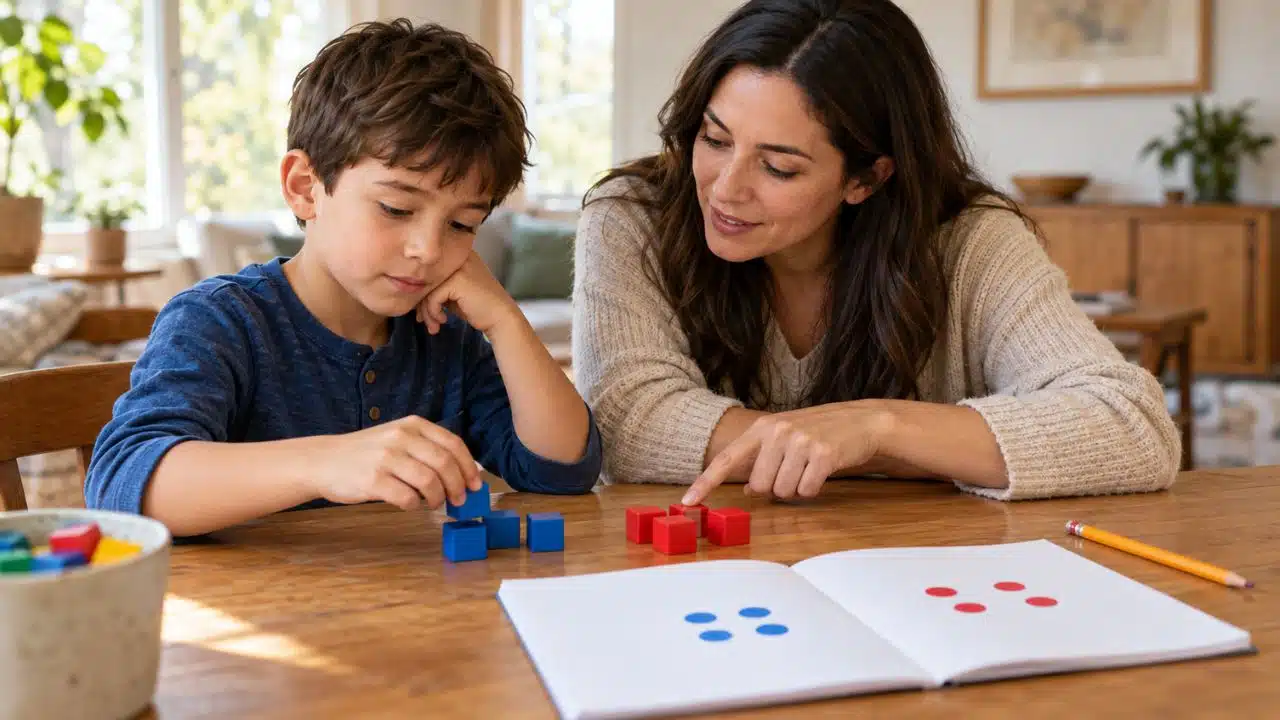
When a child says, “Math is hard,” it can be difficult to know what to say or do next. For some children, a few challenging problems can quickly turn into frustration, self-doubt, or a belief that they are simply “not good at math.” The good news is that struggling with math does not mean a child cannot learn it. With the right support, patience, and encouragement, children can build stronger math skills and become more confident learners.
Helping a child who finds math difficult starts with understanding what is making the subject feel overwhelming. It could be a confusing concept, a fear of making mistakes, gaps in basic skills, or simply needing more time to understand a new idea. In this guide, we’ll explore practical ways parents, caregivers, and teachers can help a child overcome math struggles, develop confidence, and make learning math feel less stressful and more manageable.
Why Do Kids Struggle With Math?
Children struggle with math for a combination of reasons: gaps in earlier skills, a mismatch between teaching style and learning style, working-memory demands, and emotional stress that blocks clear thinking. Math builds on itself more than most subjects, so a missed concept in second grade can cause confusion in fourth grade even if the child is bright and hardworking.
Common contributing factors include:
- Skill gaps from missed instruction. Remote learning disruptions, absences, or a fast-moving classroom can leave holes in number sense.
- Working memory load. Multi-step problems require holding several pieces of information at once, which is hard for many children, not just those with diagnosed learning differences.
- Teaching mismatch. A child who thinks in pictures may struggle with a teacher who explains everything verbally, and vice versa.
- Emotional interference. Stress narrows attention and blocks access to skills a child actually has, which is why an anxious child can “forget” something they knew the night before.
Research cited by the National Center for Education Statistics shows math scores dropped across many U.S. states following pandemic-era learning disruptions, which widened these gaps for a large share of students in the 2022 and 2024 NAEP assessments. This means a child who seems behind may simply be catching up from systemic disruption, not facing a lasting deficit.
What Are the Signs Your Child Has Math Anxiety?
Math anxiety shows up as physical stress symptoms, avoidance behavior, and self-defeating talk specifically tied to math tasks, separate from general difficulty with the subject. A child with math anxiety may understand a concept fine when calm but freeze during a timed quiz or homework session.
Watch for these signs:
- Stomachaches, headaches, or crying before math homework or tests
- Statements like “I’m just bad at math” or “I’ll never get this”
- Avoidance: stalling, “forgetting” math homework, or rushing through it carelessly
- Strong performance on untimed work but much weaker results under time pressure
- Reluctance to ask questions in math class specifically, even if the child participates freely in other subjects
Math anxiety is increasingly treated as a children’s mental health concern rather than a purely academic issue, because the stress response it triggers overlaps with general anxiety patterns. A 2012 study from Stanford University, published in Psychological Science, found that math anxiety activated fear-related brain regions in children as young as first and second grade, which means the emotional reaction to math can start well before a child faces high-stakes testing.
How to Help a Child Who Says Math Is Hard Build Confidence
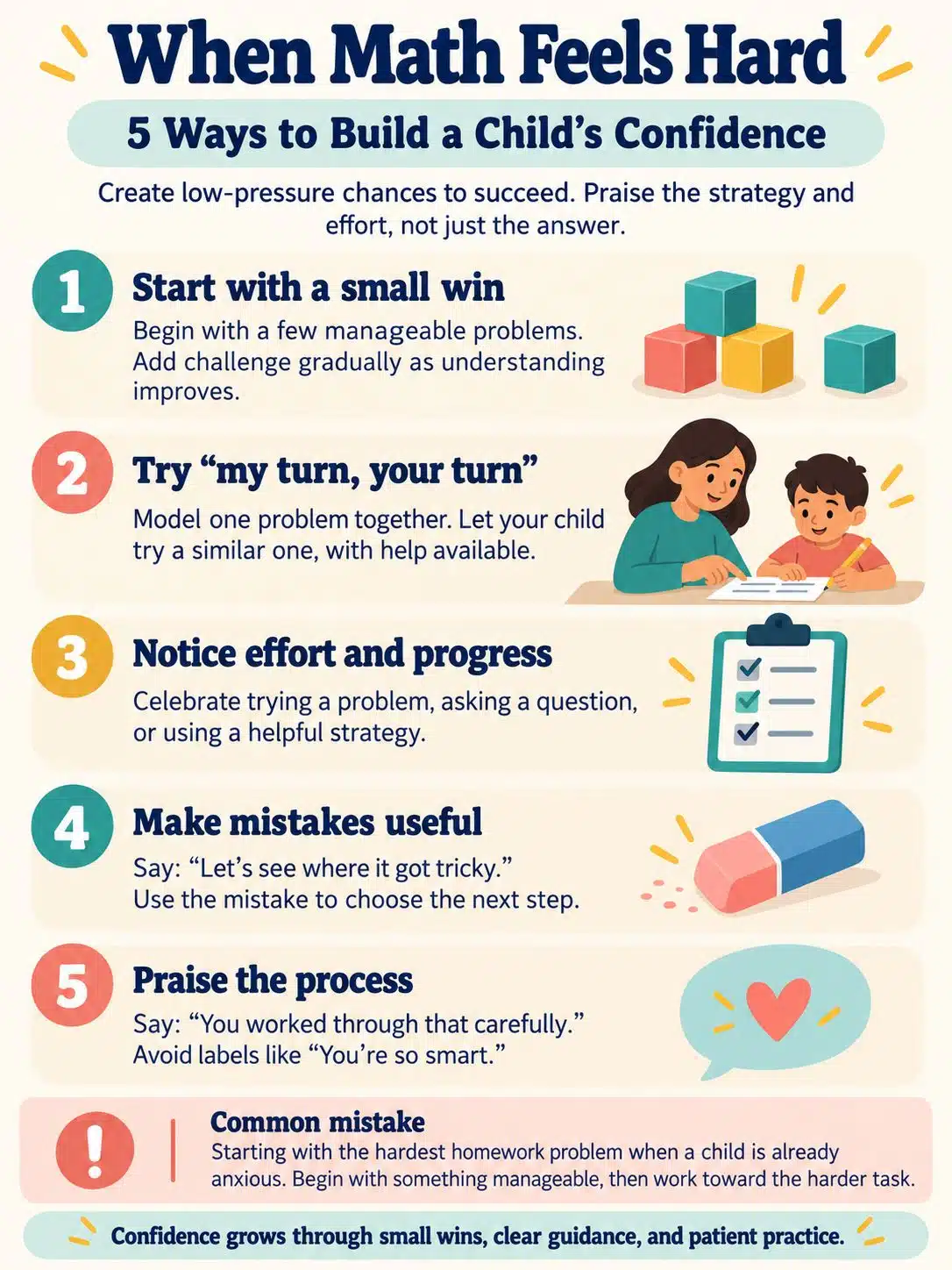
The most reliable way to help a child who says math is hard build confidence is to create frequent, low-stakes chances to succeed and to praise the strategy they used, not just the correct answer. Confidence grows from repeated small wins, not from one big pep talk.
Try these confidence-building exercises:
- Start below grade level for a week. Give the child a few problems they can solve easily to rebuild a sense of competence before introducing harder material.
- Use a “my turn, your turn” model. Solve one problem together, then let the child try a near-identical one alone.
- Track effort, not just scores. A simple chart marking “tried a hard problem” or “asked a good question” reinforces persistence.
- Normalize mistakes out loud. Say things like “Mistakes show us where to focus next,” echoing the growth-mindset approach backed by educational psychology research on resilience and learning.
- Separate identity from performance. Avoid “you’re so smart” in favor of “you worked through that carefully.”
Common mistake: Jumping straight to the hardest unfinished homework problem when a child is already anxious. Starting with something solvable resets their stress response before tackling the harder content.
How to Make Math Fun for Kids Who Hate It
Math becomes more enjoyable when it is tied to games, real objects, and everyday situations instead of worksheets alone. Children who say they “hate” math often mean they associate it with stress, not that the content itself is unpleasant.
Practical ways to make math fun:
- Cook together. Measuring cups and recipe doubling teach fractions naturally.
- Play dice and card games. Yahtzee, Uno, and simple card addition games build fluency without feeling like schoolwork.
- Use money. Grocery store budgeting, counting change, or planning a small purchase teaches real-world math.
- Try “Bedtime Math” style routines. A short, playful math question before bed, unattached to grades, lowers pressure.
- Build with blocks or Legos. Spatial reasoning tasks support geometry and fractions later on.
How to Talk to Your Kid About Math Difficulties Without Making It Worse
The safest way to talk to a child about math difficulties is to validate the feeling first, separate the subject from their intelligence, and avoid comparisons to siblings or classmates. The wrong words, even well-meaning ones, can deepen avoidance.
A short script that works for most families:
- “I can see math feels really hard right now.”
- “That doesn’t mean you’re bad at it, it means we need a different approach.”
- “Let’s figure out which part is tripping you up.”
- “We’ll work on it together, a little at a time.”
Phrases to avoid:
- “I was bad at math too” (signals it’s hereditary and fixed)
- “This is easy, just focus” (dismisses real struggle)
- “Your sister never had this problem” (adds comparison stress)
Clinical guidance from child psychology sources emphasizes normalizing the anxiety response and teaching coping skills, such as slow breathing before a timed test, rather than only addressing the academic content. This dual approach, pairing skill practice with calming techniques, reflects findings from intervention studies at Stanford showing that combining tutoring with relaxation training reduced anxiety and improved test scores more than tutoring alone.
Does My Child Need a Tutor, or Just More Practice?
A child needs a tutor when the struggle involves specific, identifiable skill gaps or a learning difference; a child usually just needs more practice when the issue is pacing, confidence, or recent inconsistent instruction. Tutoring and practice solve different problems, so matching the right fix to the right cause saves time and money.
| Situation | Best Fit |
|---|---|
| Struggles with one specific topic (fractions, long division) | Short-term tutor or teacher support |
| Generally behind after absence or school transition | Daily short practice at home |
| Strong understanding but freezes on tests | Confidence-building exercises, not more content |
| Struggles across multiple subjects, not just math | School evaluation for learning differences |
Options for tutoring support include school-based Title I programs, community learning centers, college-student tutors through local tutoring networks, and online platforms with certified teachers. For many families, a short six-to-eight week block focused on one skill gap works better than an open-ended, year-long commitment.
Math Learning Disabilities vs. Just Being Slow at Math
A math learning disability like dyscalculia involves a persistent, significant difficulty understanding numbers and quantity that doesn’t improve much with typical instruction, while being “slow at math” usually reflects pacing differences that close with practice and time. The distinction matters because it changes the right response.
Signs that point toward dyscalculia rather than typical slow progress:
- Difficulty recognizing which of two numbers is larger, even in upper elementary grades
- Trouble connecting a number symbol (7) to the quantity it represents
- Persistent struggle with basic arithmetic facts despite repeated practice over months
- Math difficulty appearing alongside otherwise average or strong performance in reading and other subjects
Dyscalculia affects an estimated 5 to 7 percent of children, a rate similar to dyslexia, yet it receives far less public attention. A formal evaluation, often through the school psychologist or an outside neuropsychologist, can confirm whether a child’s struggle fits this profile.
Common Math Mistakes Kids Make and How to Fix Them
Most recurring math mistakes trace back to a handful of fixable habits: careless sign errors, skipping steps, misreading the question, or relying on memorized tricks without understanding why they work. Fixing the habit usually matters more than drilling more problems.
| Common Mistake | Likely Cause | Fix |
|---|---|---|
| Subtracting in the wrong direction | Weak place-value understanding | Use base-ten blocks or draw the problem |
| Misreading word problems | Rushing or weak reading comprehension | Have the child restate the problem in their own words |
| Forgetting to carry or borrow | Skipping steps under time pressure | Slow down with graph paper to align digits |
| Confusing similar operations (plus vs. times) | Memorized shortcuts without concept | Reconnect symbols to real quantities using objects |
| Giving up mid-problem | Low confidence or working-memory overload | Break problems into smaller labeled steps |
How to Help a Child With Math Without Doing Their Homework for Them
The best way to help without doing the work is to ask guiding questions that lead the child back to a method they already know, rather than supplying the next step. Handing over answers feels helpful in the moment but removes the practice a child needs to build real skill.
Useful guiding questions:
- “What do you already know about this type of problem?”
- “Can you draw a picture of what’s happening?”
- “What’s the first small step, even if you’re not sure about the rest?”
- “Does your answer make sense compared to a rough estimate?”
Structured, step-by-step supports work well for children who shut down when a problem feels too big. Breaking a worksheet into three visible chunks, with a short break between each, keeps a child engaged without a parent taking over the thinking.
Free Math Apps and Games That Actually Help
Several free or low-cost apps give children real practice without turning math into another source of pressure, and the best ones adapt to the child’s actual skill level instead of just their grade. Screen-based practice works best as a 10-to-15 minute supplement, not a full replacement for hands-on learning.
Reliable options families use:
- Khan Academy Kids, free, covers early number sense through elementary arithmetic with no ads
- Prodigy Math, game-based practice tied to curriculum standards, free tier available
- SplashLearn, adaptive practice with a limited free version
- Bedtime Math, free daily short problems designed for low-pressure family use
- DreamBox, adaptive math platform often available through school district licenses at no cost to families
How to Know if Your Child’s School Math Teaching Style Isn’t Working
A mismatch between teaching style and learning style shows up when a child performs well with one-on-one explanation at home but struggles consistently in the classroom with the same material. This is different from a general skill gap because the understanding is present, just not accessible under the school’s current method.
Warning signs of a teaching mismatch:
- The child understands concepts when a parent explains differently than the teacher did
- Grades dropped sharply after a teacher or curriculum change, with no other life disruption
- The child describes confusion about classroom instructions, not the math itself
- Multiple other students or parents report similar concerns about pacing or clarity
If this pattern appears, request a short meeting with the teacher to compare notes, ask about available accommodations, and find out whether small-group instruction or a different explanation style is available within the classroom.
What Age Should Kids Start Getting Better at Math?
Most children show noticeable gains in number sense and basic arithmetic fluency between ages 6 and 9, though the exact timeline depends on instruction quality, practice consistency, and individual development. There is no single “catch-up” deadline, but persistent struggle beyond typical ranges deserves attention.
General benchmarks many educators reference:
- Ages 5 to 6: counting, basic number recognition, simple addition concepts
- Ages 7 to 8: addition and subtraction fluency, early multiplication concepts
- Ages 9 to 10: multiplication and division fluency, fractions, multi-step problems
- Ages 11 and up: pre-algebra reasoning, ratios, more abstract problem-solving
A child who is six months to a year behind these general ranges is not automatically a cause for alarm, especially after disruptions like a school move or extended absence. A child who is significantly behind across multiple years, despite consistent support, is a stronger signal to pursue evaluation.
Final Thoughts
A child who says math is hard is sending a clear signal that something in their current approach, whether it’s pacing, teaching style, or emotional stress, needs to change. Start by identifying the real cause: a skill gap, a teaching mismatch, or anxiety, since each requires a different response. Build confidence through small wins, ask guiding questions instead of supplying answers, and bring in a tutor only when a specific gap needs targeted attention.
Keep communication calm and specific, use free tools and everyday activities to rebuild number sense without pressure, and reach out to the school or a specialist if struggle persists for months despite consistent support. Most children move past “math is hard” with steady, patient help at home paired with the right support at school, and small, consistent changes now tend to matter more than one big intervention later.
Frequently Asked Questions
Why is my child suddenly struggling with math when they used to do fine?
A sudden change usually points to a new teaching method, a skill gap from a missed unit, or rising anxiety tied to harder content, grades, or peer comparison. Checking in with the teacher about recent curriculum changes is a good first step.
Can math anxiety be cured, or does it last forever?
Math anxiety is very treatable, especially with early intervention combining skill practice and calming strategies, and many children see real improvement within a few months. It rarely resolves on its own without some change in approach.
What’s the best way to help with math homework without taking over?
Ask guiding questions, let the child attempt the first step alone, and review mistakes after the full set is finished rather than correcting in real time. This keeps the thinking work with the child.
Should I hire a tutor for math, or is more practice enough?
Hire a tutor for a specific, identified skill gap or a suspected learning difference; rely on more structured practice at home when the issue is pacing, review, or confidence after a disruption like absence or a school change.