A child may decide they are “bad at math” during a counting game, a worksheet, or a tense homework session. For parents, “I can’t do this” brings another worry: Did something at home cause it?
The evidence supports a cautious answer: math anxiety in children can be shaped through learning and socialization, but parents are neither the only cause nor always the cause. Children absorb adults’ words, expectations, and reactions to mistakes. Their own skill development, general tendency toward anxiety, classroom experiences, and repeated difficulty also matter.
Everyday interactions are a useful place to begin because parents can change the tone around math at home.
Is math anxiety in children learned?
Math anxiety goes beyond disliking a subject. It involves fear, tension, or worry when a person anticipates or performs math. A child may know the material and still freeze, rush, avoid the task, or struggle to retrieve information under pressure.
Research consistently finds a negative relationship between math anxiety and achievement. A meta-analysis of 223 studies found a small-to-moderate correlation between higher anxiety and lower achievement. Correlation cannot establish direction: anxiety may disrupt problem-solving, while weak skills and repeated failure may make later tasks feel threatening. Both pathways can operate together.
Nor is math anxiety entirely environmental. One study of 514 12-year-old twins estimated that genetic differences accounted for roughly 40% of the variation within that sample. The influences were related to general anxiety and mathematical problem-solving; child-specific environmental factors accounted for the rest. An estimate from one population does not predict an individual child.
What children learn from adults without being taught
Children notice the sigh before a bill is calculated, the joke about being “hopeless with numbers,” and the urgency when a homework answer is wrong. One comment is unlikely to create lasting anxiety. A pattern can teach a child what math means in the family.
Several quiet messages are especially influential:
- Math ability is an identity. Statements such as “Your brother is the math person” make ability sound fixed and unevenly distributed.
- Speed proves intelligence. Repeatedly asking for faster answers can make a thoughtful child feel incapable, even when the reasoning is sound.
- Mistakes are dangerous. Visible frustration, immediate correction, or taking over the pencil turns an ordinary error into a social threat.
- Some people do not belong in math. Gender stereotypes and comparisons can narrow a child’s sense of what is possible.
- Math is something to avoid. When adults skip number activities because they feel uncomfortable, children receive fewer chances to meet math in calm, useful settings.
A study of 36 parent-child pairs found preliminary evidence that parents with greater math anxiety used less cardinal-number talk with children under three. Cardinal-number talk connects a number word to a quantity, as in “three blocks”; the study did not find the same relationship for counting aloud.
Longitudinal studies in the United Kingdom and Italy linked parents’ math anxiety with lower early attainment after accounting for parental math performance or education. Neither found that a parent’s anxiety directly predicted the child’s math anxiety. These results also show why achievement and anxiety should not be treated as the same outcome.
Homework is where anxiety often becomes visible
Homework often reveals math anxiety in children. A 2015 study followed first- and second-grade children across a school year. Children of highly math-anxious parents learned less math and reported more anxiety by year’s end, but only when those parents reported frequent homework help. With less frequent help, the parent’s anxiety was not related to the child’s outcomes.
Because the study relied on relationships and parents’ reports of help frequency, it did not prove that helping caused the outcomes. Anxious parents should not withdraw automatically. A later study suggests one possible mechanism: parents with higher math anxiety were more controlling and, in observations, less supportive of autonomy when helping children with lower achievement. Controlling involvement was most likely to predict lower achievement a year later among those children.
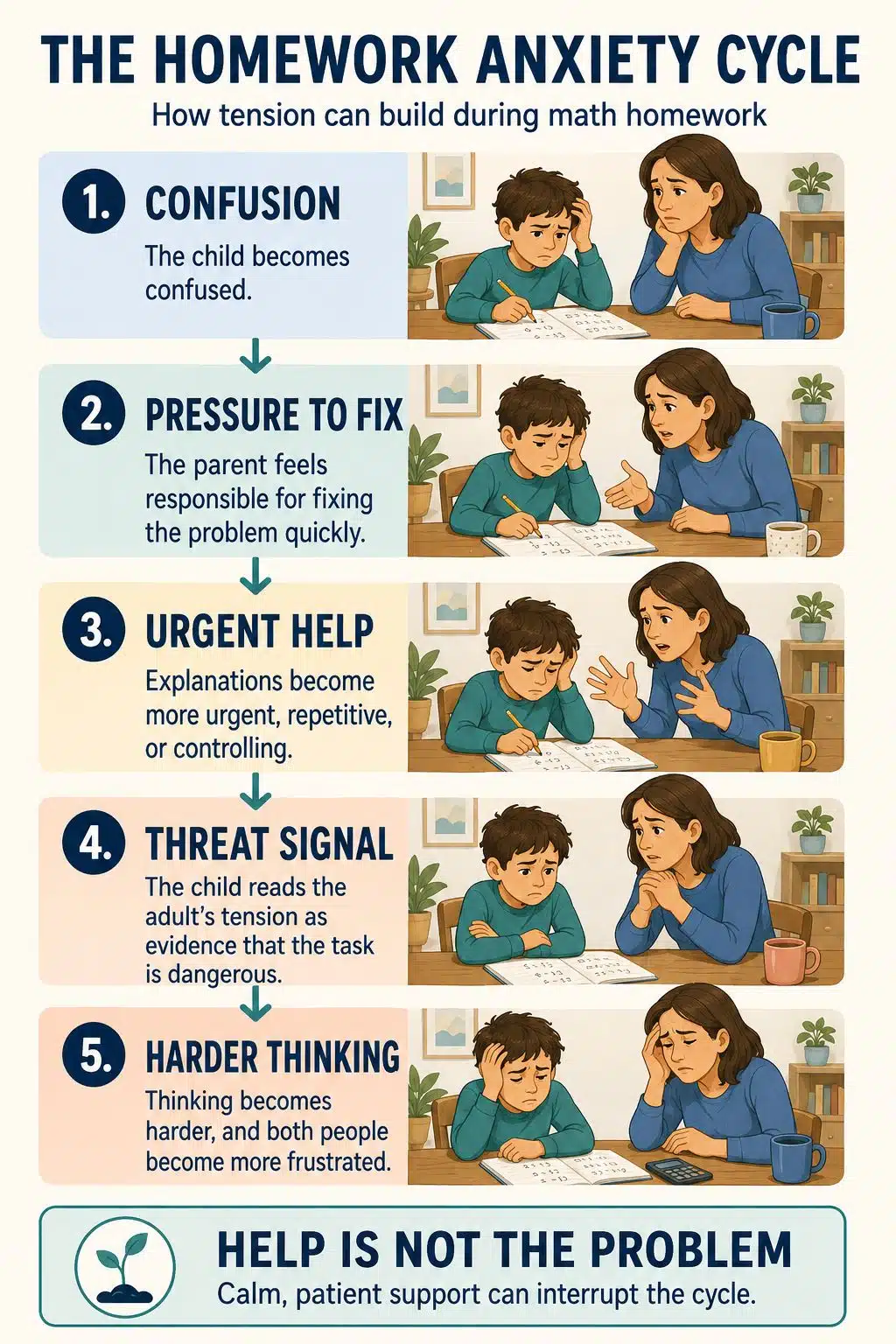
A familiar cycle can develop:
- The child becomes confused.
- The parent feels responsible for fixing the problem quickly.
- Explanations become more urgent, repetitive, or controlling.
- The child reads the adult’s tension as evidence that the task is dangerous.
- Thinking becomes harder, and both people become more frustrated.
Is this anxiety, frustration, or a learning difficulty?
Not every complaint signals anxiety. Frustration is normal when a child meets a new idea. Look for patterns across time and settings rather than judging one difficult evening.
Ordinary frustration is usually tied to a particular topic. The child may need a break but can settle with support. Objects, drawings, or a smaller first step often help.
Possible math anxiety tends to appear before or during math in a recognizable pattern: blanking, tears, physical discomfort, rushing, repeated reassurance-seeking, or avoidance. Reduce the immediate pressure, note the triggers, and tell the teacher what you are seeing.
A learning gap or learning difference deserves consideration when basic number concepts remain difficult even when the child is calm and has had clear instruction. More pressure is not a useful diagnostic tool; ask for a closer review of the underlying skills.
If anxiety appears across subjects and ordinary situations, math may be only one part of a broader concern. That pattern is worth discussing with a school or health professional.
Math anxiety and dyscalculia are not the same. The US National Institute of Child Health and Human Development describes dyscalculia as a math learning disability that can affect arithmetic concepts and operations such as addition, multiplication, and measurement. A child can have either one or both. A timed test alone cannot identify the cause.
What parents can change at home
Repair the language first
Parents do not need to pretend that math has always been easy. Honest, non-defeatist language is more useful.
Instead of “I was never a math person,” try: “I found math hard and did not get the support I needed.”
Instead of “This is easy,” try: “This is new. Let’s find the part that makes sense first.”
Instead of “You’re so smart,” be specific: “You drew a diagram when the first method did not work. That helped you see the problem.”
If a child has heard years of negative math talk, acknowledge it: “I have joked that I am terrible at math. That was about my experience, not your ability. I am working on how I talk about it.”
During homework, slow the interaction down
Reasoning is difficult when a child is crying or bracing for criticism. Pause before explaining again. Let the child stand up, get water, breathe slowly, or name what feels hard. Validation should not confirm the fear: “I can see this is stressful” recognizes the feeling; “Yes, math is awful” strengthens the threat.
Once the child is ready to return, keep them in the role of thinker. Useful questions include:
- “What is the problem asking you to find?”
- “Which part do you already understand?”
- “What method did your teacher use?”
- “Where did the answer stop making sense?”
Ask one question, then wait. Rapid-fire prompting can feel like another test. If the child cannot start, narrow the task: cover the rest of the page, read one sentence together, or solve a simpler version with the same idea.
If the school method is unfamiliar, avoid turning the evening into a contest between “new math” and the way an adult learned it. Ask the child to explain the class method, consult the teacher’s example, or send a short question to the teacher. Teaching a second shortcut before the first idea is understood can increase confusion.
Build evidence of progress
Confidence grows from credible evidence: “I handled something I could not do before.” Begin at a secure level before moving to the difficult problem. Break longer tasks into smaller sets, and stop before fatigue turns every answer into a battle.
Avoid empty effort praise. A child who worked hard and still failed does not need to hear only “Try harder.” Notice a useful strategy, careful checking, a good question, or a specific piece of progress. If the teaching did not work, change the explanation or seek help.
Young children need experiences in which math is useful and low-pressure. Compare which bowl holds more fruit. Count the plates needed for dinner. Estimate how many steps reach the gate, then check. Discuss shapes while building with blocks.
Ask open questions such as “How could we find out?” and allow more than one approach. If a child senses that every snack and shopping trip has become a lesson, the pressure has merely changed location. Stop while the exchange is still light; not every estimate needs to become a correction exercise.
The Institute of Education Sciences recommends routines, play, math language, and open-ended questions. A meta-analysis found a small positive relationship between the home math environment and children’s achievement. Family activities can support learning, but they cannot compensate for unsuitable instruction or an unrecognized learning difficulty.
For most families, changing the interaction is a better first move than buying another learning app. In one US trial, first-grade families were randomly assigned to use either a math story app or a reading app. A later follow-up found that the usual negative relationship between parents’ math anxiety and children’s achievement was absent in the math-app group through third grade. That supports one structured intervention, not the idea that any app—or more screen time by itself—will ease anxiety.
Bring the teacher into the problem early
Ask the teacher what happens before the child becomes distressed. Is the trigger timed work, public correction, independent practice, word problems, or a missing foundational skill? Share what happens at home without labeling the child as lazy or incapable.
A practical conversation should cover:
- the exact skills the class is working on;
- whether the child understands the concept outside tests;
- how much speed is expected and why;
- which visual models or objects are used in class; and
- whether a formal assessment is appropriate.
Fluency involves choosing methods flexibly and using them accurately and efficiently. It is not simply speed. The National Council of Teachers of Mathematics warns that timed tests do not assess fluency and can have negative effects. If a school uses timed work, ask what it measures and whether the child can also demonstrate understanding without a countdown.
When home strategies are not enough
Seek additional support when distress is persistent, increasing, or interfering with school attendance, sleep, family life, or the child’s willingness to participate. The same applies when basic skills remain unexpectedly difficult despite clear instruction and appropriate practice.
Start with the teacher and, where available, a learning-support specialist or school psychologist. A pediatrician or qualified mental health professional can help when anxiety is intense, extends beyond math, or causes significant physical symptoms. The available roles and assessment routes differ across countries, so families may need to ask the school or local health service where to begin.
Good support addresses both sides of the problem. Calming strategies alone will not repair missing number knowledge. Extra drills alone may deepen fear if the child feels unsafe and unsuccessful. Instruction and emotional support should work together.
Final Thoughts
Parents can influence math anxiety in children, but influence is not destiny and it is not the same as fault. The most useful response is not to manufacture constant positivity. It is to make math emotionally safer: remove fixed labels, slow down tense homework interactions, let the child think, treat mistakes as information, and ask for skilled help when difficulty persists.
A child does not need a parent who loves every calculation. They need an adult who can face uncertainty without turning it into fear. That change is small enough to begin with the next problem.
Frequently Asked Questions about Math Anxiety in Children
How early can math anxiety begin?
Children can develop worried or avoidant reactions to numbers during the preschool and early primary years, although one difficult worksheet does not establish a lasting problem. Look for a repeated pattern of distress, rushing, physical complaints, or avoidance rather than a single bad day.
Can a child be good at math and still have math anxiety?
Yes. Anxiety and ability are related, but they are not the same. A child may understand the material during calm practice and then blank during a timed test, public exercise, or pressured homework session. Performance in the anxious moment may underestimate what the child knows.
Should a math-anxious parent stop helping with homework?
Not automatically. The research does not show that parental help is inherently harmful. What matters is how the help feels. Use the teacher’s method, ask one question at a time, allow the child to do the thinking, and pause when either person becomes tense.
Do timed tests cause math anxiety in children?
Timed tests are not the only possible cause, but they can add pressure and make anxiety more visible. They also provide a limited picture of mathematical understanding. If speed-based work is causing distress, ask the teacher how else the child can demonstrate accuracy, reasoning, and flexible strategy use.