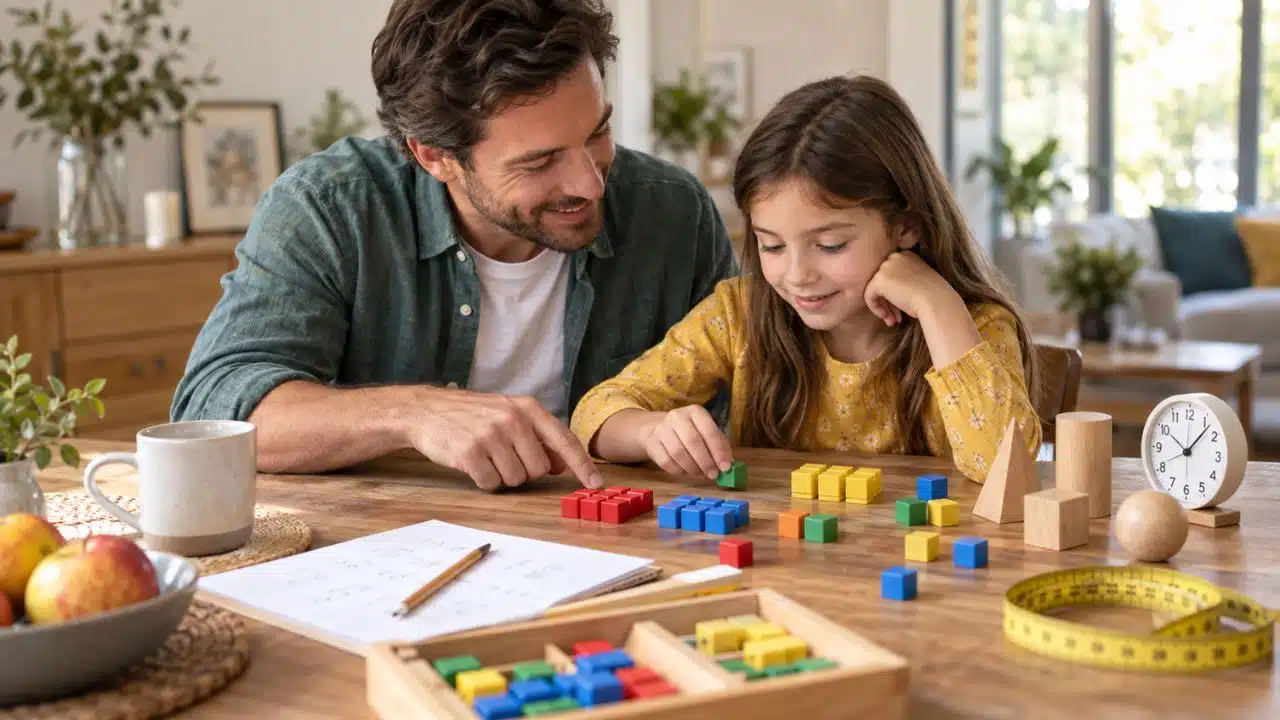
Parents trying to understand how to raise a kid who likes math often start by looking for more practice: another workbook, a tutoring program, or an educational app. Those options can address a particular skill, but none can make a child enjoy mathematics by itself.
A child’s attitude is shaped by what happens around the work. Are wrong answers treated as useful information or as failures? Does the child have time to think? Do numbers appear only during homework, or do they help solve real problems?
Not every child will choose mathematics as a favorite subject. That is not the standard parents need to chase. A more useful aim is to raise a child who sees math as understandable, relevant, and safe to attempt.
Liking Math Is Not the Same as Being Fast
Children who enjoy mathematical thinking do not always calculate quickly. Interest may appear when a child notices a pattern, tests another method, estimates before counting, or wants to know why a rule works.
Speed has a limited place in developing fluency. It should not become the family’s main measure of mathematical ability. Some children recall number facts immediately but cannot explain their reasoning. Others work more slowly while building a stronger understanding of how quantities relate.
Consider 8 + 7. Remembering that the answer is 15 is useful. Recognizing that 7 can be split into 2 and 5—turning 8 into 10—gives the child a reusable strategy.
Parents should pay attention to that kind of reasoning. It reveals more than the time taken to reach an answer.
What Mathematical Learning Looks Like at Different Ages
Children between 3 and 12 cannot be supported with one fixed routine. The activities should change as their thinking develops.
Ages 3–5: Make Numbers Mean Something
A preschooler may recite numbers without understanding quantity. Saying “one, two, three, four, five” does not necessarily mean the child knows that the final number represents the total number of objects counted.
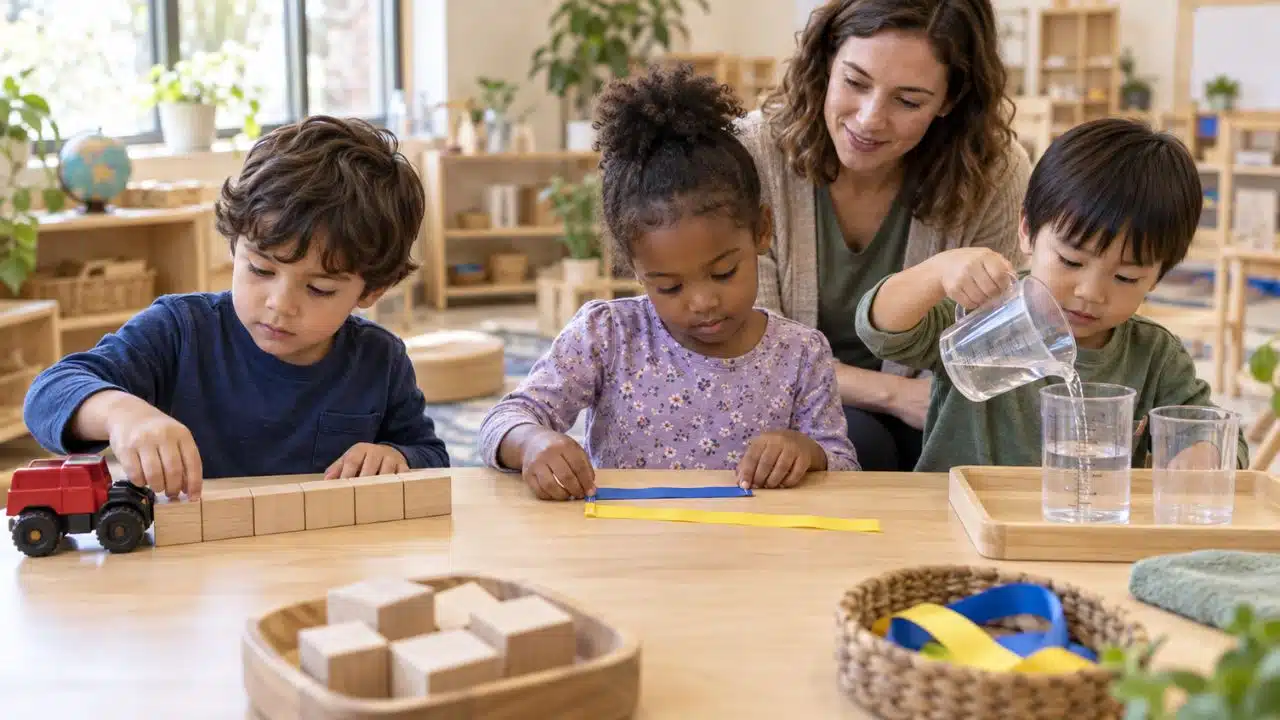
Use familiar objects to build that connection. Ask the child to give one pretend snack to each toy animal. Compare two piles of blocks. Build towers of different heights. Sort leaves by size or extend a simple color pattern.
Water play is useful for exploring capacity, although young children may assume a taller container always holds more. Rather than correcting them immediately, pour the water from one container into another and let them observe what changes.
At this age, short exchanges work better than formal lessons. Counting stairs once may be enjoyable. Counting everything the child touches soon becomes tiring. Everyday math should feel natural, not like a quiz disguised as play.
Ages 6–8: Connect Symbols With Quantities
Written equations become more prominent during the early primary years. Some children learn to follow a procedure without understanding what the symbols represent. Others can solve a problem with objects but struggle to write the corresponding equation.
Counters, coins, bottle caps, fingers, blocks, drawings, and number lines can help make an abstract relationship visible. They are legitimate mathematical representations, not signs that a child is behind.
Suppose the problem is 13 − 5. A child might remove five counters, count backward, use 5 + 8 = 13, or break 13 into 10 and 3. Ask for an explanation before showing a preferred method.
The explanation may reveal that the child understands subtraction but made a counting error. It may instead show that the operation itself is unclear. Those problems require different help.
Board and card games can reinforce counting, comparison, combinations, and planning. Games dominated by speed are less helpful for a cautious child. Choose one in which decisions matter, and adjust the rules when age or skill differences make the outcome predictable.
Ages 9–12: Find the Exact Point of Confusion
Fractions, decimals, multiplication, division, area, and multi-step problems can expose gaps that were less visible in earlier grades.
“Fractions make no sense” is too broad to guide anyone. The child may not understand the denominator, may struggle to compare unequal pieces, or may be using so much attention on multiplication that little remains for the new concept.
Return to a representation before adding another rule. Fold paper, draw fraction bars, use a number line, or compare measuring cups. Keep the model connected to the problem. Manipulatives are not helpful merely because they are present; the child must understand what each part represents.
Older children can also take responsibility for real calculations:
- Scale a recipe for a different number of people.
- Compare two discounts without assuming the larger percentage always produces the lower final price.
- Estimate travel time and account for stops.
- Work within a small event or shopping budget.
- Measure a room before moving furniture.
- Compare package sizes using the quantity and price shown.
Do not turn every outing into a test. A shopping trip becomes unpleasant when each price label produces another question.
Use Math Talk Instead of Constant Quizzing
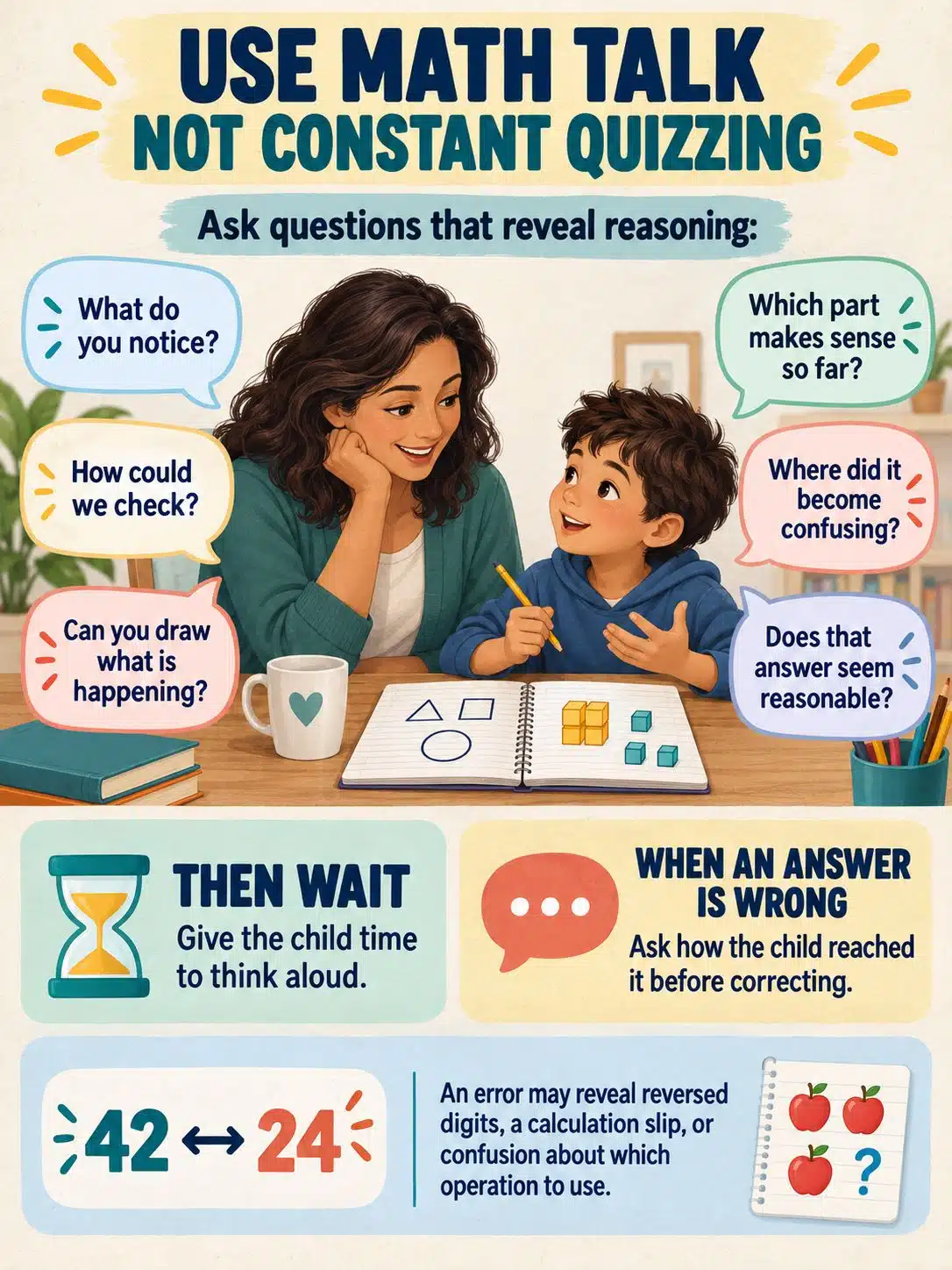
Questions such as “What is 7 × 8?” have a place, but they do not reveal much about a child’s reasoning. Open prompts are often more informative:
- “What do you notice?”
- “How could we check?”
- “Can you draw what is happening?”
- “Which part makes sense so far?”
- “Where did it become confusing?”
- “Does that answer seem reasonable?”
Then wait. Adults often answer their own questions because silence feels uncomfortable. The child soon learns that waiting is easier than thinking aloud.
When an answer is wrong, ask how the child reached it. This does not mean treating every answer as acceptable. It helps locate the error.
A child who writes 42 instead of 24 may have reversed the digits. A child who adds all the numbers in a word problem may not understand which operation the situation requires. Immediate correction can hide that distinction.
Everyday Math Works Best When the Task Is Real
Families do not need expensive materials to build mathematical habits. Ordinary household activities are often better because the numbers have a purpose.
Cooking combines counting, fractions, measurement, sequencing, temperature, and time. Let a younger child count spoonfuls. An older child can halve a recipe or decide when two dishes should start so they finish together. Some mess is unavoidable. If the adult takes control of every measurement, the child becomes a spectator.
Shopping can teach comparison and estimation, but give the child one genuine responsibility rather than a stream of mental calculations. A child might select three items within a budget or estimate the total before checkout. Unit prices can help with package comparisons, although stores display them differently and taxes may or may not appear in shelf prices depending on the country.
Building activities bring in length, shape, area, symmetry, angle, and balance. When a cardboard structure collapses, resist rebuilding it. Ask which part seems unstable and what might strengthen it. The failed model has created a mathematical problem worth solving.
The Language Adults Use Matters
Children notice how adults describe their ability. Statements such as “I was always terrible at math” or “Nobody in our family is good with numbers” make mathematical competence sound inherited and fixed.
Parents do not need to pretend they find every problem easy. More constructive responses include:
- “I learned a different method. Show me the one you use at school.”
- “The first step looks clear. Let’s find where it changed.”
- “That method did not work here. What else could we try?”
- “We may need to look at an example before continuing.”
Positive labels also deserve caution. Calling a child a “math genius” can create pressure to remain effortlessly successful. When harder work arrives, the child may avoid risks to protect that identity.
Praise something observable instead: choosing a useful diagram, checking an answer, explaining a pattern, or changing an ineffective strategy. Effort matters, but repeatedly applying the wrong method is not productive persistence. Children also need feedback.
How Math Anxiety Can Enter Homework Time
Math anxiety may involve worry, tension, avoidance, physical discomfort, or feeling mentally blocked around numbers. Its relationship with achievement is not one-directional. Weak skills may contribute to anxiety; anxiety and avoidance may also make learning harder.
A 2015 study followed children in first and second grade and examined their parents’ math anxiety and homework involvement. Children with highly math-anxious parents showed less growth in mathematics and reported more anxiety by the end of the school year—but only when those parents said they frequently helped with math homework.
The study identified an association, not a simple cause. It does not suggest that anxious parents should withdraw. It does suggest that the emotional tone of help matters.
A parent who feels uneasy about math can still be useful:
- Read the question before reacting.
- Ask the child to explain the method taught in class.
- Check the teacher’s example rather than insisting on a remembered method.
- Admit calmly when the approach is unfamiliar.
- Pause when either person becomes upset.
- Ask the teacher for clarification when the instructions remain confusing.
Saying “This method is new to me” models learning. Saying “This makes no sense” can confirm the child’s fear that the work is impossible.
Help With Homework Without Taking It Over
A completed page is not evidence that a child understands the lesson. The parent’s role is to help the child begin, identify where the difficulty lies, and provide enough support for the child to continue.
First check the obvious sources of friction. A hungry, tired, distracted child may appear unable to do work they could manage under better conditions. Long or unclear assignments can create the same impression.
Ask the child to explain:
- What the question requires
- Which information is useful
- What has already been tried
- Where the work stopped making sense
Offer the smallest effective hint. Suggest a number line, drawing, worked example, or smaller version of the same problem. Solving the entire question teaches the child to wait for rescue.
Leave meaningful errors visible. Teachers need to know what the child can do independently. If homework routinely takes much longer than expected or requires extensive adult teaching, tell the teacher. Finishing it quietly at home only hides the problem.
Timed Practice Is a Tool, Not a Verdict
Children need practice retrieving number facts and using procedures efficiently. Evidence-based guidance from the What Works Clearinghouse includes timed activities as one possible way to build mathematical fluency.
That recommendation is narrower than “children should do more timed tests.” Timed practice should use material the child has already learned. It should be brief, purposeful, and followed by useful feedback. It should not introduce a new concept, rank siblings, punish mistakes, or define who is “good at math.”
For a child who freezes under time pressure, untimed practice may be the better starting point. The teacher can help determine whether the main issue is fact fluency, conceptual understanding, anxiety, or a combination.
More practice is not automatically better. Ten focused minutes can be more productive than an hour that ends in conflict.
When Home Strategies Are Not Enough
Occasional frustration is normal. Persistent difficulty deserves attention when it affects school progress, everyday tasks, confidence, or willingness to attend class.
Math anxiety, dyscalculia, attention difficulties, language-processing needs, and gaps in instruction can overlap, but they are not interchangeable. A parent should not diagnose the cause from an online checklist.
Begin with the teacher. Ask which skills are secure, where errors occur, how the child responds during instruction, and what support has already been attempted. Share examples of difficult homework sessions, including how long the work takes and how much assistance is required.
Depending on the child and local education system, further support may involve targeted school instruction or evaluation by a qualified learning specialist or educational psychologist. Games and practical activities remain useful, but they cannot replace structured intervention when a child has a persistent learning need.
Habits Worth Dropping
Some common approaches create more tension than progress:
Comparing siblings or classmates: Another child’s speed does not explain what this child needs.
Correcting every unfinished thought: Constant interruption discourages children from revealing their reasoning.
Teaching shortcuts before meaning: A rule may generate correct answers temporarily while leaving the concept fragile.
Using math as punishment: Extra problems for misbehavior build an association families should be trying to prevent.
Adding work when a child is exhausted: Sometimes food, movement, sleep, or a break is the necessary first response.
A Sensible Place to Begin
Parents wondering how to raise a kid who likes math do not need to redesign family life. Start with one change.
During the next week, let the child handle one real calculation, play one game involving numbers or strategy, and discuss one incorrect answer without rushing to correct it. If homework has become tense, change the way help begins: ask the child to show what they understand before explaining anything.
Watch for reasoning, not just speed. Keep practice focused. Contact the teacher when a problem persists instead of answering it with ever more worksheets.
A child does not need to love every math lesson. Learning that confusion can be examined, mistakes can be repaired, and difficult problems can eventually make sense is a strong foundation in its own right.
FAQs about How to Raise a Kid Who Likes Math
Should children memorize addition and multiplication facts?
Yes, fluent recall is useful because it leaves more attention available for complex work. Understanding should come first, followed by brief retrieval practice. Memorization is most useful when children can also explain the relationships behind the facts.
Are fingers, counters, and drawings bad habits?
No. They are valid mathematical representations. Children should develop more efficient strategies over time, but removing a useful support before the concept is understood can cause unnecessary confusion.
Can a child perform well and still have math anxiety?
Yes. A capable child may fear timed work, public mistakes, disappointing adults, or losing a reputation for being naturally gifted. Strong marks do not rule out anxiety, particularly when completing the work causes visible distress or persistent avoidance.