My first understanding of football did not come from studying formations, following league tables or comparing famous players. It came from watching matches with my father. He was the one who told me about Lionel Messi.
My father liked Messi because of his playing style, but he also described him as a sincere player. I was too young and knew too little about football to understand exactly what he meant. I only knew that there was an extraordinary player from Argentina named Messi and that my father believed he was worth watching. That was enough for me.
I became a Messi fan before I could properly explain why. There was no comparison of statistics and no debate over who was the greatest. My connection to Messi began with curiosity, admiration and the trust a child naturally places in a parent’s judgment.
As I watched more football, Argentina became my team and Messi became the player through whom I learned the game. The more I understood, the more my admiration grew. What began as simple fandom gradually developed into an appreciation of his movement, decision-making, patience and ability to see possibilities that other players appeared to miss.
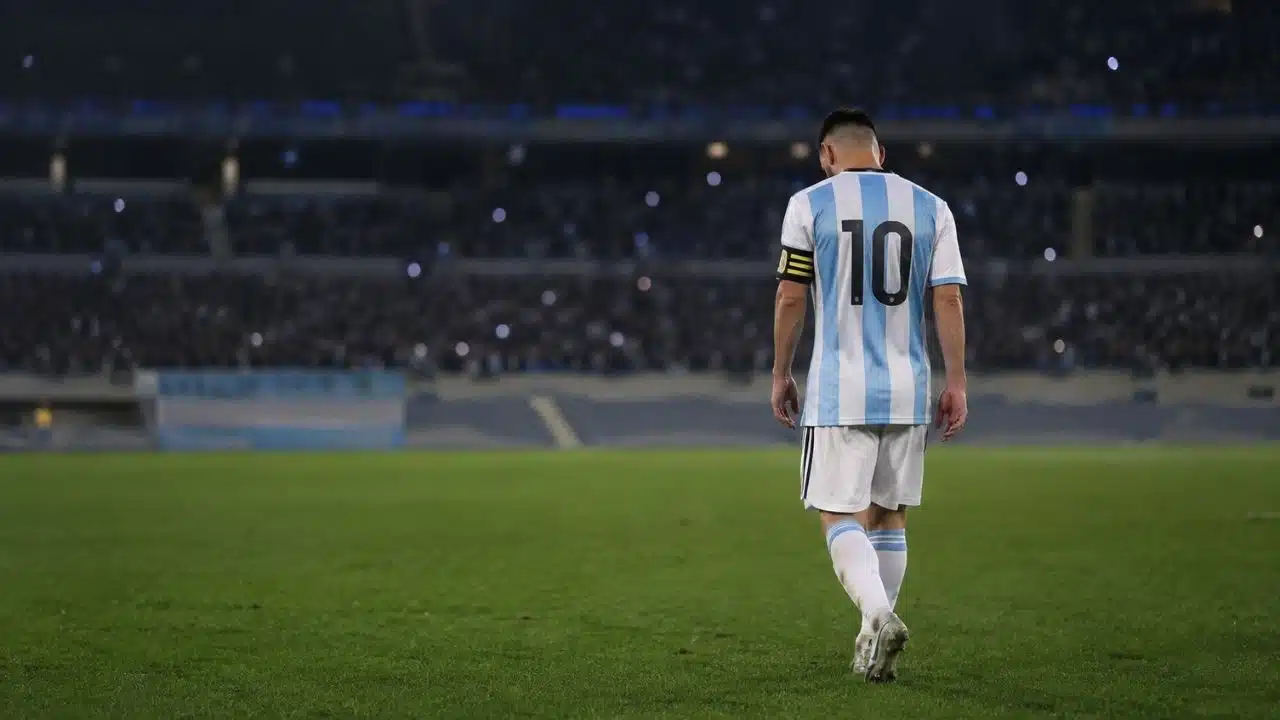
I am 26 now, and I have never really known international football without Messi playing for Argentina. That is why Lionel Messi farewell feels so personal. He is not simply a great player reaching the end of his international career. He is part of how football entered my life in the first place.
I Became a Fan Before I Understood Why He Was Different
When I first watched Messi, the obvious qualities were enough. His dribbling looked impossible. The ball remained close to his feet even when he was moving at speed, surrounded by defenders or changing direction in a space that seemed too narrow.
Later, I started noticing the less obvious parts of his game. Messi did not only beat defenders after receiving the ball. He unsettled them before the ball reached him. He knew when to move towards midfield, when to drift into the space between the lines and when to remain still until a defender lost concentration.
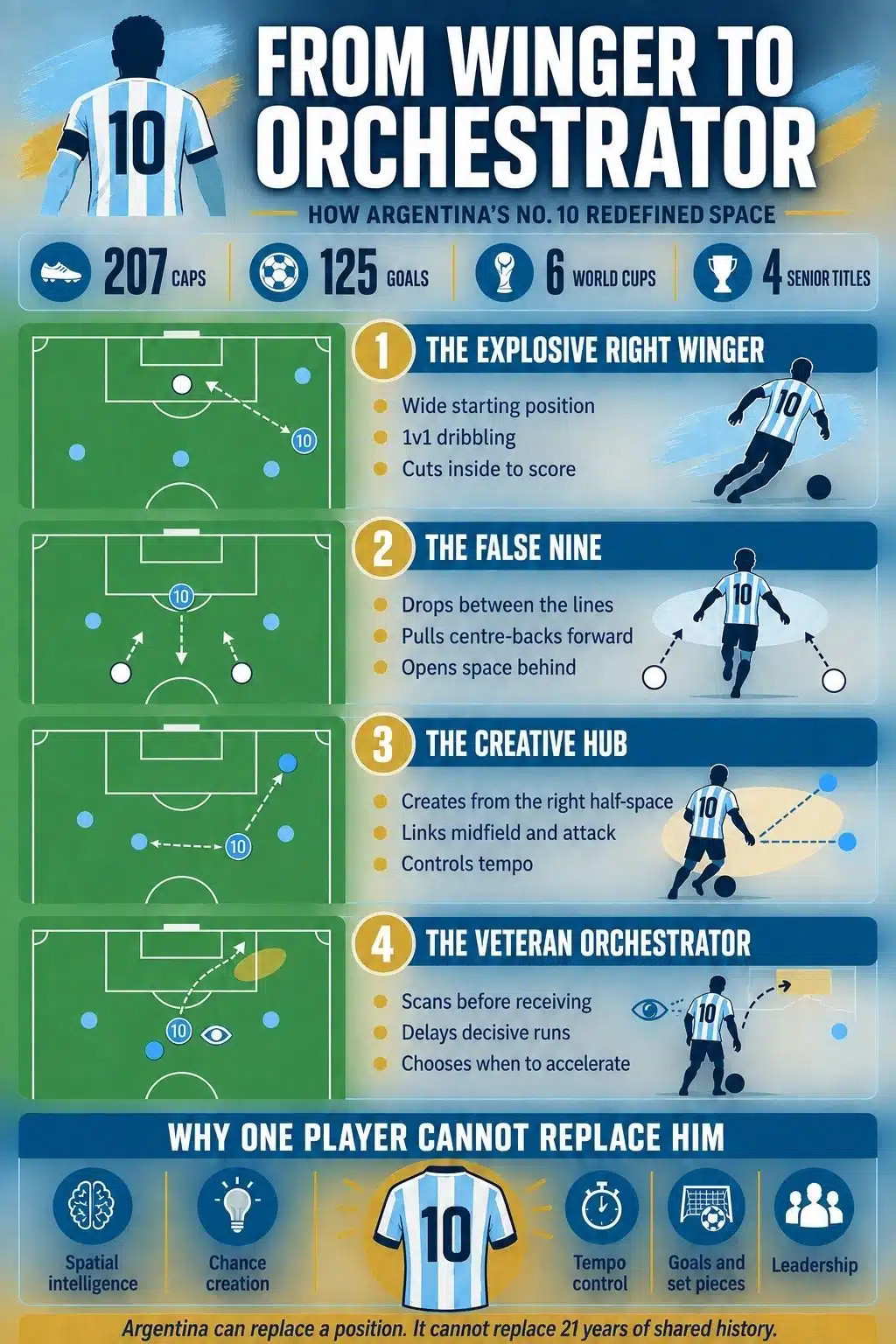
During his Barcelona years, he evolved from an explosive right-sided attacker into the most famous modern example of the false nine. He did not invent the position, but he demonstrated how damaging it could be when occupied by someone capable of creating and finishing at the same level.
A centre-back following him into midfield left space behind. A centre-back staying in position allowed Messi to receive and turn. Neither decision offered much protection.
As he grew older, his game changed again. He became more selective and increasingly operated as a playmaker. He did not run simply to appear active. He watched the shape of the defence, waited for it to shift and then acted.
Some people saw him walking and assumed he was disconnected from the match. I saw a player reading it.
His greatest strength was never only speed. It was timing. He seemed to know when a match required patience and when one sudden movement could destroy everything the opposition had organised.
The first version of Messi made me love football. The later versions helped me understand it.
I Came to Understand What My Father Meant by Sincere
My father’s description of Messi as a sincere player stayed with me. As a child, I probably understood sincerity in its simplest sense. Over time, I formed my own understanding of what that word meant in Messi’s case.
He never needed to behave as though he were bigger than football. His ability already commanded attention. He could decide a match without spending the rest of it performing his importance for the cameras.
That does not mean I consider any athlete flawless. It means Messi’s relationship with the game often felt direct. He played, created and accepted the responsibility that came with being the player everyone expected to produce something extraordinary.
His leadership also developed without turning him into someone he was not. Football often expects a captain to shout constantly and make authority visible. Messi led in a quieter way. His persistence, preparation and willingness to return after disappointment gave his teammates something more substantial than a dramatic speech.
The longer I watched him, the more I understood why my father had chosen that particular word. Messi’s football felt sincere because it did not need decoration. The game itself was enough.
Argentina Made My Admiration Deeper
Messi’s success at Barcelona arrived so regularly that greatness could almost appear effortless. His journey with Argentina revealed how difficult football could be even for a player of his ability.
He reached the 2014 World Cup final but lost to Germany. Argentina then suffered Copa América final defeats in 2015 and 2016. After the second loss, Messi briefly retired from international football.
Those defeats produced an unreasonable level of criticism. Messi was constantly compared with Diego Maradona, and every tournament without a trophy became another excuse to question his leadership, identity or commitment to Argentina.
Some critics appeared to believe that losing proved he did not care enough. It was a strange accusation to make against someone who kept returning to carry the same burden.
When Messi reversed his retirement, he had no guarantee that the story would improve. Returning meant accepting the possibility of more failure and more public judgment. He returned anyway.
Argentina finally won the Copa América in 2021, defeating Brazil at the Maracanã. The Finalissima followed in 2022, and then Messi lifted the World Cup in Qatar. Argentina retained the Copa América in 2024 before reaching another World Cup final in 2026.
Those trophies did not suddenly make Messi more committed to Argentina. They forced many of his critics to recognise the commitment that had been there all along.
That distinction matters to me. If we admire Messi only because he eventually won, we miss the most human part of his international career. He lost, suffered, stepped away, returned and continued until the story changed.
Talent made him extraordinary. Persistence made his journey with Argentina meaningful.
Lionel Messi Farewell: His Final Match Did Not Need to Be Perfect
Messi’s final match for Argentina ended in defeat. Spain beat Argentina 1–0 after extra time in the 2026 World Cup final.
It was not the farewell supporters wanted. There was no second consecutive World Cup, no decisive Messi goal and no final celebration with the trophy. I would have loved to see that ending. But he did not need it.
Football is not responsible for giving every legend a perfect final scene. Real careers do not follow scripts, and one defeat cannot rewrite everything that came before it.
Messi leaves Argentina with 207 senior appearances and 125 goals, both national records. He represented his country across six World Cups and won two Copa América titles, the Finalissima and the World Cup.
Another trophy would have made the farewell happier. It would not have made his career more complete.
By the time Messi lifted the World Cup in 2022, the great unfinished argument surrounding his international career had already been settled. Everything that followed was an extension of a journey that had reached its emotional destination.
His final medal may have been silver, but his legacy was decided long before that match ended.
Argentina Can Replace His Position, Not His Presence
Football will immediately begin searching for the next Messi. A young Argentine will dribble past several defenders or score an outstanding goal, and the comparison will appear before he has been given the chance to build an identity of his own. That is not fair.
Argentina can select another attacker. Someone else can wear No. 10, take free kicks and receive the ball between the lines. Lionel Scaloni and future coaches can create a different tactical system with new leaders and responsibilities. What no player can replace is 21 years of shared history.
No young footballer should be expected to reproduce Messi’s goals, influence, leadership and connection with supporters. Those qualities were built over hundreds of matches and through victories, injuries, criticism, lost finals and eventual triumph.
Calling someone the next Messi may sound like praise. In practice, it can become a burden no player deserves.
Argentina must learn what the team looks like without him. That does not mean the country will stop producing talent or competing for trophies. It means the next era must be allowed to become something different.
The gap Messi leaves should be acknowledged, not hurriedly assigned to someone else.
Respecting His Decision Is Part of Being His Fan
Messi has retired from international football, not from football entirely. He continues to play for Inter Miami, so there will still be opportunities to watch him. But seeing Messi at club level will not replace seeing him in Argentina’s shirt.
There will be no more World Cup campaigns centred on him. No more major international tournaments in which an entire country waits for the ball to reach its captain. No more familiar image of Argentina’s No. 10 studying the pitch before creating something nobody else had noticed.
A part of me naturally wants one more match. Supporters are rarely ready when the players they love decide they have given enough. But Messi has given enough.
He represented Argentina for 21 years. He continued through lost finals, injuries, fierce criticism and the pressure of carrying expectations that no individual should have been asked to carry alone. At 39, after leading Argentina to another World Cup final, he decided it was time to leave.
I respect that decision. Being a fan does not give me the right to demand another tournament from him. Wanting more is natural. Believing he owes us more would be selfish.
Messi deserves to leave on his own terms.
Saying Goodbye Means Returning to Where It Started
At 26, I am about to experience something unfamiliar: an Argentina team without Lionel Messi.
New players will arrive. Argentina will develop another identity, and another generation of supporters will discover football through names that mean little to us today. But Messi will always be the player who introduced me to the game.
Before I understood tactics, records or international pressure, I knew his name. Before I could explain why his movement was unusual, I knew I wanted to watch him. Over time, knowledge did not weaken that early admiration. It gave me more reasons for it.
His farewell is difficult because it is connected to more than football. It takes me back to sitting with my father, listening as he explained why he liked this remarkable player from Argentina.
Watching Messi became part of growing up. His career continued while I learned the sport and gradually formed my own opinions about it. Different versions of Messi appeared over the years, but he remained a constant presence in Argentina’s shirt.
Now that presence is ending. Football will continue, and Argentina will continue. Yet some absences are not problems to solve. They are reminders of how fortunate we were to witness what came before them.
My father called Messi a sincere player when I was too young to fully understand what he meant. After all these years, I think I finally do.