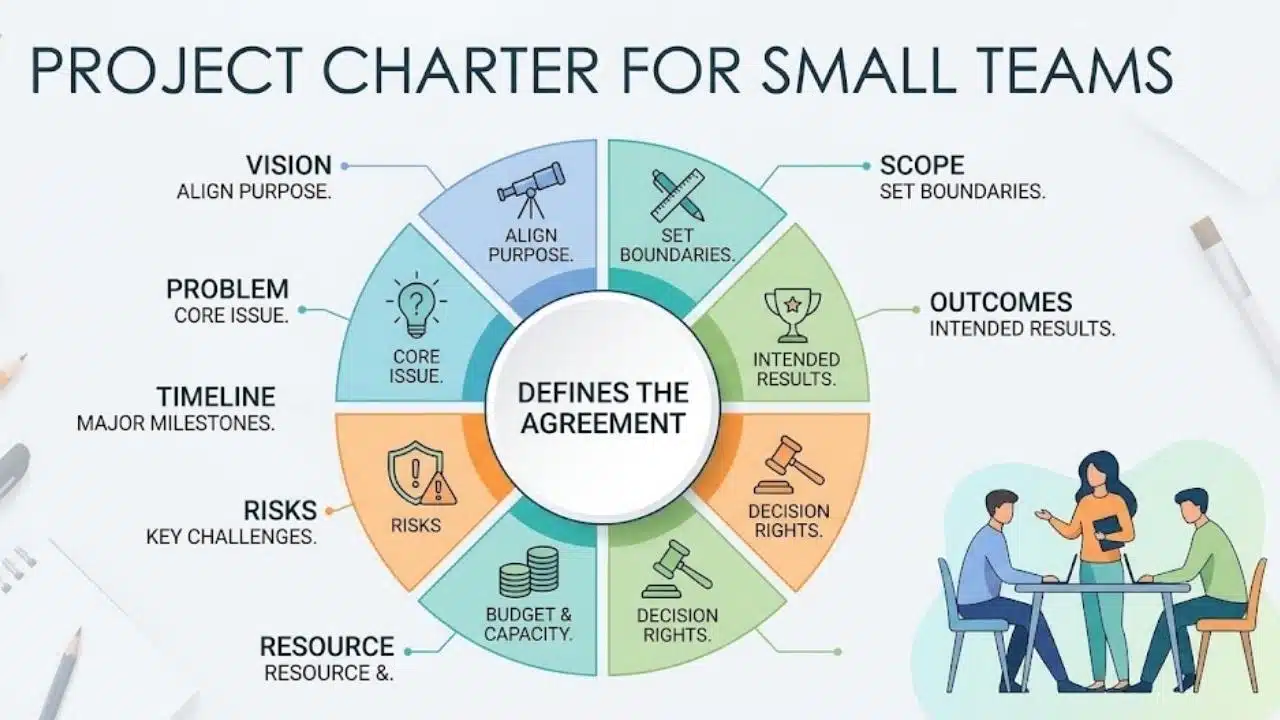
A project charter for small teams is a concise, formal agreement that defines a project’s purpose, scope, key deliverables, and decision-makers before work begins. It prevents scope creep and wasted resources by converting casual requests into clear operational alignment.
Work often starts before anyone agrees on what the project actually is—like a simple site redesign quickly ballooning into new messaging, CRM integrations, and full campaign launches. A one-page charter fixes this by clearly outlining why the initiative exists, who leads decisions, and which requests fall strictly outside the assignment.
What a Project Charter Actually Does
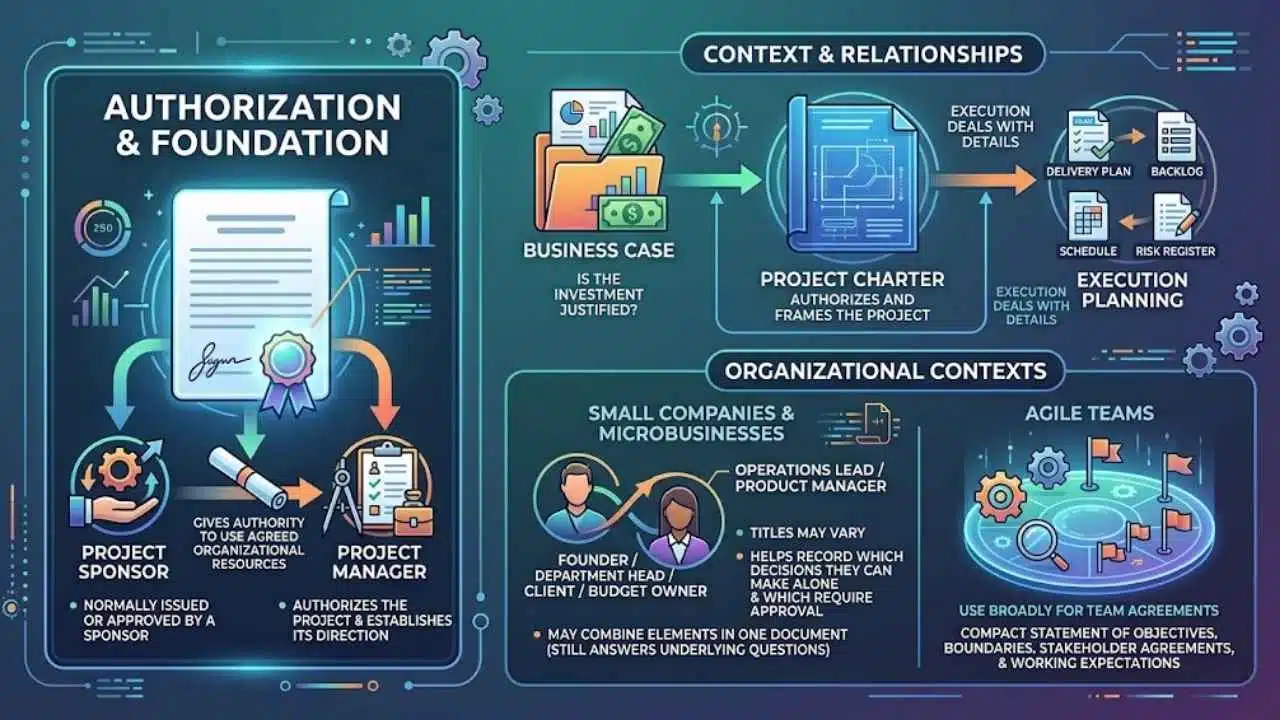
A project charter is a high-level document that authorizes a project and establishes its direction. In formal project management, it is normally issued or approved by a sponsor and gives the project manager authority to use agreed organizational resources.
Small companies may not use either title. The sponsor might be a founder, department head, client, or budget owner. The project manager may be an operations lead or product manager handling delivery alongside other work. Even when one person occupies several roles, it helps to record which decisions they can make alone and which require another approval.
Organizations also use the word “charter” differently. Some mean a formal authorization document. Agile teams may use it more broadly for a compact statement of objectives, boundaries, stakeholder agreements, and working expectations.
A business case asks whether the investment is justified. A charter authorizes and frames the project. The delivery plan, backlog, schedule, and risk register then deal with execution. A microbusiness may combine some of these elements in one document, but it still needs to answer the underlying questions.
Why Small Teams Keep Skipping It
The usual reason is speed. Opening a task board feels productive; discussing authority and scope feels like a delay. Small teams also place a great deal of trust in shared context. When five people work closely together, they assume everyone understands the founder’s priorities and the customer problem. That confidence can disappear as soon as each person describes the expected result in their own words.
The familiar reasons for skipping a charter do not hold up well:
- “We already discussed it.” A verbal agreement is difficult to check after memories diverge.
- “The project is too small.” A short project can still consume scarce engineering, marketing, or operational capacity.
- “We are agile.” Adaptable delivery still needs a purpose and decision structure.
- “We will define it as we go.” Details can emerge later, but the team needs boundaries for deciding which details belong.
- “The founder knows what they want.” That knowledge helps only when the delivery team can act on it.
Writing the charter often exposes disagreement earlier. That can make the first meeting less comfortable, but it is cheaper than discovering halfway through that “finished” means something different to the sponsor and the team.
The Strategic Value of a Project Charter for Small Teams
A useful charter forces a few decisions while changes are still inexpensive. “Redesign the website” names an activity. “Help qualified prospects understand the service and request a consultation” describes the intended result. That difference gives designers, writers, and developers a basis for judging which requests support the project.
The charter also makes decision rights visible. A project lead might be free to rearrange tasks and choose an implementation method but unable to increase spending, delay the launch, or add another department without approval.
At a minimum, the document should settle:
- Why the project deserves time and resources
- What should be different when it ends
- How the team will judge the result
- What is included and explicitly excluded
- Who leads, approves, and resolves disagreements
- Which time, budget, staffing, or technical limits apply
- What could undermine the work before it gains momentum
This is the strategic value of a project charter for small teams: it gives everyday delivery decisions a stable reference point without prescribing every task in advance.
What to Put in a Lean Project Charter
The one-page rule is useful, but it is not sacred. A straightforward internal project may need only a page. Work involving regulation, security, several vendors, or material financial risk will need supporting documentation.
Most small teams should resist the urge to download a large corporate template. Empty sections encourage filler and can make the charter look more complete than the underlying decisions really are.
The problem or opportunity
Describe what prompted the work before naming a preferred solution. “Customers cannot finish account setup without manual help” leaves room to investigate the cause. “Build an onboarding wizard” assumes that a wizard is the answer. If the team cannot agree on the problem, it is not ready to plan the solution.
The intended outcome
Explain what should improve and what evidence would show progress. Depending on the project, that might mean completion rate, processing time, error frequency, support demand, adoption, revenue, or another measure connected to the original problem.
Do not insert an impressive-looking percentage without a dependable baseline. When baseline data is missing, identify the measure and make establishing the baseline part of the early work.
What is in and out of scope
Exclusions are where a charter earns much of its value. A customer-onboarding project might include CRM fields, internal ownership, notifications, and a handoff checklist. Pricing, sales qualification, contract terms, and replacement of the CRM could remain outside it.
This does not make the scope untouchable. It ensures that additions are treated as decisions, with their effect on time, cost, and capacity considered before the team accepts them.
Name the sponsor or budget owner, project lead, and essential contributors. Then state who can approve spending, accept the final result, change the deadline, and resolve a dispute.
A list of responsibilities is not enough. Teams often know who must do the work but remain unclear about who can settle a trade-off.
Constraints, dependencies, and early risks
Record the conditions most likely to shape delivery: a fixed launch window, limited access to a specialist, dependence on a vendor, a security review, or a budget ceiling.
Keep this section selective. The charter should expose the conditions that could redirect or stop the project. Day-to-day risks belong in a working risk log.
A Practical Example
Consider a small software company trying to improve the handoff between sales and customer onboarding. Its charter might contain:
- Problem: New customers reach onboarding with missing account information, causing repeated follow-up.
- Outcome: Customer success receives the information required to begin onboarding.
- Measures: Handoff completeness, time from contract signing to kickoff, and cases returned for missing information.
- In scope: Required CRM fields, ownership, notifications, and the handoff checklist.
- Out of scope: Pricing, qualification, contract terms, and CRM replacement.
- Project lead: Operations manager.
- Sponsor: Founder responsible for revenue operations.
- Constraint: Changes must work within the existing CRM.
- Early risk: Extra fields may face resistance if they make the sales process unnecessarily slow.
The risk matters because a technically tidy workflow can still fail if the people entering the information avoid it. The charter does not solve that problem, but it makes the concern visible early enough to test the proposed process with sales.
How to Create One Without Slowing the Team Down
Draft the charter with people who understand the problem and those expected to deliver the work. For a modest internal project, reserve 30 to 60 minutes for the first discussion. Unresolved commercial, technical, or compliance questions can be assigned separately rather than guessed at in the room.
Start with the problem, intended outcome, and exclusions. Those areas usually reveal the most consequential disagreements. Then settle authority, constraints, and the first meaningful milestone.
Replace phrases such as “improve efficiency” or “enhance customer experience” with a description of what will become faster, easier, safer, cheaper, or more reliable.
Before delivery begins:
- Have the sponsor or budget owner approve the charter.
- Store one current version where the team already works.
- Review it during the kickoff instead of attaching it unread.
- Refer to it when new requests or competing priorities appear.
- Revisit it if the purpose, scope, budget, authority, or success criteria materially change.
Use a single current link in Google Docs, Notion, Confluence, SharePoint, or the team’s existing workspace. Emailing downloaded copies creates a small but avoidable problem: nobody knows which version reflects the latest decision.
Agile Delivery Does Not Make a Charter Obsolete
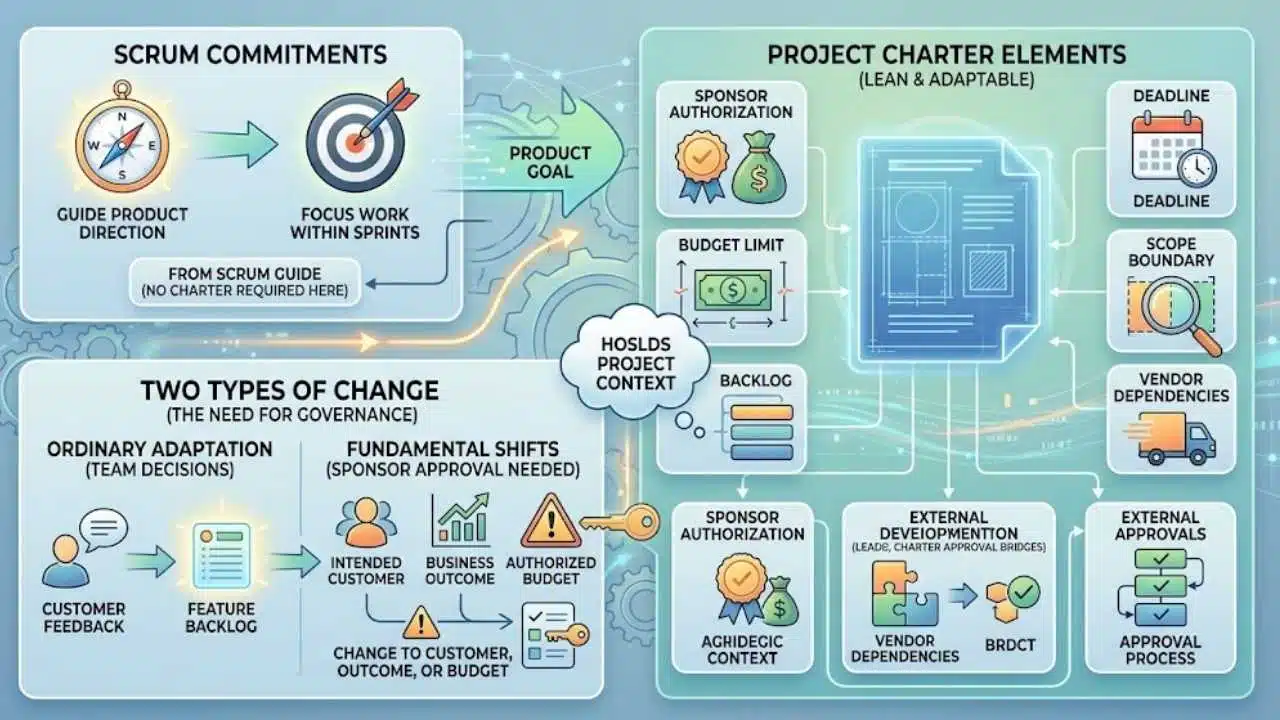
The Scrum Guide does not require a project charter. Scrum uses the Product Goal to set longer-term product direction and the Sprint Goal to create focus within a Sprint.
Those commitments do not automatically document every project-level decision. A temporary initiative may still need a sponsor, budget limit, deadline, scope boundary, vendor dependency, or external approval process. A lean charter can hold that context while the backlog changes as the team learns.
Changing a feature after customer feedback is ordinary adaptation. Changing the intended customer, business outcome, or authorized budget is a different decision and may need sponsor approval.
When a Charter Is Not Worth the Effort
A routine operational task, minor fix owned by one person, or short and reversible discovery exercise may be handled adequately through an existing ticket or team process.
A charter becomes worthwhile when work crosses functions, competes for scarce resources, affects customers, carries meaningful cost or risk, depends on outside approval, or is likely to attract additional requests. Small teams have little spare capacity, which makes vague projects more disruptive than they first appear.
Signs the Missing Charter Is Already Hurting
Pause and establish a charter when:
- People give different explanations of the project’s purpose.
- Work keeps expanding through informal requests.
- Nobody knows who can approve a trade-off.
- The deadline is clear, but the expected outcome is not.
- Tasks are moving while a central business decision remains unresolved.
- The team cannot explain what would count as a successful finish.
Writing it late is still better than allowing unresolved assumptions to direct the rest of the project.
Final Thoughts
A project charter for small teams should make the next difficult decision easier. If a new request appears, the team should be able to check whether it serves the agreed outcome, fits the scope, and has the right approval.
Start with a blank page rather than a complicated template. Write down the problem, outcome, boundaries, authority, constraints, and success measures. If the team cannot agree on those points, creating more tasks will only hide the disagreement.