
When generative tools flooded the market, every agency founder got sold the exact same dream. We were promised ten times the output with half the headcount. Software vendors promised insane operational efficiency, lower labor costs, and profit margins that would make SaaS founders jealous.
If you actually run a digital agency, you know how that story really played out.
Instead of swimming in profits, agency owners are watching their bottom lines get hammered. The issue comes down to a glaring disconnect between tool speed and commercial reality. Overall ai marketing profitability is collapsing because client expectations have completely warped, editing bottlenecks are consuming senior staff time, and software bills keep multiplying.
Warped Client Expectations and Retainer Battles
The moment business owners started experimenting with ChatGPT or Claude on their laptops, their perception of marketing value plummeted.
They generated a few rough blog outlines or social posts in seconds and arrived at a flawed conclusion. They decided that if an algorithm can spit out text instantaneously, agency work should cost a fraction of what it used to.
That perception has turned monthly retainer conversations into a knife fight, heavily impacting ai marketing profitability across accounts.
Clients look at a $10,000 monthly retainer and demand to know why they are paying premium rates for work they assume took twenty minutes and a clever prompt. They completely ignore the invisible strategy that actually drives commercial performance. They skip right past market research, customer positioning, funnel architecture, messaging hierarchy, and offer design. They only see the final block of text, assume a machine created it, and demand a massive discount.
I have sat in revenue reviews where long-term clients explicitly asked for line-item price cuts simply because our team uses AI tools in our workflow. Trying to explain to a stubborn client that software is just an execution medium, and that profitable campaigns still require high-level human positioning, has become a constant drain on agency leadership.
The Real Cost of Cleaning Up Machine Output
Drafting copy with AI takes two minutes. Turning that raw draft into something that actually converts buyers takes hours.
Generative software eliminates the initial blank page, but it dumps a massive operational headache right onto your editing queue. When junior team members rely heavily on raw AI drafts, the resulting copy looks convincing at a glance, but falls completely flat upon closer inspection. It is filled with subtle factual hallucinations, repetitive sentence structures, generic corporate jargon, and weak value propositions that destroy a client’s brand authority.
That is where your labor costs spike, quietly eroding your ai marketing profitability.
To protect client performance and agency standards, your highest-paid strategists have to step in and fix the draft. Instead of junior writers building clean content from scratch at a reasonable cost, you end up paying senior directors $150 to $200 an hour to rewrite flat copy, verify stats, and inject actual brand personality.
Every single minute you saved during initial generation gets swallowed up in review. You do not save money; you simply transfer labor from low-cost creation to high-cost editing. If a senior editor spends three hours fixing a five-minute draft, the profit margin on that account is gone.
Software Subscriptions Are Quietly Eating Your Margin
While clients push for aggressive discounts, the cost of running a competent agency tech stack keeps climbing, further complicating ai marketing profitability.
You cannot run a serious marketing agency on a basic $20 ChatGPT Plus account. To deliver real commercial results across SEO, paid acquisition, and content distribution, you have to stack multiple enterprise tools and pay heavy API usage fees every month.
Take a look at what a modern agency stack actually costs to maintain:
-
OpenAI and Anthropic API token costs for custom internal workflows, which easily run into thousands per month depending on account volume.
-
Specialized copywriting engines like Jasper or Copy.ai for structured campaign generation.
-
Visual asset platforms and design suites like Midjourney, Runway, and Adobe Firefly.
-
SEO and content intelligence platforms such as Ahrefs, SurferSEO, and Clearscope to guide keyword modeling.
-
Automation infrastructure tools like Make.com or Zapier Enterprise to glue all these pipelines together.
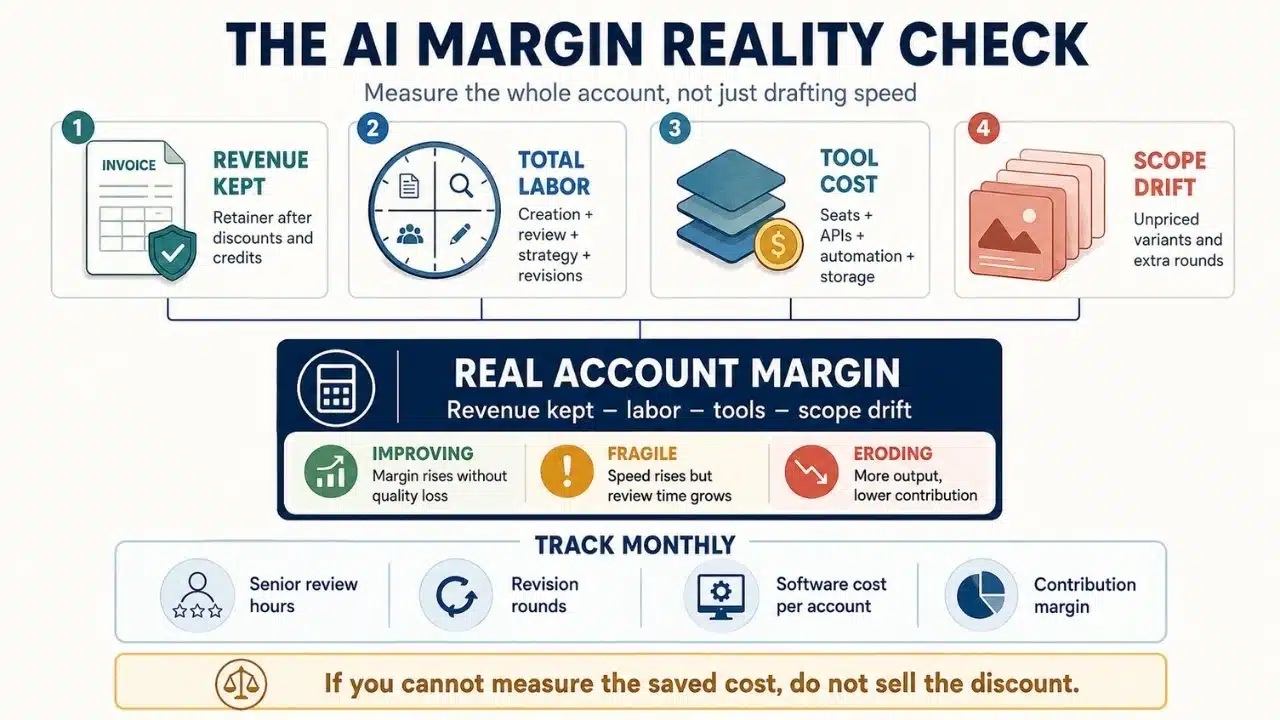
These software invoices hit your business accounts every single month without fail. What used to be a healthy operational margin is now getting chipped away by dozens of SaaS subscriptions required just to stay operational. When client retainers shrink at the same time your software overhead grows, your business gets caught in a vice.
Why Faster Output Leads to Infinite Client Revisions
Beyond shrinking retainers and ballooning software bills, AI introduces a dangerous trap into account management: the velocity paradox.
Because clients know you utilize advanced software, they expect instant turnarounds on everything. A campaign launch that used to take two weeks of deliberate positioning and asset creation is now expected in 48 hours.
This acceleration breaks your team’s operational health.
When clients assume asset creation is frictionless, scope creep explodes. They start requesting endless revisions, six additional ad variants, and constant messaging shifts without expecting to pay extra. They ask for ten email subject line options, multiple landing page variations, and endless social tweaks, treating your strategic team like a drive-thru window.
Instead of leveraging tool efficiency to reduce team hours or take on new clients, your agency ends up trapped on a treadmill of endless production. You produce three to five times the asset volume for the exact same retainer, burning out your talent and wrecking account profitability.
Decoupling Agency Revenue From Time and Deliverables
If your agency still charges by the hour or sells deliverables off a static price list, your business model is on borrowed time.
Clients will always resist paying high hourly rates or per-item fees for work they think a computer helped generate. The second your pricing is tied directly to production hours or deliverable volume, you hand over all your leverage to the client.
The only way to restore long-term ai marketing profitability is to decouple your pricing from time and production completely.
You need to shift immediately toward value-based or performance-driven contracts.
Stop pricing individual blog posts, email sequences, or ad sets. Instead, anchor your pricing directly to commercial metrics like qualified sales pipeline, conversion rate improvement, lower customer acquisition costs, or net new revenue generated.
If your strategic campaign generates $500,000 in gross sales for a client, a $50,000 fee is completely justified regardless of whether your team spent five hours or fifty hours executing it. When your income is tied to commercial business outcomes, your internal workflows are nobody’s business but your own. If custom AI automations allow you to deliver that $500,000 outcome faster, that efficiency gain stays right where it belongs: in your profit margin.
What Surviving Agencies Will Do Differently
Generative software is not going anywhere, but the fantasy that it provides automatic profit margins is officially dead.
Reclaiming your ai marketing profitability isn’t about moving faster or pumping out higher volumes of content. The agencies that thrive over the next few years will be the teams that double down on high-level strategic positioning, enforce strict editorial quality control, and refuse to let clients dictate pricing based on tool perception.
Stop letting clients treat your agency like a prompt engineering service. Shift your pricing to focus purely on revenue results, protect your team’s editing time, and build a business model that captures the true economic value of expert human direction.