Household chores offer rich, multi-sensory environments for hands-on learning. Learning how to turn laundry into a math lesson allows parents to introduce fundamental concepts like sorting, counting, pattern recognition, and volume measurement without extra prep time or educational worksheets.
By linking math to daily routines, children build real-world early math skills in a natural, low-pressure environment.
| Strategy / Activity | Primary Math Skill | Ideal Age Range | Quick Execution |
| 1. Sock Matching & Pairing | One-to-one correspondence & Sets | Ages 3–6 | Pair identical socks and count by 2s |
| 2. Sorting by Category | Data classification & Venn diagrams | Ages 3–7 | Group clothes by owner, size, or type |
| 3. Laundry Basket Target Toss | Counting fluency & Skip counting | Ages 4–7 | Toss folded items while counting |
| 4. Pattern Making with Towels | Patterning & Sequences | Ages 4–8 | Create visual sequences (AABB, ABC) |
| 5. Size Comparisons & Ordering | Measurement & Comparative order | Ages 4–8 | Line up shirts from smallest to largest |
| 6. Detergent Measuring Math | Volume measurement & Fractions | Ages 6–10 | Measure detergent cups using fractional lines |
| 7. Weight Estimation Challenge | Weight estimation & Comparison | Ages 6–10 | Estimate dry vs. wet load weights |
| 8. Folding Geometry & Angles | Spatial reasoning & Geometry | Ages 5–10 | Identify halves, quarters, and right angles |
| 9. Cycle Timers & Elapsed Time | Time calculation & Data tracking | Ages 7–11 | Track washing machine cycles and elapsed time |
9 Ways to Turn Laundry Into a Math Lesson
1. Sock Matching and Pairing Sets
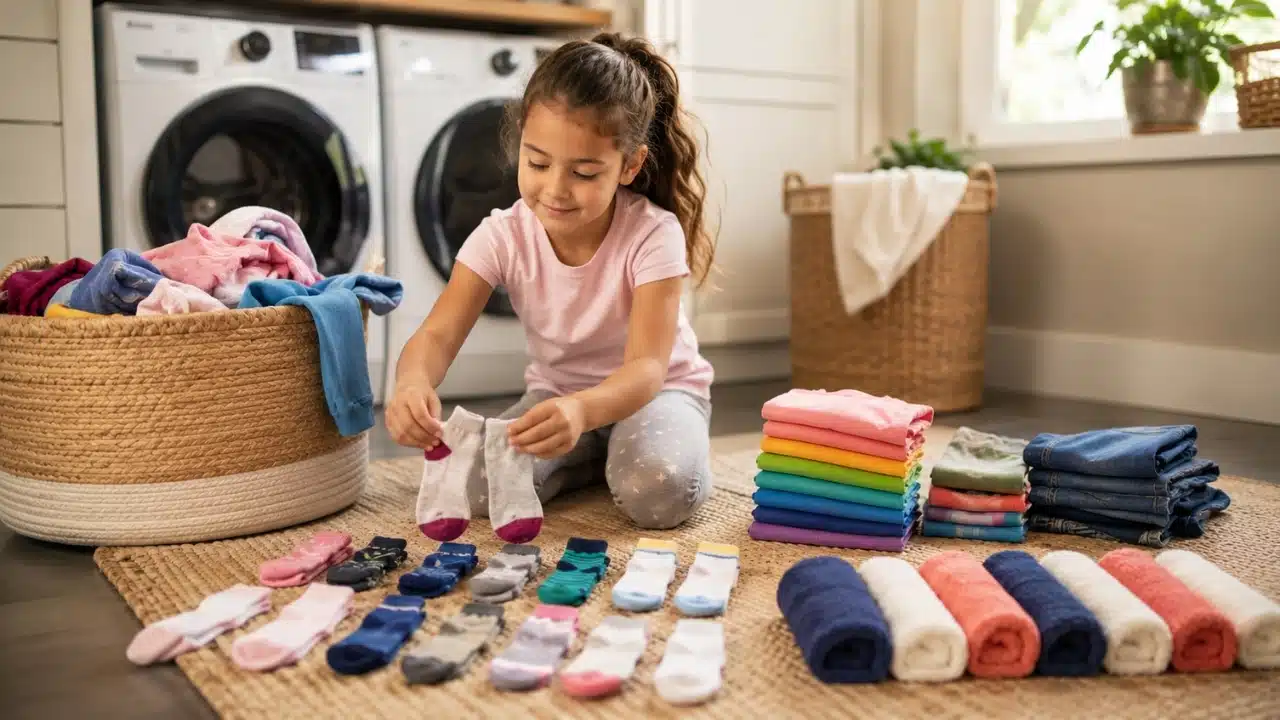
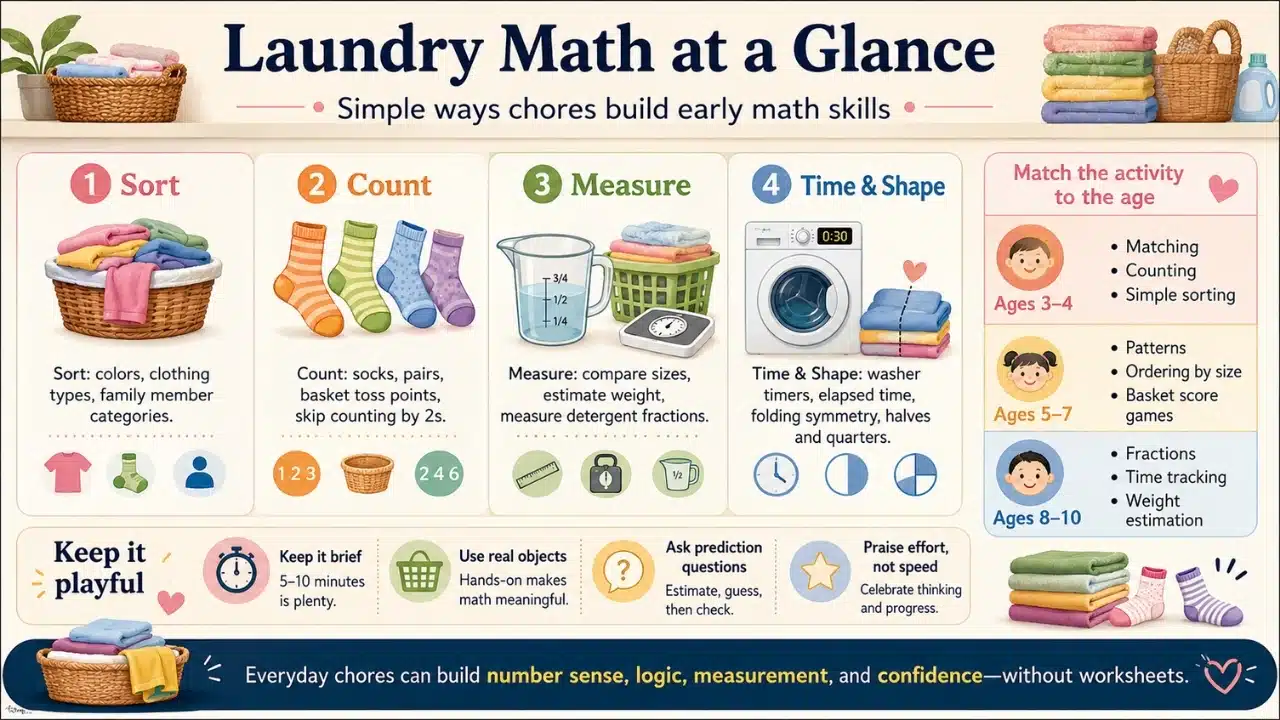
Pairing socks is a classic lesson in set theory and one-to-one correspondence. Children examine visual attributes like color, size, pattern, and texture to match identical items. Once paired, ask your child to count the total number of socks by $2$s ($2, 4, 6, 8$), reinforcing skip-counting concepts.
2. Categorical Sorting and Classification
Before folding, ask your child to sort the entire pile into specific categories. You can group items by family member, clothing type (e.g., shirts vs. pants), or color (darks vs. lights). This exercise lays the groundwork for data handling, categorical logic, and visual classification.
3. Basket Toss and Counting Fluency
Turn folding into an interactive counting game. Every time a child folds a towel or pairs a sock, they toss it into the laundry basket while counting aloud. For younger children, practice basic counting by $1$s; for older children, assign different point values to different items (e.g., towels = $5$ points, socks = $2$ points) to practice mental addition.
4. Creating Pattern Sequences
Lay out clean clothing items in visual repeating patterns across a bed or floor—such as Towel, Sock, Towel, Sock (AB pattern) or Shirt, Shirt, Pants, Shirt, Shirt, Pants (AABB pattern). Ask your child to identify the pattern core and predict which item comes next in the sequence.
5. Size Ordering and Measurement
Line up family members’ clothing items from smallest to largest (e.g., toddler socks to adult socks, or kids’ shirts to parents’ shirts). This non-standard measurement exercise introduces comparative vocabulary such as longer, shorter, widest, and narrowest, strengthening intuitive spatial measurement.
6. Detergent Measuring and Fractional Volume
Involve older children in the washing phase by having them measure liquid or powder detergent. Use the graduation markings on the measuring cap to discuss fractions—such as $\frac{1}{2}$ cap versus $\frac{3}{4}$ cap—and liquid volume units, connecting abstract numeric fractions to physical space.
7. Wet vs. Dry Weight Estimation
Have children lift a basket of dry laundry before loading the machine, then lift it again after the wash cycle completes. Ask them to estimate how much heavier the water made the load. Comparing dry and wet weights introduces concepts of mass, absorption, and numerical estimation.
8. Folding Geometry and Symmetry
Folding clothes is a practical exercise in applied geometry. Show children how folding a square washcloth in half creates two equal rectangles ($\frac{1}{2}$) or two triangles, and folding it again creates smaller squares ($\frac{1}{4}$). Point out lines of symmetry, parallel edges, and right angles as you smooth out folded towels.
9. Cycle Timers and Elapsed Time Tracking
Check the digital timer on the washer or dryer before starting a load. Have your child note the start time on an analog or digital clock, calculate the predicted finish time, and track the elapsed time in minutes. This builds practical time-telling and subtraction skills.
Connecting Daily Chores to Interactive Practice
While active tasks like sorting clothes build physical math intuition, guided digital tools help children link those real-world experiences to written numbers and symbols.
123 Magic Number Fun
Designed by Edutorial and accessible on both the App Store and Google Play, 123 Magic Number Fun delivers a secure, educational platform for young minds. It transforms practical counting habits into engaging touchscreen exercises that strengthen number identification and handwriting control.
-
Officially Verified for Quality: Earned the Google Play Teacher Approved seal for meeting rigorous safety, privacy, and pedagogical standards.
-
Core Math Exercises: Features intuitive tracing modules for numbers 1 to 50, interactive quantity challenges, and basic identification games.
-
Kid-Friendly Interface: Uses bold visual cues and positive feedback loops to promote self-directed learning and healthy device habits.
Making Household Math a Natural Daily Routine
Learning does not require expensive workbooks, structured flashcards, or extra hours added to a busy family schedule. Knowing how to turn laundry into a math lesson demonstrates that the most effective learning tools are often already sitting in your home.
By converting everyday household chores into active math practice, you help children see numbers as practical, engaging tools for navigating the real world. Integrating these simple sorting, counting, and measurement habits into your weekly routine builds natural mathematical confidence, spatial reasoning, and critical problem-solving skills that serve young learners far beyond the laundry room.
Frequently Asked Questions (FAQs) on Turning Laundry Into a Math Lesson for Kids
At what age can kids start learning math through laundry?
Toddlers as young as 2 or 3 years old can practice basic sorting by color and counting individual socks. As children grow into early elementary ages, you can introduce fractions, geometric symmetry, and elapsed time calculation.
Why are household chores effective for teaching math concepts?
Chores provide tangible, 3D objects that engage tactile and visual senses. Physical interaction helps solidify abstract mathematical concepts—such as fractions, sets, and spatial symmetry—far more effectively than passive worksheets.
How do I keep my child engaged without making laundry feel like schoolwork?
Keep sessions brief, collaborative, and playful. Frame activities as speed challenges, guessing games, or teamwork rather than formal lessons or testing drills.