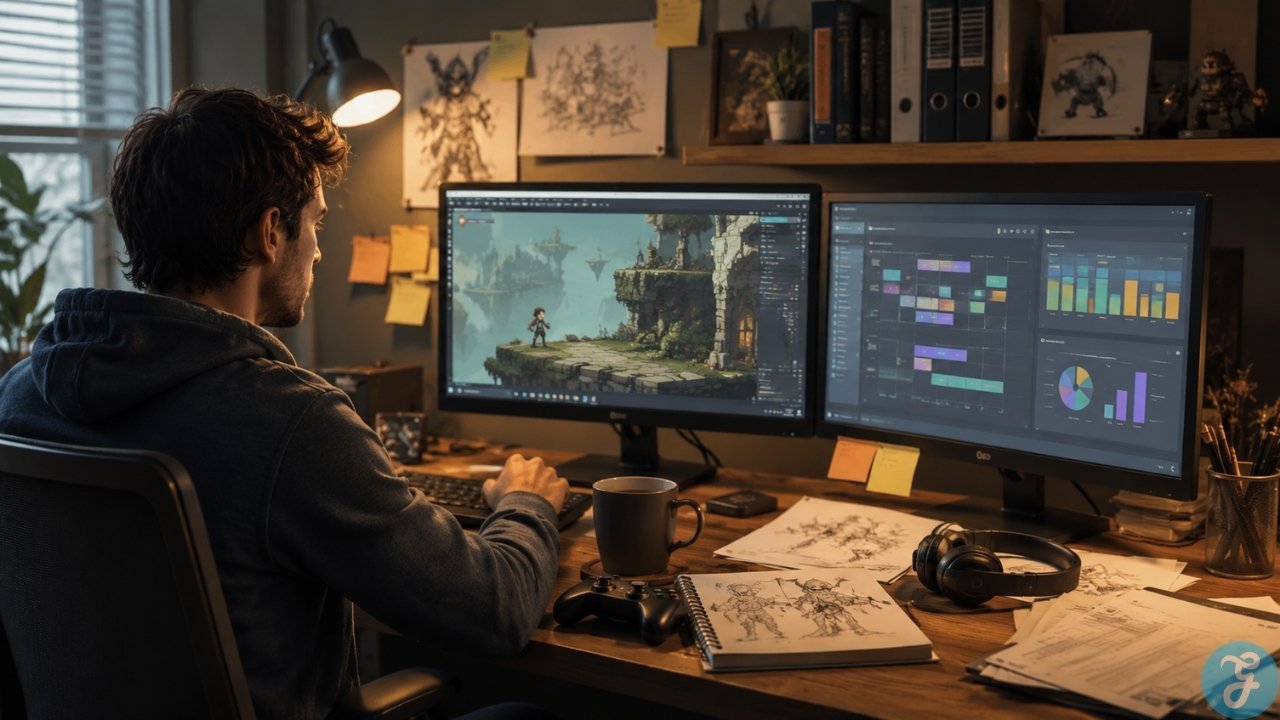
Indie game development is usually sold through its most flattering success stories: a tiny team follows its creative vision, releases a breakout hit, outshines bloated AAA studios, and proves that passion beats corporate machinery.
It is an inspiring narrative that glosses over almost everything that actually happens during development.
Creative independence does not eliminate commercial pressure, technical risk, competition, exhaustion, or financial reality. An indie developer escaping a publisher’s design committee often ends up managing support tickets, accounting, community moderation, and marketing alongside their core development duties. Unpacking the real truths about indie game dev means looking past the inspirational montages and examining what it actually takes to turn an idea into a discoverable, financially survivable product.
1. “Indie” Is a Business Model, Not an Artistic Personality
The pitch for going indie usually centers on creative control, its the freedom to make your own game on your own terms. In practice, you are running a small, high-risk entertainment business where creative choices constantly collide with bank balances.
Independence exists across a wide spectrum. A studio might take publisher financing, sign a platform exclusivity deal, hire contractors, outsource console ports, or rely on grant money. Taking external support alters who holds authority over schedules, pricing, and marketing, but it doesn’t automatically make a studio “less indie.”
Money always arrives with expectations. Too many teams accept deal terms that seem harmless during the initial pitch, only to spend two years reshaping their mechanics to fit whatever sub-genre an investor currently considers safe.
The GDC State of the Game Industry report regularly shows that roughly half of surveyed developers self-fund their games. But self-funding is rarely just money sitting in a business account. It usually means draining personal savings, working unpaid nights, taking contract work on the side, or relying on family support to keep the studio afloat until the next milestone.
2. Scope Creep Begins with Small, Rational Choices
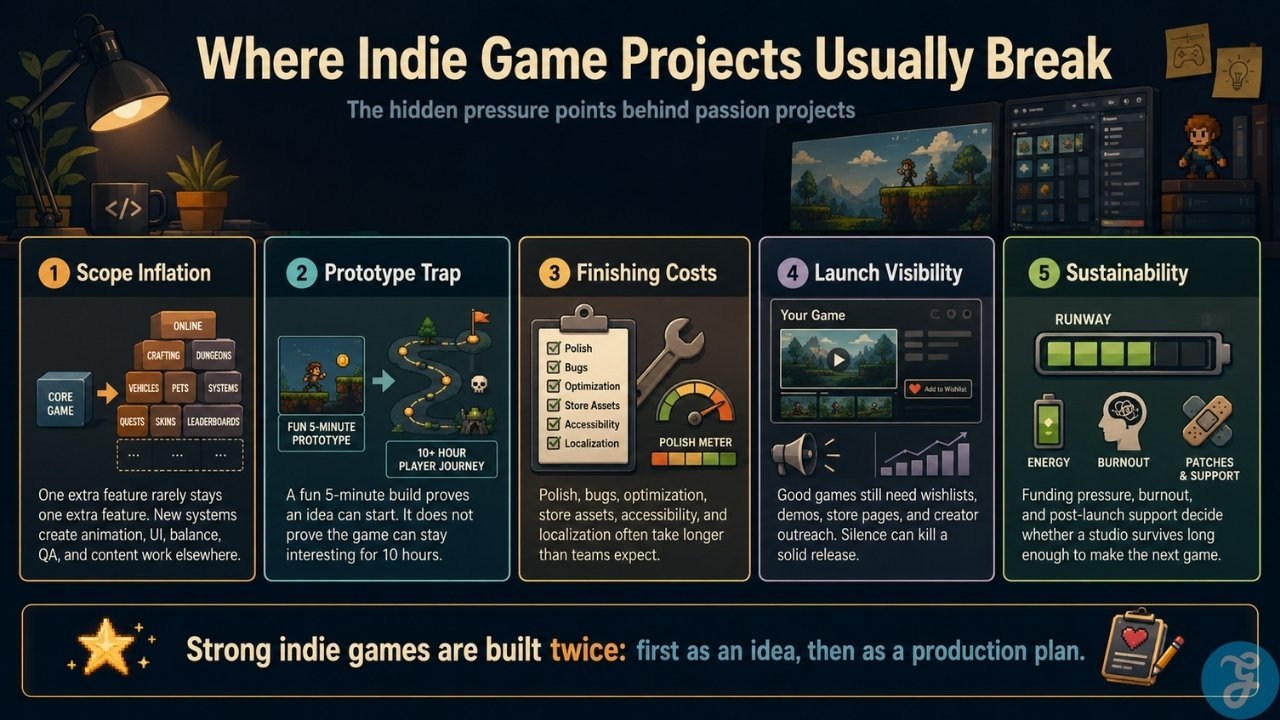
Consider how a project actually gets out of hand. A team sets out to build a tight, single-player 2D action game. Three months in, playtesters mention that the levels feel repetitive, so procedural level generation gets added. To give players something to do in those levels, the team designs a crafting system. Then comes branching dialogue, followed by online co-op because co-op games sell better on Steam. Finally, character customization enters the plan because players expect cosmetic rewards.
In isolation, every single one of those additions makes sense. Combined, they create a project the team has neither the time nor the labor to balance, polish, or finish.
Features rarely add work in isolation. Every new system creates dependencies elsewhere. Adding a single new weapon seems simple on paper, but it demands new animations, visual effects, sound design, user interface tweaks, weapon balancing, enemy reaction code, save-state compatibility, localization, and controller mapping. Experienced leads evaluate proposed additions by how much work a feature forces onto every other part of the team, rather than how quickly a basic version can be written in code.
3. The Prototype Illusion and the Hidden Cost of Finishing
Prototypes are built to answer small, isolated questions. They tell you if movement feels responsive, if a puzzle mechanism makes sense, or if a combat loop is satisfying for five minutes. They tell you almost nothing about whether a mechanic will hold a player’s attention over ten or twenty hours.
A quick prototype relies heavily on novelty. Testers haven’t played it long enough to spot dominant strategies, break the economy, or realize the progression system lacks substance. Developers routinely mistake a proof of concept for a proof of product. Before expanding a prototype into a multi-year project, you have to determine whether the core mechanic can generate real systemic variety, whether your team can realistically produce enough art and levels within budget, and what happens once the novelty wears off.
Even when a prototype validates well, the first half of development moves fast. Systems get built, greybox levels become playable, and the project looks like a real game. Then you hit the final stretch.
Finishing a game requires resolving obscure bugs, rewriting confusing UI text, balancing difficulty curves, optimizing performance across low-spec hardware, handling save-data corruption, setting up store assets, integrating achievements, building appropriate accessibility support, and ensuring the engine doesn’t crash when a player opens a menu mid-animation.
None of this work looks impressive in a promotional clip, yet it dictates whether the game feels professional. A project can sit at “feature complete” for months while the invisible labor of stability and compliance slowly grinds the team down.
4. Your Team’s Weakest Discipline Will Dictate the Quality
Wearing multiple hats sounds flexible, but it often means a lead programmer is editing the launch trailer at 3 a.m. without understanding video pacing or audio mixing.
A studio might have world-class engineers, stunning concept art, and an incredible soundtrack, but if project management is absent or marketing is treated as an afterthought, the final product suffers. The market will eventually feel the weight of whichever discipline your team neglected, whether that shows up as poor onboarding, unreadable visual hierarchy, or a launch that completely fails to reach an audience.
5. Innovation Is Expensive, and the Market Penalizes Complexity
There is a comforting idea that indie games exist to push the medium forward while big studios play it safe. While indies certainly have more creative leeway, true innovation is a tough sell.
The more unfamiliar a game is, the more work it takes to explain, market, and teach. A pitch like “roguelike deck-builder” works instantly because players already understand the baseline rules. A genuinely novel concept requires custom tutorials, explicit trailer explanations, and longer demos just to show people what they are supposed to be doing.
Unfamiliar mechanics also lack established development templates. Without industry benchmarks, estimating build times and balancing systems becomes guesswork.
This creates a cynical reality: it is often financially safer to make a polished variation of an existing popular genre than to invent something new. When indie studios stick close to familiar templates, it isn’t always a lack of imagination, it’s often a rational response to a market that punishes games players can’t understand in a five-second scroll.
6. Funding, Commercial Reality, and Legal Terms
When employees, contractors, and personal debts are involved, financial sustainability becomes a matter of keeping the lights on. Creating art for its own sake is legitimate, but once other people depend on the studio for income, generating revenue is no longer optional.
External capital can fund specialized hires, extend development time, and cover console porting costs. It also introduces milestones, oversight, revenue splits, and external pressure on creative decisions.
Before accepting any external capital, developers should insist on clear answers to a specific set of contractual terms:
-
Who retains ownership of the intellectual property?
-
Which expenses are explicitly defined as recoupable by the funder?
-
How is net revenue calculated and split after launch?
-
Who holds final authority over pricing, regional adjustments, and discount events?
-
What are the explicit conditions and penalties for milestone delays?
-
What triggers a contract termination, and what happens to the assets if it occurs?
-
Who owns sequel, spin-off, and merchandising rights?
-
What marketing budget or concrete deliverables are legally guaranteed?
7. Marketing Must Begin Early, but Wishlists Are Not Revenue
Treating marketing as something that happens a month before launch is a failure of planning. Promotion should begin as soon as the team can clearly show material that reflects the actual game experience—opening store pages, sharing updates, running playtests, and gathering player feedback.
Wishlists are widely monitored on PC platforms, but their value is easily misinterpreted. They indicate baseline interest and trigger platform notifications when a game releases or goes on sale, but they do not represent guaranteed day-one purchases.
In practice, a wishlist entry might mean a player intends to buy the game at full price, but it just as often means they liked the art style for five seconds during a festival or are waiting for a 70% discount two years later. Wishlists should be treated as a rough measurement of marketing reach, not a reliable projection of launch revenue.
8. Demos and Early Access Create Their Own Production Burden
Releasing a demo sounds straightforward until you have to carve out a self-contained slice of your game, build dedicated UI, design a custom tutorial, handle save files, and construct a compelling ending that leaves players wanting the full version. A poorly scoped demo can actively suppress sales by spoiling the novelty, confusing the player, or offering so much content that players feel satisfied without buying the main game.
Early Access comes with a similar trap. It is an ongoing operational commitment, not an emergency bailout for an underfunded studio.
Launching early to fix a cash-flow crisis usually leads to negative reviews, community friction, and an overwhelming volume of bug reports that halts new feature development. Early Access works best when a game’s core systems are already stable and enjoyable, and the team has the resources to deliver months or years of continuous updates.
9. Distribution Fees Are the Smallest Part of Launching a Game
The $100 fee to list a game on Steam Direct creates the illusion that PC distribution costs almost nothing. The store fee itself is minor; bringing a finished, legal, multi-region product to market is where expenses actually live.
Long before reach launch day, costs accumulate across business registration, legal advice, accounting, software licenses, contractor payouts, age ratings, localization services, QA testing, and promotional assets.
Once the game goes live, development pressure shifts directly into post-launch operations. Players run into hardware-specific bugs, request key remaps, demand ultrawide monitor support, debate balance tweaks, and report localization errors. Resolving these issues while managing community channels, preparing store discounts, and deploying hotfixes requires dedicated time and budget that must be planned well in advance.
10. Industry Instability Hits Small Studios Hardest
Mass layoffs and studio closures are often framed as a problem restricted to major AAA publishers, with the assumption that small indie teams are protected by lower overhead and agility.
Smaller teams can pivot faster, but they also run out of cash faster. A single delayed contract, an unexpected platform policy change, a publishing partner’s internal restructuring, or a weak launch can wipe out an independent studio’s entire operating budget in a matter of weeks. Low overhead gives you flexibility, but it offers very little protection against a sudden shift in the market.
11. Passion Is Not a Production Plan
Passion sustains developers through complex technical and creative challenges. But it is also frequently used to justify unpaid overtime, unmonitored working hours, and persistent crunch under the guise of “dedication to the vision.”
Burnout remains a widespread issue across independent studios. Accepting the truths about indie game dev requires strict scope management, realistic timelines, clear financial planning, and the willingness to cut features or cancel projects entirely when the numbers show they are no longer viable.
What Aspiring Indie Developers Should Do Instead
Before you commit years of your life and money to full production, these are the basics I would lock down:
-
Define the smallest complete version of the game that remains fun.
-
Build a minimal prototype focused strictly on testing the primary mechanic.
-
Verify that the core loop supports multi-hour play before writing high-level systems.
-
Estimate production pipelines for art, audio, and levels, not just programming logic.
-
Identify your team’s weakest technical and creative disciplines and hire or scope around them.
-
Establish explicit financial and personal metrics for what constitutes project success before spending capital.
-
Build a financial runway budget that aims for a 3- to 6-month buffer after launch.
-
Review legal, tax, entity setup, and platform obligations with a qualified professional.
-
Conduct blind playtests with players who have no personal connection to the team.
-
Launch a public store page and begin public updates as soon as the core loop is validated.
-
Set aside dedicated funds and developer time specifically for post-launch patching and support.
-
Define hard, objective criteria for when the project must be downscoped, delayed, or canceled.
Shipping Responsibly
Good intentions and raw effort do not insulate you from commercial failure. The market does not care how hard you worked, how many late nights your team put in, or how much personal sacrifice went into the code. It only evaluates the software that lands on the store page.
If you run out of money six months before release, overwork your team into burnout, or push out an unoptimized build because you ran out of runway, that is a failure of planning and leadership. Facing the unvarnished truths about indie game dev isn’t about being cynical, it’s about respecting production discipline so you can actually finish what you start. If you cannot respect the realities of running a project, you shouldn’t be asking players for their money or teammates for their labor.
Frequently Asked Questions (FAQs) About Truths About Indie Game Dev
1. How much money does it actually cost to release an indie game?
While listing a game on Steam costs $100, the real expenses come from business registration, software licenses, legal advice, localization, QA, and marketing. Most credible indie games require thousands to tens of thousands of dollars in runway before launch.
2. Is self-funding safer than taking publisher funding?
Self-funding gives you complete creative freedom, but it shifts 100% of the financial risk onto your personal savings and health. Publisher funding provides financial stability and resources, but it comes with milestones, deadlines, and shared revenue.
3. How early should an indie developer start marketing?
Marketing should start as soon as you have a validated core loop and visuals that accurately represent the final game experience. Setting up a Steam store page early allows you to gather wishlists and build an audience long before launch day.
4. Why do so many indie prototypes fail to become full games?
Prototypes rely on initial novelty and short play sessions that hide long-term design problems. Transforming a fun five-minute mechanic into a full game requires massive amounts of unseen content, progression balancing, and system depth.
5. Is Early Access a good way to fund development?
No, Early Access should never be used as an emergency cash infusion for an unfinished, broken concept. It works best when the core game is already fun and stable, but requires player feedback to expand and evolve.