Have you ever watched an AI agent get one small step wrong, then spiral into a costly mess two actions later? That is the moment when human in the loop design for AI agents stops sounding like a theory and starts feeling like a requirement.
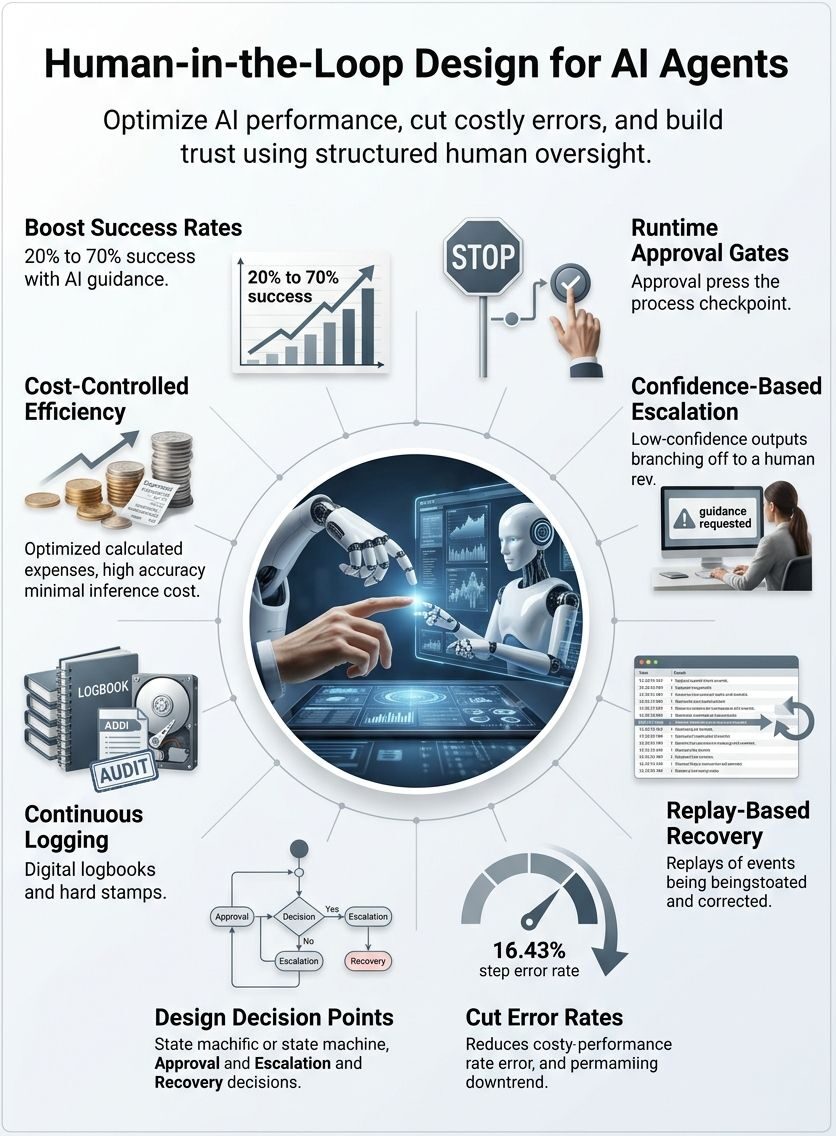
In my own AR agent work, I saw that change up close. With AI guidance, first-time task success rose to 70% from 20% without help, which meant fewer stalled workflows, fewer unsafe guesses, and a lot less stress for the people using the system.
In this guide, I am going to show you the approval gates, escalation rules, and recovery patterns I trust most, along with the metrics that make them worth the effort.
What Is Human-in-the-Loop (HITL) Design?
I use human-in-the-loop design to place people at the moments that matter most, right before an AI system takes an action that is costly, hard to reverse, or easy to misread. The goal is not to slow every workflow down. The goal is to give the system a smart safety net.
In the NIST AI RMF, human oversight is something teams should define, assess, and document, and post-deployment monitoring should include appeal, override, incident response, recovery, and change management. That is a useful way to think about HITL: it is a design choice tied to risk, not a last-minute patch.
Overview of HITL in AI Systems
Human-in-the-loop design keeps humans in key spots of AI systems without forcing them to watch every step. I treat it as a way to shape agentic AI behavior at decision points, especially when a model is about to write, send, delete, publish, approve, or escalate.
This idea has deep roots in interactive machine learning. Dr. Rebecca Fiebrink’s Wekinator showed that real-time human feedback can steer a model much faster than waiting for a long offline retraining cycle, which is one reason HITL still works so well for modern large language model workflows.
Current tools make that pattern practical. LangChain’s HumanInTheLoopMiddleware can interrupt tool calls and allow a reviewer to approve, edit, reject, or respond, while OpenAI’s Agents SDK can pause a run, surface the pending tool call, and resume it later from saved state.
- Low-risk actions: let the agent read data, summarize, or draft without interruption.
- Medium-risk actions: ask for human input when confidence drops or the context looks unusual.
- High-risk actions: require explicit approval before the agent sends, deletes, purchases, or publishes anything.
- Irreversible actions: pair approval with logging, so recovery starts from evidence instead of guesswork.
I have found that HITL works best when the human sees the exact action, the relevant context, and the consequence of saying yes.
Importance of Human Oversight in AI Workflows
I have tested generative AI in real workflows, and the hard part is rarely getting a model to produce an answer. The hard part is knowing when that answer deserves trust.
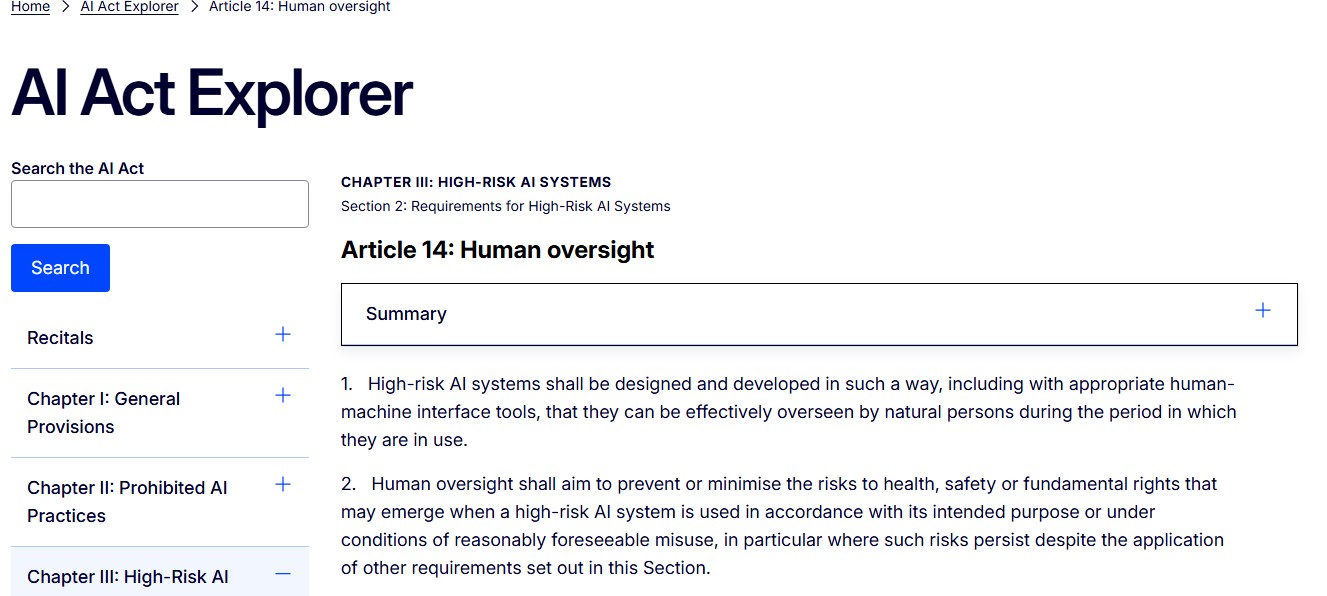
According to July 2026, the European Commission’s guidance on the EU AI Act makes that expectation very concrete for high-risk AI systems: people assigned to oversight should be able to understand the system’s limits, monitor for anomalies, interpret outputs correctly, override or reverse the output, and stop the system safely when needed.
A stop button is useful, but real oversight starts earlier: at the point where a person can catch a bad action before it lands.
That matters because humans carry tacit knowledge that never fits neatly into a prompt or policy file. In medical tasks, emergency response, content moderation, and logistics, the reviewer often notices that something is off before the model can explain why.
I also watch for automation bias. If reviewers only see a green check and a confidence score, they start rubber-stamping. Good HITL design fights that by showing the proposed action, the evidence behind it, and a simple way to reject or correct it.
The HITL Control Loop
I map the HITL control loop as a short cycle: the agent proposes an action, a policy decides whether it can proceed, a human steps in when risk or uncertainty crosses the line, and the system either continues, retries, or rolls back.
That sounds simple, but the value comes from making each stage explicit. Once approval, escalation, and recovery are first-class parts of the workflow, teams can measure them, price them, and improve them.
Key Stages: Approval, Escalation, and Recovery
I design HITL loops around three moves: approve what is safe, escalate what is unclear, and recover fast when something fails.
| Stage | What happens | Why it matters |
| Approval | The agent pauses before a risky action and waits for human sign-off. | This is where I gate actions like external writes, refunds, account changes, or safety-critical guidance. |
| Escalation | The system routes uncertain or policy-sensitive cases to a person instead of guessing. | This protects quality when confidence is low, the sequence looks wrong, or the cost of a false move is high. |
| Recovery | The workflow rolls back, retries with new constraints, or hands off to a human after failure. | This keeps one bad step from turning into a broken session, a compliance issue, or a customer-facing mistake. |
OpenAI’s current Agents SDK is useful here because it supports a true pause, approve, reject, and resume flow, plus durable run state for long-running approvals. LangGraph and LangChain add a similar advantage with interrupts and persistent checkpointing, which matters if a reviewer steps in minutes or hours later.
- Approval gate: I require human sign-off for high-risk tasks, then log the decision with the reviewer, timestamp, and exact tool arguments.
- Escalation mode: When the agent detects out-of-sequence behavior, low confidence, or conflicting evidence, it switches from action mode into clarification mode.
- Recovery workflow: If the step fails, I replay the trail, roll back to the last safe state, and retry with tighter rules or a higher threshold for autonomy.
- Runtime policy check: I place approvals inside the live workflow, not at the very end, so the human can prevent damage instead of cleaning it up later.
- Structured review queue: I batch similar cases so humans can move quickly without losing context.
- Audit chain: I keep the event log, the decision, and the recovery action together so the next failure is easier to diagnose.
One runtime walkthrough makes the pattern clear. At t+3.2 seconds, the Perception Service detected an out-of-sequence gesture and raised an alert at 0.28 confidence. The Conductor paused the active node, sent the case to a structured review queue in 0.9 seconds, opened a 45-second review window, and logged the event with an 8-second replay buffer. When the reviewer rejected the step, the system rolled back two nodes and retried with the threshold raised by 0.12.
When to Trigger Human Intervention
I do not want humans reviewing everything. I want them reviewing the moments where their judgment changes the outcome.
OpenAI’s practical guidance for agents suggests rating tools by read versus write access, reversibility, required permissions, and financial impact. I use that same logic to decide what should auto-run, what should escalate, and what should never proceed without approval.
- Irreversible write actions: deleting records, sending messages, publishing content, approving payouts, or changing production settings.
- Low-confidence outputs: multimodal LLMs, classifiers, or retrieval pipelines return weak or conflicting signals.
- Out-of-sequence behavior: the user or agent moves outside the expected task order.
- Policy collisions: the output touches privacy, safety, moderation, or regulated domain rules.
- Repeated retries: the agent keeps failing the same step, which usually means the plan is wrong, not just the wording.
- Timeouts: a step or review takes too long, which often signals confusion or missing context.
A 2026 Stanford Digital Economy Lab report found that agentic implementations delivered median productivity gains of 71%, versus 40% for non-agentic ones, but the report also ties the best results to tasks with recoverable errors and clear success criteria. That is the key trigger rule I keep coming back to: if the error is expensive and hard to undo, bring a human in earlier.
Benefits of HITL in AI Agent Design
I use HITL because it makes AI systems easier to trust in the real world. You get clearer decisions, safer behavior, and a better balance between speed and control.
The biggest win is that the human role becomes intentional. Instead of hovering over the whole workflow, people step in where they create the most value.
Enhanced Trust and Transparency
I saw stronger trust whenever the system showed its work. In my evaluation setup, synchronized video, audio, outcome labels, error categories, and detailed rationales made it much easier for reviewers to understand what the agent did and why a step failed.
That same principle shows up in IBM watsonx.governance, which tracks AI assets from request to production and surfaces facts, thresholds, and monitoring data in one place. For teams running multiple AI systems, that kind of visibility turns abstract trust into something you can inspect.

The performance lift in my study was large enough to matter. Across 144 sessions, the AR-guided condition delivered a 70.0% first-time Macro Success Rate with a mean task time of 186.54 seconds. Paper instructions reached 28.57%, and unassisted runs reached 20.0%.
Step error rates told the same story. Unassisted runs reached 38.75%, while post-exposure paper-instruction runs dropped to 6.70%, and inference stayed near $0.002 per session. When I can show operators numbers like that, the approval queue feels like a targeted control, not wasted overhead.
- Visible evidence: reviewers can see the output, the context, and the reason for the intervention.
- Clear audit trail: every approval, rejection, and retry is tied to a timestamp and a decision owner.
- Measurable quality: trust grows faster when teams can compare task success, error rate, and cost side by side.
Improved Safety in High-Stakes Tasks
I used an AR-equipped AI agent to guide tourniquet application, and this is where HITL proved its value. The AI-assisted condition cut the Step Error Rate to 16.43% versus 18.37% for practitioner instruction, both well below unassisted trials.
The ResNet-based Step Classifier, CLS, outperformed the salient region method for task accuracy, which made it a better trigger source for escalation. When the classifier, timer, and reviewer worked together, safety improved without forcing a human to narrate every step.
In high-stakes settings, I keep three controls close together:
- Real-time anomaly detection so the system notices bad sequencing early.
- A fast approval path for safe continuation when the reviewer agrees.
- A safe-stop or rollback path when the output should be ignored or reversed.
That is much stronger than relying on a single emergency stop button after the system has already acted.
Balancing Efficiency with Human Judgment
I care a lot about speed, but I care even more about where speed is safe. HITL works when the human checkpoint is small, well-timed, and backed by enough context to make a fast decision.
The Stanford Digital Economy Lab’s 2026 report makes a similar point from the business side: the best oversight model depends on error tolerance, task complexity, and regulation. In other words, there is no prize for removing the human from a workflow that still needs one.
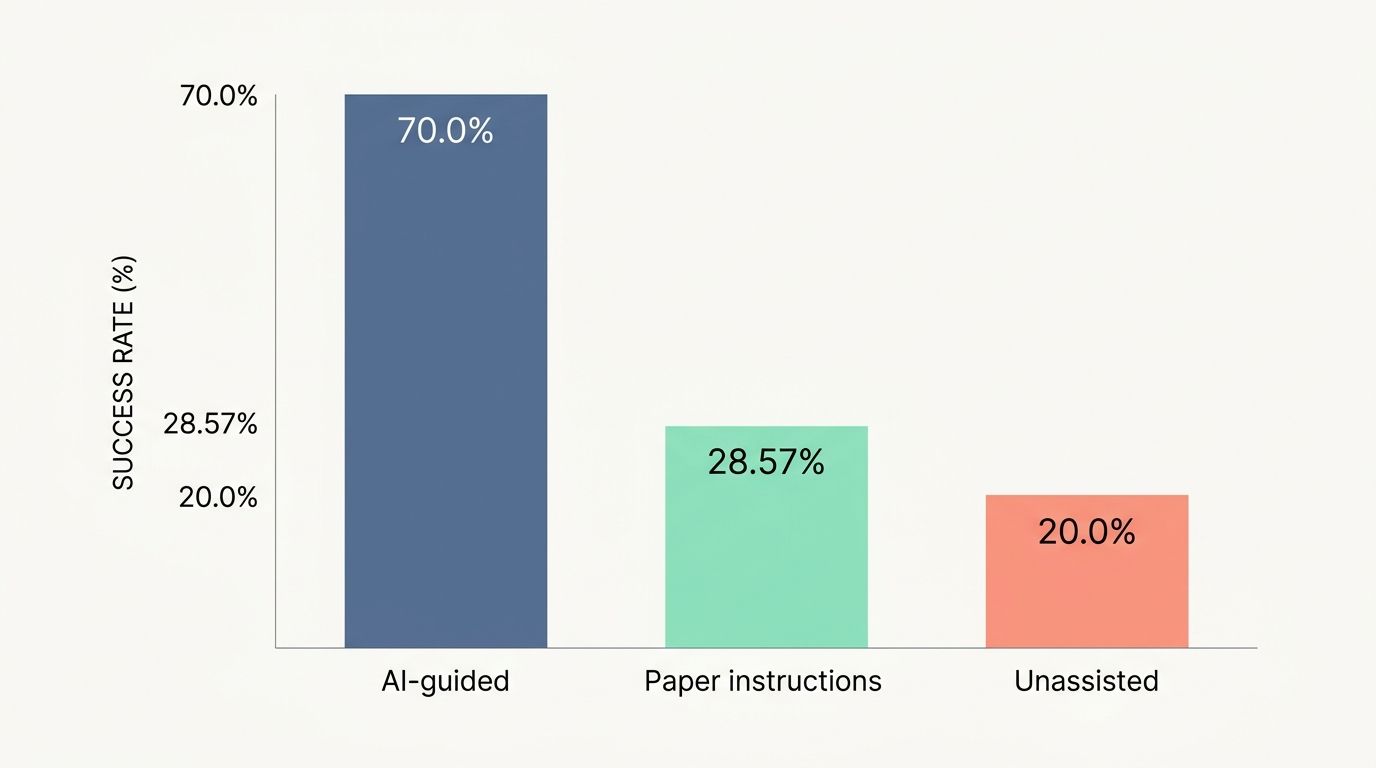
| Condition | First-time success | Mean task time | What it tells me |
| AI-guided | 70.0% | 186.54 seconds | Fast enough to be useful, with far better reliability on first attempt. |
| Paper instructions | 28.57% | Varied | Helpful, but much weaker at real-time correction. |
| Unassisted | 20.0% | Varied | Too much cognitive load lands on the user. |
Post-exposure learning mattered too. Unassisted performance rose to 66.67%, and paper instructions climbed to 75% with a 6.70% error rate, which tells me the AI agent helped people build skill, not just finish one task.
Each session cost about $0.002 in inference, and the measured cost-to-success ratio was 0.000029 $/%. For a workflow team, that is the sweet spot I want: tiny marginal cost, strong lift, and a clear place for human judgment.
Common Challenges in HITL Implementation
HITL solves real problems, but it creates new ones too. The biggest pain points I run into are review latency and the sheer difficulty of scaling oversight across many agents, models, and workflows.
Latency in Human Review Processes
I logged 144 sessions and 15.15 hours of valid video, and delays were impossible to ignore. AI-guided tasks averaged 186.54 seconds, while full session length averaged 4.73 plus or minus 2.01 minutes, so even a short review pause can shape throughput.
NIST’s March 2026 monitoring report warns that one challenge of human-in-the-loop monitoring is that humans may not keep up with the speed and release cadence of deployed AI systems. That is exactly why approval design has to be selective.
- Set review timeouts: if no one answers in time, block the action or move to a safe fallback.
- Show the minimum useful context: the proposed action, key evidence, and the likely consequence.
- Use short checklists: reviewers move faster when they know the decision criteria.
- Separate reversible from irreversible actions: auto-run what can be undone, queue the rest.
The AWS Well-Architected Agentic AI Lens now recommends timeout policies with safe fallback actions, and it also recommends logging reviewer identity, timestamps, the operation under review, and escalation events. That is practical advice, because a slow queue becomes much easier to fix when every pause has a reason attached.
Scaling Oversight for Large-Scale Systems
Scaling oversight gets harder as soon as one agent becomes ten. The original dataset here came from 12 participants across four tasks and three assistance conditions, which produced 144 sessions with synchronized egocentric and exocentric recordings. That was manageable by hand, but enterprise agent fleets are not.
I annotated video with the VGG Image Annotator and stored structured fields in machine-readable JSON, including task duration, step boundaries, out-of-order mistakes, and fine-grained mistakes. That structure matters because scaling starts with consistent evidence.
For production systems, I look for governance tools that can discover assets across the stack. IBM’s 2026 watsonx.governance updates added AI Asset Discovery for unmanaged AI agents, tools, MCP servers, and models, which is helpful when shadow AI starts bypassing your review process.
- Standardize event schemas: every agent should log the same core fields for approvals, retries, failures, and overrides.
- Tag ownership: each workflow needs a clear human owner for policy changes and exception handling.
- Keep review queues specialized: moderation reviewers, medical reviewers, and logistics reviewers should not share one generic queue.
- Connect governance to orchestration: tools like watsonx.ai pipelines or LangGraph flows become easier to audit when queue events map back to named nodes and policies.
This is where rich datasets help. Once graph nodes, task steps, reviewer actions, and model outputs all speak the same language, oversight becomes something you can scale instead of something you improvise.
Key Design Patterns for HITL Workflows
I keep coming back to three patterns because they solve most real production problems: runtime approval gates, confidence-based escalation, and structured review queues. They are simple enough to maintain and flexible enough to fit embodied agents, chat agents, and backend automation.
Runtime Approval Gates
Runtime approval gates stop risky actions before they execute. I place them at the exact decision point, not after the workflow is already committed.
- Use a Conductor or state machine: it should know the current node, allowed next actions, and rollback targets.
- Gate write actions: file writes, database changes, outbound messages, purchases, and destructive shell commands deserve stronger control than read-only actions.
- Persist the paused state: LangGraph checkpointers and OpenAI RunState are both good examples of how to resume safely after a delayed decision.
- Log the full request: reviewer identity, tool name, arguments, policy reason, and final decision should travel together.
- Support rejection paths: a rejected action should return useful feedback to the agent instead of leaving it stuck.
- Limit standing trust: if you allow repeat approvals, scope them narrowly to a tool, parameter shape, or session.
A common mistake is putting a big Approve button at the end of the workflow. That feels safe, but it is too late to catch harmful intermediate actions.
Confidence-Based Escalation Mechanisms
I use confidence-based escalation when I want the agent to stay fast on easy work and slow down on risky work. The trick is to combine model confidence with task context instead of trusting a score in isolation.
- Start with a risk rule: low-confidence read actions may still auto-run, while low-confidence write actions should escalate.
- Blend signals: use model scores, sequence validation, policy checks, and retry counts together.
- Prefer interpretable thresholds: reviewers should know why a case reached them.
- Use task-aware perception: active perception by task node helps the system focus on the step that matters now.
- Keep a review rationale: every escalation should include the score, the error category, and the short reason for handoff.
- Retrain from outcomes: reviewer edits and rejections are some of the best data you will get for improving thresholds.
In my own setup, SCE helped highlight salient regions while CLS delivered better task accuracy, so I treated CLS as the stronger source for escalation. That is a useful pattern in general: use one model to spot attention areas and another to make the harder judgment call.
Confidence rules also work better when they match the human interface. If the reviewer cannot see the payload, score, and expected effect of the tool call, the escalation will still feel like a blind guess.
Structured Review Queues for Output Validation
Structured review queues give humans enough context to make fast, consistent calls at scale. I keep synchronized video, audio, annotations, and event logs in one place because fragmented evidence makes reviewers slow and inconsistent.
| Queue field | Why I include it | Minimum format |
| Proposed action | The reviewer needs to know what the agent wants to do. | Plain-language summary plus raw tool arguments |
| Trigger reason | It explains why the item was escalated. | Confidence, policy hit, anomaly, timeout, or retry |
| Evidence | It lets the reviewer verify instead of guess. | Relevant frames, text span, retrieved context, or logs |
| Decision options | Clear buttons speed up judgment. | Approve, edit, reject, or escalate again |
| Audit metadata | It supports learning and compliance later. | Reviewer, timestamp, outcome, and recovery action |
YouTube’s current help documentation says that in the majority of cases its automated systems flag potentially violative content for trained human review before action is taken, and that appeals receive human review case by case. I like that pattern because it treats human review as targeted verification, not a blanket fallback.
Inside my own queues, I also tag Boolean success, floating-point timestamps, and failure comments. Those fields sound small, but they make replay, escalation, and postmortem analysis much easier.
Real-World Use Cases of HITL Systems
HITL gets easier to understand once you see it in live workflows. I use it most in content moderation, logistics, and exception handling because each one mixes speed, ambiguity, and operational risk.
Content Moderation with Human Oversight
Content moderation is one of the clearest examples of why human oversight matters. Models can catch obvious violations, but they still struggle with nuance, context, satire, educational framing, and policy edge cases.
YouTube’s review process is a good real-world pattern to study. Its documentation says automated systems may act when confidence is very high, but in the majority of cases they flag content to a trained human reviewer, and appeals are reviewed by a human case by case. That is exactly how I think a moderation queue should work.
- Use AI for triage: let classifiers surface the likely problem and priority.
- Send ambiguous cases to humans: humor, context, and intent still need judgment.
- Keep policy labels consistent: moderators should choose from clear categories, not write free-form notes every time.
- Support appeals: some of the most valuable oversight data comes from disputed decisions.
I also like step-by-step reviewer checklists here. They reduce drift between moderators and make policy changes easier to roll out across a team.
AI-Assisted Decision Making in Logistics
Logistics is a strong fit for AI agents because the work is repeatable, time-sensitive, and packed with structured decisions. It is also a place where one bad choice can ripple across inventory, routing, and customer communication.
I helped deploy an AI-assisted workflow that raised logistics success rates to 70%, using a modular architecture with a Conductor, multimodal LLM support, and decision logging at every handoff. The key was never full autonomy by default. The key was selective autonomy.
The Stanford Digital Economy Lab’s 2026 enterprise report is useful here because it found the strongest agentic gains in workflows with clear success criteria and recoverable errors. That is exactly why logistics can work so well: a route can be replanned, an exception can be reviewed, and a failed suggestion can be corrected before it becomes a permanent loss.
- Auto-run: read-only lookups, standard status checks, and obvious route suggestions.
- Escalate: conflicting shipment data, customs issues, unusual cost spikes, or missing proof of delivery.
- Require approval: vendor changes, expensive reroutes, customer-facing compensation, or regulatory exceptions.
That structure keeps the workflow fast without pretending every logistics decision is low stakes.
Exception Handling in Automated Workflows
Exception handling is where weak agent design usually breaks. The system hits an odd case, the model improvises, and the logs are too thin to explain what happened.
I prefer a simpler pattern. The Perception Service catches the anomaly, the workflow pauses, the human sees the synchronized evidence, and the system either resumes, reroutes, or rolls back to the last safe state.
This works especially well when you pair it with a timer and a durable state store. OpenAI’s pause-and-resume run state and LangGraph’s checkpointing both support that style of recovery because the agent does not need to restart from scratch after rejection.
If your recovery path depends on a human reverse-engineering the failure from memory, the workflow is under-instrumented.
I log every exception with the trigger, the local context, the reviewer action, and the follow-up path. That is what turns exception handling into continuous improvement instead of repeated chaos.

Best Practices for Effective HITL Design
I keep HITL design effective by making decisions explicit, policies consistent, and logging unavoidable. Those three habits do more for trust than a dozen vague safety promises.
Design for Decision Points, Not Just Prompts
I focus design on real decision points, the moments where the system can branch into action, delay, handoff, or rollback.
- Name the checkpoints: approval, escalation, retry, override, and safe-stop should exist as clear workflow states.
- Map the graph: every node should have a known owner, allowed transitions, and a recovery target.
- Separate guidance from authority: the model can recommend, but it should not always execute.
- Prefer reviewable payloads: humans should inspect the action itself, not a vague summary of it.
- Plan the rejection path: decide what the agent does after a no, not just after a yes.
- Simulate failures: test prompt injection, missing context, repeated retries, and reviewer timeout before launch.
That last point matters more than teams expect. If you only test the happy path, the first live failure becomes your design review.
Use Policies for Consistent Oversight
Policies keep HITL from turning into gut feeling. I want the same risky action to get the same treatment whether it happens at noon on Tuesday or 2 a.m. on Sunday.
In the NIST AI RMF, governance comes before the rest of the lifecycle, and human oversight should be documented in line with organizational policy. That is why I write policy in operational terms: threshold, trigger, reviewer role, timeout, fallback, and log field.
- Set confidence thresholds: define what score, pattern, or anomaly triggers review.
- Tie rules to domain risk: a medical step, refund action, and content flag should not share one generic policy.
- Define timeout behavior: choose block, reroute, or safe-stop before the queue fills up.
- Control exceptions: spell out who can override policy and how that override is recorded.
- Review policies regularly: edge cases and reviewer feedback should change the rules over time.
Good policy is what keeps oversight meaningful instead of decorative.
Log and Monitor All Interactions
I record every meaningful interaction in real time because AI memory is not evidence. If I cannot replay what happened, I cannot improve it or defend it.
- Capture the event stream: approvals, escalations, retries, overrides, and failures all belong in the same trail.
- Keep timing precise: timestamps make bottlenecks and drift visible.
- Link output to context: store the user request, retrieved data, model output, and tool call together.
- Track reviewer behavior: identity, decision speed, edit rate, and reversal rate help spot approval fatigue.
- Archive replay artifacts: video, audio, annotations, and logs should be easy to inspect side by side.
- Feed the loop back: use logged failures to update prompts, policies, thresholds, and training data.
IBM watsonx.governance, OpenAI run-state persistence, and LangGraph checkpointing all point in the same direction: durable oversight works best when the system treats monitoring as part of the workflow, not as a report you generate after the fact.
Wrapping Up
After working through hands-on studies and real task flows, I do not see human-in-the-loop design as a brake on AI. I see it as the control surface that lets an AI agent stay useful when the workflow gets messy, ambiguous, or high stakes.
The numbers in my own work made that plain: higher task success, fewer step errors, and tiny inference costs, all while keeping room for human judgment where it mattered most.
If you are building agentic systems now, start with clear checkpoints, narrow approvals, durable logs, and a recovery path you can actually test. That is how I build AI systems people can trust in the real world.
Frequently Asked Questions on Human In The Loop Design For AI Agents
1. What is human-in-the-loop design for AI agents?
It puts a person into the workflow with automated systems, to approve, guide, and fix actions. Humans check outputs from a Neural network (machine learning), and watch data from each Node (networking).
2. How does approval and escalation work?
A reviewer sees a decision, approves it, or sends it up. The system maps roles and paths on a Graph (discrete mathematics), and each Vertex (graph theory) marks who must act, like passing a note from desk to desk.
3. How does recovery work after a failure?
Teams trace the error to a Node (networking) or a model layer, then roll back or isolate the part. People fix the issue, update the model, and run tests, so the automated system learns from the repair.
4. How do we keep behavior clear and traceable?
Keep logs, audits, and strong Transparency (behavior), so each choice links to a Vertex (graph theory) and a person who reviewed it.