Wondering whether transitioning from homeschool to college will feel exciting or like your whole routine got flipped overnight? That mix is normal, and the good news is that many of the skills you built at home already match what college asks from you.
In the latest NCES data, about 3.4% of U.S. K-12 students were homeschooled, so admissions teams and campuses are used to working with homeschool applicants, transcripts, and nontraditional learning paths.
You still need a plan. I’m going to walk you through the paperwork, study habits, test choices, and social moves that make the switch feel much smoother.
Preparing for the Transition
The smoothest transitions start before move-in day. If you build a repeatable weekly routine, practice working under outside deadlines, and get comfortable asking for help, college feels less like a shock and more like a stronger version of what you already know how to do.
Developing time management skills
One of the best homeschool-to-college advantages is that you already know how to work without constant reminders. Sarah Smith, writing about her own move from homeschooling to York College, described balancing 12 dual-enrollment credits, two math classes, and more than 20 hours a week at a job before she ever became a full-time college student.
That matters because college is really a deadline system. If you can already break big assignments into weekly pieces, read a syllabus early, and protect study time on your calendar, you are much closer to college readiness than you might think.
- Map every due date from the syllabus in the first week.
- Block study time before work, clubs, or family plans fill the day.
- Start papers early enough to leave room for revision, not just completion.
- Review your calendar once a week, so surprises stay small.
Good time management is less about being busy and more about making fewer last-minute decisions. That lowers stress fast.
Building resilience and adaptability
What changes in college is not your ability to learn; it is the environment. Lecture halls are louder, group projects are less predictable, and professors will not always remind you twice.
A smart way to build resilience before freshman year is to add one outside-the-home pressure point, such as a community college class, a co-op with firm deadlines, or a job with fixed hours. Research reviewed by the Institute of Education Sciences found dual enrollment programs have positive effects on college access, credit accumulation, and degree attainment, which is one reason these experiences make the first semester feel more familiar.
When something goes sideways, and sooner or later it will, use a quick reset: find the missed step, email the professor, update the calendar, and keep moving. College rewards recovery speed more than perfection.
Strengthening self-directed learning habits
Homeschooled students often arrive with strong self-directed learning habits, but college adds a twist: independence has to be paired with help-seeking. A 2024 review of homeschooled dual-enrollment students highlighted time management, metacognition, collaboration, and seeking support as major success habits.
Metacognition sounds technical, but it simply means noticing how you learn best. If long lectures make your attention drift, use Cornell notes, write a three-sentence summary right after class, and turn that summary into practice questions before the next session.
The strongest students do not wait until they are falling behind. They test note-taking systems, use the library and tutoring center early, and treat office hours like part of the course, not extra credit.
Transitioning From Homeschool To College: Documentation and Admissions Requirements
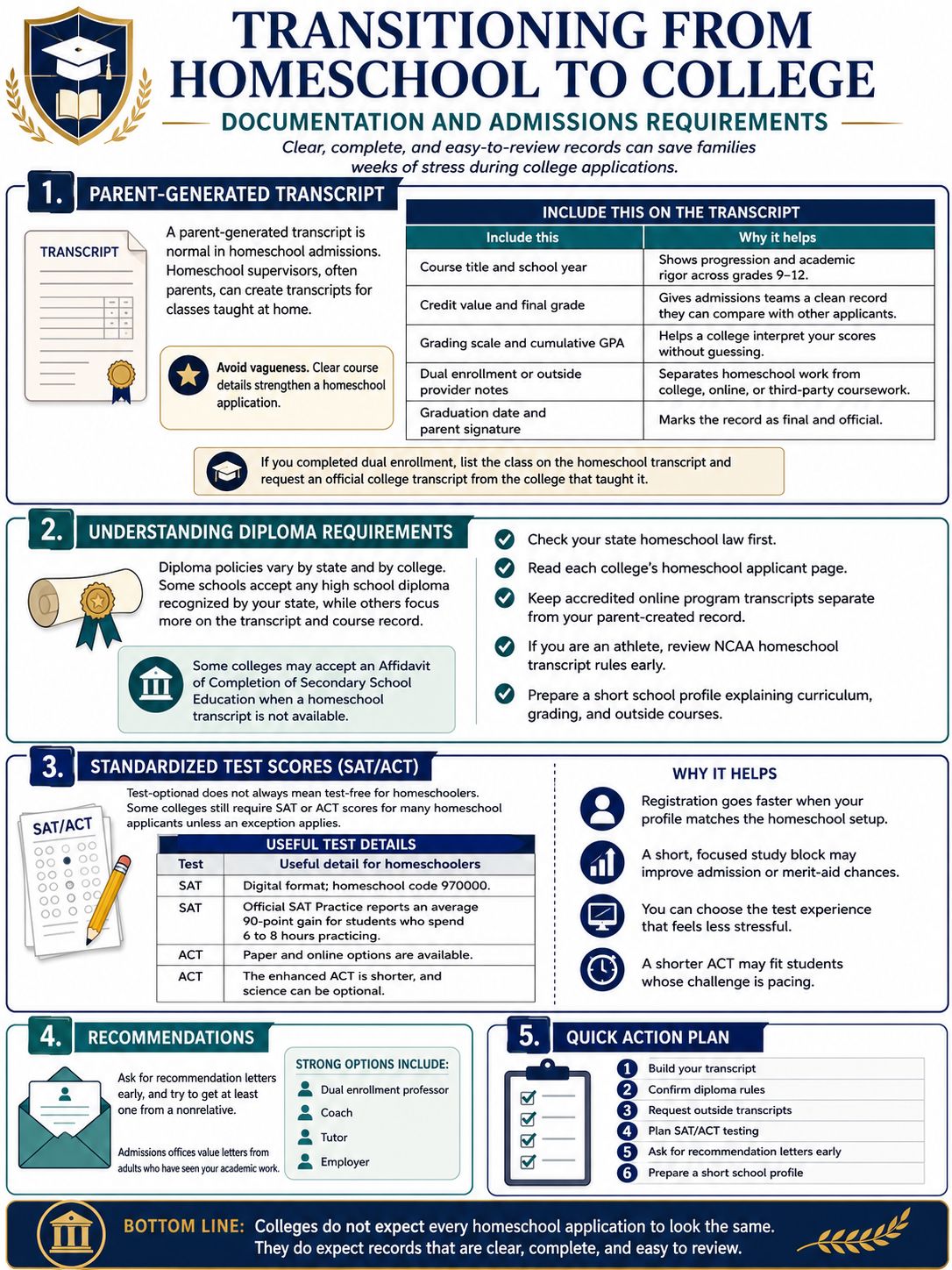
This part feels tedious, but it can save you weeks of stress later. Colleges do not expect every homeschool application to look the same, but they do expect your records to be clear, complete, and easy to review.
Creating a parent-generated transcript
A parent-generated transcript is normal in homeschool admissions. Caltech states that a homeschool supervisor, often a parent, can create the transcript for classes taught at home, and Arizona State says the transcript should list each course with the credit and grade attached to it and include a parent or guardian signature.
Where families get into trouble is vagueness. Boston College says homeschooled applicants help their case when they itemize courses clearly and, for stronger subjects like science, include useful context such as texts used or lab hours completed.
| Include this on the transcript | Why it helps |
|---|---|
| Course title and school year | Shows progression and academic rigor across grades 9 through 12. |
| Credit value and final grade | Gives admissions teams a clean record they can compare with other applicants. |
| Grading scale and cumulative GPA | Helps a college interpret your scores without guessing. |
| Dual enrollment or outside provider notes | Separates homeschool work from college, online, or third-party coursework. |
| Graduation date and parent signature | Marks the record as final and official. |
If you completed dual enrollment, do two things every time: list the class on the homeschool transcript and request an official college transcript from the college that taught it. Admissions offices often want both.
Understanding diploma requirements
Diploma rules are one of the biggest reasons you should check each college before senior year, not after. Policies vary by state and by campus.
Some colleges, such as Boston College, accept any high school diploma recognized by your state as part of final proof of graduation. Others focus more on the transcript and course record. Arizona State also offers an Affidavit of Completion of Secondary School Education when a homeschool transcript is not available, which is a useful backup for families with unusual recordkeeping.
- Check your state homeschool law first, so your diploma matches state requirements.
- Read each college’s homeschool applicant page, especially the transcript, final proof of graduation, and recommendation sections.
- If you used an accredited online program, keep that school’s official transcript separate from your parent-created record.
- If you are an athlete, review NCAA homeschool transcript rules early because they can require extra details.
If a school uses the Common App or a similar application, be ready to explain your learning setup in plain English. A short school profile that explains curriculum, grading, and outside courses can clear up confusion fast.
Preparing standardized test scores (SAT/ACT)
Test-optional does not always mean test-free for homeschoolers. Boston College encourages homeschooled applicants to submit available scores even though it is test-optional, while the University of Washington and North Central College still list SAT or ACT scores as required for many homeschooled applicants unless an exception applies.
If you take the SAT, College Board uses 970000 as the homeschool high school code. If you prefer the ACT, homeschooled students can register directly through MyACT, and since September 2025 the enhanced ACT has been shorter with an optional science section, which gives you a little more control over the format that fits your strengths.
| Test | Useful detail for homeschoolers | Why it helps |
|---|---|---|
| SAT | Digital format, homeschool code 970000 | Registration goes faster when your profile matches the homeschool setup from the start. |
| SAT | Official SAT Practice reports an average 90-point gain for students who spend 6 to 8 hours practicing | A short, focused study block can be enough to raise a score that matters for admission or merit aid. |
| ACT | Paper and online options are available | You can pick the test experience that feels less stressful. |
| ACT | Enhanced ACT is shorter and science can be optional | That can be a better fit if pacing, not content, has been your weak spot. |
One more practical tip: ask for recommendation letters early, and get at least one from a nonrelative if possible. College Board guidance notes that admissions offices value letters from adults who have seen your academic work, such as a dual enrollment professor, coach, tutor, or employer.
Academic Preparation
Academic adjustment gets easier when you practice college-style work before the stakes feel high. That means real deadlines, real notes, real feedback, and a study system you can repeat every week.
Dual enrollment opportunities
Dual enrollment is one of the best bridges between homeschooling and higher education. It gives you college-level expectations while you still have a home base.
Sarah Smith’s path is a strong example: she took courses through Harrisburg Area Community College and transferred 35 credits to York College. That kind of head start is not guaranteed everywhere, but it shows why checking transfer policies early can save both time and money.
National Student Clearinghouse data is especially persuasive here. Community college students who entered with prior dual enrollment completed a bachelor’s degree within six years at a 27.5% rate, compared with 15.8% for students without dual enrollment, and they transferred to four-year colleges at higher rates too.
Before you register, confirm three things: whether the course transfers, whether it counts toward general education or only elective credit, and whether the class will appear on an official college transcript.
Adjusting to structured syllabi and lecture-based learning
Homeschooling often lets you learn deeply and flexibly. College asks you to do that on someone else’s clock.
Your syllabus is the control center. The best move in week one is to copy every exam, paper, lab, and discussion deadline into one master calendar, then work backward so you start papers at least ten to fourteen days early instead of when the pressure spikes.
- Read the grading policy before the first assignment is due.
- Check whether attendance affects your grade.
- Notice how much of the course depends on exams, papers, quizzes, or participation.
- Learn the class platform early, usually Canvas, Blackboard, or Moodle, so a tech glitch does not cost you points.
Lecture learning is also a stamina change. Sit where you can focus, write down questions as they come up, and review your notes within 24 hours. That small review window is where a lot of retention happens.
Note-taking and study strategies
College lectures move fast, so simple systems beat fancy ones. Pick one method, use it for two weeks, and adjust after you have real evidence.
- Cornell notes: Split the page into notes, cues, and summary. This works well when professors lecture quickly and exams focus on big ideas.
- Active recall: Close the notebook and answer questions from memory. If you cannot explain it out loud, you do not know it yet.
- Spaced repetition: Review over several short sessions instead of one long cram session. This is especially useful for science terms, formulas, and vocabulary-heavy courses.
- Writing Center: Bring messy drafts early. Tutors help you shape ideas before the night a paper is due.
- Supplemental Instruction: At many campuses, this is a free peer-led group study session attached to hard classes. The University of Iowa describes it as course-specific and peer-facilitated, which is exactly why it helps students practice material instead of just rereading it.
- TRIO Student Support Services: If you qualify as first-generation, low-income, or a student with a disability, this federal program can add advising, tutoring, mentoring, and financial guidance in one place.
The best study plan is the one you will actually repeat. Start with two focused review blocks per class each week, then add more only if the course demands it.
Social Transition to College
The social side of college often changes faster than the academic side. You can know the material and still feel off-balance if you do not build a few steady connections on campus.
Engaging in campus clubs and organizations
Clubs give you structure, which makes socializing easier. You do not have to start by trying to meet everyone. You just need one room where people share an interest with you.
Indiana University Indianapolis reported that first-year students involved in at least one student organization were retained at an 81% rate, compared with 67% for peers who did not get involved. That does not mean every club changes a life, but it is a strong reason to join something early instead of waiting until you feel settled.
- Go to the first involvement fair and pick two or three groups, not ten.
- Choose one familiar interest, such as music, robotics, faith, writing, debate, or service.
- Stay long enough to attend three meetings before you decide a club is not for you.
- Volunteer for a small task, because shared work makes conversation easier.
- Keep one low-pressure option, like an intramural sport or hobby club, so campus life does not feel like another assignment.
If big events wear you out, look for smaller organizations, honors groups, service teams, or department clubs. Those spaces usually make it easier to learn names and speak up.
Building relationships with professors during office hours
Office hours are one of the fastest ways to make a big campus feel smaller. You do not need a crisis to go.
The smartest first visit is short and specific. Bring one question about the syllabus, one question about how to study for that class, or one paragraph of a paper you want feedback on.
- Go in the first three weeks, before your first rough grade.
- Ask what strong work looks like in that course.
- Bring your notes or draft, so the conversation stays concrete.
- Write down what the professor tells you and use it on the next assignment.
- Return once or twice during the term, especially after a quiz or paper, so the relationship becomes familiar.
These meetings do more than answer questions. They help professors see your effort, and that can matter later when you need research opportunities, references, or honest advice.
Study groups work well for homeschooled students because they blend academics with social practice. You are not forcing small talk out of nowhere. You are solving a shared problem together.
Research on community college engagement has linked study-group participation and faculty interaction with stronger early academic outcomes and better odds of transfer. That is why joining a group before you are struggling is usually smarter than waiting for midterms to go badly.
Keep the group small; four to six people is usually enough. Trade summaries, quiz each other, and end each meeting with one clear goal for the next class.
Advantages of Homeschoolers in College
Your homeschool background comes with real strengths. The trick is naming them clearly and using them on purpose once college starts.
Self-motivation and independent learning skills
Many homeschooled students already know how to start work without a bell schedule or constant supervision. That habit matters because professors expect you to manage reading, projects, and exam prep on your own.
A 2024 review of homeschooled students in dual enrollment programs pointed to self-knowledge, time management, parental support, collaboration, and help-seeking as major success habits. In college, that mix looks like this: you read the assignment early, make a plan, and ask a question before the deadline becomes a crisis.
Independent learning becomes even stronger when you pair it with outside feedback. That is why dual enrollment, lab courses, music lessons, internships, and coached activities matter so much on a homeschool record.
Familiarity with personalized education approaches
Homeschooling usually teaches you how you learn best. That is a big advantage in college, where one study method will not fit every course.
You may already know that you learn math by working problems out loud, history by building timelines, or biology by sketching processes. Keep that self-awareness. College does not reward students for using the most standard method; it rewards students who can get results consistently.
- Use your strongest learning style as a starting point, then adapt it to each class.
- Translate flexible homeschool habits into fixed college systems, such as weekly study blocks and exam countdowns.
- Keep building breadth too. ACT continues to recommend a college-prep core of four years of English, three years of math, three years of science, and three years of social studies because students who complete that core tend to be more college-ready.
That mix of self-knowledge and academic range is powerful. It helps you stay flexible without losing structure.
Challenges of Transitioning
Even strong students can feel rattled during the first semester. The hard part is usually not intelligence. It is adapting to systems you did not design.
Adapting to institutional schedules and expectations
College runs on fixed class times, published policies, and due dates that do not move just because the week got busy. That loss of flexibility can feel sharp at first.
Start by assuming every class has its own micro-culture. One professor may care most about discussion. Another may grade almost everything on two exams. A third may lock assignments after the deadline with no exceptions.
- Read every syllabus like a contract.
- Set alarms for hard deadlines, not just reminders in your head.
- Learn the add/drop date, withdrawal date, and exam schedule during week one.
- Keep digital copies of every major form, transcript, and confirmation email.
This structure can feel stiff, but it gets easier once you stop expecting one system and start learning each course on its own terms.
Managing increased academic workload
College work stacks quickly. You may handle one tough class well, then feel buried when three classes assign major work in the same week.
The 2024 National Student Clearinghouse report showed a large gap between full-time starters and part-time starters in first-year retention, which is a useful warning: your schedule matters. If you overload yourself with too many credits, work hours, and activities at once, the problem may be your setup, not your ability.
Protect your bandwidth with a simple rule set.
- Limit new commitments during your first month.
- Break every paper or project into research, outline, draft, and final edit dates.
- Email instructors early if you see trouble coming.
- Use active recall instead of rereading when exam week hits.
- Book tutoring before you are in panic mode.
College workload becomes manageable when you stop treating every task as equal. Deadlines, point value, and course difficulty should decide where your time goes first.
Tips for a Smooth Transition
You do not need a perfect plan to make a smooth transition. You just need a few smart steps taken early enough to matter.
Touring colleges early
A campus tour helps you test fit in a way brochures never can. You can see whether you want a quieter campus, a commuter school, a strong honors program, or easy access to tutoring, advising, and student life.
Make your tour questions practical. Ask where first-year students study, how dual enrollment credits are evaluated, what support exists for writing and math, and how easy it is to join clubs in the first month.
Do the paperwork side early too. Federal Student Aid says students must file a FAFSA each year they want aid, and the online form can send your information to up to 20 schools, so having a solid list ready saves time when deadlines get close.
Exploring community college pathways
Community college is often the most flexible and affordable bridge into postsecondary education. It can give you outside grades, transfer credit, and a gentler introduction to campus systems.
College Board’s 2025 pricing report put average published tuition and fees at $4,150 for public two-year in-district colleges, compared with $11,950 for public four-year in-state colleges. That cost gap is a big reason many families use community college for dual enrollment or as a first stop before transferring.
If you go this route, ask three questions before enrolling: Will the credits transfer, does the course satisfy a future degree requirement, and do I need a separate official transcript sent later?
HACC, for example, continues to market dual enrollment specifically to high school students starting their college journey, and many community colleges now make that pathway much easier to start than families expect.
Staying organized with planners and tools
Organization does not need to be complicated. It just needs to be visible and hard to ignore.
- Use one semester calendar for every exam, paper, lab, club event, and work shift.
- Keep a weekly planning session; about 20 minutes is enough to reset priorities every Sunday.
- Use a paper planner if you think best on paper, or a digital tool like Google Calendar, Apple Calendar, Notion, or Todoist if alerts help you follow through.
- Color-code classes only if it makes the page clearer. If color becomes decoration, skip it.
- Check your learning management system daily, because professors often post changes there before they mention them in class.
- Create one folder for transcripts, test logins, financial aid records, and admissions emails so nothing important gets buried.
A simple system you use every day is better than a perfect system you abandon after two weeks.
Final Thoughts
Transitioning from homeschool to college gets easier when you treat it as a series of small systems: clear records, solid time management, outside academic validation, and a few steady people on campus.
Your independence is a strength, not a problem to fix. Use dual enrollment, community college options, office hours, clubs, and study groups to turn that strength into confidence, and college will start to feel like a place you know how to handle.
FAQs about Transitioning From Homeschool To College
1. How do I apply to college as a homeschooler?
Start with a clear transcript, a work portfolio, and notes on any college-level courses, then send those to admissions, along with your essays and scores from standard tests. If you took dual enrollment or classes at a local community college, list them; they act like credits.
2. Do colleges accept homeschool students?
Yes, many colleges accept homeschool students; they read your records, talk to your teachers or mentors, and look at your work sample.
3. How can I get college credit from homeschool work?
Take college-level classes, enroll in a local college course, or pass a credit exam, then ask the college to evaluate your work. Keep syllabi, graded work, and teacher notes; they make your case stronger.
4. How do I settle into campus life after homeschooling?
Go to orientation, meet your advisor, join a club or two, and say yes to small invites; it helps you find your people. Think of it like joining a new team; you learn the plays as you go, and soon you will feel at home.