Trying to find STEM Activities By Age Group that actually fit your child? That is where most parents and teachers get stuck.
You want hands-on science, technology, engineering, and math projects that match a child’s attention span, use easy supplies, and still feel genuinely fun.
As of 2026, the U.S. Bureau of Labor Statistics projects STEM occupations to grow 8.1% from 2024 to 2034, compared with 3.1% for all occupations, and the 2024 median annual wage for STEM jobs was $103,580.
That is one reason these activities matter.
Below, you’ll find age-appropriate ideas for preschoolers through teens, with practical notes on prep time, cost, difficulty, mess level, and what each activity teaches. Grab a few basic supplies, and let’s go through it together.
| Age group | Best session length | Typical budget | What kids practice most |
|---|---|---|---|
| Preschool, ages 3–5 | 10 to 15 minutes | Usually under $5 | Observation, sorting, vocabulary, simple predictions |
| Elementary, ages 6–10 | 20 to 35 minutes | About $5 to $15 | Variables, measuring, basic design, troubleshooting |
| Middle school, ages 11–13 | 30 to 45 minutes | About $5 to $20 | Iteration, coding logic, testing, graphing results |
| High school, ages 14–18 | 45 to 90 minutes | About $10 to $40 | Data analysis, documentation, real tools, team roles |
STEM Activities for Preschoolers (Ages 3–5)
For ages 3 to 5, the best STEM activities are short, sensory, and playful. Head Start’s early learning framework notes that preschoolers can engage in scientific reasoning and early math thinking, so your job is to give them one clear question, a few safe materials, and time to explore.
At this age, simple beats impressive. A 10-minute activity that invites kids to predict, test, and talk will do more than a long project that loses their attention halfway through.
Sink or Float Experiment
This classic activity works because it gives preschoolers a clear job: make a guess, test it, and notice what happened. It also builds the habit of comparing results, which is the real heart of early science.
- Gather a clear tub of water and a small group of objects such as paper clips, cotton balls, plastic eggs, corks, spoons, and small toy blocks. Keeping the object set manageable helps young children stay focused.
- Ask children to make a prediction before each test. Let them say it out loud, point to a picture card, or place the object under a simple “sink” or “float” sign.
- Drop one item at a time and pause after each result. That pause matters, because it gives kids time to observe instead of rushing to the next object.
- Use simple language first, then add one science word. You might say, “It floated because it stayed on top,” then introduce buoyancy as the idea that helps explain why.
- Sort the finished items into two groups and look for patterns. Kids often notice that heavy-looking items can float and tiny items can sink, which makes the lesson more memorable than a yes-or-no answer.
Marshmallow and Toothpick Structures
Building with marshmallows and toothpicks gives preschoolers a first taste of engineering. They quickly see that some shapes wobble, some hold firm, and small design changes make a big difference.
- Gather mini-marshmallows, toothpicks, a tray, and a few shape pictures for inspiration. If you are working with younger preschoolers, close supervision matters because the pieces are small and toothpicks are sharp.
- Start with simple builds such as a square, a cube, or a low tower. Young kids do better when they can copy one structure first, then invent their own.
- Talk about shape strength as they build. Triangles are especially helpful to show because they resist wobbling better than a plain square frame, which makes them an easy first lesson in stability.
- Use the activity to strengthen fine motor control. Pinching a marshmallow and pushing in a toothpick takes hand strength and coordination, both of which support later writing and tool use.
- Add one gentle challenge, such as “Can you build a bridge for a toy car?” or “Can your tower stay up after one small tap?” These prompts turn random stacking into real problem solving.
Baking Soda Volcanoes
Preschoolers love this project because it feels dramatic, but it is also a strong first chemistry lesson. The fizz comes from carbon dioxide gas, and the visual reaction gives kids something concrete to describe.
- Put a small plastic cup on a tray and build a simple volcano shape around it with clay or play dough. The tray matters because it keeps the mess contained and makes cleanup much faster.
- Add about 1 tablespoon of baking soda to the cup, along with a few drops of dish soap and food coloring if you want more foam and color. Dish soap helps trap the gas in bubbles, which usually makes the eruption look taller and thicker.
- Pour in vinegar slowly and watch the reaction. Keep the first round small so kids can focus on the fizz, sound, and foam instead of getting overwhelmed by the mess.
- Ask short questions such as “What do you see?” and “What changed when we poured?” Short prompts work better than long explanations with this age group.
- Run a second trial and change just one thing, such as a little more vinegar or a little less dish soap. This tiny design change teaches preschoolers that experiments work best when you test one variable at a time.
STEM Activities for Elementary School (Ages 6–10)
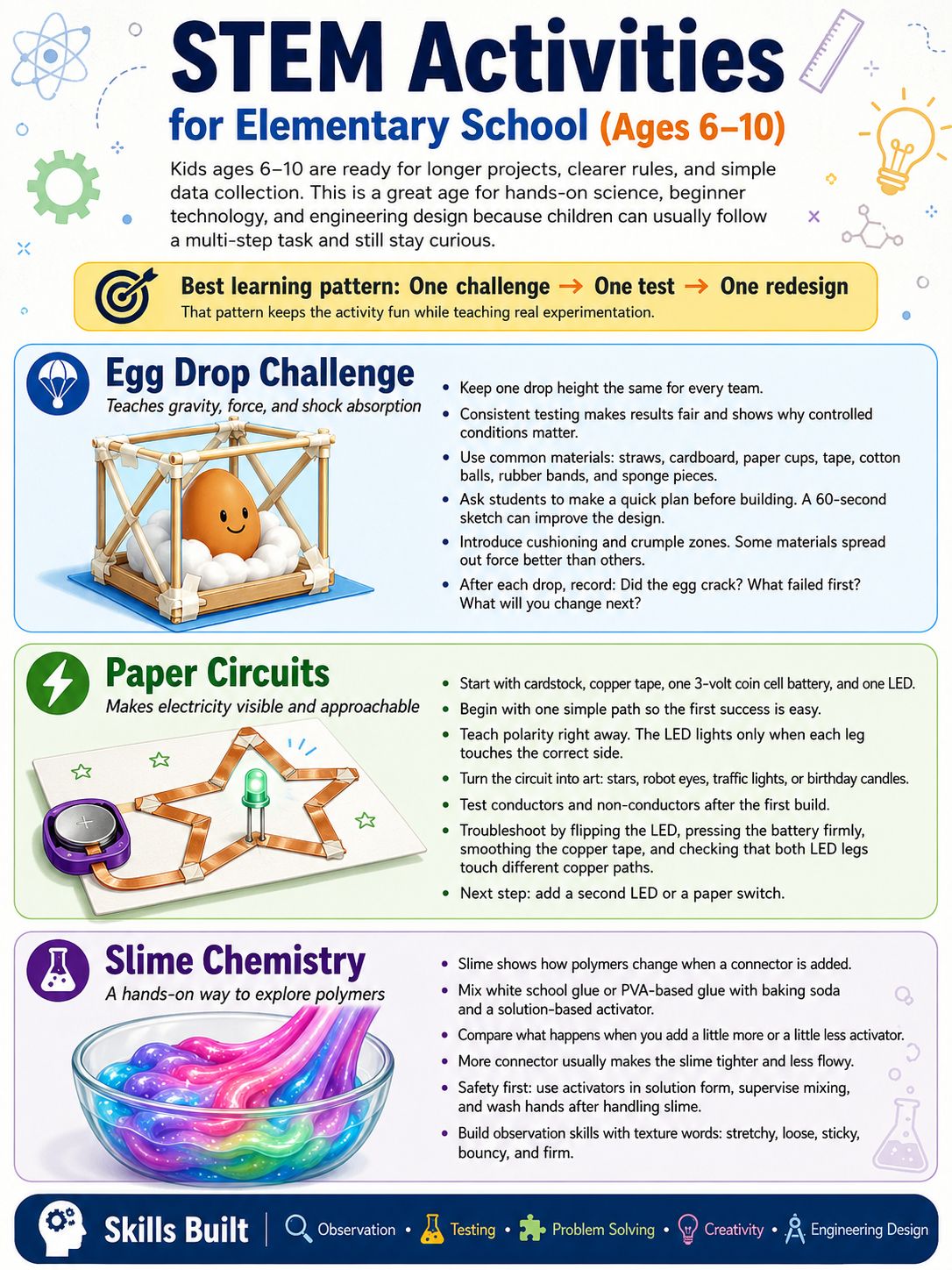
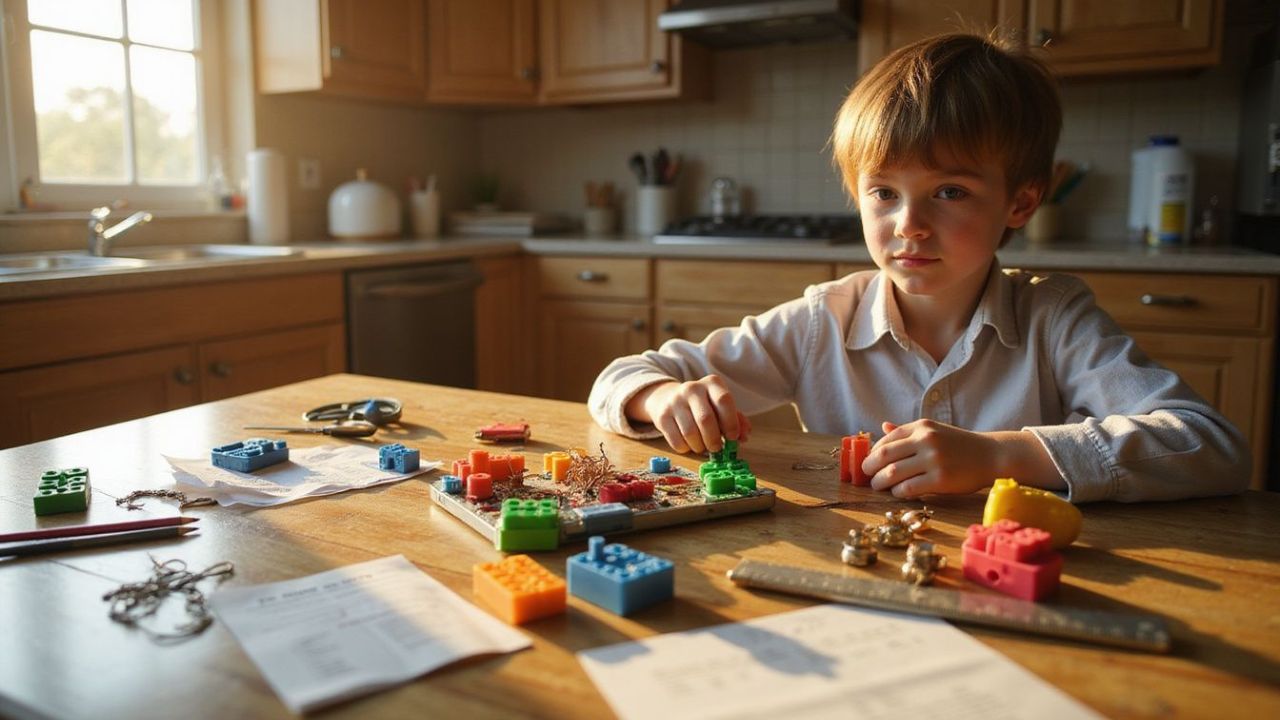
Kids ages 6 to 10 are ready for longer projects, clearer rules, and simple data collection. This is a great age for hands-on science, beginner technology, and engineering design because children can usually follow a multi-step task and still stay curious.
The sweet spot here is one challenge, one test, then one redesign. That pattern keeps the activity fun while teaching real experimentation.
Egg Drop Challenge
The egg drop challenge is popular for a reason. It turns gravity, force, and shock absorption into something kids can see and improve with each round.
- Set one drop height and keep it the same for every team. Consistent testing makes the results fair and helps students understand why controlled conditions matter.
- Use common materials like straws, cardboard, paper cups, tape, cotton balls, rubber bands, or sponge pieces. Science Buddies uses this same kind of low-cost supply mix, which is helpful because you can run the challenge without buying specialty gear.
- Ask students to plan before they build. A 60-second sketch often leads to better designs because kids start thinking about where the egg will sit and what part of the structure should absorb impact.
- Introduce the ideas of cushioning and crumple zones. Kids do not need advanced physics to understand that some materials spread out the force better than others.
- After each drop, have teams record three things: whether the egg cracked, what part failed first, and what they will change next. That small reflection step turns a fun stunt into actual engineering design.
Paper Circuits
Paper circuits make electricity feel approachable because kids can see the full path on the page. A standard 3-volt coin cell battery, copper tape, and one LED are enough to create a real working circuit.
- Start with one simple path on cardstock using copper tape, a coin cell battery, and one LED. This keeps the first win easy, which matters because early success builds confidence fast.
- Teach polarity right away. The LED has a long side and a short side, and it only lights when each leg touches the correct side of the circuit.
- Use drawings that make the circuit feel like art. Students can turn stars, robot eyes, traffic lights, or birthday candles into a working design, which blends creativity with engineering.
- Have kids test conductors and non-conductors after the first build. Copper tape usually works reliably, while gaps, loose contact, or the wrong battery position stop the current.
- Keep a short troubleshooting list nearby: flip the LED, press the battery more firmly, smooth the copper tape, and check that both LED legs touch different copper paths. Those are the fixes that solve most failed builds.
- Once one light works, challenge students to add a second LED or a paper switch. That is the moment when they shift from following directions to designing a real circuit.
Slime Chemistry
Slime is more than a sensory activity. It gives elementary students a hands-on way to see how polymers change when a connector is added, which is why the texture shifts from runny to stretchy.
- Mix white school glue or a PVA-based glue with baking soda and a solution-based activator. In the American Chemical Society’s kids’ chemistry materials, the “chemical connector” idea is used to show why the slime thickens and stretches.
- Let students compare what happens when they add a little more or a little less activator. More connector usually makes the slime tighter and less flowy, which gives kids an easy variable to test.
- Set clear safety rules before you begin. Use activators in solution form instead of loose powder, supervise mixing, and have everyone wash hands after handling slime.
- Ask students to describe the texture with words like stretchy, loose, sticky, bouncy, or firm. That builds observation skills and makes the science feel more concrete.
STEM Activities for Middle School (Ages 11–13)
Middle schoolers are ready for bigger challenges and a little more independence. They still love fast feedback, but they can also handle planning, revising, and explaining why a design worked.
This is a great age for projects that mix creativity with data, especially when students can test several versions in one class period.
Block Coding with Scratch
Scratch works especially well for this age because students can focus on logic before worrying about typing every symbol correctly. Scratch is designed for ages 8 to 16 and is available in more than 40 languages, so it feels welcoming instead of intimidating.
- Start with a simple game that uses movement, scoring, and one goal. That gives students a fast win while teaching sequencing, loops, and conditionals.
- Ask students to build one feature at a time, such as movement first, then score, then sound. Small milestones reduce frustration and make debugging easier.
- Use sprite collisions and timer blocks to teach logic without heavy jargon. Students can see cause and effect on the screen right away.
- After one successful project, have teams remix a partner’s game. This is a great way to introduce collaboration, code reading, and respectful feedback.
Popsicle Stick Bridge Building
Bridge building is one of the best middle school engineering activities because students can see forces at work without expensive equipment. It also rewards patience, since small changes in joint placement can change the final strength a lot.
- Build miniature bridges with popsicle sticks and wood glue, then let the glue cure fully before testing. Rushing the drying step is one of the quickest ways to get misleading results.
- Introduce tension and compression in plain language. One part of a bridge gets pulled, another gets squeezed, and students can often predict failure points once they know what to watch for.
- Use triangle-based truss patterns when students want stronger designs. Triangles help spread forces more evenly than a simple flat frame, which is why they show up so often in real bridges.
- Test with repeatable weights such as coins, washers, or sandbags. Using the same weight units makes it easier to compare team results fairly.
Straw Rocket Engineering
Straw rockets are fast, cheap, and surprisingly rich in science. NASA’s classroom version encourages students to keep modifying the rocket to make it fly farther, which is exactly the kind of quick test cycle middle schoolers enjoy.
- Build several paper rockets and change one feature per round, such as fin size, nose shape, or body length. Keeping one variable steady makes the results easier to read.
- Teach the four basic flight forces in plain words: thrust pushes the rocket forward, drag slows it down, lift affects motion through air, and gravity pulls it back down.
- Use fins as a design conversation, not just a decoration. Students quickly notice that rear fins usually stabilize the flight better than random placements.
- Measure distance with a tape and record launch angle for each test. Even a simple data table makes the activity feel more like real engineering.
Planning note for teachers: A full straw rocket lesson can stay low cost and still fit one class period. For 24 students working in 8 teams, materials totaled $18.40, including paper, straws, tape, cardstock, nose pieces, and one reusable launch tube. That works out to about $2.30 in consumables per team. Teacher prep took about 20 minutes to cut templates and build the launch tube. In a 45-minute class, teams were typically able to complete about three design iterations within 30 minutes of testing, which makes this activity easy to run as a fast engineering cycle.
STEM Activities for High School (Ages 14–18)
High school STEM should feel closer to real work. Students this age can handle data quality, technical documentation, coding tools, and design tradeoffs, so the best projects move past demos and into evidence.
You do not need a fancy lab for that. You just need a project that asks students to collect information, make decisions, and defend those choices.
Environmental Data Testing
Local water testing is a strong high school project because students gather real data and compare it with meaningful benchmarks. For context, the EPA uses a freshwater pH reference range of 6.5 to 9 for aquatic life, and drinking water treatment rules use very low turbidity targets, which quickly shows students why both chemistry and cloudiness matter.
- Collect water samples from at least three local sites and label each bottle with date, time, location, and weather conditions. Good labeling matters because weak records make the data much less useful later.
- Measure pH with strips or a digital meter and log every reading in the same format. A shared spreadsheet keeps the class data organized and easier to graph.
- Measure turbidity with a turbidity tube or meter and report the result in NTU if your equipment allows it. That gives students a concrete way to compare water clarity across sites.
- Discuss why raw surface water and finished drinking water are not the same thing. This is a useful distinction, because students often assume one cloudy sample means the water is automatically unsafe.
Advanced Coding Projects (Python, C++)
By high school, students can move from beginner logic to tools that look much more like professional practice. Python is a strong entry point for automation and data work, while C++ is useful when students want faster, lower-level control for robotics or embedded systems.
- Start with Python scripts that read files, clean input, or log sensor data. These are practical wins that teach syntax, variables, functions, and debugging without a huge setup.
- Use C++ for microcontroller or robotics builds when students need speed and hardware control. It gives them a taste of memory handling and stricter syntax, which is valuable if they plan to keep coding.
- Ask students to build a small tool with a real job, such as a quiz app, a weather-data parser, a study timer, or a command-line calculator. Real purpose makes the code feel less abstract.
- Bring in Git early, even for short projects. Version control helps students save progress, test changes safely, and collaborate without overwriting each other’s work.
Engineering Design Competitions
Competitions are valuable because they add deadlines, rules, limited materials, judging criteria, and teamwork. Those are the exact pressures that turn a class project into something closer to college or career work.
- FIRST Robotics is a strong fit for students who want the full package of design, coding, fabrication, strategy, and presentation. As of the 2026 season, FIRST says 600 Robotics Competition teams will attend the FIRST Championship, which gives students a clear sense of the scale and seriousness of the program.
- Use NSBE pre-collegiate programs when students would benefit from mentorship, academic support, and a stronger bridge into engineering pathways. The network element can matter just as much as the build itself.
- Choose competitions with clear rubrics. When students know whether they are being judged on speed, innovation, documentation, or cost control, they make better design decisions.
- Assign team roles early, such as CAD lead, coder, builder, documenter, and presenter. Clear roles reduce confusion and help quieter students contribute in meaningful ways.
STEM Activities for All Ages
Some STEM projects work beautifully across a wide age range because you can scale the questions, not just the supplies. A preschooler can observe and describe, while a teen can measure, graph, and compare results from the same basic setup.
That makes these activities especially useful for families, mixed-age groups, camps, and classrooms that need flexible options.
Tornado in a Bottle
This activity is quick, cheap, and easy to repeat. NOAA explains that the vortex forms because the spinning motion and gravity work together, letting water drain faster while air moves back into the top bottle.
- Fill one clear bottle with water, connect it securely to another bottle, then flip and swirl. The funnel shape appears fast, which makes this a great opener for mixed-age groups.
- Use the first trial just for observation. Ask younger kids what they see, and ask older kids why the water drains faster once the vortex forms.
- Time how long the water takes to drain with and without swirling. That simple comparison turns a neat visual into measurable data.
- Add glitter or a drop of dish soap if you want the vortex to stand out more clearly. This helps younger learners track the motion with their eyes.
DIY Newton’s Cradle
A homemade Newton’s cradle is a simple way to show momentum and energy transfer. The cleanest results usually come from matching balls hung at the same height with equal string lengths.
- Gather five similar balls, string, a frame, tape, and scissors. Matching size and mass matter because uneven balls make the transfer look messy and confusing.
- Cut the strings to the same length and hang the balls so they just touch at rest. This alignment is the part worth taking your time on.
- Pull back one ball and release it. Kids can immediately see that motion transfers through the line and sends the ball on the far end outward.
- Scale the questions by age. Younger kids can count swings, elementary students can compare one-ball and two-ball starts, and older students can talk about momentum conservation and small energy losses to sound and friction.
- Try one controlled change, such as slightly wider spacing or a different ball material. Students quickly see how sensitive the system is to setup quality.
Solar Oven S’mores
This project mixes engineering, renewable energy, and a snack, which is why it stays popular. NASA Climate Kids recommends using a sunny day of at least 85 degrees Fahrenheit and preheating the oven for at least 30 minutes, so timing and weather really do affect the outcome.
- Build the oven with a pizza box or cardboard box, aluminum foil, clear plastic wrap, black paper, tape, and a stick or ruler to hold up the flap. The black surface helps absorb heat, while the foil reflects more sunlight into the box.
- Place the oven in direct sun and keep the reflector angled toward the light. Small angle adjustments can make a noticeable temperature difference.
- Use a thermometer if you can. Older kids get more from the activity when they can track temperature changes instead of guessing.
- Plan for waiting time. NASA’s kid-friendly s’more version notes that marshmallows often take about 30 to 60 minutes to get squishy enough, depending on sunlight and outdoor temperature.
- Scale the task by age. Little kids can help assemble ingredients, elementary students can record temperature changes, middle schoolers can compare insulation ideas, and high schoolers can test efficiency across different oven designs.
Final Thoughts
STEM Activities By Age Group make it much easier to choose projects that fit a child’s skills, curiosity, and attention span. Preschoolers do best with short sensory investigations, while elementary kids are ready for circuits, chemistry, and simple engineering tests.
Middle and high school students can take on coding, bridge design, data collection, and real competitions. Start with one activity, keep the supplies simple, and give kids room to test, adjust, and try again.
FAQs about STEM Activities By Age Group
1. What STEM activities suit the preschool age group?
Start with simple, hands-on play for the preschool age group, like stacking, pouring, and sorting, to teach cause and effect. These STEM activities build curiosity, fine motor skills, and early number ideas.
2. How do I pick STEM activities for the elementary age group?
Pick short experiments and playful projects, such as circuits with safe parts, plant growth studies, and basic coding games. Let kids test ideas, fail, tweak them, try again, that is how learning sticks. Match tasks to the child’s skill level and interest.
3. What STEM activities fit the middle school age group?
Use hands-on projects that ask them to design, build, and test, including small machines, data collection work, and coding challenges.
4. How do I choose STEM activities for the high school age group and prepare for careers?
Use project-based STEM activities for the high school age group that mirror real work, with open investigations, data analysis, and team roles. Add mentoring, internships, and coding tools to bridge school and work. Teach them to present findings clearly, so their ideas land, and doors open.