The first local AI demo can make an API bill look almost insulting. A model downloads. The GPU wakes up. Someone types a prompt, gets a decent answer, and looks around the room as if the company has just discovered free electricity. “Why are we paying an AI provider when we can run this ourselves?”
I understand the reaction. Hosted-model spending is painfully visible. Every million tokens has a price. Usage rises, the invoice follows, and finance has one clear number to question.
Self-hosting feels different. The weights may cost nothing to download. The server already exists, or perhaps someone has found a GPU rental that looks affordable. The team runs a few tests, multiplies an hourly rate by expected usage, and decides the economics are obvious.
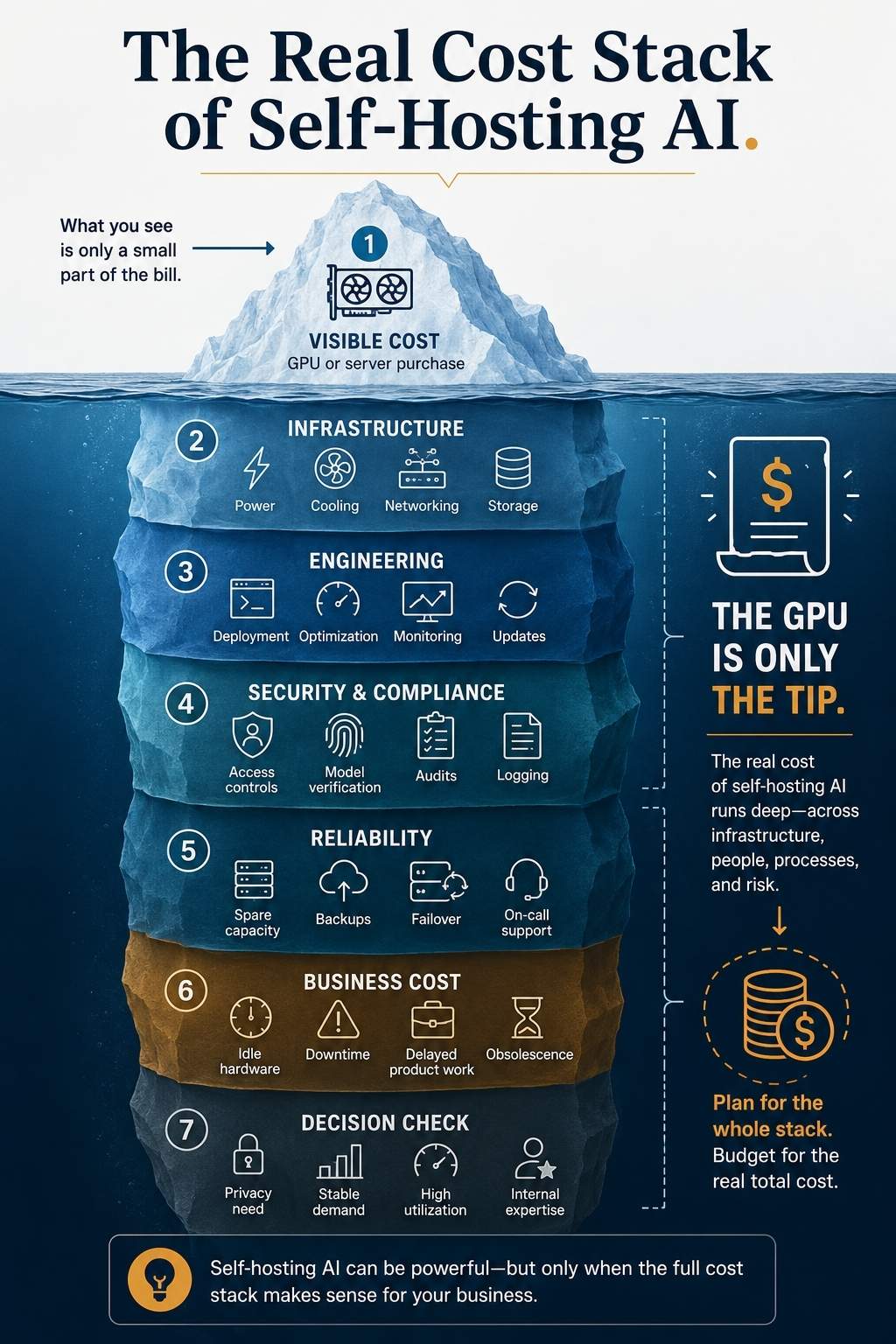
They rarely are. The self-hosting AI costs do not disappear when the API is removed. They break apart and move into budgets that nobody initially labels “AI.” Hardware goes into capital expenditure. Electricity disappears into facilities. Engineers lose days to serving infrastructure. Security inherits another system. Legal reviews the license. Product waits for performance fixes. Finance sees a collection of ordinary expenses instead of one uncomfortable invoice.
The total may be lower. In the right situation, it genuinely can be. But a successful local demo proves only that a model can produce an answer. It does not prove that your company can operate that model reliably, securely, concurrently, and economically. That distinction is where most self-hosting calculations begin to fall apart.
The Demo Leaves Out the Expensive Part
A downloadable model is not a production service. That sounds obvious, yet a surprising amount of AI planning treats the model file as if it were the product. In practice, it is one component in a system that also needs authentication, access controls, storage, networking, logging, monitoring, rate limits, backups, evaluation, model routing, incident response, and some way to recover when the process dies at the worst possible moment.
The local demo does not need most of that. It has one user. The prompt is short. Nobody has promised a service-level agreement. If the application crashes, someone restarts it. If the answer is slow, the team waits. If the output quality changes after an update, the consequences are limited.
Production removes those comforts. Real users arrive at the same time. They paste long documents. They generate long answers. They retry requests. They expect the service to remain fast when traffic rises, and they do not care that a particular driver version has developed an attitude problem.
Once a system matters to the business, it needs an owner. It also needs people who can answer awkward questions. Who receives the alert at night? Who decides whether to roll back a model? Who knows why latency doubled? Who investigates a suspicious model file? Who proves that sensitive prompts are not being retained in logs?
The weights may be open. The responsibility is entirely yours.
Running AI Locally Cost More Than the GPU Quote
Most conversations about the running AI locally cost begin with the graphics card. That is reasonable, but it encourages people to treat the card as the whole machine. It is not.
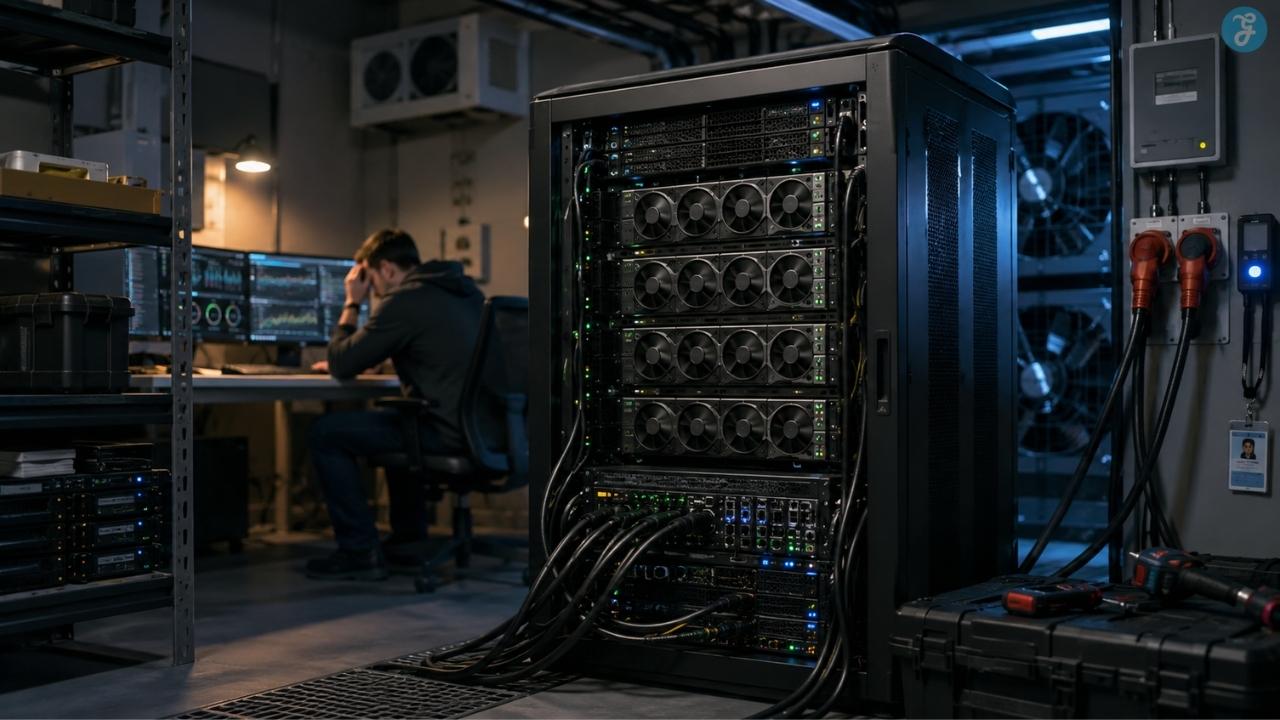
A production deployment may also need CPUs, system memory, fast storage, networking, power supplies, rack space, cooling, monitoring hardware, and redundant capacity. Larger models can require several GPUs connected through high-speed interconnects. Multi-node systems add switches, orchestration, distributed communication, and more ways for the system to misbehave. The physical requirements can become serious quickly.
NVIDIA documents a maximum power input of 10.2 kilowatts for its eight-GPU DGX H100/H200 system. At the U.S. commercial electricity average reported for April 2026, running continuously at that maximum would cost roughly $12,000 a year in electricity.
That is an illustrative upper bound, not an expected annual bill. Actual draw depends on utilization. It also excludes cooling, facility losses, storage, networking, financing, and maintenance. The point is not that every company needs a DGX. Most do not.
The point is that hardware power figures are only the first visible layer. A company can become fixated on whether a server costs $8,000, $80,000, or several hundred thousand dollars while barely discussing the employees who will spend the next three years operating it.
The electricity meter is easy to read. The cost of interrupted engineering work is not.
Idle Capacity Is Where the Cheap-Inference Story Gets Uncomfortable
Self-hosting works best when expensive hardware stays busy. That sounds simple until traffic stops behaving like a spreadsheet average. A company can size its infrastructure for typical demand, in which case performance may collapse during busy periods. Or it can size for peak demand and accept that a large portion of the hardware will sit underused during quieter hours.
Neither option is free. Hosted providers can spread capacity across many customers. One customer slows down while another becomes active. A private deployment has a much smaller pool, and its demand may arrive in bursts.
An internal assistant may be busy during office hours and nearly silent overnight. A customer-facing product may experience sudden peaks after an email campaign or product launch. A document-processing system may sit idle for hours and then receive thousands of files. The expensive GPU waiting for traffic is still being financed. It still occupies space. It still needs maintenance and redundancy.
Cloud GPU autoscaling can reduce some waste, but it introduces its own work. Models take time to load. Warm capacity protects latency but costs money. Aggressive scale-down saves money but can produce miserable cold starts. Capacity may not be available exactly when the system needs it.
This is why direct comparisons between API prices and GPU-hour prices often tell only half the story. Utilization, context length, output length, concurrency, batching, caching, latency targets, and traffic patterns can change the answer completely.
When someone says self-hosting is cheaper, I want to know one thing before I believe them: Cheaper at what utilization? Without that answer, the calculation is unfinished.
A Model That Fits Is Not Necessarily a Service That Works
Local-model discussions often focus on whether a particular model fits in GPU memory. That is useful for getting started. It is not enough for deciding whether the deployment can support a real product.
Google’s current memory estimates for its 31-billion-parameter Gemma 4 model show why the hardware discussion can change dramatically with precision. The estimated inference memory falls from about 58.3 GB at BF16 to roughly 17.4 GB at 4-bit precision.
That is a major saving. Quantization can turn an impractical deployment into a realistic one. But the model weights are not the only thing consuming memory.
The serving runtime needs space. Active requests need space. Long context windows expand the KV cache. Concurrent users compete for the same memory. A model that runs nicely for one person may become painfully slow or start rejecting requests when many users arrive together.
vLLM’s documentation treats KV-cache capacity and maximum request concurrency as explicit deployment constraints. It also explains how spreading a model across more GPUs can free memory for the cache, while warning that additional parallelism can introduce synchronization or latency penalties.
That is the production reality in miniature. Solving one bottleneck often creates another. The question is no longer: “Can we run the model?” It becomes: “How many real requests can we serve at the latency our users will tolerate?”
That answer requires load testing, not optimism.
Quantization Is an Engineering Choice, Not a Magic Discount
I am strongly in favor of smaller and quantized models when they can do the job. Using the largest model available for every workflow is not sophistication. It is often a substitute for thinking carefully about the task.
A focused model, paired with good retrieval, sensible prompts, structured outputs, and clear constraints, can be much cheaper and faster than a giant general-purpose system. Still, compression is not a free lunch.
A team has to test whether a quantized version remains dependable for its actual use case. A small average benchmark loss may hide important failures in long-context work, uncommon languages, tool use, calculations, structured output, or industry-specific terminology.
Hardware and software support also vary. A quantization format may be highly optimized on one GPU and awkward on another. The serving engine may support it technically without delivering the throughput the team expected.
There is only one useful question: How far can we reduce the model before the product becomes noticeably worse? Answering it takes evaluation data, engineering time, and usually human review. That cost does not appear in the download button.
The Real OSS AI TCO Sits in Payroll
The most common mistake in an OSS AI TCO calculation is treating internal labor as free. A company may not hire a dedicated team for its self-hosted model. Instead, the work is divided among people who already have jobs.
A platform engineer spends two days fixing deployment problems. An ML engineer tunes batching and memory use. A security analyst reviews the model supply chain. A developer builds authentication and logging. Legal checks the license. Product creates regression tests. Someone becomes the unofficial on-call person because they were the one who originally made the demo work. The costs are real even when no new job title appears.
U.S. Bureau of Labor Statistics data puts the May 2024 median annual wage at $133,080 for software developers, $124,910 for information-security analysts, and $96,800 for network and computer systems administrators. Those figures do not include benefits, equipment, recruitment, management, or other employer costs.
A relatively small share of an experienced engineer’s time can cost more than the annual electricity used by a server. More importantly, that engineer is not doing something else.
The opportunity cost is rarely included in the original self-hosting proposal. It should be. A technically successful deployment can still be a poor business decision if it turns the company’s strongest engineers into part-time infrastructure maintainers.
Sometimes the API premium is not just a charge for inference. It is the price of keeping your own team focused.
Your Best AI Engineer May Become a Very Expensive Plumber
Infrastructure work has a way of arriving without ceremony. A CUDA update conflicts with a library. A container behaves differently in production. A model uses more memory than expected. One node cannot communicate properly with another. A new release improves throughput but changes output quality. Latency rises, the dashboards show the symptoms, and nobody immediately knows the cause.
None of this proves that self-hosting is a mistake. It proves that self-hosted inference is infrastructure. Tools such as vLLM are powerful precisely because production serving is complicated. They support tensor parallelism, pipeline parallelism, KV-cache management, multi-node scaling, and detailed performance controls.
Every capability a company uses becomes something it must understand well enough to operate. That may be worthwhile when AI infrastructure is part of the company’s advantage. A business building a specialized inference platform should probably own deep serving expertise.
The calculation looks different for a company whose core product is logistics, publishing, insurance, or legal workflow software. If the internal AI system is useful but not strategically distinctive, the company should ask whether maintaining its own serving stack is the best use of scarce technical attention.
Control feels valuable in architecture diagrams. It can feel much less valuable while debugging a failed deployment at midnight.
Privacy Moves Risk. It Does Not Remove It
Privacy is one of the best reasons to consider self-hosting. Some information should not be sent to an external service. Regulated data, sensitive legal material, government records, proprietary research, and internal financial information may require tighter control, local processing, or strict data residency.
In those environments, self-hosting can be worth the cost even when it is not the cheapest option. But keeping the model behind a firewall does not make the system secure by default.
Prompts may still appear in logs, backups, monitoring tools, vector databases, debugging traces, and support systems. Internal users may have excessive access. An AI application connected to company tools can still expose data or take unsafe actions. Prompt injection does not stop at the building entrance. The model files also become part of the software supply chain.
Hugging Face warns that loading pickle-based files can enable arbitrary code execution and recommends using trusted sources, signed commits, or safer formats where possible. That warning matters because self-hosting often involves downloading weights, tokenizers, libraries, containers, adapters, and community-created quantizations from several places.
A company may bring a model inside to reduce vendor risk while quietly introducing a new collection of dependency and supply-chain risks. “Nothing leaves our network” is a meaningful privacy statement. It is not a complete security plan.
Open Weights Do Not Mean No Legal Work
The AI industry often uses “open source” as a loose synonym for “downloadable.” That is not always accurate. The Open Source Initiative defines open-source AI around the freedoms to use, study, modify, and share a system, along with access to the preferred form needed to make meaningful modifications.
Many popular models are better described as open weight. Their parameters can be downloaded, but the surrounding licenses, training information, restrictions, and modification rights vary.
Some models use permissive licenses. Others use custom community terms or acceptable-use rules. Conditions may apply to commercial deployment, redistribution, attribution, derivative models, or particular uses. This does not make those models unusable. It means someone has to read the terms.
License review belongs in the self-host AI hidden costs discussion because mistakes can become expensive after a model is already embedded in a product. The company should know whether it can commercially deploy the model, modify it, redistribute it, offer it through a service, or move to a future version under different terms.
A public model card does not eliminate private legal work.
Every Model Upgrade Creates More Work Than “Swap the Weights”
One of the attractions of self-hosting is control over updates. A provider cannot suddenly change the model behind an API without the company noticing. The self-hosting team can hold a stable version, test a replacement, and decide when to move. That control is valuable. It also creates a permanent evaluation job.
A new model or quantization may improve one task and harm another. Prompt templates may behave differently. Tool calling can regress. Structured outputs may become less reliable. Memory requirements can change. Retrieval quality may shift. Safety behavior may loosen or become overly restrictive.
Generic benchmarks do not answer whether the upgrade is safe for your users. The company needs its own test set, built from real tasks and real failures. It needs regression thresholds, reviewers, release procedures, documentation, and a rollback plan.
NIST’s Generative AI Profile treats trustworthiness as a lifecycle responsibility spanning the design, development, use, and evaluation of AI systems. That is the right framing. Evaluation is not something a team finishes before launch.
It becomes maintenance. For companies that rarely change models, the burden may remain manageable. For teams chasing each new release, it can become a continuous internal project.
Reliability Costs Money Even When the Spare Server Does Nothing
A single machine is enough until it fails. Once the AI service supports customers, employees, or important workflows, the company has to decide what downtime is acceptable. If the answer is “not much,” one server is no longer the real design.
The system may need multiple replicas, spare GPU capacity, load balancing, health checks, replicated storage, backups, failover procedures, monitoring, and an on-call response.
Some of that infrastructure will sit idle during normal operation. That is not waste. It is the cost of reliability. A simplistic cost-per-token calculation will treat the spare capacity as inefficient because it produces no tokens most of the time.
The business will view it differently when the primary server fails. Hosted providers fail too. They impose rate limits, change prices, retire models, and experience outages. Vendor dependency is a legitimate concern.
The difference is not that one option has risk and the other does not. The difference is which risks the company wants to own.
Owning GPUs Means Betting on Tomorrow’s Workload
Buying hardware converts an operating expense into a commitment. The company is betting that demand will remain high enough, long enough, to justify the purchase. It is also betting that the hardware will remain useful as new accelerators, smaller models, better quantization methods, and cheaper hosted services appear.
That is not an easy forecast in AI. A server that looks efficient today may feel dated sooner than expected. The product may change. The traffic may never arrive. A smaller model may suddenly match the old model’s quality at a fraction of the cost.
Cloud and API providers charge a margin partly because they carry more of that utilization and obsolescence risk. Self-hosting can produce lower unit costs when the workload is steady and the equipment remains busy. It can produce painful economics when usage is uncertain.
Depreciation belongs in the TCO model. So does the possibility that the machine will be technically functional and financially obsolete.
When Self-Hosting Actually Makes Sense
After all of that, I still believe self-hosting can be the right decision.
The strongest cases usually have at least one hard requirement:
- Data cannot leave a controlled environment.
- The system must operate offline or in a restricted network.
- Local latency matters.
- Usage is consistently high and predictable.
- The company already has capable infrastructure and security teams.
- A specialized model creates a real competitive advantage.
- Vendor dependence presents an unacceptable strategic risk.
- Regulatory or residency requirements make external processing impractical.
The economics improve when several of those conditions overlap. The case weakens when the workload is small, unpredictable, or still experimental. It also weakens when the company lacks people who understand production inference, security, and model evaluation.
A useful proof of concept does not automatically justify a permanent platform. Before buying hardware, I would want the team to measure actual traffic, latency needs, prompt and output lengths, concurrency, growth expectations, required uptime, and engineering ownership.
Then I would compare at least three options: A managed API, a managed dedicated endpoint, and a self-operated deployment.
The goal is not to prove that self-hosting wins. The goal is to find out whether it does.
Calculate the Cost of the Service, Not the Price of the Model
A credible self-hosting calculation should include: Hardware or cloud GPU capacity, electricity, cooling, networking, storage, facilities, integration, security, AI observability, evaluation, model updates, redundancy, idle capacity, financing, depreciation, downtime, and engineering time. Effective AI observability helps teams understand how models behave in production by tracking performance, latency, reliability, usage patterns, and potential issues before they impact users.
Then the total should be divided by something the business values. Completed workflows. Reliable requests. Active users. Documents processed correctly. Hours saved. Revenue supported. Raw tokens are useful for billing. They are not always the best measure of value.
A cheap token that creates unreliable work is not cheap. A self-hosted model that reduces inference spending but consumes the platform team may not save money. A hosted API that allows the company to launch months earlier may be the less expensive choice even at a higher unit price.
TCO is not a contest between a GPU and an API invoice. It is a decision about where the company wants its money, attention, and operational risk to live.
You Did Not Escape the AI Vendor; You Became One
This is the part I think many teams understand too late. Removing the provider does not remove the provider’s job.
Your company becomes responsible for capacity, uptime, security, access, monitoring, upgrades, evaluation, incident response, and cost control. The internal product team now depends on you in the same way it once depended on an external vendor. That can be strategically powerful. It can also be a spectacular distraction.
The self-hosting AI costs are easy to underestimate because no single invoice captures them. The spending gets divided among hardware, facilities, salaries, security reviews, legal work, delayed product development, and the capacity kept ready for the day something fails.
Self-hosting should be chosen because the workload, privacy requirements, utilization, and business strategy justify owning those responsibilities. It should not be chosen because one API bill looked offensive.
Running a model locally is easier than it has ever been and running it as a dependable service is still a business.