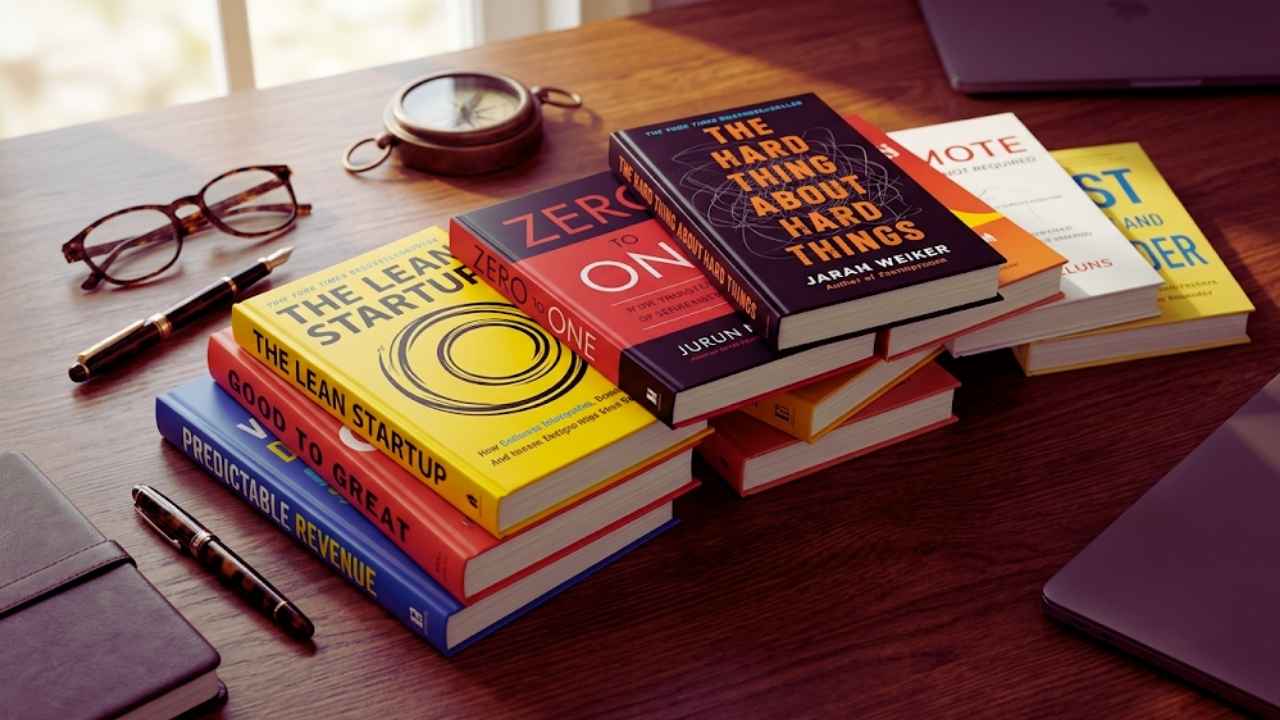
A founder can waste a lot of time reading the right book at the wrong stage. That is the problem with most startup reading lists. They mix customer discovery, fundraising, growth, leadership, and big-company strategy as if all of that advice matters equally on day one. It does not. A founder still trying to prove demand needs different guidance from a founder hiring managers or choosing a growth channel.
Best startup books founders can use to make better decisions, not just books that sound impressive on a shelf. Some are classics. Some are short and tactical. A few are only useful once the company has real traction.
The order follows a practical founder path: Learn from customers, test the idea, find traction, sharpen positioning, cross into a wider market, then handle the harder leadership and scaling problems.
For bootstrapped SaaS founders, this pairs naturally with the upcoming Growth Tactics for Bootstrapped SaaS. Books can improve judgment. A growth plan turns that judgment into weekly action.
How This Founder Reading List Was Ranked?
The ranking is based on usefulness at different startup stages, not popularity alone.
Early founders usually need less inspiration and more evidence. They need to know whether customers care, whether the problem is urgent, whether the first market is narrow enough, and whether any growth channel is worth serious effort.
| Founder Stage | Main Question | Best Reading Focus |
| Idea validation | Do people really have this problem? | Customer conversations |
| Early testing | Which assumption could kill the idea? | Lean validation |
| First users | Where will customers come from? | Traction channels |
| Sales confusion | Why do buyers not understand the product? | Positioning |
| Wider adoption | Can this move beyond early users? | Market strategy |
| Team pressure | How do I lead when choices are ugly? | Management |
| Scaling | What breaks as the company grows? | Operating systems |
| Long-term strategy | What makes this company meaningfully different? | Strategic thinking |
The best founder reading list should reduce waste. If a book does not help a founder decide, focus, sell, or lead better, it does not belong near the top.
What Most Startup Book Lists Get Wrong?
Many lists push founders toward big strategic thinking before they have done enough unglamorous work.
That is risky. A founder who has not spoken to enough customers should not start with board management. A solo builder with no paying users does not need a complex hiring system. A founder whose homepage sounds vague may get more value from positioning than from another book about culture.
The better question is not, “Which startup books are famous?”
It is: “Which book fits the decision I need to make next?”
That is the logic behind this list.
1. The Mom Test by Rob Fitzpatrick
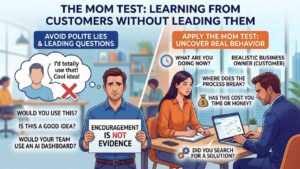
Most founders should start here because bad customer conversations are one of the cheapest ways to create expensive mistakes. The Mom Test is about learning from customers without accidentally leading them into polite lies. Founders often ask questions like, “Would you use this?” or “Do you think this is a good idea?” Those questions feel harmless. They are not. People want to be encouraging, especially when the founder is excited.
That kind of feedback can make a weak idea look alive. The book pushes founders toward conversations about real behavior. What are people doing now? What have they already tried? Where does the current process break? Has the problem cost them time, money, trust, or status? Did they search for a solution before?
A SaaS founder building reporting software, for example, should not begin with, “Would your team use an AI dashboard?” A better conversation would ask how reports are prepared today, who owns the work, what gets delayed, which mistakes create trouble, and whether the company already pays for tools or labor to solve it. That is less flattering than hearing, “Cool idea.” It is also much more useful.
This book is especially strong for first-time founders, technical founders who would rather build than interview, and teams getting compliments but no sales. It will not tell you what to build. It teaches you how to stop mistaking encouragement for evidence. That lesson belongs at the top.
2. Running Lean by Ash Maurya
Running Lean is for the founder who has an idea but too many unknowns. Its value is not in making a neat plan. Its value is in forcing the founder to break the business into assumptions: customer segment, problem, solution, value proposition, channel, revenue model, and key metrics. Once those pieces are visible, the team can stop treating the startup as one giant bet.
Early teams often test the easiest assumption, not the riskiest one. They polish the landing page when the real risk is willingness to pay. They add features when the real risk is urgency. They talk about pricing before they know who the early buyer is. The useful question is simple: what has to be true for this startup to work?
For a bootstrapped SaaS founder, that question is not academic. There may be no large ad budget, no big sales team, and no spare year to wander. Every month spent validating the wrong thing has a real cost.
Use this book when you need to:
- Turn a vague idea into testable assumptions
- Compare possible customer segments
- Decide what to test in the next few weeks
- Separate product progress from business progress
The warning: Do not let the canvas become decoration. A clean plan without customer evidence is still guesswork.
3. The Lean Startup by Eric Ries
The Lean Startup gave founders a common language for building under uncertainty: MVP, validated learning, build-measure-learn, pivot, and vanity metrics. Some of those terms are now overused. That does not make the book weak. It means founders need to read it carefully.
The strongest idea is that a startup should learn before it spends too much time and money committing to the wrong direction. That sounds obvious until a team spends six months building features for a buyer who was never urgent, never had budget, or never had authority.
For software founders, this book still matters because software creates a false sense of progress. Shipping features feels productive. Redesigning onboarding feels productive. Adding integrations feels productive. None of it proves demand by itself.
The book is less tactical than The Mom Test or Running Lean, so it should not be the only startup book an early founder reads. Read it for the operating mindset. Then use the more practical books on this list to sharpen the actual work: customer conversations, assumption testing, channel selection, and positioning.
A minimum viable product is not a poor-quality product. It is a focused learning tool. That distinction is where many founders go wrong.
4. Traction by Gabriel Weinberg and Justin Mares
A useful product can still die quietly if the founder cannot reach customers. Traction earns its place because it moves the founder’s attention from product building to customer acquisition. The book is known for its 19 traction channels and the Bullseye framework, which helps teams decide which channels to test seriously instead of chasing every new marketing tactic.
This is where many founders become scattered. One week they try SEO. Then cold email. Then LinkedIn posts. Then paid ads. Then partnerships. Activity goes up, but learning stays weak because nothing is tested clearly enough.
A better traction test needs boundaries:
- Which channel are we testing?
- Which customer segment are we trying to reach?
- What would count as a promising signal?
- How much time or money are we willing to spend?
- What will we stop doing if the test fails?
For a bootstrapped SaaS company, this thinking connects well with Growth Tactics for Bootstrapped SaaS. Traction gives the channel map. A practical growth plan helps turn that map into focused experiments. Do not try all 19 channels at once. That is not discipline. The book is most useful when it widens your thinking first, then forces you to narrow it.
5. Obviously Awesome by April Dunford
Some startups do not have a product problem. They have a positioning problem. That shows up in familiar ways. The homepage sounds vague. Sales calls take too long. Prospects compare the product to the wrong category. Users like one feature but cannot explain why the product matters. The founder keeps adding features because the offer itself is unclear.
Obviously Awesome is one of the strongest entrepreneur books for B2B software and technical products because it treats positioning as a business decision, not a copywriting exercise.
A weak positioning line might sound like this: “An AI productivity platform for modern teams.”
That could mean almost anything.
A clearer version might be: “Meeting follow-up software for customer success teams that need faster account updates after client calls.”
The second version gives the buyer, use case, and outcome. It is easier to sell because it is easier to understand.
This book becomes more useful after the founder has some real market evidence. If nobody has used or bought the product, positioning work can become imagination. But once a few real customers exist, the founder can study patterns: who buys fastest, what they compare the product with, what they stop using, and which problem they describe in their own words.
For SaaS founders, this book is underrated. Better positioning can improve the homepage, sales deck, demo flow, onboarding, pricing page, and content strategy.
6. Crossing the Chasm by Geoffrey A. Moore
Crossing the Chasm is not the book to read before your first customer interview. It becomes more useful when early traction is not turning into wider adoption. Early adopters are forgiving. They may try a product because it is new, technically interesting, or strategically useful. Mainstream customers are more cautious. They want proof, reliability, references, support, and a clear reason to switch.
That difference catches founders off guard. A product can excite early users and still feel too risky or unclear for the next group of buyers. The book’s most useful idea for founders is the beachhead market. Instead of trying to sell to everyone who could use the product, choose a narrow segment where the product can become the obvious answer.
For SaaS, this matters a lot. “For small businesses” is usually too broad. “Client document collection for independent accounting firms before monthly close” is narrower, but it gives the team a clearer buyer, clearer pain, clearer messaging, and a better chance at word-of-mouth within a defined market. Some examples in the book come from an older technology era, so readers should not copy every reference literally. The adoption logic is the valuable part.
Read it when you have signs of demand and need sharper market focus.
7. The Hard Thing About Hard Things by Ben Horowitz

This is not a book about finding your first users. It is a book about what happens when the founder’s job stops being clean. The Hard Thing About Hard Things deals with pressure: firing, hiring executives, making ugly decisions, managing fear, handling weak options, and leading when the company is not moving according to plan. A solo founder may not need every chapter immediately. But once a company has employees, investors, major customers, or serious cash pressure, the book becomes more relevant.
The reason it belongs on this founder reading list is that startup work eventually becomes management work. Building a product is not the same as building a company. A founder has to communicate clearly, make decisions with incomplete information, and protect the team from confusion without pretending everything is fine.
This book is also a useful antidote to overly clean startup advice. Many business books make decisions sound tidy after the fact. In real companies, the options are often uncomfortable. The founder may have to choose between speed and stability, loyalty and performance, transparency and panic, survival and comfort. Read this when leadership pressure becomes real, not when you are still trying to validate the first idea.
8. High Growth Handbook by Elad Gil
High Growth Handbook is valuable, but timing matters. A founder with no product-market fit should not spend much energy thinking about IPOs, late-stage funding, or board dynamics. That can become a sophisticated form of procrastination. But once the company is growing quickly, informal habits start to break.
This book focuses on scaling: The CEO role, executive hiring, recruiting, board management, M&A, IPOs, and late-stage funding. Some parts are more relevant to venture-backed companies than small bootstrapped teams, so founders should read selectively.
The useful sections help founders see what tends to break as a company grows:
- The founder becomes the bottleneck for every decision.
- Hiring becomes reactive instead of deliberate.
- Senior roles are filled without clear expectations.
- Communication that worked with five people fails with 50.
- The team keeps old habits after the company has changed.
For bootstrapped founders, this is not a book to follow page by page. It is a reference for when growth creates operating strain. Even a smaller SaaS company needs clearer hiring standards, better management rhythm, and stronger decision-making as the team expands. Keep this one for the scaling stage. Reading it too early can create unnecessary complexity.
9. Zero to One by Peter Thiel and Blake Masters
Zero to One is one of the most discussed startup books. It deserves a place here, but not as a beginner’s operating manual. The book is useful because it pushes founders to think about creating something distinct instead of copying what already exists. That matters in crowded markets where many startups describe themselves as a cheaper, faster, or slightly smarter version of an existing tool.
A startup should have a sharper reason to exist than “we can build this too.”
The caution is that beginners can misuse this book. Contrarian thinking can become an excuse to ignore customer evidence. Big strategic language can hide a weak understanding of the buyer. A founder may sound visionary while still being unable to explain the customer’s pain in plain words.
That is why this book is lower on the list. It is valuable, but it is better after customer discovery has made the founder more grounded. Read it as a strategy lens. Do not use it as a substitute for validation.
A Practical Reading Order for Busy Founders
Most founders do not need to read all nine books immediately. Read for the bottleneck in front of you.
Start with The Mom Test if you are still validating the problem. Move to Running Lean when you need to turn the idea into testable assumptions. Read The Lean Startup when you want the broader experimentation mindset. Pick up Traction when customer acquisition becomes the constraint. Read Obviously Awesome when buyers seem confused or your messaging sounds too broad.
After that, choose by stage.
Read Crossing the Chasm when early users are not turning into a wider market. Read The Hard Thing About Hard Things when leadership pressure becomes real. Use High Growth Handbook when hiring, management, and scaling problems start to appear. Read Zero to One when the company needs a sharper strategic point of view.
This order is more useful than treating every startup must-read as equally urgent.
Common Mistakes Founders Make With Startup Books
The first mistake is reading instead of acting. Books can become a safe place to hide from sales calls, customer interviews, pricing decisions, and uncomfortable product cuts.
The second mistake is applying late-stage advice too early. A two-person startup does not need the operating system of a 500-person company. Too much process can slow down the learning that still needs to happen.
The third mistake is copying examples without context. A developer tool, consumer app, marketplace, agency-style SaaS, and enterprise platform do not grow the same way.
The fourth mistake is treating books as proof. A smart book can improve your thinking. It cannot validate your market.
For SaaS founders working without a large budget, the useful path is to connect reading to action. After a book changes how you think, turn that lesson into one practical test. That is also the spirit behind Growth Tactics for Bootstrapped SaaS: fewer vague ideas, more focused execution.
Final Thoughts
The best startup books founders can read are not always the newest books or the loudest recommendations. They are the books that help founders make better decisions when uncertainty is high.
Start with the book that matches your current constraint. If you are still unsure whether people care, read about customer conversations. If you have interest but weak growth, study traction. If buyers seem confused, fix positioning. If the company is growing and the team is straining, move into leadership and scaling.
Do not turn the founder reading list into another task you keep postponing. Pick one book, apply one useful lesson, and let the market respond. That will teach you more than another month of passive reading.
Frequently Asked Questions (FAQs) About Best Startup Books Founders
What is the best startup book for first-time founders?
The Mom Test is the best starting point for most first-time founders because it helps them avoid one of the earliest mistakes: trusting polite feedback. Before building too much, founders need to learn how customers already handle the problem, what they have tried, and whether the pain is serious enough to change behavior.
Which startup book should SaaS founders read first?
For SaaS founders, The Mom Test and Running Lean are the strongest first reads. The Mom Test improves customer conversations, while Running Lean helps turn a SaaS idea into testable assumptions. Together, they reduce the risk of building features before proving demand.
Are startup books enough to build a successful company?
No. Startup books can improve judgment, but they cannot replace customer interviews, sales calls, product testing, pricing decisions, and real market feedback. The best approach is to read one book that matches your current problem, apply one or two lessons, and then measure what happens.
Which book is best for startup growth and customer acquisition?
Traction by Gabriel Weinberg and Justin Mares is the most useful book on this list for growth and customer acquisition. It helps founders think beyond one favorite marketing channel and test different routes to customers more deliberately.
When should founders read scaling books like High Growth Handbook?
Founders should read High Growth Handbook after the company has real traction and growth is creating operating problems. It is less useful at the idea stage. It becomes more valuable when hiring, management, executive roles, board communication, or organizational structure start to matter.
Is Zero to One a good book for beginner founders?
Zero to One can be useful for beginner founders, but it should not be the first operating manual. It is better as a strategy book after the founder has done customer discovery. Read it to think about uniqueness and long-term advantage, but do not use it as a substitute for validating real customer demand.