Founders are surrounded by advice, but most of it arrives without context. One person tells you to raise venture capital. Another tells you to bootstrap. Someone in a comment thread says your pricing is wrong after reading two sentences about your company.
That is the problem with founder isolation in public. You can be “connected” all day and still have nobody useful to pressure-test your decisions.
The best online founder communities give founders something more valuable than noise: peer judgment, honest feedback, tactical help, warm intros, launch visibility, accountability, and people who understand why a small product decision can ruin your week. Good communities make the founder less alone and more precise. Bad communities turn into self-promotion rooms with better branding.
This list focuses on founder forums, startup communities online, and entrepreneur groups that can actually help founders build, launch, sell, fundraise, or think more clearly. Some are open and free. Some are curated or paid. Some work best for SaaS founders, while others fit indie builders, no-code founders, VC-backed teams, or early-stage entrepreneurs still looking for the right people.
Our Selection Criteria
We selected these communities based on usefulness, access, and founder relevance, not just brand recognition.
A founder community can look active and still waste your time. The useful ones create better conversations, not just more notifications. They help founders find answers, meet peers, test ideas, get feedback, launch products, or stay accountable when building gets lonely.
We used these criteria:
- Founder relevance: The community needs to serve founders, startup operators, builders, makers, or entrepreneurs directly.
- Practical value: We looked for communities that help with feedback, accountability, fundraising, product launch, growth, peer support, or founder education.
- Access model: We included a mix of free, paid, open, private, and curated communities so founders can choose based on stage and budget.
- Signal quality: Strong moderation, founder density, topic focus, or curation mattered more than raw size.
- Stage fit: Some communities are better for idea-stage founders. Others fit bootstrapped SaaS, VC-backed startups, no-code builders, or scaling founders.
- Current usefulness: We prioritized communities with active current pages, clear positioning, or ongoing community infrastructure.
A good founder community should make you sharper. If it only makes you scroll more, it is probably not the right room.
Who This Founder Community List Is For
This guide is for solo founders, technical founders, non-technical founders, SaaS builders, indie hackers, early-stage startup teams, bootstrapped entrepreneurs, and founders preparing to launch, raise, or scale.
It is also useful for startup mentors, accelerators, and operators looking for founder forums or startup communities online to recommend. The right choice depends on what the founder needs right now: co-founder search, product feedback, growth help, investor awareness, accountability, launch visibility, or peer support.
13 Best Online Founder Communities for Smarter Startup Support
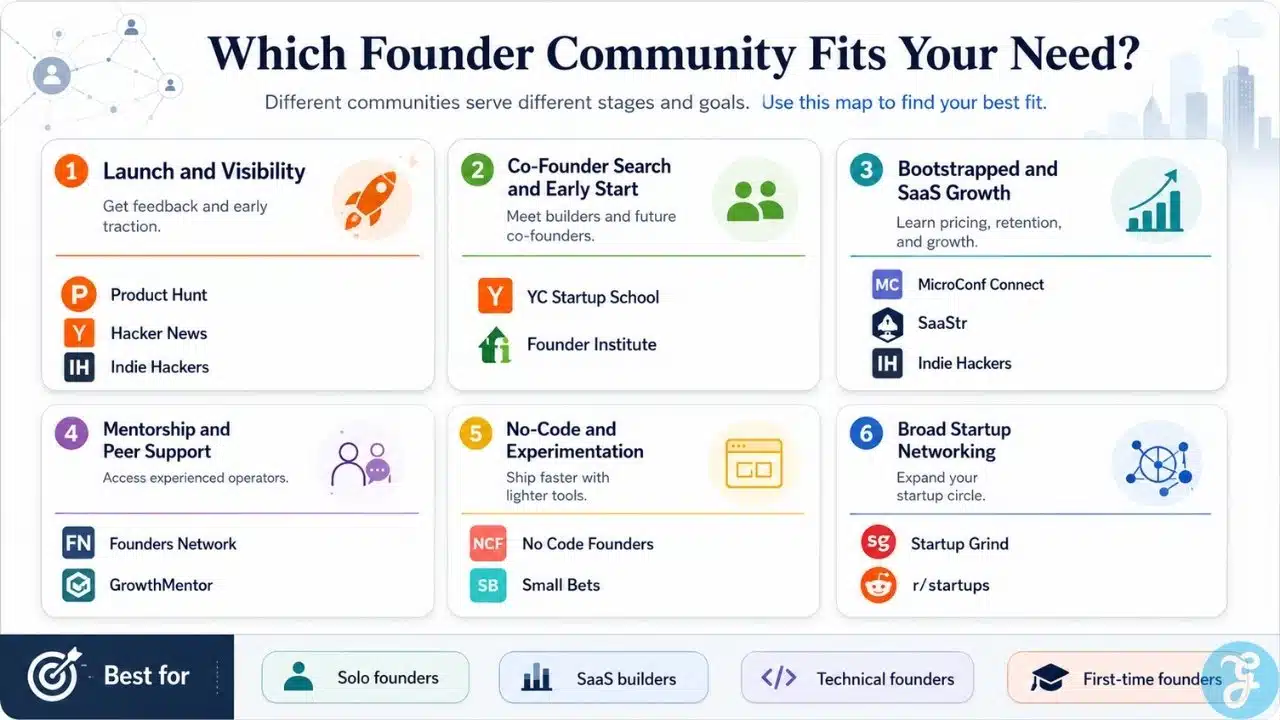
The communities below are not ranked as a universal hierarchy. A bootstrapped SaaS founder needs a different room from a founder looking for a co-founder, a Product Hunt launch, or VC feedback.
Use this list like a map. Pick the community that matches the problem you are trying to solve this quarter.
1. Indie Hackers
Indie Hackers is one of the strongest online homes for founders building profitable internet businesses, especially bootstrapped products, side projects, SaaS tools, newsletters, and creator-led companies. The community works well because the conversations tend to center on building, revenue, launches, customer acquisition, and the messy middle between idea and traction. It is especially useful for founders who want practical peer feedback without every discussion turning into venture capital theater.
Best Feature/For: bootstrapped founders, indie SaaS builders, and solo operators building profitable online businesses.
Why We Chose It:
- It has founder-focused discussions around revenue, growth, launches, and business-building.
- Its groups make it easier to find people working on similar problems.
- It works well for founders who want practical, non-VC-biased advice.
Things to consider:
- The quality varies by thread, so founders need to filter carefully.
- It is better for online businesses and software-style projects than local or heavily regulated businesses.
Indie Hackers is best when you are trying to build something real without pretending every company needs a billion-dollar outcome.
2. Y Combinator Startup School and Co-Founder Matching
YC Startup School is useful for early founders who want structured startup education, growth tracking, and access to YC’s co-founder matching platform. It is especially relevant for founders still looking for a co-founder or trying to sharpen the fundamentals before applying to accelerators, raising money, or building too far in isolation. The real value is not just the YC brand. It is the combination of startup learning, founder momentum, and access to a serious pool of people looking to build.
Best Feature/For: early-stage founders, co-founder search, and structured startup learning.
Why We Chose It:
- It gives founders access to YC-style startup education and tools.
- The co-founder matching platform is useful for founders who need the right building partner.
- It helps early founders think more clearly before pitching or applying to accelerators.
Things to consider:
- Not every connection will be high quality, so founder judgment still matters.
- It is most useful when the founder is actively building, not just browsing.
YC Startup School works best when you use it with urgency. Watching lessons without talking to users, shipping, or meeting potential co-founders will not move the company.
3. Founders Network
Founders Network is a curated community for full-time tech startup founders who want founder-to-founder help, mentoring, events, forums, and warm introductions. It is a stronger fit for founders who already treat the company seriously and want more private, high-signal conversations than they would get in open public groups. The curated nature matters because founders often need to discuss problems they would not post publicly.
Best Feature/For: full-time tech founders who want a curated peer network and founder-only support.
Why We Chose It:
- It is built specifically around founders helping other founders.
- The private forum and events support more candid conversations.
- It fits founders who want mentorship, introductions, and peer problem-solving.
Things to consider:
- It is more selective than open communities.
- It may be less useful for casual idea-stage entrepreneurs who are not building full-time.
Founders Network is a better fit when you need serious founder peers, not another giant chat room.
4. Startup Grind
Startup Grind is a global startup community with online and in-person programming, founder events, investor conversations, and local chapters. It works well for founders who want access to a broader entrepreneurial network instead of a narrow niche forum. The strongest use case is ecosystem exposure: meeting other founders, learning from operators, attending events, and finding connections outside your immediate circle.
Best Feature/For: founders who want a global startup community with events, education, and ecosystem access.
Why We Chose It:
- It has a broad global footprint and startup-focused programming.
- It helps founders connect with local and international startup ecosystems.
- It is useful for networking, learning, and staying plugged into founder events.
Things to consider:
- Because it is broad, not every event or conversation will match your exact stage.
- Founders should choose chapters, topics, and events carefully to avoid generic networking.
Startup Grind is useful when you want more ecosystem surface area. It is less useful if you need a tiny room of peers solving the same problem this week.
5. Product Hunt
Product Hunt is not a traditional founder forum, but it is one of the most useful startup communities online for product launch visibility, maker feedback, and early adopter discovery. Founders use it to launch products, see what the tech community is paying attention to, and join conversations around new tools. It is strongest for makers building software, AI products, productivity tools, consumer apps, developer tools, or other products that benefit from public launch energy.
Best Feature/For: founders launching new products and seeking early user attention.
Why We Chose It:
- It gives founders a launch surface with community comments, votes, and visibility.
- It helps makers learn how other products position themselves.
- It is useful for early attention, feedback, and market sensing.
Things to consider:
- A Product Hunt launch does not equal product-market fit.
- It can reward launch polish more than long-term business quality.
Product Hunt is best treated as a launch channel and feedback room, not as proof that the company is working.
6. MicroConf Connect
MicroConf Connect is built for bootstrapped SaaS founders who want honest advice, peer accountability, and a private space without heavy pitching. It is a strong fit for founders building sustainable software companies rather than chasing venture-scale outcomes by default. The community’s focus on bootstrapped B2B SaaS gives it a clearer center of gravity than broad entrepreneur groups.
Best Feature/For: bootstrapped SaaS founders who want practical peer support and accountability.
Why We Chose It:
- It focuses on sustainable SaaS growth, not generic startup motivation.
- It is private and vetted, which can improve conversation quality.
- It fits founders who care about revenue, retention, positioning, pricing, and independence.
Things to consider:
- It is less relevant for consumer, marketplace, biotech, local service, or heavily VC-backed companies.
- Founders outside SaaS may find the advice too narrow.
MicroConf Connect is the right room when you want SaaS operators who care about profit, not just fundraising headlines.
7. Founder Institute
Founder Institute is more structured than a casual online community. It is a company-building program and global network designed for aspiring, first-time, solo, and early-stage founders. It can be useful for people who need structure, feedback, mentor pressure, and a path from idea to a more fundable startup.
Best Feature/For: first-time founders and solo founders who need structure, feedback, and a global startup network.
Why We Chose It:
- It offers a more guided path than open founder forums.
- It is useful for founders who need accountability and mentor feedback.
- It supports early founders who may not yet have a co-founder or technical background.
Things to consider:
- It is a program, not just a free discussion community.
- Founders should check cohort format, time commitment, fees, and local availability before joining.
Founder Institute is best for founders who need a structured push. If you already have traction and a strong operator network, a lighter peer community may be enough.
8. SaaStr
SaaStr is a major community for B2B SaaS founders, executives, and operators. It works well for founders who want SaaS-specific learning around sales, customer success, scaling, revenue, AI-native software, and go-to-market lessons. It is broader than a private peer group, but its strength is the density of SaaS knowledge and operator conversations.
Best Feature/For: B2B SaaS founders who want sales, GTM, scaling, and enterprise software insight.
Why We Chose It:
- It has strong SaaS-specific content, events, and founder/operator learning.
- It is useful for founders trying to understand enterprise software growth.
- It helps SaaS founders see how sales, customer success, and revenue operations evolve.
Things to consider:
- Some advice assumes a venture-backed or high-growth SaaS path.
- Early founders should filter scaling advice carefully before they have repeatable traction.
SaaStr is useful when your company is already facing SaaS growth questions. It is less useful if your immediate problem is simply finding the first ten customers.
9. GrowthMentor
GrowthMentor is a mentorship and community platform where founders, marketers, and product operators can connect with vetted practitioners. It is not a pure discussion forum, which is part of the appeal. Founders can book calls with people who have solved specific problems, then use the community layer to network with other growth-minded operators.
Best Feature/For: founders who want practical mentoring around growth, marketing, product, and startup execution.
Why We Chose It:
- It gives founders access to vetted mentors instead of relying only on public advice.
- It is useful when a founder has a specific bottleneck and needs a thinking partner.
- The community aspect can support networking with founders and marketers.
Things to consider:
- It is membership-based, so founders should have clear problems before paying.
- Mentor quality and fit still need judgment.
GrowthMentor is best when the founder can name the problem clearly. “We need help improving activation” will get more value than “we need general startup advice.”
10. r/startups
r/startups is one of the more accessible founder forums for broad startup discussion, startup problems, and peer advice. Its strength is scale and accessibility: founders can see a wide range of questions, mistakes, and blunt community responses. It can be especially useful for early founders who want to understand common startup problems before they pay for a private community.
Best Feature/For: founders looking for free, public startup discussion and broad peer feedback.
Why We Chose It:
- It is accessible and covers many startup topics.
- It exposes founders to common mistakes, questions, and founder concerns.
- It can be useful for getting a reality check from a broad community.
Things to consider:
- Public Reddit advice varies sharply in quality.
- Founders should avoid sharing sensitive details and should verify serious advice elsewhere.
r/startups is useful for pattern spotting. It should not be the only place you make strategic decisions.
11. Hacker News
Hacker News is not a founder support group in the warm-and-fuzzy sense. It is a high-signal, high-critique technology community where founders can study how technical builders, investors, operators, and early adopters react to ideas. For technical founders, developer tool builders, open-source founders, and deep tech products, it can be especially useful for launch feedback and market sensing.
Best Feature/For: technical founders, developer-focused products, and founders who want sharper public feedback.
Why We Chose It:
- It has a strong concentration of technical and startup-minded readers.
- Show HN can be useful for product exposure and feedback.
- The comments often surface technical objections founders need to hear.
Things to consider:
- Feedback can be blunt and not always commercially informed.
- It is not a private community, so founders should be careful with sensitive information.
Hacker News is not where you go for emotional support. It is where you go when you want to learn whether a technical audience finds your product interesting or weak.
12. No Code Founders
No Code Founders is built around founders using no-code and AI tools to build businesses. It is especially useful for non-technical founders, solo builders, and operators who want to launch faster without writing traditional code. The community and resource angle matters because tool choice, build paths, templates, and practical examples can save founders from wasting weeks on the wrong stack.
Best Feature/For: non-technical founders and builders using AI, no-code tools, templates, and lightweight launch systems.
Why We Chose It:
- It focuses on building real businesses with AI and no-code tools.
- It fits founders who need practical build help without a technical co-founder.
- It is useful for templates, tool discovery, and plain-English guidance.
Things to consider:
- No-code speed can create fragile products if the business logic is unclear.
- Founders should not mistake tool fluency for customer demand.
No Code Founders is strongest when the founder uses tools to test demand faster, not to avoid hard customer discovery.
13. Small Bets
Small Bets is a community and class library for entrepreneurs who want to start smaller, test ideas, and build through practical experiments. It fits indie founders, creators, consultants, solo operators, and digital entrepreneurs who do not want the default venture-backed startup script. The community’s value is in the mindset: test smaller, learn faster, avoid overbuilding, and build around practical experiments.
Best Feature/For: indie entrepreneurs, solo founders, and creators testing smaller business ideas.
Why We Chose It:
- It supports a practical, experiment-led approach to entrepreneurship.
- It is useful for founders who want classes plus community instead of only forum discussion.
- It fits people building digital products, services, newsletters, courses, or small software businesses.
Things to consider:
- It may not fit founders building venture-scale startups or regulated companies.
- The “small bets” mindset works only if the founder actually ships and tests.
Small Bets is useful for founders who need action over theory. It is less useful for founders who want to keep collecting ideas without launching anything.
A Quick Overview
Not every community solves the same founder problem. Some help with co-founder search, others with launch visibility, SaaS growth, mentorship, technical feedback, or peer accountability.
Use this comparison to match the community to the kind of support you need most.
| Community | Best For | Main Strength | Access Style |
|---|---|---|---|
| Indie Hackers | Bootstrapped online business founders | Revenue, launches, peer feedback | Open community |
| YC Startup School | Early founders and co-founder search | Startup learning and co-founder matching | Free platform |
| Founders Network | Full-time tech founders | Curated peer support and intros | Curated membership |
| Startup Grind | Broad startup ecosystem access | Events, education, global network | Open and event-based |
| Product Hunt | Product launches | Maker visibility and launch feedback | Open platform |
| MicroConf Connect | Bootstrapped SaaS founders | Accountability and SaaS peer advice | Private vetted community |
| Founder Institute | First-time and solo founders | Structured company-building support | Program-based |
| SaaStr | B2B SaaS founders | SaaS sales, GTM, scaling insight | Community and events |
| GrowthMentor | Founders needing specific execution help | Mentor access and growth advice | Paid membership |
| r/startups | Broad startup questions | Public founder forum discussion | Open Reddit community |
| Hacker News | Technical founders | Technical critique and launch feedback | Open public forum |
| No Code Founders | Non-technical builders | AI, no-code tools, templates | Community and resources |
| Small Bets | Indie entrepreneurs | Experiments, classes, peer learning | Paid community |
Our Top 3 Picks and Why?
This list depends heavily on founder type, but three communities stand out because they serve different but common founder needs: early building, serious peer support, and bootstrapped SaaS growth.
Indie Hackers: Best for founders building online businesses who want practical conversations around revenue, launches, and customer growth without defaulting to VC logic.
YC Startup School: Best for early founders who need structure, startup fundamentals, and co-founder matching before they build too far alone.
MicroConf Connect: Best for bootstrapped SaaS founders who want a more private, focused, and accountability-driven community.
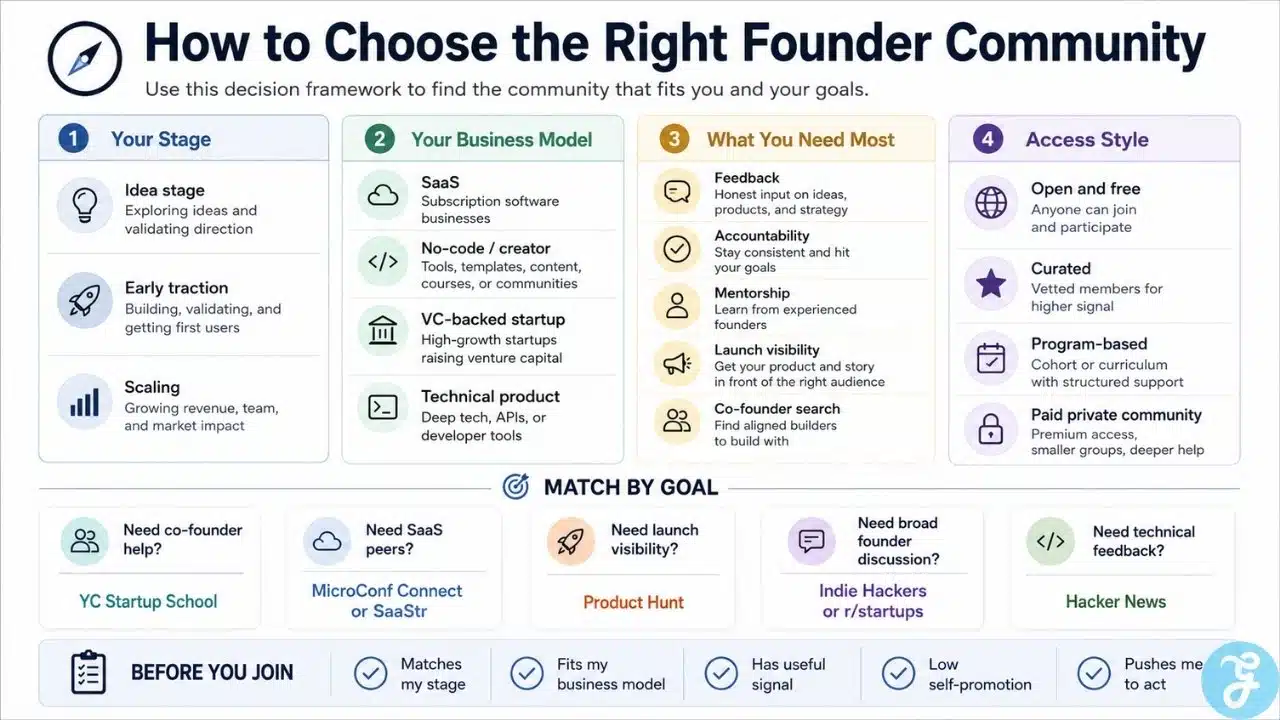
How to Choose the Right Online Founder Community for Yourself
Do not choose a founder community because it looks popular. Choose it because the people inside are wrestling with problems close to yours.
A pre-seed AI founder looking for a technical co-founder needs a different room from a bootstrapped SaaS founder trying to reduce churn. A non-technical founder testing no-code tools needs a different community from a B2B SaaS founder hiring the first VP of Sales. A founder launching on Product Hunt needs launch feedback, not a mastermind about seven-figure revenue operations.
Use this selection framework:
- Match by stage: Idea-stage, pre-seed, seed, bootstrapped, scaling, and post-revenue founders need different peer groups.
- Match by business model: SaaS, no-code, consumer products, marketplaces, services, developer tools, and creator businesses attract different advice.
- Check signal quality: Look for specific feedback, good moderation, low self-promotion, and people who share real numbers or real lessons.
- Know the job of the community: Co-founder search, launch feedback, accountability, mentorship, investor access, and emotional support are not the same thing.
The Final Checklist
Before joining one of the best online founder communities, use this quick check:
- Does this community match my company stage and business model?
- Are the conversations specific enough to help me make better decisions?
- Is the community moderated well enough to avoid spam and self-promotion?
- Can I contribute honestly, or will I only lurk and consume?
- Will this community help me act, or just give me more founder content to scroll?
The Uncomfortable Truth About Founder Communities
Founder communities can help, but they can also become a beautiful way to avoid the work.
A founder can ask for feedback in five groups and still never talk to customers. They can join three paid entrepreneur groups and still avoid fixing pricing. They can post updates, collect encouragement, and call it momentum while the product sits untouched.
The future of startup communities online will probably get louder. More private Slacks, more Discord groups, more paid communities, more AI-assisted “networking,” more founder circles, more curated rooms. Some will be excellent. Many will be repackaged noise.
The useful communities will not be the ones with the most members. They will be the ones where founders share real problems, give specific feedback, protect trust, and push each other toward action.
Use the best online founder communities as leverage, not shelter. Ask better questions. Share enough context to get useful answers. Offer help before extracting value. Leave rooms that turn into promotion loops.
The right founder community will not build the company for you.
It should make it harder to keep lying to yourself about what needs to happen next.
Frequently Asked Questions (FAQs) About Best Online Founder Communities
What are the best online founder communities for early-stage founders?
Indie Hackers, YC Startup School, Founder Institute, r/startups, and Small Bets are strong options for early-stage founders. The right choice depends on whether the founder needs co-founder matching, startup education, peer feedback, or practical experiments.
Which founder forums are best for technical founders?
Hacker News, Product Hunt, Indie Hackers, and YC Startup School can be useful for technical founders. Hacker News is especially strong for technical critique, while Product Hunt is better for launches and early product visibility.
Are paid entrepreneur groups worth it?
Paid entrepreneur groups can be worth it when they offer strong curation, accountability, expert access, or peer quality that free communities do not provide. They are not worth it if the founder joins without a clear problem to solve.
What are the best startup communities online for SaaS founders?
MicroConf Connect, SaaStr, Indie Hackers, GrowthMentor, and SaaSBoomi-style SaaS communities can be useful for SaaS founders. MicroConf fits bootstrapped SaaS especially well, while SaaStr is stronger for B2B SaaS scaling and go-to-market learning.
How many founder communities should a founder join?
Most founders should actively use one or two communities, not ten. Join one broad community for exposure and one focused community for serious peer support. More than that can turn into content consumption instead of company-building.