
Cap table management is easy to ignore when the company is still two founders, one idea, and a messy spreadsheet nobody opens unless an investor asks for it.
That works until it doesn’t.
The first time a seed investor asks who owns what, how many options are reserved, whether the SAFEs convert pre-money or post-money, and what the founder ownership looks like after the next round, the spreadsheet either becomes a fundraising tool or an embarrassment.
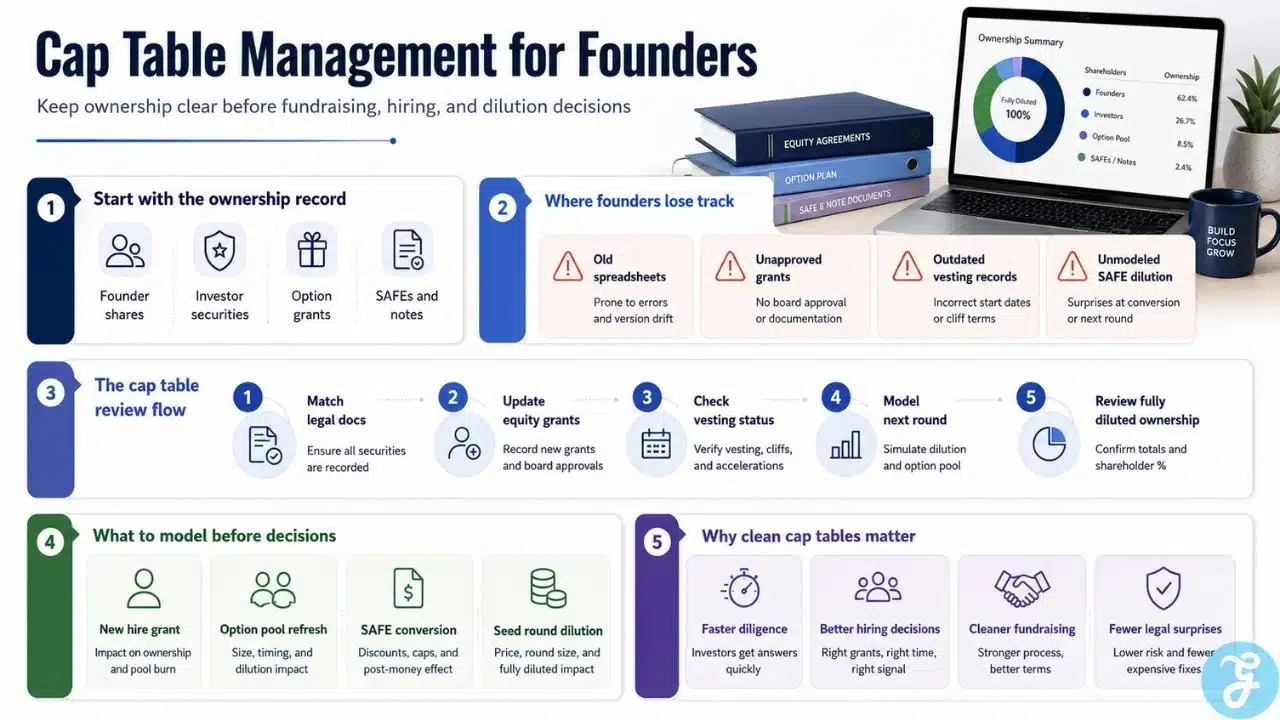
A startup cap table is not just a list of names and percentages. It is the record of every ownership promise the company has made: founder shares, investor stock, option grants, SAFEs, convertible notes, warrants, advisor equity, vesting schedules, repurchases, exercises, and future dilution. If that record is wrong, almost every serious financing conversation gets harder.
Founders usually learn this too late. They think cap table management is finance admin. Then a lawyer finds missing board approvals, an employee grant was never issued properly, an advisor claims more equity than the documents show, or a SAFE conversion model suddenly drops founder ownership lower than expected.
Bad equity tracking does not always explode immediately. It sits quietly until the company needs to raise money, hire senior talent, issue options, sell itself, or clean up diligence under pressure.
That is when small mistakes become expensive.
What are the Benefits of Cap Table Management?
Good cap table management gives founders a clean answer to a basic question: what happens to ownership when the company makes its next move?
That next move could be a seed round, a new option pool, a senior hire, an advisor grant, a bridge note, a Series A, a secondary sale, or an acquisition offer. Each decision changes the ownership picture. If the cap table is current, founders can see the trade. If it is messy, they are guessing with company ownership.
The benefits are practical, not cosmetic.
A clean startup cap table helps founders understand dilution before signing term sheets. It makes investor diligence faster. It keeps employee equity promises consistent with board approvals and grant documents. It helps the company prepare for 409A valuations, option grants, and hiring plans. It reduces the risk of disputes when people leave, vesting schedules change, or old financing documents resurface.
It also protects trust.
Employees want to know that their option grants are real. Investors want to know that the ownership model matches the legal documents. Founders need to know that the company has enough equity left to hire without giving away more than planned.
Cap table management will not make a weak startup fundable. But poor cap table management can make a fundable startup look careless.
The Startup Cap Table Needs to Match the Legal Reality
The cap table is only useful if it matches the documents behind it.
That sounds obvious until a founder realizes the spreadsheet says one thing, the signed stock purchase agreement says another, and the board consent approving the option grant never happened.
The cap table should tie back to actual legal records: incorporation documents, founder stock purchase agreements, restricted stock agreements, option plan documents, board approvals, investor financing documents, SAFE or note agreements, exercise notices, repurchase records, and transfer restrictions.
If the legal documents do not support the cap table, the spreadsheet is not truth. It is a wish.
This matters during fundraising. Investors and their counsel do not only ask for the ownership summary. They ask for the paper trail behind it. If the company cannot produce the documents, diligence slows down and confidence drops.
The most dangerous cap table errors are not dramatic. They are boring gaps.
A founder grant was recorded but never approved. An advisor was promised 1% in an email but the final agreement says 0.25%. An employee left before vesting, but the cap table still shows the full grant as active. A contractor was casually promised equity before the company had a stock plan. A SAFE was entered at the wrong valuation cap.
None of these need to become fatal. But they are much cheaper to fix before the next investor is already in diligence.
Founder Equity Should Be Clean From Day One
Founder equity is where cap table mistakes can do the most long-term damage.
At formation, founders should agree on ownership, vesting, repurchase rights, IP assignment, and what happens if someone leaves. Skipping that conversation because everyone trusts each other is not maturity. It is avoidance.
Equal splits can work. Unequal splits can work. What does not work is a split nobody can defend later.
If one founder leaves after six months with a large fully vested stake, the company may become harder to finance, harder to hire into, and harder to explain to investors. That dead equity does not just hurt the remaining founder. It hurts every future employee who expects meaningful upside.
A clean founder setup usually includes vesting, company repurchase rights for unvested shares, signed IP assignments, and clear documentation of who owns what. If the company has already started without those pieces, fix them before raising serious outside capital.
The worst time to discover founder equity problems is when the investor’s lawyer is already reviewing the round.
Option Pools Are Hiring Tools, Not Decorative Percentages
An option pool exists to recruit and retain employees. It should be sized around a real hiring plan.
Too many founders treat the pool as a default number. Ten percent. Fifteen percent. Twenty percent. Whatever the investor suggests. That is how dilution sneaks in without a serious conversation.
The right question is not “What pool size looks normal?” The right question is, “Which roles do we need to hire before the next financing, and what equity ranges will those roles require?”
A pre-seed company hiring two engineers and a designer does not need the same pool as a post-seed company hiring a VP of Sales, a head of product, five engineers, and customer success staff. The pool should reflect the actual hiring roadmap.
Option pool placement also matters. If the pool is expanded before a financing, existing shareholders absorb the dilution. If it is expanded after the financing, new investors share in it. That can change the real price of the round.
Cap table management should make this visible before founders agree to terms. The pool is not just an HR line item. It is part of the economics of the financing.
Equity Tracking Breaks When Promises Move Faster Than Paperwork
Early startups make equity promises casually.
An advisor helps with three investor intros. A contractor accepts lower cash for possible equity. A first employee negotiates options over email. A friend helps with product positioning and gets told, “We’ll take care of you.”
That language is dangerous.
If the company intends to issue equity, write it down properly, approve it properly, and track it properly. If the company is not ready to issue equity, do not make vague promises that sound like ownership.
Equity tracking needs discipline because the cap table is not just a founder tool. It affects employees, advisors, investors, tax planning, option grants, and legal rights.
Track grant date, vesting start date, vesting schedule, exercise price, expiration date, board approval, grant type, shareholder name, share class, and whether the grant has been accepted. If an employee leaves, update the vested and unvested amounts. If options expire, remove them from the active pool. If shares are repurchased, record it.
Loose equity promises become disputes because people remember percentages differently when the company becomes valuable.
SAFEs and Convertible Notes Can Hide Future Dilution
SAFEs and convertible notes make early fundraising faster, but they can make cap table management harder if founders do not model the conversion.
A founder may raise several small checks on different SAFEs and feel like ownership has barely changed because no priced round has happened yet. That feeling is wrong. The dilution is already waiting. It just has not converted.
The problem gets worse when the company stacks instruments with different valuation caps, discounts, most-favored-nation rights, or pre-money and post-money SAFE mechanics. One note may accrue interest. Another may have a maturity date. A SAFE may convert differently from what the founder casually assumed.
A messy SAFE stack can surprise founders during the priced round.
Before signing another early instrument, update the fully diluted cap table and model the next financing. Show founder ownership, investor ownership, option pool size, and employee pool needs under realistic round sizes and valuations.
Do not wait until the Series Seed term sheet arrives to learn what the last six small checks really cost.
Cap Table Management Matters Most Before a Fundraise
Investors do not expect a young startup to have enterprise-level finance operations. They do expect the ownership story to make sense.
Before fundraising, founders should clean up the cap table and supporting documents. That means verifying issued shares, option grants, SAFE and note entries, advisor equity, board approvals, and vesting schedules. It also means modeling the proposed raise before accepting terms.
A clean cap table lets founders answer investor questions without scrambling.
How much do the founders own today?
What does founder ownership look like after the round?
How much of the option pool is issued, promised, and available?
How will SAFEs or notes convert?
Which shareholders have special rights?
Are there outstanding promises not reflected in documents?
If those answers take three days and several panicked emails to counsel, the company is not ready.
Fundraising already creates enough pressure. Do not add ownership confusion to the list.
Cap Table Software Helps Only If the Inputs Are Clean
Cap table software can make equity tracking easier, but it does not fix bad records by magic.
Platforms such as Carta, Pulley, Morgan Stanley at Work, Cake Equity, AngelList-related tools, and other equity systems can help founders manage ownership records, option grants, stakeholder visibility, scenario modeling, and financing preparation. The right tool depends on company stage, geography, security needs, legal support, pricing, investor expectations, and how complex the cap table has become.
A two-founder startup with no outside investors may survive on a careful spreadsheet for a short time. The moment the company adds SAFEs, options, advisors, multiple investors, or a priced round, the spreadsheet starts becoming risky.
Version control breaks. Formulas get overwritten. Someone sends the wrong file. A former employee remains in the active option pool. A note converts incorrectly. The founder makes a hiring offer using a stale ownership model.
Cap table software helps by creating one source of record, improving scenario modeling, and reducing manual errors. But the system only works when the company enters the documents correctly, keeps approvals current, and reviews the model after every equity event.
Do not buy software to avoid discipline. Buy it to support discipline.
409A Valuations and Option Grants Need Coordination
For U.S. startups issuing stock options, 409A valuations matter because the company needs a defensible fair market value for common stock when setting option exercise prices.
This is not just tax trivia. If the exercise price is wrong, employees can face ugly tax consequences, and the company can create compliance problems it did not need.
Cap table management connects directly to this process. The company’s ownership structure, recent financings, preferred stock rights, option pool, and business performance can all affect the valuation work. If the cap table is outdated, the 409A process becomes harder and less reliable.
Founders should coordinate option grants with board approvals and 409A timing. Do not promise a new hire a specific strike price before confirming the valuation and grant process. Do not delay grants for months and assume everything can be backdated casually. Do not treat 409A as a once-a-year paperwork chore if the company just raised a round or had another material event.
Equity is compensation. Treat the paperwork like compensation, not a clerical afterthought.
Scenario Modeling Is Where Founders See the Real Trade
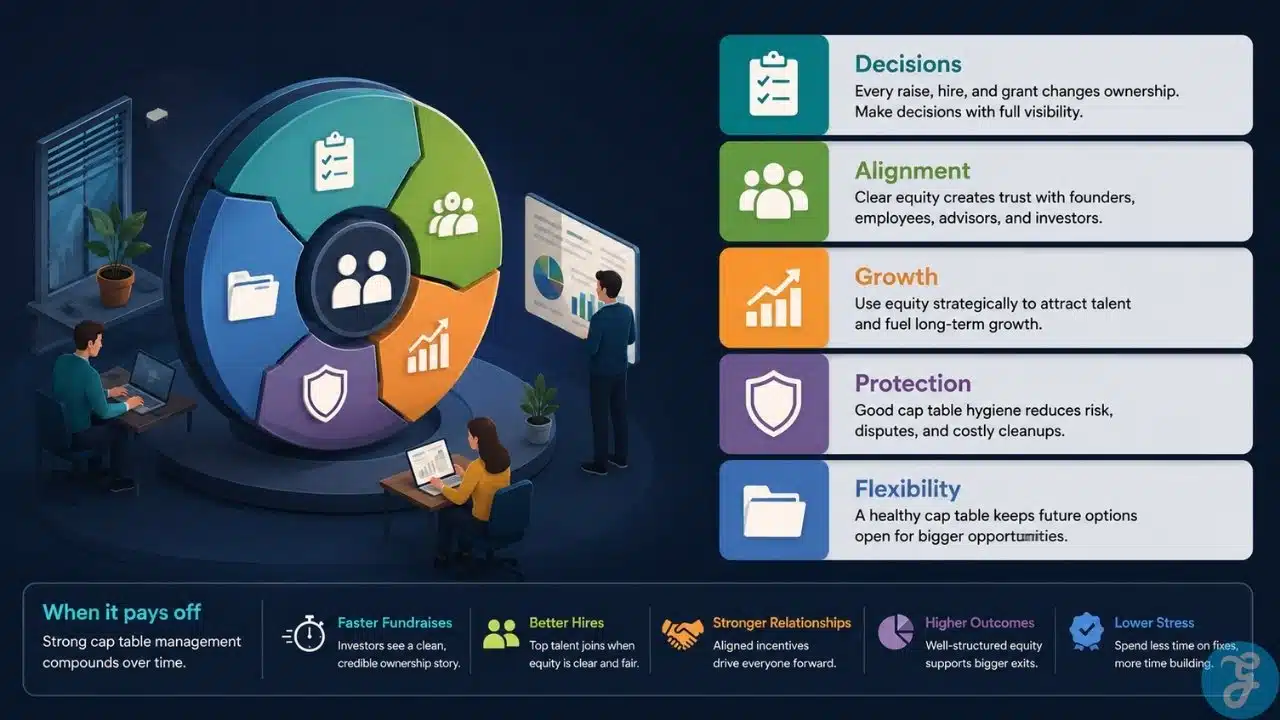
A cap table is not just a history file. It is a decision tool.
Founders should use it to model future rounds, option pool increases, SAFE conversions, secondary sales, down rounds, exits, and hiring plans. The goal is not to predict the future perfectly. The goal is to see how today’s decision changes the ownership picture tomorrow.
Model the next round before negotiating it. Model the option pool before agreeing to it. Model the SAFE conversion before signing another SAFE. Model a modest exit, not just the dream outcome.
The uncomfortable model is usually the useful one.
If a planned seed round leaves founders with less ownership than expected, find out before signing. If the company needs a larger option pool to hire properly, know that before the term sheet arrives. If employee equity becomes thin after Series A, understand that before making offers that sound generous but are not.
Founders do not need to become cap table technicians. They do need to understand the consequences of ownership decisions before those decisions become permanent.
Common Cap Table Mistakes That Hurt Founders
Cap table mistakes usually start as small shortcuts.
The founder delays issuing stock because “we’ll clean it up later.” An advisor grant is promised but never approved. The option pool is tracked in one spreadsheet while counsel has another version. A SAFE conversion is modeled incorrectly. A departing employee’s unvested options stay active. A founder forgets that a pre-money option pool increase changes the real economics of the round.
The pattern is simple: the company treats ownership like admin until ownership becomes leverage.
That is when the damage appears. Investors ask harder questions. Employees lose trust. Counsel spends time cleaning up old gaps. A financing slows down. A founder realizes the latest deal dilutes the team more than expected.
The fix is not complicated, but it requires consistency. Update the cap table after every equity event. Match every entry to documentation. Keep one source of truth. Review the model before fundraising. Do not let side promises live outside the system.
A messy cap table is rarely one mistake. It is usually months of small avoidance.
When a Spreadsheet Stops Being Enough
Spreadsheets are fine at the very beginning if the company is simple and disciplined.
They stop being enough when the cap table includes multiple security types, option grants, SAFEs, notes, warrants, advisor equity, secondary transfers, investor rights, or multiple financing scenarios. At that point, a spreadsheet does not just become inconvenient. It becomes a risk surface.
The problem is not that spreadsheets cannot calculate ownership. The problem is that they do not manage workflow, approvals, audit trails, stakeholder access, documents, or scenario history well enough once complexity increases.
A founder should consider cap table software when the company is preparing for an institutional round, issuing employee options, managing several SAFEs, running 409A valuations, planning a larger hiring push, or preparing for serious diligence.
Do not wait until the cap table is already broken to move into a proper system. Migration is easier before the mess hardens.
The Founder’s Cap Table Check Before the Next Round
Before raising money, make the cap table boring.
Boring means the documents match the model. The founder shares are issued properly. Vesting is clear. The option pool is current. Grants are approved. SAFEs and notes are entered correctly. Departed employees are updated. Advisor equity is documented. Side letters are tracked. The fully diluted model is ready.
Boring is good.
Investors should not have to wonder whether the company understands its own ownership. Employees should not have to chase the founder to confirm whether their grant exists. Founders should not have to guess what happens after the next round.
Cap table management is not about keeping a neat spreadsheet for its own sake. It is about protecting the company from ownership confusion at the exact moments when clarity matters most.
Before the next term sheet, hiring offer, SAFE, or board approval, check the cap table. If the answer is “we need to clean that up later,” later has already arrived.