Replacing a heating system is not the kind of home project most people enjoy. It is expensive, full of technical terms, and usually happens when the old furnace, boiler, or air conditioner is already causing problems. That is why heat pumps can feel confusing at first. They are promoted as efficient, electric, climate-friendly, and useful for both heating and cooling, but homeowners still need a clear answer to a simpler question: will one actually work well in this house?
This is where heat pumps explained properly matters. A heat pump is not just an electric furnace with better marketing. It heats differently. It cools like an air conditioner. It can be ducted or ductless. It can replace a furnace in some homes, work alongside one in others, or disappoint badly if it is sized or installed poorly.
The right decision comes down to the house, climate, utility rates, insulation, ducts, contractor quality, and how the system will be used on the coldest and hottest days of the year. A heat pump can be a smart upgrade. It is not a magic box.
What a Heat Pump Actually Does
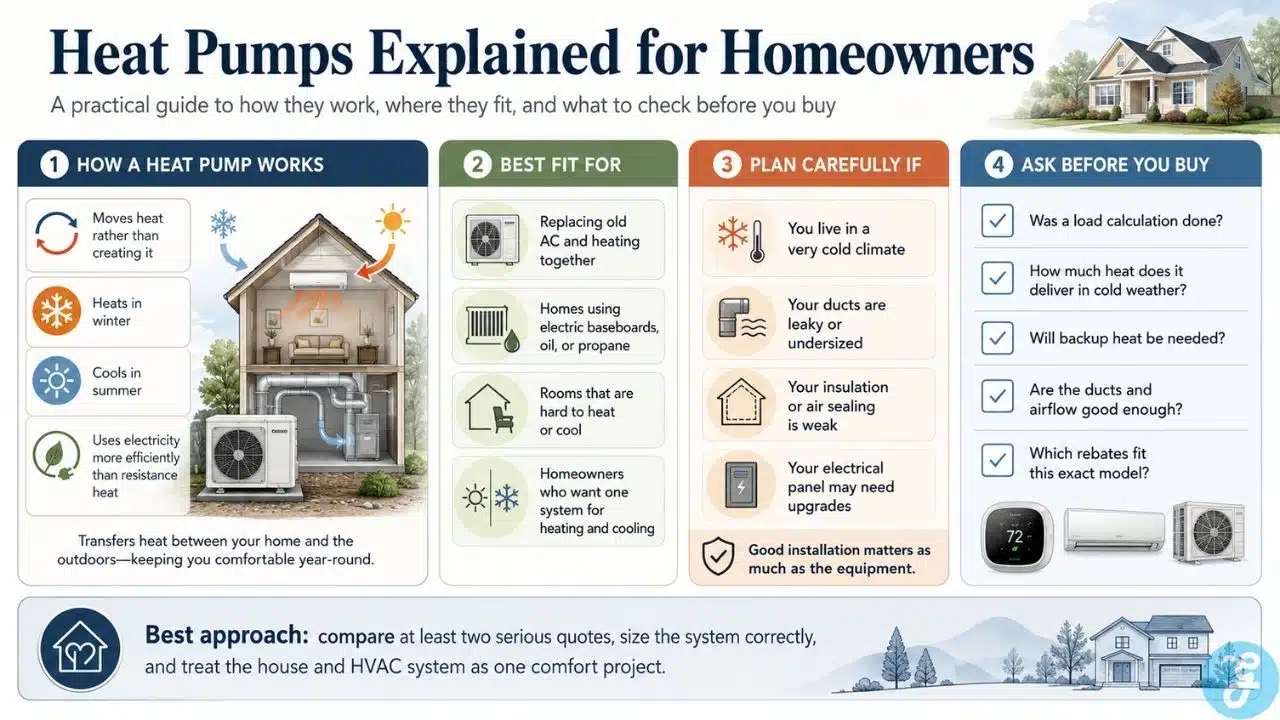
A heat pump moves heat instead of making heat from scratch.
In winter, it pulls heat from outside air, ground, or water and moves that heat indoors. That sounds strange because cold air does not feel like it contains usable heat, but it does. A heat pump uses refrigerant, a compressor, coils, and fans to collect and transfer that heat into the home.
In summer, the same system runs in the opposite direction. It pulls heat out of the house and releases it outside, which is why many heat pumps also replace or supplement central air conditioning.
That two-way function is one of the reasons homeowners pay attention to them. One system can handle heating and cooling. For homes that already need a new air conditioner and heating system, that can make the upgrade more attractive.
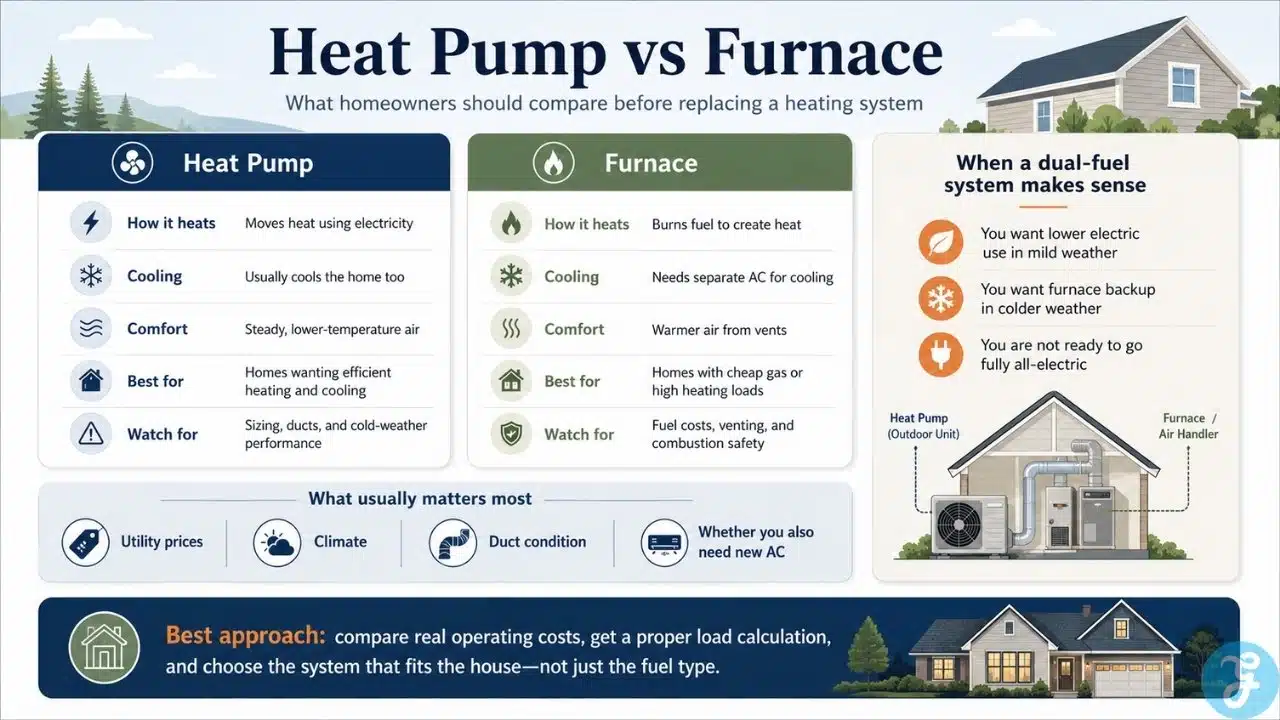
The key difference from a furnace is simple:
A furnace burns gas, propane, or oil to create heat. A heat pump uses electricity to move heat.
That difference shapes almost everything else: efficiency, operating cost, comfort, installation, maintenance, backup heat, and whether the system makes sense for a specific home.
Why Heat Pumps Can Be So Efficient
Electric resistance heat, such as baseboard heaters, electric furnaces, or space heaters, turns electricity directly into heat. At the point of use, that process can be nearly 100% efficient. One unit of electricity becomes roughly one unit of heat in the room.
A heat pump is different. It may use one unit of electricity to move two, three, or even more units of heat into the home under the right conditions. That is why heat pumps can use far less electricity than resistance heating.
This is also why comparing a heat pump to “electric heating” can be misleading. A heat pump is electric, but it is not the same as old baseboard heat or a glowing coil inside an electric furnace.
For homeowners, the practical meaning is this:
- A heat pump can be much cheaper to run than electric resistance heat.
- It may or may not be cheaper than gas heating, depending on local gas and electricity prices.
- It usually becomes more attractive when it also replaces an aging air conditioner.
- Efficiency drops as outdoor temperatures fall, though modern cold-climate models perform much better than older units.
If a contractor says, “It is electric, so it will be expensive,” that is too simplistic. If a salesperson says, “It will always cut your bills,” that is too confident. Both can be wrong.
Heat Pump vs Furnace: The Homeowner Version
The heat pump vs furnace comparison is not just about fuel. It is about how heat feels, how the system behaves, and what the home already has.
| Question | Heat pump | Furnace |
|---|---|---|
| How it heats | Moves heat into the home using electricity | Burns fuel to create heat |
| Cooling ability | Usually provides cooling too | Does not cool without a separate AC |
| Heat feel | Often steadier, lower-temperature air | Often hotter air from vents |
| Best fit | Homes needing efficient heating and cooling, especially with good sizing and insulation | Homes with cheap gas, very high heating loads, or existing furnace infrastructure |
| Cold weather | Modern models can work well in cold climates, but design matters | Strong output in cold weather if fuel supply is available |
| Emissions at the home | No on-site combustion for an all-electric heat pump | Produces combustion gases that must be vented |
| Installation concerns | Sizing, duct condition, electrical capacity, outdoor unit placement | Venting, gas line or fuel supply, duct condition, combustion safety |
A furnace often delivers warmer-feeling air through the vents. Some homeowners notice this when they switch to a heat pump. A heat pump may run longer at a lower output, which can feel more even but less dramatic. That is normal.
The worst mistake is assuming the new system should behave exactly like the old one. A well-designed heat pump home may feel quieter and steadier, but the thermostat strategy often changes. Big temperature setbacks may not save as much as expected because the system has to work harder to recover, especially in cold weather.
The Main Types of Heat Pumps Homeowners See
Most homeowners are not choosing from every heat pump technology on the market. They are usually comparing a few practical options.
Ducted Air-Source Heat Pumps
This is the closest replacement for a central furnace and air conditioner setup. An outdoor unit connects to an indoor air handler and uses ductwork to move heated or cooled air through the home.
A ducted air-source heat pump can make sense when the home already has decent ducts. “Decent” matters. Leaky, undersized, uninsulated, or poorly routed ducts can hurt comfort and efficiency. Replacing the box outside without fixing bad ductwork is a common way to waste money.
Ductless Mini Split Heat Pumps
Ductless mini splits use one outdoor unit connected to one or more indoor heads mounted on walls, ceilings, or floors. They are useful for homes without ducts, additions, garages, finished basements, old houses, and rooms that never feel comfortable.
They can also solve a specific problem without replacing the whole system. For example, a homeowner might add a mini split to a sunroom, upstairs bedroom, home office, or converted attic.
The trade-off is visual. Indoor heads are visible. Some people do not mind. Some hate the look. Condensate drainage, line-set routing, and outdoor unit placement also need careful planning.
Cold-Climate Heat Pumps
Cold-climate heat pumps are designed to maintain better heating capacity and efficiency at lower outdoor temperatures. They matter most in places with long, cold winters.
A cold-climate label does not remove the need for good design. The system still needs proper sizing, airflow, controls, and sometimes backup heat. It does mean homeowners in colder regions should not dismiss heat pumps based on old assumptions from twenty years ago.
Dual-Fuel or Hybrid Systems
A dual-fuel system pairs a heat pump with a gas, propane, or oil furnace. The heat pump handles heating during milder weather, and the furnace takes over when outdoor temperatures drop below a chosen balance point or when electricity becomes less economical.
This can be a sensible middle path for homeowners who want to electrify much of their heating but are not ready to remove the furnace. It can also work well in cold climates where utility rates make full electric heating less predictable.
The control setup matters. If the system switches too early, the heat pump savings shrink. If it switches too late, comfort or cost may suffer. Ask the contractor how the changeover point will be set and adjusted.
Ground-Source or Geothermal Heat Pumps
Geothermal systems move heat through the ground or water instead of outdoor air. They can be very efficient because ground temperatures are more stable than air temperatures.
The issue is upfront cost and site work. Ground loops, drilling, trenching, and property conditions can make geothermal more complex than air-source options. It may be worth considering for new construction, major renovations, large properties, or homeowners planning to stay long enough to justify the investment.
For many existing homes, an air-source system is the more realistic comparison.
Heat Pumps and Electric Heating Are Not the Same Thing
The phrase electric heating causes confusion because it covers very different technologies.
A plug-in space heater, electric baseboard, electric furnace, radiant electric mat, and heat pump all use electricity. They do not use it the same way.
Electric resistance heat is simple and often inexpensive to install, but it can be expensive to run in places with high electricity prices or long heating seasons. It makes heat directly.
A heat pump uses electricity to operate the compressor and fans while moving heat from one place to another. That usually gives it a major efficiency advantage over resistance heating.
This distinction matters for homeowners replacing baseboards. A ductless mini split can often reduce heating electricity use while also adding air conditioning. That is one of the cleanest use cases for heat pumps, especially in homes where installing ducts would be unrealistic.
Where Heat Pumps Make the Most Sense
A heat pump is especially worth considering when several of these are true:
- The home needs a new air conditioner soon anyway.
- The existing heating system is old, inefficient, unsafe, or expensive to repair.
- The house uses electric resistance heat, fuel oil, or propane.
- The home has solar panels or plans to add them.
- The local grid is getting cleaner over time.
- The homeowner wants both heating and cooling in one system.
- The home has rooms that are hard to heat or cool with the existing setup.
- Local rebates or tax credits lower the installed cost.
- The house has decent insulation and air sealing, or those upgrades are planned.
Heat pumps are not only for new homes. They can work in older homes too, but old houses often need more care. Air leaks, weak insulation, bad ducts, and uneven room loads can make any HVAC system struggle. A heat pump simply exposes those problems more clearly.
Where Heat Pumps Can Disappoint
Heat pumps usually fail homeowners for practical reasons, not because the technology itself is useless.
The first problem is bad sizing. Oversized systems can short-cycle, create uneven comfort, and control humidity poorly. Undersized systems may rely too much on backup heat or fail to keep up during extreme weather.
The second problem is poor ductwork. If the ducts leak into an attic, crawlspace, garage, or wall cavity, the homeowner pays to heat or cool places nobody lives. A new heat pump attached to bad ducts will not perform like the brochure suggests.
The third problem is the wrong model for the climate. A mild-climate heat pump in a cold region can lead to heavy backup heat use. A cold-climate system may cost more upfront, but it can be the right equipment for the job.
The fourth problem is weak controls. Some systems are installed with thermostats or settings that call for electric resistance backup too often. That can quietly raise bills.
The fifth problem is unrealistic expectations. Heat pumps often run longer than furnaces. They may blow air that feels less hot. That does not mean they are broken. Comfort should be judged by room temperature, consistency, noise, humidity, and cost, not just how hot the vent feels.
Cold Weather: What Homeowners Should Know
Older heat pumps had a weak reputation in cold climates, and some of that reputation was earned. Modern systems are much better, especially cold-climate models, but homeowners still need to ask sharper questions.
A good cold-climate plan should answer these:
- What is the design temperature for this area?
- How much heat does the home need at that temperature?
- How much heat can the chosen system deliver at that temperature?
- Will the system need backup heat?
- If backup heat is needed, will it be electric resistance, a furnace, or another source?
- How will the thermostat avoid unnecessary backup heat?
- What happens during a power outage?
In very cold weather, any heating system has to meet the home’s heat loss. A heat pump can only do that if it is selected and installed for the real load, not for a rough square-foot guess.
This is where a proper load calculation matters. A contractor should not simply replace a 3-ton air conditioner with a 3-ton heat pump because the old unit had that size. The old system may have been wrong from the start, and insulation, windows, additions, or air sealing may have changed the home since then.
The Installation Matters as Much as the Equipment
Homeowners often compare brands first. That is understandable, but the installer can matter just as much as the logo on the outdoor unit.
A good contractor should look at the house, not only the old equipment. They should ask about comfort complaints, cold rooms, hot rooms, noise, humidity, utility bills, insulation, duct condition, electrical panel capacity, and whether the homeowner wants to remove or keep the existing heating system.
For a ducted system, they should inspect airflow and ducts. For a mini split, they should discuss head placement, drain lines, outdoor unit clearance, service access, and how air will move between rooms. For a cold-climate system, they should explain capacity at low outdoor temperatures, not just the rated efficiency on a mild day.
Ask for the boring paperwork. It is not glamorous, but it protects the homeowner.
Useful documents include:
- Heating and cooling load calculation
- Model numbers for indoor and outdoor units
- Efficiency ratings
- Low-temperature heating capacity
- AHRI match certificate where applicable
- Details on backup heat
- Electrical work included or excluded
- Warranty terms
- Rebate or tax credit eligibility details
- Maintenance requirements
A vague quote that says “install heat pump system” is not enough for a major home investment.
What Heat Pump Ratings Mean Without Getting Lost in Acronyms
HVAC ratings can get messy quickly. Homeowners do not need to become engineers, but a few terms help during quotes.
SEER2 measures seasonal cooling efficiency. Higher is better, but only within a fair comparison.
HSPF2 measures seasonal heating efficiency for heat pumps. Higher usually means better heating efficiency.
COP means coefficient of performance. A COP of 3 means the system delivers about three units of heat for each unit of electricity used under those conditions. COP changes with outdoor temperature and system operation.
Capacity tells how much heating or cooling the system can deliver. This matters as much as efficiency. A highly efficient system that cannot meet the heating load on cold days is not the right system.
Cold-climate designation helps identify models tested for stronger low-temperature performance. It does not replace proper sizing.
Do not chase the highest rating blindly. A slightly less efficient system installed correctly may outperform a premium unit installed badly.
Costs, Rebates, and the Payback Question
Heat pump costs vary too much to give one honest universal number. Home size, region, ducts, electrical work, number of zones, equipment type, labor rates, and difficulty of installation all change the price.
The payback question also varies. A homeowner replacing electric baseboards may see a clearer operating-cost benefit than someone with very cheap natural gas. A homeowner who needs both heating and cooling may justify the project differently than someone whose furnace is only five years old.
Rebates and tax credits can change the math. In the United States, federal incentives have applied to qualifying heat pumps, and many utilities, states, and local programs offer separate rebates. These rules can change, and eligibility often depends on exact equipment specifications. Homeowners should confirm current details before signing a contract.
A good contractor should help identify eligible models, but the homeowner should still verify. Do not rely only on a sales claim.
A Heat Pump Home Still Needs Good Home Basics
A heat pump home works best when the building itself is not fighting the system.
Before spending heavily on equipment, homeowners should look at the basics:
- Attic insulation
- Air leaks around doors, windows, attic hatches, rim joists, and recessed lights
- Duct leaks
- Dirty filters
- Blocked returns
- Poor ventilation
- Old windows or major solar gain
- Damp crawlspaces or basements
- Rooms with closed doors and weak airflow
These upgrades are not as exciting as a new outdoor unit, but they can reduce the heating and cooling load. That may allow smaller equipment, improve comfort, and reduce backup heat use.
A heat pump should be part of the home comfort plan, not a substitute for fixing the house.
Questions to Ask Before Choosing a Heat Pump
Bring these questions to the contractor before accepting a quote:
- Did you perform a heating and cooling load calculation?
Ask what method they used and whether it accounts for insulation, windows, air leakage, orientation, and local design temperatures. - Is this system sized for heating, cooling, or both?
In some climates, the heating load and cooling load point to different equipment choices. - How much heat does this model deliver at low outdoor temperatures?
This matters more than the headline efficiency rating in cold areas. - Will I need backup heat?
If yes, ask what type, when it turns on, and how much it may cost to run. - Will my electrical panel need upgrades?
Heat pumps, air handlers, and backup heat may require electrical work. - Are my ducts good enough?
For ducted systems, ask about leakage, sizing, insulation, and airflow. - Where will the outdoor unit go?
It needs clearance, drainage, service access, and protection from poor placement. - How loud will the indoor and outdoor units be?
Noise ratings and placement matter, especially near bedrooms, patios, and property lines. - What maintenance does the system need?
Filters, coils, outdoor clearance, drain lines, and annual service all matter. - Which rebates or credits does this exact model qualify for?
Get model numbers and documentation before assuming eligibility.
The best contractor will not resent these questions. They will answer them clearly.
Who Should Strongly Consider a Heat Pump
Heat pumps are often a strong fit for homeowners replacing electric baseboards, electric furnaces, oil systems, propane systems, aging central AC, or an old HVAC system that already needs major work.
They also make sense for additions and problem rooms. A ductless mini split can be cleaner than extending ductwork into a space that was never designed for it.
Homeowners who want to reduce on-site combustion may also prefer an all-electric heat pump setup, especially if they are planning solar, battery backup, or other electrification upgrades.
A heat pump is also worth comparing when comfort is uneven. Variable-speed systems can run for longer periods at lower output, which may improve temperature consistency and humidity control when designed properly.
Who Should Be More Cautious
Some homeowners should slow down before removing an existing furnace.
If the home is in a very cold climate, has weak insulation, has expensive electricity, or has an older electrical panel, the project may need extra planning. That does not rule out a heat pump. It may point toward a cold-climate model, envelope upgrades, a dual-fuel system, or phased installation.
Homes with steam radiators or hot-water boiler systems need special thought. Replacing a boiler with ducted air is not a simple one-for-one swap. Ductless mini splits may handle part of the load, but comfort expectations and room layout matter.
A homeowner with a fairly new high-efficiency gas furnace and no need for air conditioning may not see the same financial case as someone replacing electric resistance heat. The environmental case may still matter, but the cost case deserves careful math.
A Sensible Decision Path
The cleanest way to approach the decision is not to ask, “Should every home have a heat pump?” That question is too broad.
Ask this instead:
What problem should the new system solve?
If the problem is high electric baseboard bills, a ductless or ducted heat pump deserves a serious look. If the problem is an old furnace and failing air conditioner, a heat pump or dual-fuel system may be the best comparison. If the problem is one uncomfortable room, a mini split may solve it without touching the whole house. If the problem is a drafty, under-insulated home, equipment alone will only go so far.
Heat pumps explained honestly come down to this: the technology is mature, efficient, and often practical, but it rewards good design. A properly selected system can heat, cool, reduce energy use, and make a home more comfortable. A rushed installation can leave the homeowner with high bills, noisy equipment, and rooms that still feel wrong.
Before signing, get a load calculation, compare at least two serious quotes, check low-temperature performance, understand backup heat, and verify incentives using the exact model numbers. That work is less exciting than choosing the equipment, but it is what separates a smart heat pump upgrade from an expensive experiment.
Frequently Asked Questions(FAQs) About Heat Pumps
Can a heat pump replace a furnace?
Yes, in many homes. In colder climates or homes with high heating loads, the better choice may be a cold-climate heat pump or a dual-fuel system that keeps a furnace for backup. The answer should come from a load calculation and local utility cost comparison, not a guess.
Do heat pumps work below freezing?
Modern heat pumps can work below freezing, and cold-climate models are designed for stronger low-temperature performance. Capacity and efficiency still change as outdoor temperatures fall, so homeowners in cold regions should ask how much heat the system delivers at the local design temperature.
Is a heat pump cheaper to run than a furnace?
Sometimes. It depends on electricity prices, gas or fuel prices, climate, home insulation, equipment efficiency, and installation quality. Heat pumps often compare very well against electric resistance, oil, and propane. The comparison against natural gas varies more by region.
Do heat pumps blow cold air?
A properly working heat pump should not blow cold air during normal heating, but the air from the vents may feel cooler than furnace air because heat pumps often supply steady, lower-temperature heat. If the room reaches the thermostat setting and stays comfortable, the system may be working normally.
Do I need ducts for a heat pump?
No. Ducted heat pumps use ducts, but ductless mini splits do not. Ductless systems can heat and cool individual rooms or zones, which makes them useful for homes without ductwork, additions, garages, basements, and rooms with comfort problems.
Should I turn my heat pump down at night?
Large setbacks are not always ideal with heat pumps, especially in cold weather, because recovery can trigger backup heat. A small setback may be fine. The best setting depends on the system, controls, climate, and backup heat configuration.
How long should a heat pump run?
Longer run times are normal, especially for variable-speed systems. Short, frequent cycling can be a sign of oversizing, airflow problems, thermostat issues, or poor setup. Comfort, humidity control, noise, and energy use matter more than whether it runs like an old furnace.
Is a mini split the same as a heat pump?
A mini split can be a heat pump, but the term describes the ductless format. Many mini splits provide both heating and cooling. Some older or cooling-only models may not provide heating, so homeowners should check the exact equipment.