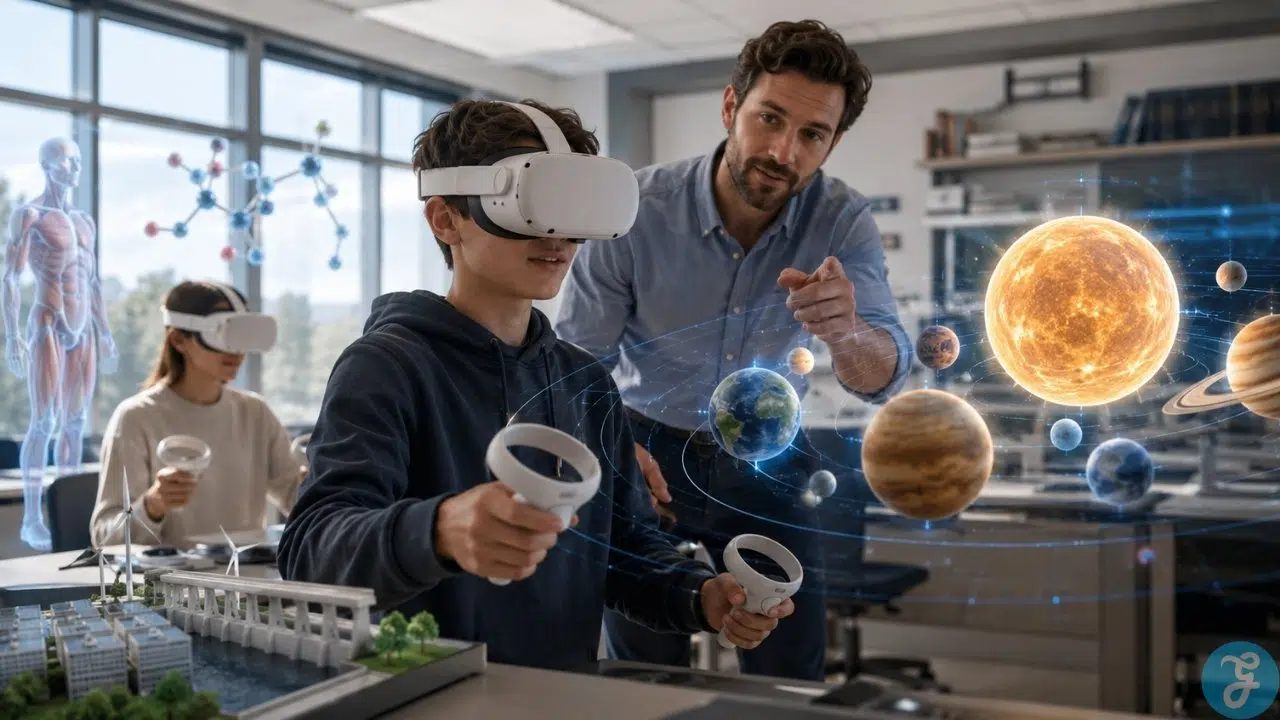
A student can read about the inside of a cell for ten minutes and forget half of it by lunch. Put that same student inside a 3D cell where the nucleus, membrane, and mitochondria behave like something they can inspect, move around, and question, and the lesson starts to feel less like memorization and more like discovery.
That is the promise behind EdTech SMEs specializing in VR learning platforms. The best companies in this space are not just making flashy headset demos. They are building structured learning environments where students, workers, nurses, technicians, teachers, and trainees can practice before the real-world cost gets high.
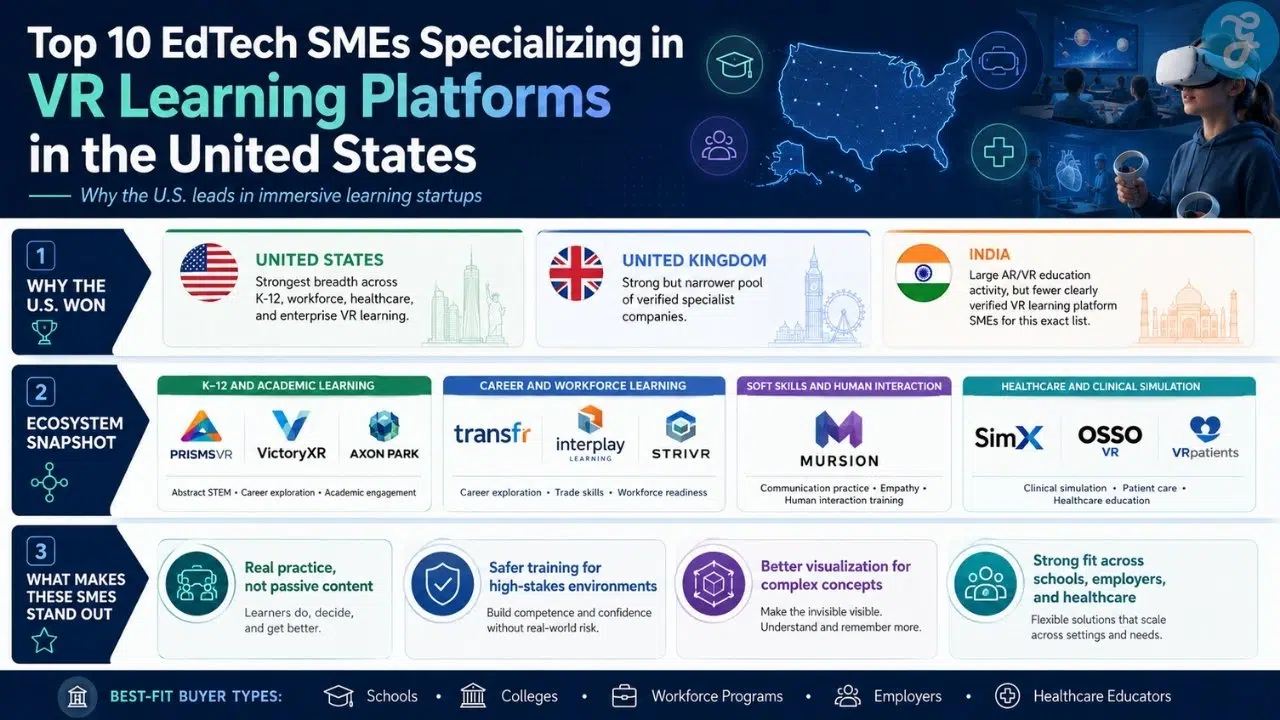
The United States is the strongest country for this list because its VR learning market is not trapped in one niche. Some companies focus on K-12 math and science. Others train HVAC technicians, nurses, surgeons, frontline workers, teachers, and enterprise teams. That range matters. A country does not lead this category only because it has a few famous VR startups. It leads when the ecosystem supports different kinds of learning problems and different buyers.
Our Selection Criteria
A good VR education company has to offer more than a headset experience that looks impressive in a demo. For this list, the companies had to show evidence that they are active, education-focused, and genuinely relevant to VR learning.
Here are the filters used to select the final 10:
| Selection filter | What it means |
|---|---|
| Country fit | The company must be headquartered in the United States |
| SME or startup profile | The company should be privately held, startup-scale, SME-scale, or still operating like a specialist growth company |
| VR learning relevance | The product must involve VR, XR, immersive simulation, spatial learning, or virtual practice tied to education or training |
| Platform depth | The company should offer a repeatable platform, simulation library, learning environment, or structured deployment model, not only custom one-off content |
| Market proof | The company should show real customers, school use, workforce use, healthcare use, funding, partnerships, or public product evidence |
| Contact visibility | The company should have a usable official website and some public contact route |
| List fit | The company must add something different to the list, such as K-12 STEM, workforce, medical simulation, enterprise training, or soft skills |
The final selection favors companies that solve specific learning problems. Some are better for schools. Some are stronger for clinical simulation. Some make more sense for workforce and enterprise training. That mix is exactly why the United States stood out.
Why the United States and not the United Kingdom or India?
The United Kingdom has some serious VR learning companies. ClassVR, Bodyswaps, and VirtualSpeech all show that the UK is strong in classroom VR, soft-skills simulation, and immersive communication training. The UK ecosystem is sharp, but it does not provide the same breadth of verified SME/startup-scale companies across K-12, workforce, skilled trades, enterprise, and healthcare.
India also has a large AR/VR education startup base. Tracxn lists more than 100 AR/VR education startups in India, and that signals real market activity. The issue is fit. Many Indian companies in this category blend AR, gamified learning, app-based content, 3D visualization, tutoring, or broader Edtech services, but fewer were easy to verify as strict VR learning platform SMEs with public company details, active education deployment, and clean contact information.
The United States won because it combines three advantages:
- It has more verified VR learning SMEs and startups across multiple education verticals.
- It has strong buyer demand from schools, employers, healthcare systems, and workforce programs.
- It has companies that have moved beyond “VR is cool” into repeatable training products, simulation libraries, and learning platforms.
That gives the US the strongest claim for this specific topic, not every Edtech topic in general.
Top 10 EdTech SMEs Specializing in VR Learning Platforms in the United States
The companies below are strictly US-based and were selected for their relevance to EdTech SMEs specializing in VR learning platforms. Some serve traditional education directly, while others serve workforce learning, healthcare training, and enterprise skill development. That wider definition matters because VR learning is no longer only a classroom technology.
1. PrismsVR
Headquarters: San Francisco, California
Website: https://www.prismsvr.com
Email: hello@prismsvr.com
PrismsVR focuses on spatial learning for math and science, especially for middle and high school students. Its platform turns abstract STEM concepts into embodied VR lessons where learners interact with problems instead of only reading formulas or watching videos. The company stands out because it treats VR as a core instructional method, not as a gimmick layered over normal lessons. For districts trying to improve STEM engagement, PrismsVR is one of the clearest school-focused names in this category.
Best Feature/For:
- Best for schools that want immersive math and science lessons.
- Strong fit for districts looking to make abstract STEM concepts more concrete.
Why We Chose It:
- It focuses directly on K-12 STEM learning rather than general VR content.
- The product connects VR experiences with curriculum-aligned academic skills.
- It offers a strong example of VR used for conceptual understanding, not only exploration.
- Its US startup profile fits the SME/startup requirement well.
Things to consider:
- Schools need headset access, teacher readiness, and classroom rollout support.
- It may suit STEM departments better than districts looking for broad all-subject VR.
2. Transfr
Headquarters: New York, New York
Website: https://transfrinc.com
Email: info@transfrvr.com
Transfr builds VR career exploration and workforce training tools for schools, workforce boards, employers, and training programs. Its simulations help learners experience jobs in industries such as manufacturing, healthcare, transportation, and skilled trades before committing to a pathway. The company is especially strong where education meets employability. It has one of the most practical use cases among US EdTech SMEs specializing in VR learning platforms because it helps learners understand careers through practice, not brochures.
Best Feature/For:
- Best for career and technical education, workforce development, and job-readiness programs.
- Strong fit for learners who need to explore career pathways before training.
Why We Chose It:
- It has a large library of career-focused VR simulations.
- It connects VR learning with workforce outcomes, not only classroom engagement.
- It works well for schools, employers, and public workforce systems.
- It gives learners a safer way to test job environments before entering real worksites.
Things to consider:
- Buyers should match simulations to local labor-market needs.
- It may be too workforce-specific for schools looking only for academic subject content.
3. VictoryXR
Headquarters: Davenport, Iowa
Website: https://www.victoryxr.com
Email: Info@VictoryXR.com
VictoryXR builds immersive classrooms, VR learning spaces, and simulation labs for schools, colleges, and training organizations. The company has become known for turnkey VR classroom environments and virtual education spaces that can support science, career training, and collaborative learning. Its strength is not one narrow lesson set, but the ability to help institutions build a broader immersive learning environment. For buyers who want a full VR classroom model rather than a single simulation product, VictoryXR deserves serious attention.
Best Feature/For:
- Best for schools and colleges building immersive classrooms or VR labs.
- Strong fit for institutions that want a broader VR learning environment.
Why We Chose It:
- It offers turnkey immersive classroom and simulation-lab solutions.
- It supports multiple subject areas and institutional use cases.
- It has visible experience working with education buyers.
- Its product direction fits both classroom VR and virtual campus-style learning.
Things to consider:
- Institutions should plan for hardware management, teacher training, and space design.
- A broader immersive setup can require more coordination than a single-purpose platform.
4. Interplay Learning
Headquarters: Austin, Texas
Website: https://www.interplaylearning.com
Email: sales@interplaylearning.com
Interplay Learning focuses on online and VR training for skilled trades, including HVAC, electrical, plumbing, facilities maintenance, and related technical fields. Its platform helps learners practice procedures, diagnose problems, and build confidence before entering real job sites. This makes Interplay especially useful for employers, trade schools, and workforce programs that need practical skills training at scale. It is one of the strongest US examples of VR learning tied directly to jobs that require hands-on competence.
Best Feature/For:
- Best for skilled trades training and workforce upskilling.
- Strong fit for HVAC, maintenance, electrical, and facilities programs.
Why We Chose It:
- It focuses on practical job skills rather than broad edtech claims.
- It combines online learning with VR-based practice.
- It serves industries where mistakes can cost time, equipment, and safety.
- Its platform supports repeatable training for large groups of workers.
Things to consider:
- It is strongest for trades and technical work, not general academic learning.
- Buyers should check how well the simulation library matches their specific trade needs.
5. Mursion
Headquarters: San Francisco, California
Website: https://www.mursion.com
Email: info@mursion.com
Mursion offers immersive simulation training for communication, leadership, coaching, teaching, and interpersonal skills. Its platform uses simulated human interactions to help learners practice difficult conversations in a controlled setting. Unlike VR platforms that focus on machinery, anatomy, or physical environments, Mursion targets the human side of learning: feedback, empathy, classroom management, leadership, and professional judgment. That makes it valuable for teacher education, corporate learning, healthcare communication, and leadership development.
Best Feature/For:
- Best for soft-skills practice, teacher training, coaching, and leadership simulation.
- Strong fit for organizations that need realistic human conversation practice.
Why We Chose It:
- It tackles a learning problem that normal videos and quizzes handle poorly.
- It gives learners a safer place to practice high-stakes conversations.
- It fits education, enterprise, healthcare, and professional development settings.
- It brings immersive learning into social and emotional skill development.
Things to consider:
- It is not a traditional headset-heavy STEM or lab simulation platform.
- Buyers should evaluate facilitator support and scenario design before scaling.
6. STRIVR
Headquarters: Santa Clara, California
Website: https://www.strivr.com
Email: media@strivr.com
STRIVR is best known for immersive enterprise learning and VR training at scale. The company has trained large workforces using VR simulations designed for operational skills, frontline readiness, safety, service, and performance. While it is not a school-only edtech company, it fits this list because workforce learning is now one of the strongest use cases for VR platforms. STRIVR shows how immersive training can move from pilot projects into large organizational learning systems.
Best Feature/For:
- Best for enterprise VR training and large-scale workforce learning.
- Strong fit for frontline training, operations, and performance practice.
Why We Chose It:
- It has proven experience deploying VR training at serious scale.
- It focuses on measurable workforce readiness and skill practice.
- It shows how VR learning can move beyond classrooms into workplace systems.
- Its enterprise model adds important range to the US VR learning ecosystem.
Things to consider:
- It may not fit traditional schools looking for curriculum-first academic content.
- Buyers should assess whether they need VR training, AI workforce tools, or both.
7. Axon Park
Headquarters: Miami, Florida
Website: https://www.axonpark.com
Email: support@axonpark.com
Axon Park builds AI-powered interactive learning environments, virtual campuses, and immersive 3D learning experiences. Its work includes Fronterra, a K-12 learning platform, along with broader virtual education environments for schools and institutions. The company stands out because it blends VR, AI, virtual-world design, and education delivery in a way that feels native to digital campuses. For institutions thinking beyond one-off simulations, Axon Park offers a more world-based approach to learning.
Best Feature/For:
- Best for virtual campuses, interactive 3D learning, and AI-supported immersive education.
- Strong fit for schools and universities exploring persistent digital learning spaces.
Why We Chose It:
- It treats immersive learning as a world-building problem, not only a content problem.
- It supports both VR and screen-based access depending on the use case.
- It has visible education partnerships and a clear US startup profile.
- Its AI angle gives it a forward-looking role in immersive edtech.
Things to consider:
- Buyers should clarify whether they need VR-first deployment or multi-device access.
- Virtual campus models require planning around moderation, curriculum, and student engagement.
8. SimX
Headquarters: San Francisco, California
Website: https://www.simxvr.com
Email: customersupport@simxvr.com
SimX builds VR medical simulation software for nurses, physicians, first responders, military medical teams, and healthcare educators. Its platform offers virtual patient encounters and clinical scenarios that let learners practice decision-making without risking real patients. This makes SimX one of the strongest healthcare-focused entries on the list. Its value is especially clear for institutions that need repeatable, scalable, high-pressure medical training without relying only on mannequins or live simulation labs.
Best Feature/For:
- Best for medical, nursing, EMS, and clinical simulation.
- Strong fit for healthcare programs that need realistic patient scenarios.
Why We Chose It:
- It focuses on high-stakes clinical learning where practice matters.
- It offers a large library of VR medical simulations.
- It can support distributed training across teams and locations.
- It gives educators a safer way to run rare or complex scenarios repeatedly.
Things to consider:
- Healthcare buyers should review scenario alignment with their curriculum or protocols.
- VR clinical simulation requires faculty buy-in and thoughtful debriefing.
9. Osso VR
Headquarters: San Francisco, California
Website: https://www.ossovr.com
Email: info@ossovr.com
Osso VR focuses on immersive procedural training, especially for healthcare professionals and medical device education. Its platform helps users practice complex procedures in a virtual environment before performing them in real clinical contexts. Osso VR stands out because procedural skill training is one of the most defensible uses of VR learning. When the task is expensive, technical, or difficult to repeat in real life, virtual practice becomes more than a novelty.
Best Feature/For:
- Best for surgical, procedural, and medical device training.
- Strong fit for hospitals, medtech companies, and healthcare education teams.
Why We Chose It:
- It focuses on procedural competence, not passive learning.
- It serves a market where simulation can reduce training friction.
- It has strong relevance for medical device rollouts and clinical education.
- It shows how VR learning can support expert-level skill development.
Things to consider:
- It is specialized, so it will not fit general education buyers.
- Healthcare organizations should evaluate integration with existing training programs.
10. VRpatients
Headquarters: Wilmington, Ohio
Website: https://www.vrpatients.com
Email: contact@vrpatients.com
VRpatients offers a no-code platform for creating virtual patient simulations across VR, mixed reality, and web-based environments. It serves nursing, EMS, and healthcare education programs that want realistic patient scenarios without building everything from scratch through custom development. Its no-code angle matters because many educators need control over scenarios, but do not have VR development teams. VRpatients gives healthcare instructors a more flexible way to design, adapt, and deploy patient encounters.
Best Feature/For:
- Best for nursing, EMS, and healthcare educators who want scenario authoring control.
- Strong fit for programs that need custom patient simulations without coding.
Why We Chose It:
- It gives educators authoring power instead of forcing them into fixed content only.
- It supports VR and web-based learning paths.
- It targets clinical reasoning and patient interaction, not just anatomy visuals.
- It fits smaller programs that need flexibility in healthcare simulation.
Things to consider:
- Scenario quality depends on how well educators design and debrief cases.
- Buyers should check device compatibility and integration with existing courses.
An Overview Of United States EdTech SMEs Specializing in VR Learning Platforms
The US ecosystem stands out because these companies do not all solve the same problem. Some help students understand STEM. Some help workers try a career before entering it. Others help healthcare learners practice procedures, conversations, and clinical judgment.
The snapshot below shows how the selected companies differ by buyer type, learning focus, and strongest use case.
| Company | Best for | Main buyer type | Platform style | Why it stood out |
| PrismsVR | K-12 STEM | Schools and districts | Spatial math and science lessons | Strong academic VR focus |
| Transfr | Career exploration and workforce | Schools, employers, workforce boards | Job simulations | Clear link to employability |
| VictoryXR | VR classrooms and labs | Schools and colleges | Immersive classroom environments | Broad institutional deployment |
| Interplay Learning | Skilled trades | Employers and trade programs | Online plus VR trade training | Practical job-skill focus |
| Mursion | Soft skills and teaching practice | Schools, enterprises, healthcare teams | Human interaction simulation | Strong conversation-based learning |
| STRIVR | Enterprise workforce training | Large employers | Immersive training at scale | Proven workplace deployment |
| Axon Park | Virtual campuses | Schools and universities | AI-powered 3D learning spaces | Strong future-facing model |
| SimX | Medical simulation | Healthcare educators and teams | VR patient scenarios | Deep clinical simulation library |
| Osso VR | Surgical and procedural training | Hospitals and medtech teams | Procedural VR practice | Strong technical healthcare focus |
| VRpatients | Nursing and EMS scenarios | Healthcare education programs | No-code patient simulation | Flexible authoring for educators |
This mix explains why the US won over the UK and India for this list. It has not only VR education companies, but several different types of VR learning companies with real market fit.
Our Top 3 Picks and Why?
Choosing the top three depends on the buyer. A school district, workforce board, and hospital do not need the same VR learning platform. Still, three companies stand out because they represent the strongest versions of three major use cases.
1. PrismsVR
PrismsVR is the strongest pick for K-12 academic learning. It gives VR a clear instructional role in math and science, where spatial understanding can help students grasp ideas that feel flat on a worksheet.
2. Transfr
Transfr is the strongest pick for career and workforce pathways. It connects VR with job exploration and training, which makes it especially useful for schools, employers, and public workforce systems trying to close skills gaps.
3. SimX
SimX is the strongest pick for healthcare simulation. Medical training has high stakes, and SimX gives learners a way to practice patient scenarios repeatedly without putting real people at risk.
VictoryXR, Interplay Learning, Osso VR, and VRpatients also came close depending on the use case. The real lesson is that “best” depends on whether the buyer needs STEM learning, job training, soft skills, enterprise training, or clinical simulation.
Why Are EdTech SMEs Specializing in VR Learning Platforms Booming in the United States?
The US has become a strong market for EdTech SMEs specializing in VR learning platforms because the demand comes from many directions at once. Schools want better STEM engagement. Workforce programs need faster career exposure. Employers need practical training that does not always require a physical training site. Healthcare educators need safe clinical practice. Colleges want virtual labs and campuses that can extend learning beyond physical classrooms.
This demand gives VR learning companies more than one buyer category. That matters because VR hardware adoption can move slowly in schools alone. When the same technology can serve K-12, higher education, enterprise training, healthcare, skilled trades, and workforce development, the market becomes more durable.
What’s their secret sauce?
The strongest US companies in this category share a few traits.
They do not sell VR as entertainment. They sell practice, safety, repetition, and access.
That difference matters. A school does not need VR because it looks futuristic. A district needs VR if it helps students understand a hard concept. A workforce board needs VR if it helps learners explore careers before wasting months in the wrong pathway. A hospital needs VR if it helps clinicians practice rare or stressful scenarios. An employer needs VR if it reduces training risk, cost, or inconsistency.
The secret sauce is not the headset. It is the use case.
The best US VR learning SMEs also tend to build around measurable pain points:
- STEM concepts that students struggle to visualize
- Skilled jobs that need hands-on practice
- Medical scenarios that are expensive or risky to repeat
- Soft skills that require live interaction
- Workforce readiness gaps
- Teacher and trainer shortages
- Training environments that are hard to access physically
That is why the strongest companies on this list feel practical. They are not asking buyers to believe in VR as a trend. They are asking buyers to solve a training problem.
The Hard Truth Behind the VR Learning Boom
The future of EdTech SMEs specializing in VR learning platforms looks promising, but it is not guaranteed. VR learning still faces serious friction: headset costs, device management, teacher training, accessibility, content quality, curriculum fit, privacy, and the simple reality that many schools already feel overloaded by technology.
The uncomfortable truth is that VR does not automatically improve learning. A weak lesson in a headset is still a weak lesson. A district with no rollout plan can waste money on hardware that gathers dust. A healthcare simulation without proper debriefing can turn into a novelty instead of training.
The companies that survive will not be the ones with the flashiest demos. They will be the ones that prove learning value, reduce implementation headaches, and fit into real institutional workflows. That is why the United States currently leads this category. Its best VR learning SMEs are not all chasing the same classroom gimmick. They are solving hard problems in STEM, trades, healthcare, workforce training, soft skills, and enterprise learning.
VR education has entered a more serious phase. The hype is no longer enough. Buyers now need platforms that teach something better, faster, safer, or more memorably than the old method.
That is where the real race begins.
Frequently Asked Questions (FAQs) About EdTech SMEs Specializing in VR Learning Platforms
Which country leads in EdTech SMEs specializing in VR learning platforms?
The United States leads for this list because it has the strongest verified mix of VR learning SMEs and startups across K-12, workforce, skilled trades, enterprise learning, and healthcare simulation. The UK and India are strong, but the US offered the clearest pool of 10 verified companies.
Are all the companies in this list strictly from the United States?
Yes. Every listed company is headquartered in the United States based on public company information, official pages, or credible company profiles. Some may serve global customers, but the country filter for this list is US headquarters.
Are VR learning platforms only useful for schools?
No. VR learning platforms now serve schools, colleges, employers, hospitals, workforce boards, trade programs, and military or emergency training teams. Some of the strongest use cases happen outside traditional classrooms.
What should buyers check before choosing a VR learning SME?
Buyers should check hardware needs, curriculum fit, content quality, accessibility, teacher or trainer support, privacy requirements, and proof of learning value. A strong demo is not enough if the platform is difficult to deploy.
Which company is best for K-12, workforce, and healthcare?
PrismsVR and VictoryXR are strong K-12 and school options. Transfr, Interplay Learning, and STRIVR are stronger for workforce and enterprise training. SimX, Osso VR, and VRpatients are stronger for healthcare simulation.