Finding paid homeschool curricula worth it is harder than it should be. Every program says it saves time. Every website promises flexibility. Every curriculum box looks complete. Every online platform claims it can help your child learn independently. And somehow, after three hours of comparing samples, reviews, grade levels, pricing pages, learning styles, worldview language, and parent dashboards, you may still feel like you are buying a year of uncertainty.
That is the real homeschool curriculum problem. A paid curriculum is not automatically better because it costs more. A free curriculum is not automatically weaker because it costs nothing. The question is whether the program solves a real problem for your family.
Do you need structure because planning drains you? Do you need online independence because you are working while homeschooling? Do you need literature-rich learning because your child hates worksheets? Do you need teacher support because high school credits feel intimidating? Do you need a hands-on kit because your child learns by building? Do you need a faith-based program, a secular program, or something faith-neutral?
The best homeschool curriculum is not the one everyone praises online. It is the one that fits your child, your teaching capacity, your budget, your state requirements, and your actual home life.
This paid curriculum review compares 11 premium homeschool programs and paid curriculum options that are worth considering for different kinds of families.
What Makes a Paid Homeschool Curriculum Worth It?
A paid homeschool curriculum is worth it when it gives you something you would struggle to build yourself.
That might be a complete lesson sequence, grading support, teacher videos, parent planning tools, physical books, experiments, projects, accreditation support, transcript help, adaptive practice, or a full year of organized materials. For some families, the value is academic quality. For others, it is time saved. For others, it is confidence.
The strongest paid homeschool curricula usually offer at least one of these:
- A clear daily or weekly plan
- Strong subject coverage
- Parent guidance that reduces planning stress
- Student-facing lessons that support independence
- Progress tracking or recordkeeping
- High-quality books, videos, projects, or assessments
- Flexibility across grade levels
- Support for different learning styles
- A clear worldview or educational philosophy
- Enough structure to satisfy homeschool requirements
The wrong curriculum creates a different problem. It may be too rigid, too screen-heavy, too parent-intensive, too expensive, too religious, not religious enough, too advanced, too easy, or poorly matched to your child’s personality. So do not ask only, “Is this curriculum good?” Ask, “Is this curriculum good for our homeschool?”
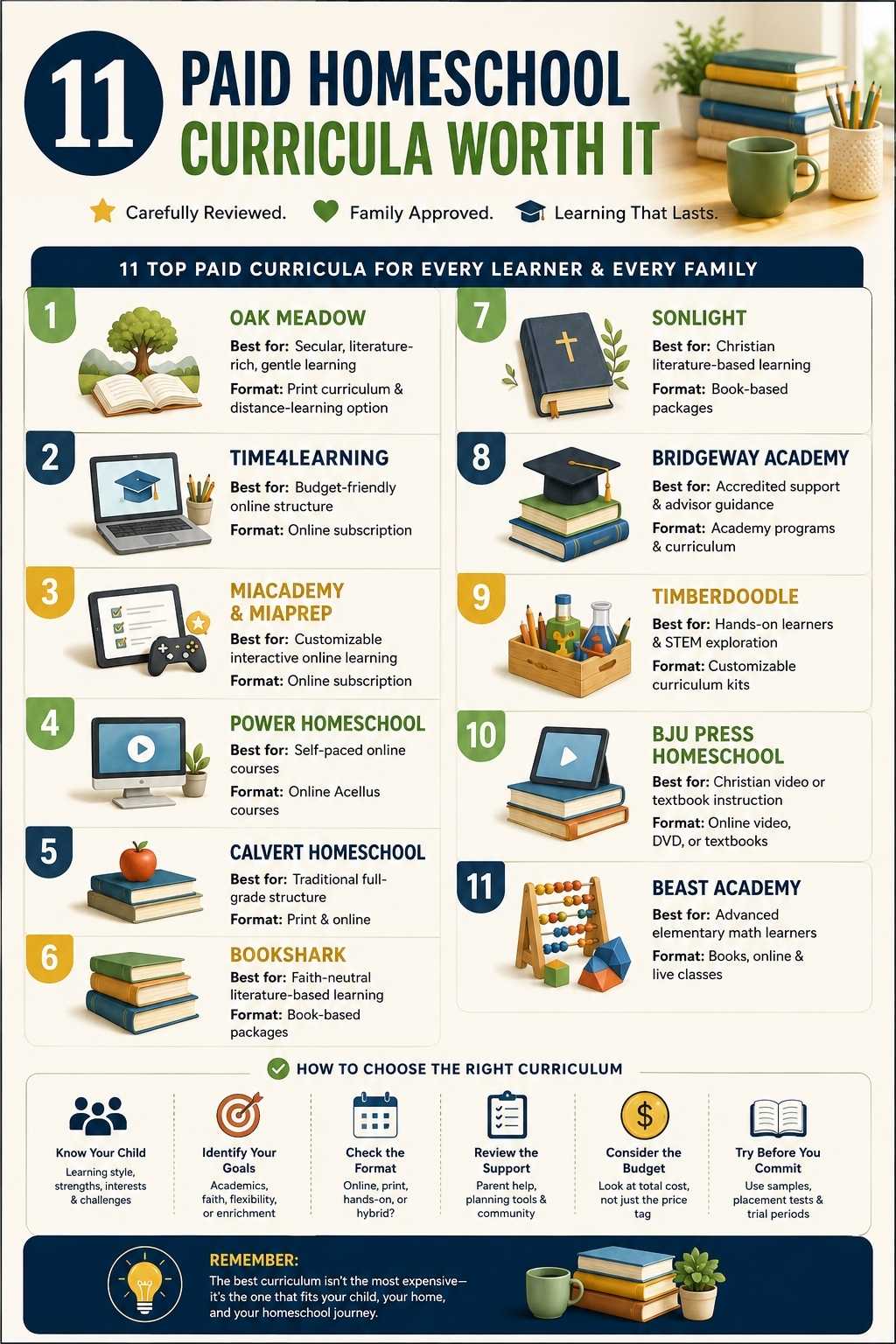
11 Paid Homeschool Curricula Worth It
These programs are not ranked as one-size-fits-all winners. They are worth considering because each solves a different homeschool problem.
1. Oak Meadow
Oak Meadow is one of the best paid homeschool curriculum options for families who want a slower, thoughtful, book-based approach instead of a screen-heavy program.
It offers secular curriculum from preschool through high school, with an emphasis on developmentally appropriate learning, creativity, nature, projects, writing, and student-centered education. Families can use the curriculum independently or enroll in Oak Meadow’s accredited distance-learning school for teacher support.
The independent curriculum works well for parents who want a clear plan but still want to teach actively. The enrolled option makes more sense for families who want teacher evaluation, transcripts, and a more formal distance-learning structure.
Oak Meadow is not the right fit if you want fast automated grading, daily video lessons, or a fully hands-off online platform. It asks for parent involvement, especially in earlier grades. But for families who want meaningful offline learning, it can feel far more human than a dashboard full of assignments.
Best for: Secular families, creative learners, nature-friendly homeschoolers, and parents who want depth over speed.
Why it is worth it: It offers a well-rounded, literature-rich, project-aware curriculum without relying on constant screen time.
Things to consider: Parent involvement matters. If you need your child to work independently online most of the day, this may not be the easiest fit.
2. Time4Learning
Time4Learning is one of the most practical paid homeschool curricula for families who need affordable online structure.
It covers preschool through 12th grade with online lessons, activities, quizzes, printable worksheets, and parent planning tools. The appeal is simple: it gives families a ready-to-use online curriculum without the commitment or cost of an accredited private academy.
This makes it useful for new homeschoolers who feel overwhelmed, families who need flexible scheduling, parents working from home, or students who do better with interactive digital lessons than textbooks.
The biggest strength is convenience. Lessons are already organized. Students can work at their own pace. Parents can use planning and reporting tools. It also works as either a primary curriculum or a supplement.
The limitation is that it may feel too screen-based or light for families who want rich literature, hands-on projects, deep writing feedback, or parent-led discussion. Parents still need to check understanding, add reading, review writing, and make sure the child is not just clicking through.
Best for: Budget-conscious families, online learners, new homeschoolers, and parents who need flexible structure.
Why it is worth it: It gives a full online curriculum path at a lower price point than many premium homeschool programs.
Things to consider: It is not a private school. Parents remain responsible for oversight, recordkeeping, and meeting homeschool requirements.
3. Miacademy and MiaPrep
Miacademy is a strong option for families who want an online curriculum that feels more customizable and engaging than a basic lesson platform.
Miacademy serves K–8 learners, while MiaPrep supports older students in middle and high school ranges. The program includes core subjects, electives, interactive lessons, progress tracking, attendance tools, and customization options. That makes it especially useful for families with kids working at different grade levels in different subjects.
The platform’s biggest advantage is flexibility. A child who is advanced in reading but behind in math does not need to stay trapped inside one grade-level box. Parents can assign lessons more intentionally and adjust the year around the child.
It can also be a good fit for kids who like a more interactive online environment. The design is more student-friendly than many traditional digital programs.
The caution is that online engagement is not the same as mastery. Parents should still check written work, discuss lessons, and make sure students are learning deeply rather than just completing tasks.
Best for: Customizable online homeschooling, multi-grade learners, and students who like interactive lessons.
Why it is worth it: It gives parents flexible assignment tools and students a more engaging online experience.
Things to consider: Families with older students should check the exact difference between Miacademy, MiaPrep, and any diploma or academy-style options before choosing.
4. Power Homeschool
Power Homeschool is worth considering for families who want a self-paced online program using Acellus courses without enrolling in an accredited online school.
It offers access to a broad range of courses, and parents can choose courses for their children while remaining in charge of homeschooling. The program is designed to support independent homeschoolers, not replace the parent’s legal role.
This can work well for students who are comfortable learning from video-based lessons and moving through courses independently. It can also help parents who want online teaching, testing, and recordkeeping support without building every lesson themselves.
The biggest reason to consider Power Homeschool is structure. It gives students a clear path through courses and reduces parent planning time.
The biggest caution is support. Power Homeschool states that it provides courses without teacher support. Parents must supervise, monitor effort, understand local homeschool requirements, and decide whether the course quality fits the student.
Best for: Independent online learners, families needing self-paced digital courses, and parents who want less daily lesson planning.
Why it is worth it: It gives broad course access and a ready online structure.
Things to consider: It is not the same as enrolling in an accredited school. Parents remain responsible for homeschool compliance and academic oversight.
5. Calvert Homeschool
Calvert is one of the more traditional paid homeschool curriculum options, which can be a strength for families who want a familiar school-like structure.
It offers print curriculum for younger learners and online curriculum for grades 3–12. The print courses include full-year learning content and required materials, while the online subscription gives access to core courses across multiple grade levels.
Calvert can be useful for parents who want a complete, organized curriculum without hunting for separate resources in every subject. It may also appeal to families who prefer a more traditional academic feel rather than a highly eclectic or unschooling-inspired approach.
The online option’s broad grade-level access can be helpful when a child needs to move ahead in one subject or review another. The print option can work well for families who want younger kids away from screens.
The caution is fit. Calvert may feel too traditional for families who want literature-led, project-based, or child-led homeschooling. But for families who want order, scope, and clear subject coverage, it earns a place on the list.
Best for: Families wanting a traditional, organized, school-style homeschool curriculum.
Why it is worth it: It offers complete grade-level structure in both print and online formats.
Things to consider: It may not feel as flexible or creative as some literature-based or hands-on programs.
6. BookShark
BookShark is a strong paid curriculum choice for families who want literature-based homeschooling without a religious framework built into the lessons.
It is faith-neutral, fully planned, and built around living books, read-alouds, history, language arts, science, and related resources. For parents who want the warmth of literature-based learning but prefer to handle spiritual instruction separately, BookShark fills an important gap.
The biggest strength is that it makes rich reading manageable. Many parents love the idea of teaching through books but do not want to spend months building booklists, schedules, discussion plans, and assignments. BookShark does that planning for you.
It can work beautifully for families who enjoy reading aloud, discussing stories, and connecting subjects through books. It also tends to fit families who want a four-day structure with room for co-ops, field trips, projects, or catch-up days.
The challenge is parent involvement. BookShark is not a hands-off program. If your child dislikes reading or you cannot realistically do read-aloud time, it may feel heavy.
Best for: Secular or faith-neutral families who want literature-based learning.
Why it is worth it: It saves planning time while giving students a book-rich homeschool experience.
Things to consider: It requires parent participation and a home rhythm that supports reading and discussion.
7. Sonlight
Sonlight is one of the best-known Christian literature-based homeschool curricula.
It offers complete packages from preschool through high school, built around real books, history, Bible, literature, science, language arts, and other subjects. Like BookShark, Sonlight is heavily planned, but it comes from a Christian worldview.
This is a strong fit for Christian families who want faith integrated into the homeschool day and who value reading, discussion, and family learning. The Instructor’s Guides are a major part of the value because they reduce the burden of daily planning.
Sonlight is especially useful for families who want an education that feels story-driven rather than worksheet-driven. Students spend a lot of time with books, ideas, history, and conversation.
The limitation is worldview fit. Nonreligious families or families wanting secular science and history will likely prefer BookShark, Oak Meadow, Moving Beyond the Page, or another secular option.
Best for: Christian families who want a complete, literature-based homeschool curriculum.
Why it is worth it: It gives families a rich book-centered plan with strong parent guidance.
Things to consider: It is parent-involved and faith-based, so worldview fit matters.
8. Bridgeway Academy
Bridgeway Academy is best for families who want more support than a curriculum box or online subscription can provide.
It offers accredited K–12 homeschool programs, advisor support, curriculum options, and live online classes. This makes it different from a simple curriculum purchase. Families are paying not only for materials or courses, but for structure, guidance, and academic support.
Bridgeway can be especially useful for parents who feel nervous about high school, transcripts, learning differences, college preparation, or choosing the right curriculum path. The advisor model can help families avoid the “I bought five programs and still do not know what to do” problem.
It may also fit families transitioning out of traditional school who want a more formal homeschool setup.
The trade-off is cost. Academy-style support is usually more expensive than simply buying curriculum. It is most worth it when you actually need the support.
Best for: Families wanting accreditation support, advisor guidance, and more formal homeschool structure.
Why it is worth it: It helps reduce parent uncertainty around planning, placement, records, and academic direction.
Things to consider: If you only need curriculum materials, a simpler program may cost less.
9. Timberdoodle
Timberdoodle is a strong option for families who want a complete curriculum kit with hands-on materials, STEM, logic, art, and core academics.
Instead of giving you only textbooks or only online lessons, Timberdoodle curates physical kits that can be customized. That makes it appealing for kids who need to build, move, draw, solve puzzles, experiment, and interact with materials instead of staring at a screen all day.
The biggest strength is practicality. Many parents want hands-on learning but do not want to research every manipulative, STEM kit, workbook, science resource, art supply, and logic game separately. Timberdoodle bundles those choices into a workable package.
It is especially good for tactile learners and families who want school to feel active. It can also help parents who like eclectic homeschooling but still need a full-year plan.
The caution is that kits can be expensive, and not every item will be perfect for every child. Customization matters.
Best for: Hands-on learners, STEM-loving kids, and families who want physical materials curated for them.
Why it is worth it: It saves planning time and brings more tactile learning into the homeschool day.
Things to consider: Review the kit contents carefully. Do not pay for items you know your child will never use.
10. BJU Press Homeschool
BJU Press Homeschool is a premium Christian curriculum option for families who want structured instruction through video lessons, textbooks, or both.
The online video course kits include access to a full year of video lessons through the Homeschool Hub, an adjustable schedule, printed textbooks, digital materials, and grading support features depending on grade level. Families can also choose textbook-only or DVD formats.
This flexibility is a major advantage. A parent who wants to teach directly can use textbooks. A parent who needs more independent student learning can use video lessons. A family with unreliable internet may prefer DVD options.
BJU Press works best for families who want a clearly Christian, structured, traditional academic approach. It can be especially helpful when parents want teacher-led video instruction but still want to homeschool.
The limitation is worldview and style. It will not fit secular families, and it may feel too traditional for families who prefer relaxed, child-led, or literature-only approaches.
Best for: Christian families wanting structured video or textbook instruction.
Why it is worth it: It gives a full-year academic plan with strong instructional support options.
Things to consider: It is explicitly Christian and more traditional than many modern homeschool programs.
11. Beast Academy
Beast Academy is not a full all-subject homeschool curriculum, but it is one of the paid subject-specific curricula most worth considering for math.
Created by Art of Problem Solving, it is designed for advanced elementary math learners and uses comic-style books, challenging puzzles, online lessons, videos, and practice problems. The curriculum covers Levels 1–5 and is aimed at students roughly ages 6–13.
This is a strong choice for children who are curious, puzzle-oriented, math-ready, or bored by repetitive worksheets. It teaches problem solving, reasoning, and deeper mathematical thinking rather than only procedural practice.
Beast Academy is not the best fit for every child. Some students need more direct, gentle, step-by-step instruction before they are ready for its level of challenge. But for the right learner, it can be one of the most valuable paid homeschool purchases.
It also pairs well with broader curricula that have weaker math components.
Best for: Advanced elementary math learners, puzzle-loving kids, and families wanting stronger problem-solving math.
Why it is worth it: It develops mathematical reasoning in a way many standard programs do not.
Things to consider: Placement matters. Starting too high can frustrate a child quickly.

Quick Comparison: 11 Paid Homeschool Curricula Worth It
| Curriculum | Best For | Format | Best Fit |
| Oak Meadow | Secular, gentle, literature-rich homeschooling | Print curriculum and distance-learning option | Families wanting thoughtful offline learning |
| Time4Learning | Budget-friendly online structure | Online subscription | Families needing flexible self-paced lessons |
| Miacademy and MiaPrep | Customizable interactive online learning | Online subscription | Kids who like gamified, flexible learning |
| Power Homeschool | Self-paced online courses | Online Acellus courses | Independent learners with parent oversight |
| Calvert Homeschool | Traditional full-grade structure | Print and online | Families wanting classic school-style curriculum |
| BookShark | Faith-neutral literature-based learning | Book-based packages | Families who want read-alouds and planned lessons |
| Sonlight | Christian literature-based curriculum | Book-based packages | Christian families wanting rich reading |
| Bridgeway Academy | Accredited support and advisor guidance | Academy programs and curriculum | Families needing support, transcripts, and structure |
| Timberdoodle | Hands-on curriculum kits | Customizable physical kits | Project-loving and tactile learners |
| BJU Press Homeschool | Christian video or textbook curriculum | Online video, DVD, or textbooks | Families wanting structured Christian instruction |
| Beast Academy | Advanced elementary math | Books, online, and live classes | Curious math learners needing challenge |
Best Paid Homeschool Curriculum by Family Need
| Family Need | Best Fit |
| Secular, offline, creative curriculum | Oak Meadow |
| Budget online all-in-one structure | Time4Learning |
| Interactive customizable online learning | Miacademy and MiaPrep |
| Self-paced online courses | Power Homeschool |
| Traditional school-style curriculum | Calvert Homeschool |
| Faith-neutral literature-based learning | BookShark |
| Christian literature-based learning | Sonlight |
| Accredited support and advising | Bridgeway Academy |
| Hands-on physical curriculum kits | Timberdoodle |
| Christian video or textbook instruction | BJU Press Homeschool |
| Advanced elementary math | Beast Academy |
What to Check Before Paying for a Homeschool Curriculum
Before buying any paid curriculum, check these points:
- Does it match your state or country’s homeschool requirements?
- Is it secular, faith-neutral, Christian, or worldview-specific?
- Does it require heavy parent teaching?
- Is it online, print, video, book-based, hands-on, or mixed?
- Does it include grading or recordkeeping?
- Does it offer placement tests or samples?
- Can your child work across grade levels?
- Does it include all subjects or only selected subjects?
- Are materials reusable for siblings?
- Is there a refund policy?
- What is the real yearly cost after books, supplies, subscriptions, shipping, and add-ons?
The best paid homeschool curriculum is the one that reduces stress without creating a new kind of stress.
Common Mistakes Parents Make With Paid Curriculum
- Buying too much at once. A full premium package looks reassuring, but if the style does not fit your child, you may feel trapped.
- Choosing based on popularity. A curriculum can be beloved by thousands of families and still be wrong for yours.
- Ignoring parent workload. Some programs look complete but require a lot of reading aloud, discussion, grading, or prep.
- Assuming online equals independent. Many children need parent check-ins even with self-paced digital programs.
- Forgetting worldview. Secular, faith-neutral, and Christian curricula can feel very different in science, history, literature, and daily lessons.
- Not checking homeschool law. Curriculum providers do not remove your responsibility to meet local requirements.
A Simple Way to Choose the Right Paid Curriculum
Use this decision path:
- Decide whether you want secular, faith-neutral, or faith-based curriculum.
- Choose your format: online, print, video, literature-based, hands-on, or academy-supported.
- Identify your child’s biggest need: independence, challenge, structure, creativity, support, or flexibility.
- Check samples before buying.
- Test one subject if possible before committing to a full year.
- Calculate the real annual cost.
- Check local homeschool requirements.
- Build in review points every 6–8 weeks.
Do not expect the curriculum to carry the whole homeschool by itself. Even the best homeschool curriculum needs parent attention, observation, and adjustment.
Wrapping Up
The paid homeschool curricula worth it are the ones that buy you the right kind of help.
Oak Meadow gives thoughtful secular structure. Time4Learning gives affordable online flexibility. Miacademy and MiaPrep offer customizable digital learning. Power Homeschool gives self-paced course access. Calvert gives traditional full-grade organization. BookShark gives faith-neutral literature-based planning. Sonlight gives Christian literature-rich homeschooling. Bridgeway Academy adds accreditation and advisor support. Timberdoodle brings hands-on kits. BJU Press gives structured Christian video and textbook options. Beast Academy strengthens advanced elementary math.
There is no single best homeschool curriculum for every family. There is only the best fit for your child, your home, your budget, your beliefs, and the amount of teaching support you realistically need. Start there. The curriculum decision becomes much easier.
Frequently Asked Questions About Paid Homeschool Curricula Worth It
1. What are the paid homeschool curricula worth it for most families?
The paid homeschool curricula worth considering include Oak Meadow, Time4Learning, Miacademy, Power Homeschool, Calvert, BookShark, Sonlight, Bridgeway Academy, Timberdoodle, BJU Press Homeschool, and Beast Academy. The best choice depends on whether your family needs online lessons, print curriculum, literature-based learning, faith-based instruction, hands-on kits, or academic support.
2. Is paid homeschool curriculum better than free curriculum?
Not always. Paid curriculum is better only when it saves time, improves structure, supports the child’s learning style, or gives parents tools they need. Free resources can be excellent, but they often require more planning, organization, and parent decision-making.
3. What is the best homeschool curriculum for beginners?
Time4Learning, Miacademy, Calvert, Oak Meadow, and Bridgeway Academy can all work for beginners, depending on the family. Time4Learning and Miacademy are easier for online structure. Oak Meadow is better for offline secular learning. Bridgeway is better if parents want advisor support.
4. What is the best paid homeschool curriculum for high school?
Bridgeway Academy, Oak Meadow, BJU Press Homeschool, Power Homeschool, Calvert, and MiaPrep are worth comparing for high school. Parents should look closely at credits, transcripts, grading, teacher support, accreditation options, and college planning before choosing.
5. What is the best secular paid homeschool curriculum?
Oak Meadow, BookShark, Moving Beyond the Page, Calvert, Timberdoodle nonreligious kits, Miacademy, and Time4Learning are all secular or broadly nonreligious options worth comparing. Families should still review samples because “secular,” “faith-neutral,” and “nonreligious” can mean different things across programs.
A premium homeschool program is worth the cost if it solves a real problem for your family. Look for clear lesson plans, quality materials, strong subject coverage, support tools, placement help, progress tracking, refund policies, and a format your child will actually use. If it only looks impressive but does not fit your home life, it is not worth it.