

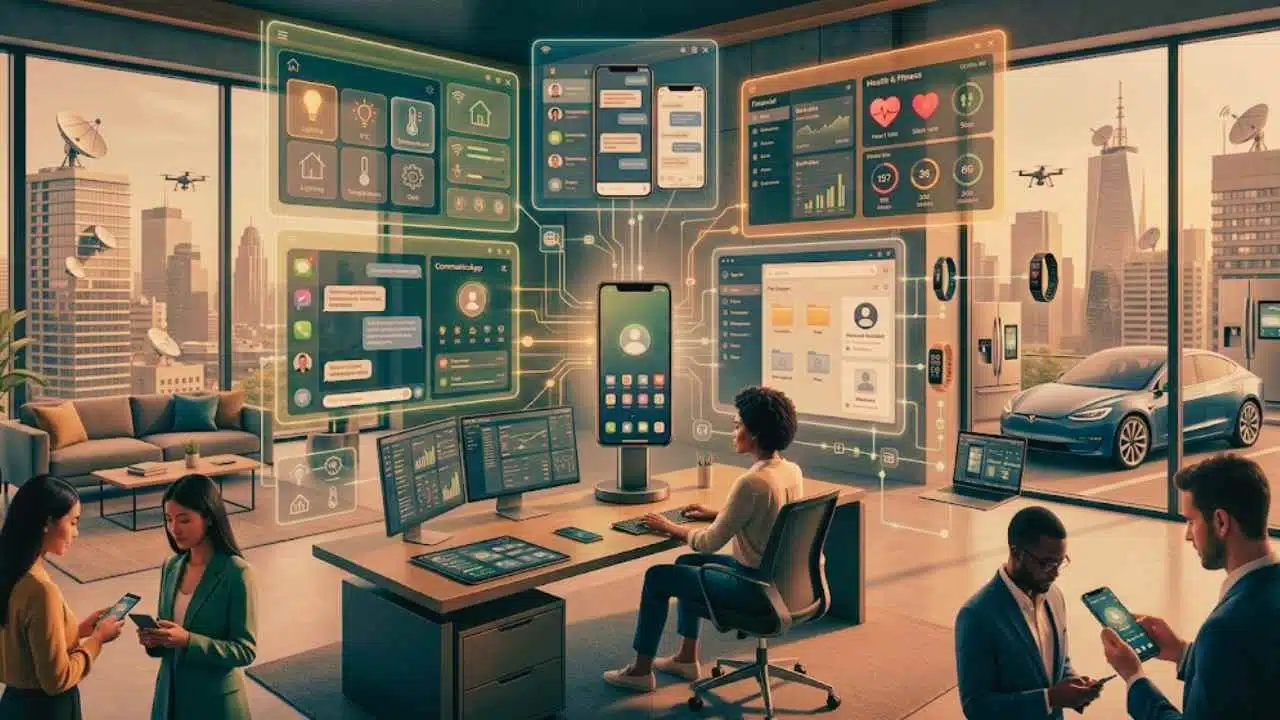
The most important shift in mobile software is not another interface trend. It is the movement from single-purpose apps to systems that manage identity, context, tasks, payments, communications, and decisions across a user’s digital life.
For most of the smartphone era, apps were separate destinations. A banking app handled money. A messaging app handled conversations. A shopping app handled purchases. Users switched between them and stitched workflows together manually.
That model is starting to break down.
As AI assistants, cross-app integrations, unified identity systems, and embedded payments become standard, leading apps are expanding from tools into personal operating systems. They increasingly act as coordination layers that connect services, remember preferences, automate routine actions, and become the primary interface through which users manage daily activities.
This shift changes product strategy, app architecture, growth tactics, and competition itself.
Companies of every size, from global technology platforms to a mobile app development company in Dallas, are rethinking what role an application should play in a user’s digital life.
What “Personal Operating System” Means
A personal operating system is an app or service that becomes the user’s default coordination layer. It typically combines:
- Identity and authentication
- Persistent user memory and preferences
- Messaging and notifications
- Payments and commerce
- Scheduling and task management
- Third-party integrations
- AI assistance and automation
- Context awareness across devices and services
In practice, users stop asking “Which app should I open?” and start asking “Can this system handle the outcome for me?”
We already see this pattern in different forms across super apps, productivity platforms, messaging ecosystems, and AI assistants. The direction is broader than any single company. The core change is that the app is becoming a container for many activities rather than a gateway to one activity.
Why This Shift Is Happening Now
Several technological and behavioral shifts are pushing apps beyond their traditional role as single-purpose tools. The change is being driven by user expectations, AI capabilities, and the growing demand for connected digital experiences.
1. Users Are Exhausted by App Switching
Modern workflows often span messaging, payments, calendars, documents, maps, shopping, and customer support. Every handoff creates friction.
Apps that can complete multi-step tasks inside one environment gain a retention advantage because they reduce cognitive overhead.
2. AI Makes Coordination Valuable
Large language models are strongest when they can access context, memory, and connected services. An AI assistant with access to calendar data, purchases, conversations, location history, and subscriptions can perform actions that a disconnected chatbot cannot.
This pushes platforms to gather more user context and expose more actions through a unified layer.
3. Embedded Payments Remove Friction
Payments are no longer confined to banking apps. Commerce now happens inside messaging, social, productivity, and service platforms. Once an app can identify the user and process payments, it becomes a candidate for handling a much larger portion of daily activity.
4. APIs Turn Features Into Commodities
Many features that once differentiated apps can now be integrated through APIs. Messaging, maps, identity, AI inference, analytics, and payments are increasingly available as services. The competitive advantage shifts from owning one feature to orchestrating many features into a cohesive experience.
The New Competitive Battlefield: Orchestration, Not Features
For years, app teams competed on individual capabilities:
| Old question | New question |
| Does the app have feature X? | Can the app complete the entire workflow? |
| Is the UI faster? | Does the system know my context automatically? |
| Can I customize this screen? | Can the app coordinate actions across services? |
| Does it integrate with one tool? | Can it act as the hub for all my tools? |
This is why companies across finance, messaging, productivity, commerce, and AI are converging on similar strategies. They want to become the place where user intent begins.
What Changes for Product Teams
As applications evolve into personal operating systems, product development priorities are changing as well. Teams can no longer focus solely on adding features or improving individual screens. The challenge now is creating systems that understand context, connect services, and help users achieve outcomes with fewer steps.
From Screens to Workflows
Traditional product planning often starts with screens and feature lists. Personal operating systems start with user outcomes.
Example:
“Book a meeting, reserve a room, notify participants, and prepare the agenda”
That outcome may touch calendar APIs, messaging systems, documents, payments, and AI summarization. Users care about completion, not which subsystem handled each step.
Memory Becomes a Core Product Surface
Preferences, history, subscriptions, contacts, habits, and prior interactions become strategic assets. The system that remembers useful context can reduce repetitive input and deliver more relevant automation.
Integrations Become Infrastructure
In a single-purpose app, integrations are often secondary. In a personal operating system, integrations are central. The value comes from connecting services rather than replacing all of them.
The Architecture Shift
Many mobile teams still treat the app as a front end attached to one backend domain. Personal operating systems require a different architecture.
Common components include:
- Identity and permissions layer
- Unified event stream
- User memory store
- AI orchestration service
- Workflow engine
- Third-party connector framework
- Policy and audit layer for automated actions
- Multi-device synchronization
The hardest engineering problem is often not AI generation. It is safe, observable orchestration across many services.
Why Privacy and Trust Become Central
As apps gather more context, they gain more responsibility. Users may tolerate extensive data access only if the value exchange is obvious and the controls are understandable.
Product teams should expect increasing scrutiny around:
- What data is stored
- How long memory persists
- Which actions AI can perform autonomously
- How decisions are logged and reviewed
- Whether users can delete or export their history
Trust becomes a growth feature. A system that feels opaque will struggle to become the user’s primary coordination layer.
The Strategic Risk: Becoming a Feature Instead of a Platform
This shift creates a major risk for many app companies.
If users increasingly interact through AI assistants, super apps, or operating-system-level agents, standalone apps may lose direct customer relationships. Their functionality can be exposed through APIs and invoked by another interface.
In that scenario, the question is no longer “How many downloads do we have?” It becomes:
“Are we the destination, or are we a service another system calls?”
Some companies will thrive as infrastructure providers. Others will try to become orchestration hubs themselves. The difficult middle ground is being neither.
What This Means for App Strategy in 2026 and Beyond
For founders, product leaders, and mobile teams, several priorities stand out.
| Priority | Why it matters |
| Build around outcomes, not screens | Users increasingly value completed tasks over feature counts. |
| Treat identity, payments, and memory as strategic assets | These are the foundations of a personal operating system. |
| Invest in connectors and APIs early | Interoperability is becoming a core product capability. |
| Define clear AI action boundaries | Autonomous behavior without governance creates trust and compliance problems. |
| Measure workflow completion, not just session time | Traditional engagement metrics may miss the value of automation. |
The Bigger Picture
The smartphone home screen trained users to think in apps. AI assistants, workflow automation, embedded payments, and cross-service orchestration are training them to think in outcomes.
That is why so many companies are expanding beyond their original category. Messaging apps add payments. Productivity tools add AI agents. Financial apps add commerce and budgeting. AI assistants add memory, scheduling, and transactions.
They are all moving toward the same position: becoming the personal operating system that sits between the user and the rest of the internet.
The next competitive race is not about who builds the most features. It is about who becomes the default layer through which users organize digital life.
























