


Online shoppers are asked to trust a product before they can touch it. They cannot feel the fabric, hold the bottle, test the weight, judge the real color in daylight, check how big it looks on a desk, or see whether it fits into an ordinary routine. That gap is where many product pages lose people. A perfect studio photo can make a product look clean. It does not always make the product feel believable.
That is why realistic product showcasing methods matter more now. Buyers do not only want to see what a product looks like on a white background. They want to understand how it behaves, how it fits, how it compares in size, how real people use it, and whether the brand is hiding anything behind polished lighting.
This does not mean brands should abandon clean product photography. Studio shots still matter for ecommerce listings, marketplaces, catalogs, and visual consistency. But realistic visuals complete the story. They answer the quiet doubts buyers have before they click “add to cart.”
Good product visuals should do three jobs at once: show the product clearly, show the product honestly, and show the product in a way that helps people imagine using it.
The strongest product pages usually do not rely on one type of image. They combine clean studio shots, lifestyle scenes, in-use demonstrations, scale references, customer-style content, before-and-after proof, interactive views, and carefully reviewed AI-assisted variations.
The goal is not to make the product look perfect. The goal is to make the buying decision easier.
Our Selection Criteria
The methods in this list were selected because they help reduce buyer uncertainty. That matters whether the product is sold through a Shopify store, Amazon listing, Google Shopping placement, Instagram ad, landing page, product catalog, or social commerce campaign.
These methods were chosen based on whether they:
- Help buyers understand real-world use
- Make size, texture, fit, function, or context clearer
- Work alongside clean studio product images
- Support ecommerce, ads, social media, marketplaces, and product pages
- Build trust without making the product look fake
- Can be used by small brands, agencies, creators, and in-house marketing teams
- Avoid over-polished visuals that hide important product details
- Make the product easier to imagine in daily life
The best product visuals are not always the most expensive ones. Sometimes the most useful image is a simple shot of the product in a real hand, on a real shelf, in a real bag, beside a real object, or being used in a normal situation.
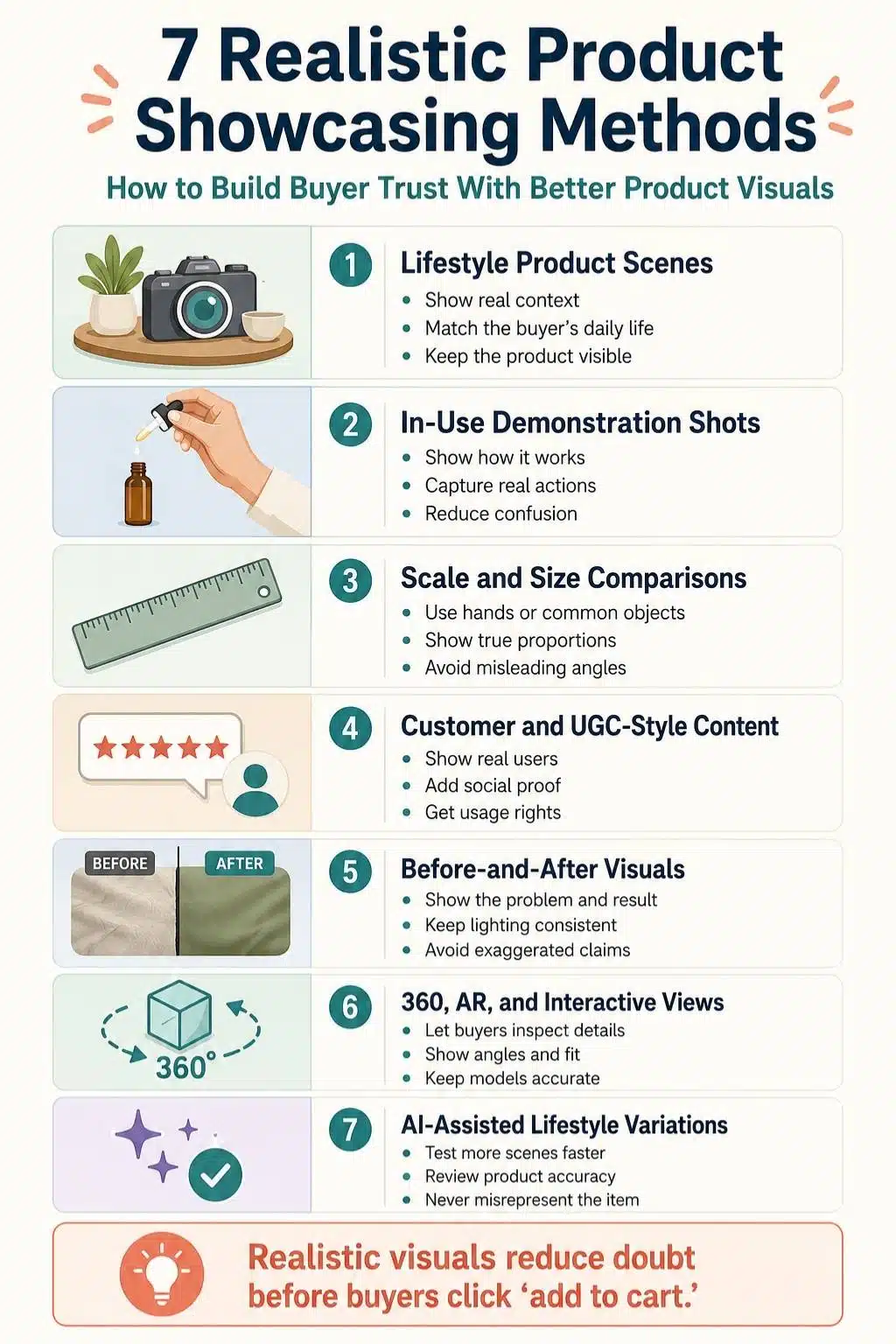
7 Realistic Product Showcasing Methods That Build Buyer Trust
Realistic product presentation is not one style. It is a mix of visual decisions that help buyers understand the product better.
Some products need a lifestyle context. Some need scale. Some need a usage demo. Some need social proof. Some need interactive views. Some need before-and-after evidence. Some need AI-assisted scene variation, but only with careful human review.
Here are seven creative methods that can make product visuals feel more real, useful, and trustworthy.
1. Lifestyle Product Scenes
A lifestyle product scene shows the product in the environment where it naturally belongs. A skincare product might sit on a bathroom shelf beside a towel and mirror. A backpack may appear on a commute, near a desk, or beside travel essentials. A coffee mug may sit on a work table with a laptop and notebook. A kitchen tool may appear during meal prep, not floating alone on a white background.
This type of image helps buyers imagine ownership. A product page that only shows isolated pack shots may answer “What does it look like?” A lifestyle image answers a more emotional question: “Can I see this fitting into my life?”
Where This Works Well
Lifestyle product scenes are especially useful for:
- Home decor
- Beauty and skincare
- Fashion accessories
- Fitness products
- Food and beverages
- Desk products
- Pet products
- Kitchen tools
- Travel items
- Wellness products
The method works because it creates context without needing too much explanation. A buyer can quickly understand the product’s mood, setting, size, and everyday role.
How to Make It Feel Real
The scene should look lived-in, not messy. There is a difference. A realistic lifestyle shot may include a towel, plant, book, chair, bag, desk, cup, or hand in the frame. But every object should support the product story. Props should not compete with the product.
The product still needs to be clearly visible. If the scene is beautiful but the item gets lost, the image becomes decoration instead of selling support.
Good lifestyle scenes usually have:
- Natural lighting or believable artificial lighting
- A setting that matches the buyer’s real environment
- Product placement that feels intentional
- Enough negative space for platform cropping
- A mood that fits the brand
- No unrealistic clutter
- No misleading scale
Common Mistake
The biggest mistake is over-staging. A $12 kitchen sponge does not need to look like it lives in a luxury villa. A budget desk lamp should not be placed in an unrealistic executive office if the actual buyer is a student or home worker. Visual aspiration can help, but if the image feels too far from the buyer’s life, trust weakens.
Realistic does not mean ugly. It means believable.
2. In-Use Demonstration Shots
In-use images show the product doing its job. This is different from a lifestyle scene. A lifestyle image shows context. An in-use demonstration shows action.
For example:
- A hand applying moisturizer
- A bottle being poured
- A backpack is being opened
- A resistance band is being stretched
- A food container being sealed
- A jacket being zipped
- A tool is tightening a screw
- A baby product being folded
- A portable charger connected to a phone
- A kitchen gadget, cutting, mixing, or storing something
These visuals are powerful because they show function, not just appearance.
Why Buyers Need This
Many product pages over-focus on how the item looks. But buyers often care about how it works.
They want to know:
- Is it easy to hold?
- How does it open?
- How much does it fit?
- How does it attach?
- Is the texture thick, thin, soft, glossy, or flexible?
- Does the product look awkward in use?
- How many steps are involved?
- Does the product solve the problem clearly?
A demonstration shot can answer those questions faster than a paragraph.
Execution Notes
The action should be clear and simple. Do not try to show five things in one image. For a product with multiple functions, create separate in-use shots. One image can show an opening. Another can show storage. Another can show carrying. Another can show cleaning.
Use hands when useful. Hands give scale, movement, and human context. They also make the image feel less sterile.
For apparel, show natural movement. For tools, show grip and contact. For beauty products, show texture. For bags, show compartments. For food products, show serving, pouring, or preparation.
Trust Advantage
In-use shots reduce hesitation because they make the product feel less mysterious. They also reduce mismatched expectations. If a product requires setup, show the setup. If it needs two hands, show that. If it folds flat but takes a small action, show the action honestly.
A product that looks effortless in photos but feels confusing in real life creates disappointment. An honest demonstration builds stronger trust than visual perfection.
3. Scale and Size Comparison Visuals
Size confusion is one of the most common problems in online shopping. A product can look bigger, smaller, heavier, or more spacious depending on camera angle, cropping, lens choice, and background. Buyers may misjudge a bottle, bag, organizer, decor piece, toy, lamp, cushion, or gadget because the image gives no familiar reference.
Scale visuals fix that. They show the product beside something people already understand.
Useful Scale References
Depending on the product, comparison objects can include:
- A hand
- A phone
- A book
- A chair
- A kitchen counter
- A backpack
- A pocket
- A desk
- A shelf
- A mug
- A laptop
- A person wearing or holding it
- A standard room setting
For furniture, room context matters. For small accessories, hands, and everyday objects, help. For bags, show the product worn, packed, and beside a body. For bottles, show the product beside a hand, sink, shelf, or travel pouch.
Where It Helps Most
Scale visuals are especially important for:
- Furniture
- Bags
- Home organizers
- Decor
- Skincare bottles
- Gadgets
- Pet products
- Toys
- Storage containers
- Travel accessories
- Kitchenware
Size is not only a product detail. It affects whether the buyer believes the product will fit their space, body, bag, shelf, car, drawer, or routine.
What to Avoid
Do not use misleading angles to make the product look bigger or more premium. Avoid wide-angle distortion when showing furniture or room products. Avoid placing a small item close to the camera in a way that makes it seem larger. Avoid hands that look oddly scaled compared with the product.
If size matters, honesty matters more. A buyer who feels tricked by scale is unlikely to trust the brand again.
4. Real Customer and UGC-Style Product Content
Customer-style product content can make a product feel more believable because it shows the item outside the brand’s perfect setup.
This can include customer photos, creator videos, casual unboxings, real-use clips, review visuals, social proof galleries, or UGC-style ads.
The appeal is simple: buyers want to know what the product looks like in ordinary life. Not in a studio. Not in perfect lighting. Not in a hand-picked brand scene. Real use matters.
Why It Builds Trust
UGC-style visuals can show:
- Different body types
- Different homes
- Different lighting
- Different skin tones
- Different styling choices
- Real packaging experiences
- Real texture and size
- Real reactions
- Real use over time
This is especially useful for beauty, fashion, wellness, home, food, pet, fitness, parenting, and lifestyle products. A product shown by real users can answer doubts that polished brand photography cannot. It shows how the product behaves when it leaves the brand’s control.
How Brands Should Use It
Use customer-style visuals on:
- Product pages
- Review sections
- Social ads
- Landing pages
- Email campaigns
- Instagram carousels
- TikTok-style product demos
- Post-purchase campaigns
But do not dump every customer image onto a page. Curate carefully. The best UGC galleries still need quality control. Images should be clear enough to help buyers. They should show the product accurately. They should not create confusion around color, size, or use.
Legal and Trust Notes
Brands should get permission before using customer content. If the content is paid, gifted, sponsored, affiliate-based, or created through a material brand relationship, disclosure rules may apply depending on the platform and country.
Realistic marketing should not pretend paid content is organic. Fake authenticity is worse than polished branding.
5. Before-and-After or Problem-Solution Visuals
Before-and-after visuals work because they make value visible. They show the problem, then the improvement.
This is useful when the product solves a clear, visual problem: clutter, dryness, stains, dullness, poor organization, messy cables, weak lighting, lack of storage, damaged surfaces, or inefficient workflow. The format is common because it works. But it has to be handled carefully.
Strong Use Cases
Before-and-after visuals are useful for:
- Cleaning products
- Skincare
- Haircare
- Home organization
- Fitness tools
- Repair products
- Decor upgrades
- Productivity tools
- Lighting products
- Garden products
- Storage systems
- Software dashboards
For a cleaning product, the image may show a stained surface before and a cleaner surface after. For a desk organizer, it can show clutter before and a usable setup after. For lighting, it can show a dark workspace before and a brighter one after. For a skincare product, it must be especially careful and honest because results vary.
How to Keep It Honest
Use consistent lighting, angle, distance, and framing. If the “before” image is intentionally ugly and the “after” image uses better lighting, cleaner styling, and a different camera angle, the comparison becomes suspicious. Buyers notice.
A fair comparison should keep the visual conditions similar. When results vary, say so in the surrounding copy. Do not let the image imply a guaranteed result if the product cannot honestly deliver that for everyone.
Why It Works
A good problem-solution visual not only shows beauty. It shows usefulness. It answers the buyer’s question: “Will this actually change anything for me?”
That is powerful. But exaggeration can damage trust quickly. The image should prove value without overselling the outcome.
6. 360-Degree, AR, or Interactive Product Views
Some products need more than flat images. Furniture, decor, eyewear, shoes, bags, appliances, electronics, watches, jewelry, and premium products often benefit from interactive views. A buyer wants to rotate, zoom, inspect, compare, or preview how the item might look in a real space.
360-degree views and AR product previews can help close that gap. They give the shopper more control.
Where Interactive Views Add Value
Interactive product visuals work well when buyers care about:
- Shape
- Dimension
- Fit
- Placement
- Texture
- Angles
- Depth
- Room compatibility
- Product details
- Premium finishing
For furniture, AR can help a buyer imagine the item in a room. For eyewear, virtual try-on can support fit confidence. For bags, 360-degree views can show side depth, strap placement, base shape, and compartments. For electronics, rotating views can reveal ports, thickness, and form.
Quality Requirements
Interactive visuals must be accurate. A poor 3D model can make the product look cheap or misleading. Bad scaling in AR can create the wrong expectation. Over-smooth textures can make real materials look fake. Missing details can frustrate buyers who rely on the view.
Interactive visuals should match the real product as closely as possible.
That includes:
- Color
- Size
- Proportion
- Finish
- Texture
- Important features
- Visible seams, buttons, openings, or attachments
When It Is Worth It
Not every product needs AR or 360-degree viewing. A simple notebook may not need it. A sofa probably does. A luxury watch may benefit from it. A basic pack of cotton pads probably does not.
The more the buyer needs to inspect or imagine placement, the more useful interactive product visualization becomes.
7. AI-Assisted Lifestyle Variations With Human Review
AI-assisted product visuals can help brands create more visual variations without physically shooting every scene.
A brand might use AI tools to test different backgrounds, seasonal settings, lifestyle scenes, ad concepts, localized creative ideas, or campaign directions. For small teams, this can save time and expand creative possibilities.
But product accuracy has to come first. AI should support realistic product showcasing methods, not distort them.
Where AI Can Help
AI-assisted workflows can help with:
- Background variations
- Seasonal campaign scenes
- Early creative testing
- Social ad variations
- Moodboard development
- Localization concepts
- Product-in-context mockups
- Lifestyle scene planning
- Retouching support
- Visual ideation before a real shoot
This is useful when a brand cannot physically shoot every location, every season, or every audience segment.
A candle brand may test bedroom, bathroom, and gift-setting scenes. A supplement brand may test gym bag, kitchen counter, and office desk visuals. A tech accessory brand may test student, remote worker, and travel contexts.
The Human Review Rule
A human must check the final image. AI can accidentally change:
- Product shape
- Logo placement
- Color
- Texture
- Size
- Packaging text
- Material finish
- Number of pieces
- Usage context
- Safety details
That is dangerous for ecommerce. A beautiful AI image that misrepresents the product can lead to returns, complaints, and trust issues.
A simple standard works well:
If the AI image makes the product look different from what the buyer receives, do not use it as a product-selling visual. Use AI for variation, not deception.
Best Place to Use It
AI-assisted visuals are safer for concept testing, social content, ad mood variations, and supporting lifestyle scenes. For primary product images, marketplace listings, packaging details, and technical product views, real photography or accurate 3D assets are usually safer.
AI can speed up creativity. It should not replace product truth.

An Overview of Realistic Product Showcasing Methods
Different products need different visual proof. A skincare product may need texture, usage, and customer-style content. A sofa may need scale, room placement, and fabric detail. A software product may need workflow visuals and problem-solution screenshots. A bag may need in-use shots, packing examples, and a body scale.
The right method depends on the buyer’s doubt.
Overview Comparison
| Method | Best Use Case | What It Helps Buyers Understand |
| Lifestyle product scenes | Context-heavy products | How the product fits real life |
| In-use demonstration shots | Functional products | How the product works |
| Scale and size visuals | Size-sensitive products | How big or small it really is |
| UGC-style product content | Trust-sensitive products | How real people experience it |
| Before-and-after visuals | Problem-solving products | What changes after use |
| 360-degree or AR views | Products needing inspection | Shape, fit, angles, and placement |
| AI-assisted lifestyle variations | Fast campaign testing | Multiple contexts and creative directions |
A strong product page often uses three or four of these methods together.
Realistic Product Visuals Sell Trust Before They Sell the Product
A beautiful product image can win attention. A realistic product image can reduce doubt. That difference matters.
Buyers are not only asking, “Does this look good?” They are asking quieter questions. Will this fit my shelf? Is the bottle smaller than it looks? Does the fabric look the same under the studio light? Can I actually use this with one hand? Is the result exaggerated? What does it look like in a real room, on a real body, beside real objects, or after real use?
That is why realistic product showcasing methods are becoming essential for serious ecommerce and product marketing. They do not replace clean studio images. They make those images more complete.
A strong product visual system usually includes clarity, context, scale, action, proof, and honesty. It shows the product beautifully, but it also shows the product truthfully.
That is the standard buyers respond to. Not fake perfection. Useful realism.
Frequently Asked Questions About Realistic Product Showcasing Methods
1. What Are Realistic Product Showcasing Methods?
Realistic product showcasing methods are visual techniques that show products in believable real-world contexts. They include lifestyle scenes, in-use photos, scale comparisons, UGC-style content, before-and-after visuals, 360-degree views, AR previews, and AI-assisted scenes reviewed for accuracy.
2. Why Are Lifestyle Product Images Important?
Lifestyle product images help buyers imagine how a product fits into daily life. They add context, mood, size cues, and emotional relevance that plain studio images may not provide.
3. Should Brands Use UGC Product Photos?
Yes, when the content is clear, approved, and honest. UGC product photos can build trust because they show products in real homes, routines, lighting, and use cases. Brands should always get permission and disclose sponsored or paid relationships where required.
4. Can AI Be Used for Product Showcase Images?
AI can be used for lifestyle variations, background testing, seasonal concepts, and ad creative support. However, the final image must be reviewed carefully so the product’s color, size, shape, texture, packaging, and use case are not misrepresented.
5. What Product Images Help Reduce Buyer Confusion?
Images that show scale, real use, close-up details, product texture, before-and-after results, and common use cases can reduce buyer confusion. The best image depends on what buyers are most likely to misunderstand.





















