While I am not a “tree-hugger” or self-proclaimed eco-friendly specialist, I try to live a greener daily life where it actually makes sense. That means using reusable products, cutting down waste, choosing eco-friendly swaps, and avoiding unnecessary chemicals whenever I can. Cleaning is one area where these small choices add up quickly, but it is also where people fall for a lot of nonsense. A bottle with a leaf on it is not automatically better, and a homemade cleaner is not automatically safe just because it came from the kitchen cabinet.
That is why Eco-Friendly Cleaning matters to me. It is not about pretending to be perfect. It is about cleaning well, wasting less, lowering the carbon footprint of everyday routines, and not getting fooled by every “green” label smiling from the supermarket shelf.
Why “Green Cleaning” Needs A Little Less Marketing And A Little More Honesty
The cleaning aisle is a very emotional place now. Every bottle wants to be natural, plant-based, planet-safe, family-safe, ocean-friendly, and apparently spiritually pure. Wonderful. Sadly, a soft green label does not count as scientific proof.
The Federal Trade Commission’s Green Guides exist because broad environmental claims can mislead people when they are not clearly explained or backed by evidence. In simple words, if a brand says “eco-friendly,” it should be able to explain what that actually means instead of hiding behind a leaf icon and good lighting.
For me, a cleaner has to answer a few basic questions before I trust it. Does it clean properly? Is it safe for the surface? Does it reduce unnecessary waste? Is it safer for indoor use when handled correctly? Is the claim specific, or is it just another bottle doing yoga in the marketing department?
That is the real comparison. Not homemade versus store-bought as some dramatic lifestyle war. Just practical cleaning, lower waste, fewer silly claims, and better decisions.
Homemade Cleaners: Useful, Cheap, And Very Overpraised
Homemade cleaners have real value. I use them because they are simple, affordable, low-waste, and often good enough for everyday messes. Vinegar, baking soda, dish soap, castile soap, lemon juice, and reusable spray bottles can handle a surprising amount of normal home cleaning.
But homemade does not mean magical. It also does not mean safer by default. People sometimes treat vinegar like it is a holy solution that can clean the sink, disinfect the kitchen, polish the floor, heal society, and maybe fix the economy. It cannot.
The CDC separates cleaning from disinfecting for a reason. Cleaning removes dirt, germs, and impurities using soap, water, and scrubbing. Disinfecting uses chemicals to kill germs left on surfaces. That difference matters, especially after illness, raw meat handling, or bathroom contamination.
This is how I look at the most common homemade options in real life:
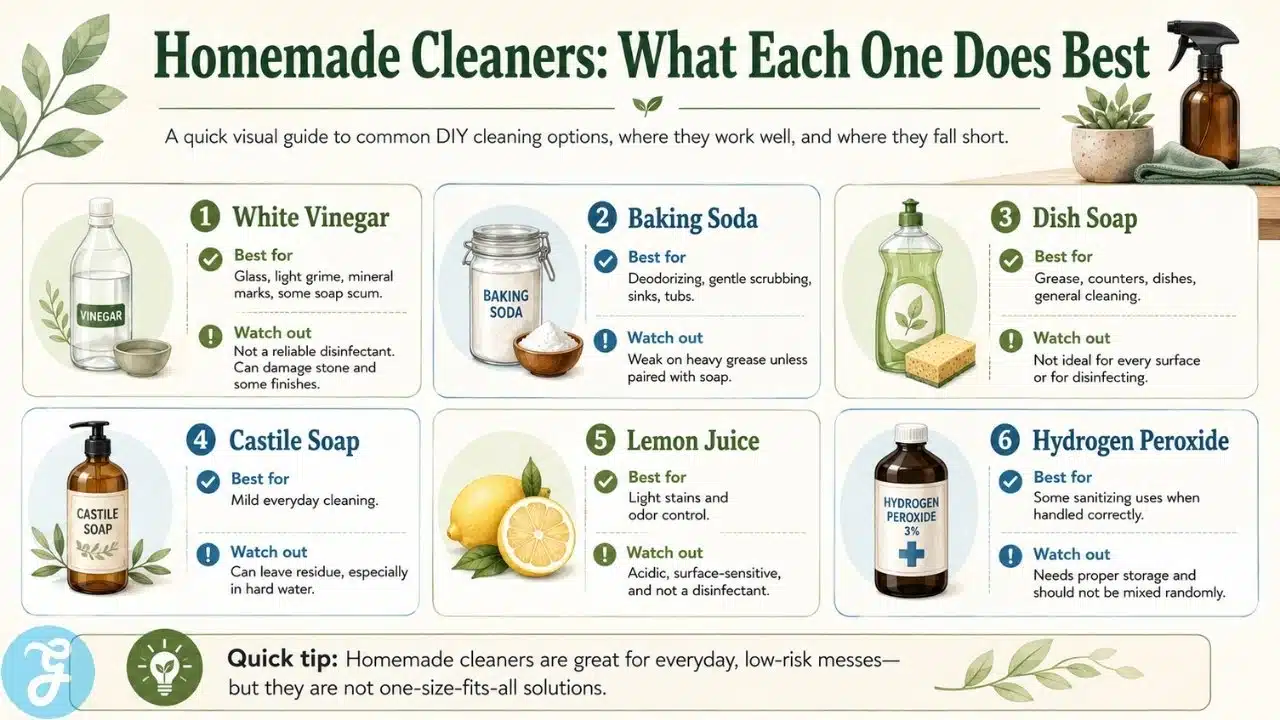
Homemade cleaners are best for normal daily cleaning, not high-risk jobs. They are the right choice when the mess is basic and the surface is safe. They are not the right choice when you need verified disinfecting or a product tested for a specific surface.
Where Homemade Cleaning Actually Wins
Homemade cleaning wins when the goal is simple maintenance. Light counter wiping, mirror cleaning, deodorizing bins, scrubbing sinks, freshening a fridge, and removing mild hard-water marks are all good places to use basic homemade options.
The biggest benefit is control. I know what I am using, I can avoid heavy fragrance, I can reuse bottles, and I do not need to buy five different sprays for five slightly different versions of dirt. That feels better than filling a cabinet with products named like superhero weapons.
For a practical low-waste setup, these few items cover a lot of daily cleaning without turning the house into a chemistry shelf:
| Basic Item | Best Use |
|---|---|
| White Vinegar | Glass, mineral marks, deodorizing suitable surfaces |
| Baking Soda | Scrubbing, odor control, sink and tub residue |
| Dish Soap | Grease and everyday surface cleaning |
| Castile Soap | Mild general cleaning |
| Microfiber Cloths | Reducing product use and disposable wipes |
| Reusable Spray Bottle | Cutting down repeat plastic bottles |
The point is not to make cleaning cute. The point is to reduce waste where it makes sense and still get the job done. If a homemade cleaner handles the task safely, I would rather use that than buy another plastic bottle because the label says “fresh rainforest whisper.”
Where Homemade Cleaning Falls Apart
This is the part that annoys people who believe every cleaning problem can be solved with vinegar and optimism. Some jobs need stronger, more specific products. Raw meat cleanup, illness-related disinfecting, toilets, mold-prone areas, stone countertops, hardwood floors, and commercial shared spaces are not the best places to experiment with internet recipes.
There is also a safety issue. Homemade cleaning advice online can be wildly careless. Some people mix bleach, vinegar, ammonia, peroxide, essential oils, hot water, and confidence, then call it a natural cleaning hack. That is not a hack. That is a poor life choice with fumes.
The CDC warns never to mix household bleach or disinfectants with other cleaners or disinfectants because dangerous vapors can be released. It also warns that mixing bleach with vinegar or ammonia can create harmful gases. So no, “extra powerful DIY spray” is not always clever. Sometimes it is just a fast way to regret being creative.
Homemade cleaning is strongest when it stays simple. The moment the recipe starts looking like a potion, step away from the spray bottle.
Store-Bought Eco Cleaners: Convenient, Tested, And Sometimes Full Of Nonsense
Store-bought eco cleaners are not the enemy. A good one can be safer, more consistent, and more effective than a homemade mix. Commercial cleaners can be formulated for specific jobs, tested for performance, labeled with directions, and designed to stay stable on the shelf.
The EPA’s Safer Choice program helps people find products that perform and contain ingredients that are safer for human health and the environment. That kind of certification is more useful than a vague “green” claim on a bottle that looks like it was designed by a meditation app.
The problem is that store-bought green cleaning also attracts greenwashing. Some products are genuinely better. Some are regular cleaners wearing an eco costume. If the front label says “natural,” “plant-powered,” or “earth-friendly” but gives no clear details, I do not trust it automatically.
This is how I separate the useful options from the pretty nonsense:
| Store-Bought Option | Where It Works Well | What To Watch |
|---|---|---|
| Certified All-Purpose Cleaner | Daily cleaning with better ingredient screening | Check fragrance and surface directions |
| Concentrated Cleaner | Lower packaging and shipping impact per use | Must be diluted correctly |
| Refill System | Reduces repeat bottle waste | Only useful if refills are easy to access |
| EPA-Registered Disinfectant | Verified disinfecting when used as directed | Not needed for every daily wipe |
| Specialty Cleaner | Better for stone, wood, steel, glass, or floors | Can lead to product clutter |
Store-bought eco cleaners make sense when I need reliable results, clear instructions, or verified disinfecting. I just do not let the label flatter me into buying every “green” bottle in sight.
The Real Eco-Friendly Cleaning Comparison
The honest answer is that neither side wins every time. Homemade cleaners are great for low-risk daily cleaning and waste reduction. Store-bought eco cleaners are better when performance, disinfection, surface safety, and consistency matter.
That may not sound dramatic, but it is useful. Cleaning does not need a fan club. It needs the right product for the right job.
Here is the practical comparison I would use before buying or mixing anything:
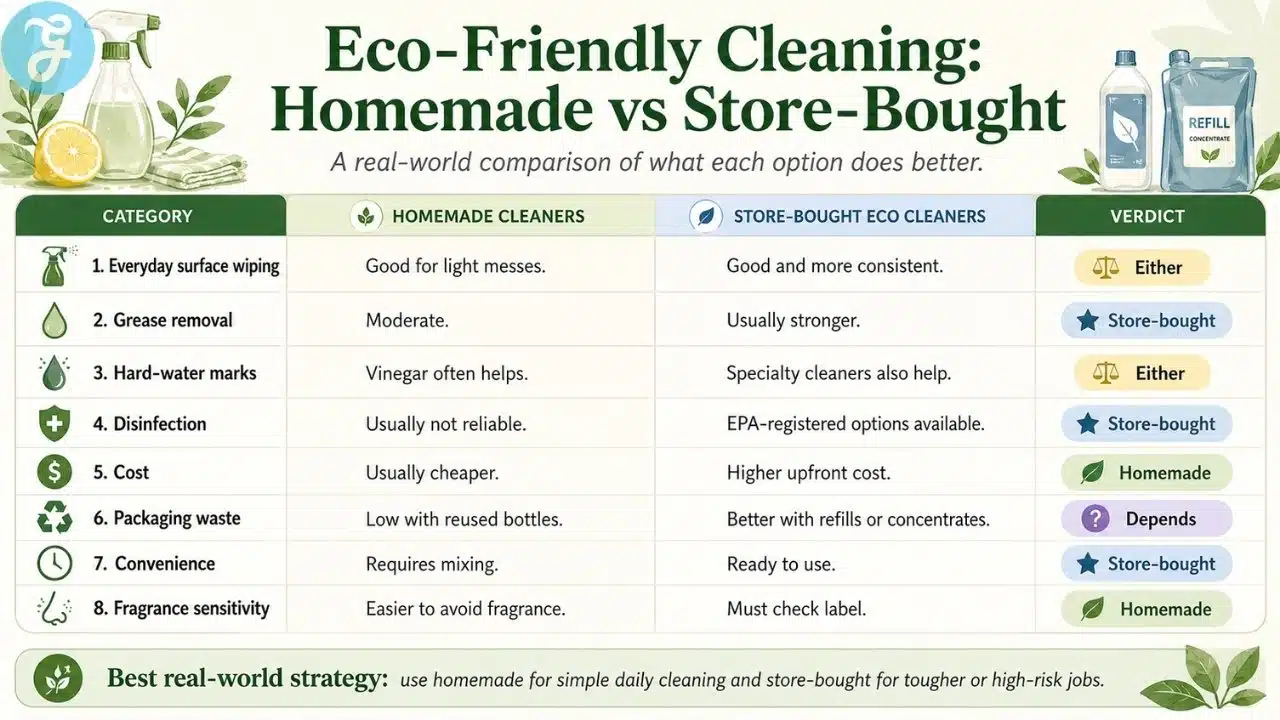
The best system is not homemade-only or store-bought-only. It is a mix. Use homemade options where they work safely. Use better store-bought products where the job needs more control.
Kitchen Cleaning: Be Green, But Do Not Be Silly Around Raw Meat
The kitchen is where I stop being flexible. I like greener cleaning swaps, but I am not gambling with food safety because someone online said vinegar can do everything except file taxes.
For daily kitchen cleaning, homemade options can work well. Mild dish soap, warm water, baking soda, reusable cloths, and vinegar on suitable surfaces can handle normal messes. This keeps waste low and avoids using stronger products when they are not needed.
After raw meat, illness, or high-risk contamination, I use a proper disinfectant. EPA-registered disinfectants are verified to work according to label directions, and the EPA makes it clear that reading and following the label matters.
For a realistic kitchen routine, this split makes more sense than trying to make one cleaner do everything:
| Kitchen Task | Better Option | Why |
|---|---|---|
| Light Counter Wipe | Homemade soap solution or certified cleaner | Good for low-risk daily cleaning |
| Greasy Stovetop | Dish soap or store-bought degreaser | Grease needs surfactants |
| Raw Meat Cleanup | EPA-registered disinfectant | Germ control matters |
| Fridge Odor | Baking soda | Cheap and effective |
| Sink Scrub | Baking soda paste | Gentle abrasion |
| Stone Countertop | Stone-safe cleaner | Vinegar can damage stone |
A green kitchen still needs to be a safe kitchen. Otherwise, it is just a nicely branded mistake.
Bathroom Cleaning: Homemade Helps, But It Has Limits
Bathrooms are not delicate little spa zones. They are damp, humid, germ-friendly spaces where soap scum, toilet residue, mildew, and mystery splashes all come together like a disgusting family reunion.
Homemade cleaners can help with mirrors, sink residue, mild soap scum, and some hard-water marks. Vinegar works on suitable surfaces. Baking soda is good for gentle scrubbing. For basic upkeep, these are useful and lower-waste.
But toilets, mold-prone grout, high-touch surfaces, and illness-related cleaning usually need stronger, clearly labeled products. The CDC explains that disinfecting products kill remaining germs on surfaces after cleaning, which is exactly why disinfectants have a place when the situation calls for them.
This is the bathroom split I would actually use:
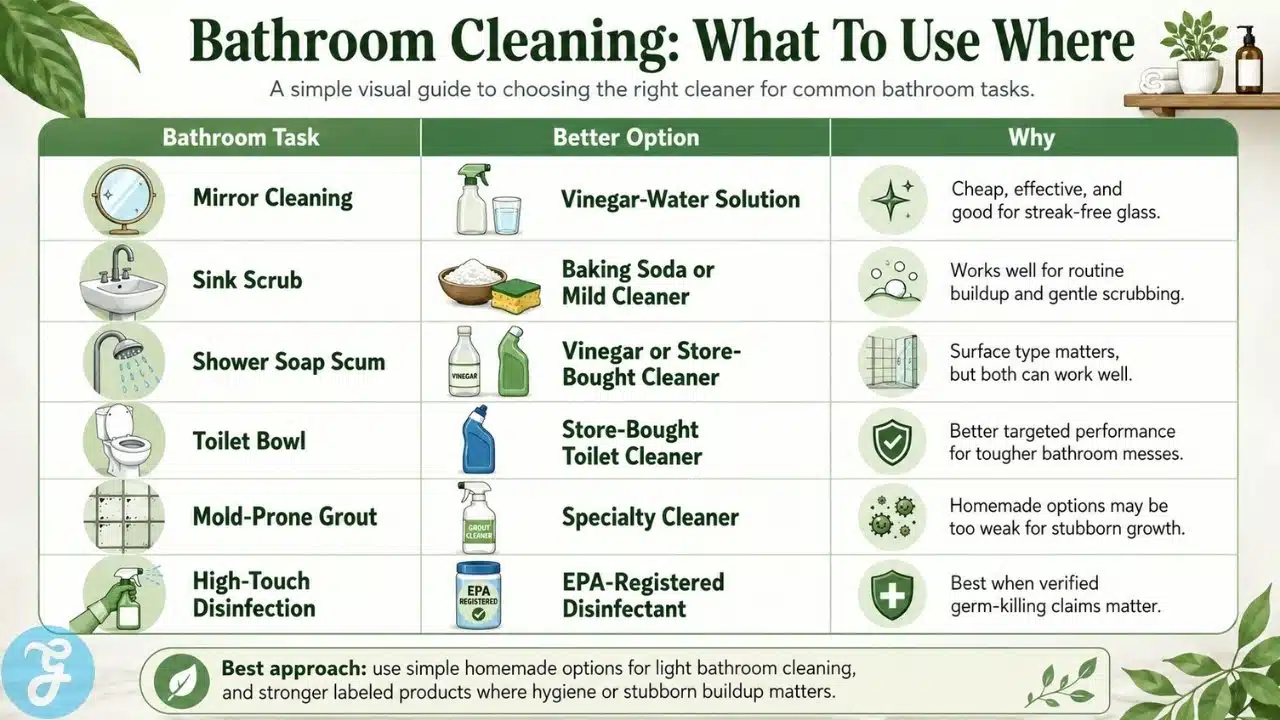
I am all for low-waste living, but I am not asking lemon juice to handle a bathroom like it has a public health degree.
Floors And Delicate Surfaces Need Adult Supervision
This is where many homemade cleaning routines go wrong. Vinegar is acidic. Baking soda is abrasive enough to matter on some finishes. Too much water can damage wood and laminate. One wrong cleaner can dull, stain, scratch, or slowly ruin a surface.
That is why I do not freestyle on expensive materials. Marble, granite, hardwood, laminate, sealed stone, stainless steel, and specialty flooring deserve the right cleaner. Saving money on a DIY mix is not impressive if it damages the surface and creates a repair bill.
A safer surface-by-surface approach looks like this:
| Surface | Homemade Risk | Better Choice |
|---|---|---|
| Marble Or Granite | Acid can etch stone | Stone-safe cleaner |
| Hardwood Floors | Moisture or acid can damage finish | Wood-safe cleaner |
| Laminate Floors | Too much water can enter seams | Labeled floor cleaner |
| Stainless Steel | Abrasives may scratch or streak | Stainless-safe cleaner |
| Glass | Vinegar solution usually works | Either |
| Ceramic Tile | Usually tolerant | Either |
If a surface costs real money, clean it carefully. A “natural hack” is not a warranty.
Cost: Homemade Usually Wins, Unless It Ruins Something
Homemade cleaners usually cost less. Vinegar, baking soda, dish soap, and reusable bottles can stretch a long way. If the goal is to reduce packaging and save money on daily cleaning, homemade options are hard to beat.
Store-bought eco cleaners cost more, especially ready-to-use sprays. Concentrates and refill systems can reduce cost and packaging over time, but only if they are practical. A refill system you cannot easily buy again is just a good intention with poor logistics.
This is how the cost side looks in real use:
| Cost Factor | Homemade | Store-Bought Eco Cleaner |
|---|---|---|
| Upfront Cost | Low | Moderate |
| Cost Per Use | Very low | Low to high |
| Packaging Waste | Low with reuse | Lower with refills or concentrates |
| Time Required | Mixing needed | Ready to use |
| Mistake Cost | Can be high on wrong surfaces | Lower if label is followed |
| Performance | May need repeat cleaning | Usually more consistent |
The cheapest cleaner is not always the smartest cleaner. A two-dollar homemade mix that damages a countertop is not budget-friendly. It is just expensive with extra steps.
Safety Rules I Actually Follow
Safety is not the glamorous part of cleaning, but it is the part that stops people from doing ridiculous things in the name of “natural living.” A greener routine should still be a safe routine.
I keep the rules simple. I do not mix cleaners. I label homemade bottles. I keep cleaners away from children and pets. I ventilate when needed. I patch-test surfaces. I follow disinfectant contact times. I make small batches instead of storing mystery liquids forever.
The CDC warns that disinfectants should be used carefully and that bleach or disinfectants should never be mixed with other cleaners. That guidance is not there to ruin anyone’s homemade cleaning aesthetic. It is there because fumes and chemical reactions do not care how eco-conscious we feel.
If a cleaning recipe sounds like it needs protective goggles, a warning label, and courage, I skip it.
Greenwashing: The Store-Bought Trap That Annoys Me Most
I do not mind paying for a better cleaner. I do mind paying for vague environmental theatre. If a product says “green,” “natural,” “planet-friendly,” or “chemical-free” without explaining the actual benefit, I treat it like marketing noise.
“Chemical-free” is especially funny because everything is made of chemicals. Water is a chemical. Air is chemicals. Your lunch is chemicals. Calling a cleaner chemical-free is not transparency; it is a sign that the marketing team had a very relaxed relationship with science.
The FTC says environmental claims should be clear enough that consumers understand the specific benefit being claimed. That is the standard I want from store-bought products. Tell me what is better, why it is better, and where the proof is.
These are the signals I trust more:
| Stronger Signal | Why It Matters |
|---|---|
| EPA Safer Choice | Better ingredient and performance screening |
| Clear Ingredient List | More transparency |
| Concentrated Formula | Less packaging and shipping weight per use |
| Refill System | Lower repeat plastic waste |
| Fragrance-Free Option | Better for sensitive households |
| Specific Claims | Easier to verify |
| Clear Surface Directions | Reduces misuse |
These are the signals I do not trust by themselves:
| Weak Signal | Why I Do Not Trust It |
|---|---|
| “Chemical-Free” | Scientifically silly |
| “Green” | Too vague |
| “Natural” | Natural does not always mean safe |
| Leaf Icons | Decoration, not evidence |
| “Non-Toxic” Without Detail | Needs explanation |
| “Planet-Friendly” | Sounds nice, proves little |
I am eco-conscious, not easily impressed. There is a difference.
My Low-Waste Cleaning Setup
The best cleaning setup for most homes is a hybrid one. Homemade cleaners handle simple, low-risk jobs. Certified or clearly labeled store-bought cleaners handle disinfection, specialty surfaces, and tougher messes.
This keeps the routine practical. It reduces waste without pretending one ingredient can do every job. It also keeps the cabinet from turning into a graveyard of half-used green products bought during moments of environmental optimism.
For most homes, this setup is enough:
| Cleaning Need | Best Practical Choice |
|---|---|
| Daily Counter Wipe | Mild soap solution or certified all-purpose cleaner |
| Glass And Mirrors | Vinegar-water solution or glass cleaner |
| Sink Scrub | Baking soda paste |
| Toilet Cleaning | Store-bought toilet cleaner |
| Raw Meat Cleanup | EPA-registered disinfectant |
| Stone Countertops | Stone-safe cleaner |
| Hardwood Floors | Wood-safe cleaner |
| Odor Control | Baking soda |
| Greasy Stovetop | Dish soap or store-bought degreaser |
| High-Touch Disinfection | EPA-registered disinfectant |
This is the routine I respect: homemade where it works, store-bought where it matters, and no patience for products or recipes pretending to be more than they are.
When Homemade Is The Better Choice
Homemade cleaners are the better choice when the job is routine, low-risk, and not surface-sensitive. They are useful for light counter cleaning, glass, mirrors, deodorizing bins, scrubbing sinks, freshening the fridge, mild soap scum, and some hard-water marks.
They also help reduce packaging waste and unnecessary fragrance. That matters to me because sustainability is not only about buying greener products. Sometimes the greener move is buying fewer products in the first place.
Homemade cleaning works best when it stays boring. A few ingredients, clear labels, simple use cases, and no dramatic mixing. That is not very exciting, but it is effective.
When Store-Bought Is The Better Choice
Store-bought eco cleaners are better when the job needs verified performance, specialty use, or disinfection. Toilets, raw meat cleanup, illness-related cleaning, mold-prone areas, stone surfaces, hardwood floors, stainless steel, shared bathrooms, and commercial spaces are all places where I prefer clearer product directions.
EPA-registered disinfectants matter because they are reviewed for specific antimicrobial claims and must be used according to label directions. The EPA says it verifies disinfectants work according to those directions, which is exactly why guessing is not good enough.
Being eco-friendly does not mean rejecting every commercial product. It means choosing better products when they make sense, using them correctly, and not buying three extra bottles just because they look responsible.
Eco-Friendly Cleaning Mistakes I Would Avoid
Some green cleaning mistakes are common because they sound reasonable at first. Using vinegar everywhere is one of them. Vinegar is useful, but it is not safe for every surface. Stone, some finishes, and certain floors can suffer.
Another mistake is trusting “natural” too much. Natural does not always mean safe. Poison ivy is natural. So are mosquitoes. Nature has range.
I would also avoid over-disinfecting everything. Routine cleaning does not always need disinfectant. Save disinfecting for higher-risk situations, illness, raw meat cleanup, and key high-touch surfaces when needed.
The last mistake is buying too many green products. A cabinet full of eco cleaners is still overconsumption if half of them do the same job. Lower-waste living should reduce clutter, not give it better branding.
The Greener Choice Is The One That Actually Works
Eco-Friendly Cleaning is not about proving homemade cleaners are morally superior or pretending every store-bought product is toxic villain juice. It is about making cleaner, safer, lower-waste decisions without falling for nonsense from either side.
Homemade cleaners are great for daily messes, simple routines, fewer bottles, lower cost, and lighter jobs. Store-bought eco cleaners are better for disinfection, specialty surfaces, consistent performance, and jobs where labels and testing matter.
The best approach is practical, not performative. Use homemade cleaners where they work. Use certified or clearly labeled store-bought cleaners where they make more sense. Read labels. Avoid silly claims. Never mix random products. Do not let a leaf icon do your thinking for you.
That is the kind of greener cleaning I can stand behind: useful, honest, lower-waste, and realistic enough to survive actual daily life.