Trying to open a US bank account as a non-resident can easily feel overwhelming, as institutions frequently demand an endless maze of forms, local addresses, and identification numbers that international applicants simply lack. Fortunately, establishing a reliable financial presence within the United States is an entirely achievable reality. Citizenship is rarely required, and a Social Security Number is frequently unnecessary.
This comprehensive overview details the essential documentation, specific account types, and the most accommodating financial institutions tailored specifically for international clients. By clearly understanding these core requirements beforehand, individuals can arrive fully prepared and eliminate the frustration of wasted branch visits. Navigating the American banking system becomes a straightforward process with the right preparation, ensuring a smooth, successful long-term setup.
Can a Non-US Resident Open a Bank Account in the US?
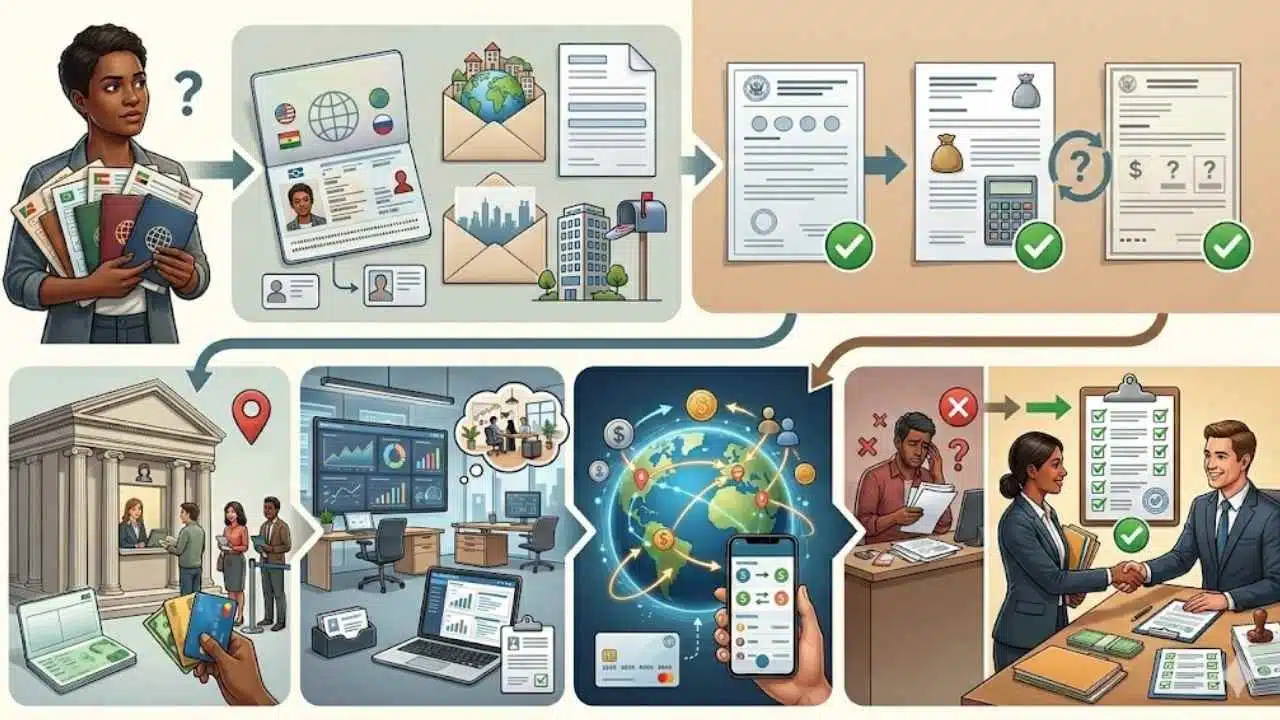
Yes, many non-residents can open a bank account in the United States. The catch is that each bank sets its own rules for identification, proof of address, and minimum deposits.
A simple way to think about it is this: your citizenship is usually not the real hurdle, your paperwork is. If your documents line up, a personal account or checking account is often within reach.
In Bank of America’s current account-opening FAQ, the bank says nonpermanent residents living in the U.S. may open an account in person if they can show a permanent foreign address, a local U.S. address, and an individual taxpayer identification number. Chase also tells non-U.S. citizens to bring original primary and secondary ID and recommends a full U.S. address before visiting a branch.
- Best fit for branch banking: large banks such as Bank of America, Chase, and Citi
- Best fit for business founders: fintech companies such as Mercury and Relay, which focus on U.S.-registered businesses
- Best fit for cross-border payments: services such as Wise, which give you USD receiving details but are not the same as a traditional bank account
A social security number is not always required. Some banks accept an individual taxpayer identification number (ITIN), and some may accept another government-issued identification number if you do not yet have an SSN.
If you want the smoothest path, treat the first appointment like a document check, not a casual bank visit.
Benefits of Opening a US Bank Account as a Non-Resident
A bank account in the United States makes everyday money tasks much easier. You can receive USD, pay rent or subscriptions, use debit cards, and keep your personal finance setup cleaner if you work, study, invest, or do business here.
| Benefit | Why it matters |
| Receive USD directly | You avoid asking clients, employers, or platforms to send money to a foreign account every time. |
| Pay U.S. bills easily | ACH, debit cards, and online banking are much easier to use with a local checking account. |
| Create a banking record | Consistent account activity can help with rentals, future credit applications, and day-to-day verification requests. |
| Lower friction on cash access | You can use ATMs, digital wallets, and branch services instead of relying on foreign cards. |
Receiving payments directly
If you expect salary, freelance income, marketplace payouts, or client payments in USD, a U.S. account saves time and usually lowers friction. It also gives you a routing number and account number that American payers already know how to use.
That matters more than people think. Bank of America currently lets customers send international wires in more than 140 currencies to over 200 countries through online and mobile banking, which is useful if you expect to move money between the United States and home on a regular basis.
Zelle can also help with domestic person-to-person payments if your bank supports it. For recurring income, ACH and direct deposit are usually the cheapest and easiest options.
Paying bills and accessing financial services
Once your account is open, you can usually pay rent, utilities, phone bills, and subscriptions from the same dashboard. That is much easier than juggling foreign card declines or extra currency conversion fees.
Good online banking also gives you alerts, bill pay, debit cards, ATM access, and often savings accounts or certificates of deposit in the same login. If you are here for school or work, that one change can make your money life feel much more settled.
- Use online banking for bill pay and transfers
- Use mobile banking alerts to catch fees or low balances early
- Link a savings account if you want to hold extra USD separately
- Ask about wire transfers before opening, especially if you send money abroad often
Building a financial history in the US
A bank account does not create a credit score by itself, and that point gets missed in a lot of articles. What it does create is a clean banking record, which can still help with future financial decisions.
Regular deposits, bill payments, and steady balances can make it easier to answer questions from landlords, card issuers, or lenders later. If you plan to apply for a credit card, lease, or small business service, having an active account already in place helps.
Access to debit cards and ATMs
Most checking accounts come with a debit card, and that makes daily spending much simpler. You can add the card to a digital wallet, withdraw cash, and pay at stores without leaning on an international card every time.
This is also where a large branch and ATM network helps. Chase says its everyday checking customers can use more than 14,000 ATMs and 5,000 branches, which is a real advantage if you will be moving around the U.S.
The safety piece matters too. The FDIC says deposits at insured banks are protected up to $250,000 per depositor, per ownership category, which is worth keeping in mind if you plan to hold larger USD balances.
Your debit card and mobile app will probably matter more day to day than the bank logo on the front door.
Requirements to Open a Bank Account
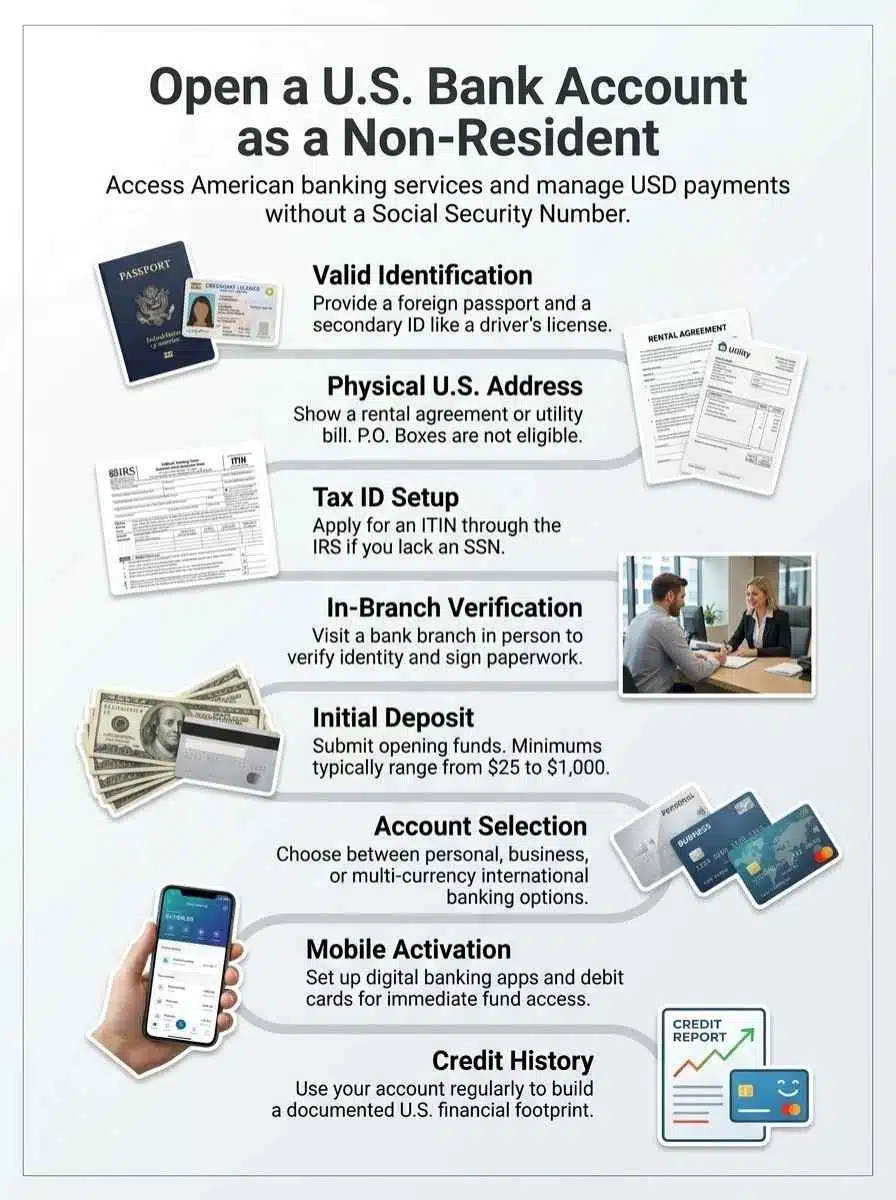
Banks usually want to verify four things: who you are, where you live, how they can report tax information, and whether you can fund the account. If you prepare those four pieces in advance, the process gets much easier.
Valid passport and secondary ID
Your passport is the core document. For tax paperwork, the IRS says a valid passport is the only stand-alone document that proves both identity and foreign status.
For the bank itself, you often need a second form of ID as well. Bank of America lists options such as a foreign or U.S. driver’s license, student or employer photo ID, or a major debit or credit card, while Chase’s ID sheet includes items such as a bank statement under 60 days old, student ID, DS-2019, I-20, or a utility bill with your name and address.
- Bring your passport
- Bring a secondary ID, even if the bank website sounds flexible
- Bring original documents, not screenshots or photocopies
Proof of US address (rental agreement or utility bill)
You will usually need a physical U.S. address, not a P.O. Box. A rental agreement, utility bill, employer letter, pay stub, or school-related document can help, depending on the bank.
Be careful here, because address problems are a common reason applications stall. Chase recommends a full U.S. address including apartment or dorm number, and Bank of America asks for documents that show your name and physical U.S. address.
If you are staying with family or in temporary housing, call the branch before you visit. A five-minute confirmation can save you a wasted trip.
Taxpayer Identification Number (ITIN) or Social Security Number (SSN)
A social security number is helpful, but it is not the only path. If you are not eligible for an SSN, the IRS issues an individual taxpayer identification number for people who need a U.S. taxpayer identification number for federal tax purposes.
The IRS currently says Form W-7 is the form used to apply for an ITIN, and its documentation page notes that a passport can work as the only stand-alone proof document. The agency also says it is currently processing Form W-7 in about 11 weeks, so this is something to start early, not the week before you travel.
One more practical detail matters here: a W-7 application usually goes in with a federal tax return unless you qualify for an exception. If you want help, a Certified Acceptance Agent or an IRS Taxpayer Assistance Center can be easier than mailing original documents.
Minimum opening deposit
Do not assume every account needs the same initial deposit. Entry-level accounts can be inexpensive to start, but the fee waiver rules often matter more than the opening amount.
As of February and May 2026, current fee sheets from major banks show a wide spread. Bank of America Advantage SafeBalance Banking lists a $25 opening deposit, Advantage Plus lists $100, and Chase Secure Banking says it requires no minimum deposit to get started.
| Account | Opening deposit | Monthly fee | Fee waiver |
| Bank of America Advantage SafeBalance Banking | $25 | $4.95 | $500 minimum daily balance or age under 25 |
| Bank of America Advantage Plus Banking | $100 | $12 | One qualifying direct deposit of $250 or more, or $1,500 minimum daily balance |
| Chase Secure Banking | $0 | $4.95 | Electronic deposits totaling $250 or more |
| Citi Access Checking | Varies by application channel | $5 | $250 in qualifying direct deposits |
The smart move is to compare the opening deposit next to the ongoing fee rule. A low opening number does not help much if the monthly fee keeps hitting your account afterward.
Types of Bank Accounts Available for Non-Residents
The best account depends on what you need the money to do. Some account types are built for everyday spending, some for savings, and some for founders who need a corporate account tied to an EIN.
| Account type | Best for | Watch out for |
| Personal checking account | Paychecks, bills, debit cards, ATM access | Monthly fees, paper-check limits, branch ID rules |
| Savings account | Holding extra USD or emergency funds | Lower transaction flexibility than checking |
| Business account | U.S. companies, client payments, bookkeeping | Extra entity documents and beneficial owner checks |
| Fintech or money account | Fast cross-border payments and remote setup | Not always a full bank account, feature limits vary |
Personal accounts
A personal checking account is the usual first step. It gives you a debit card, ATM access, online banking, direct deposit, and a clean way to separate everyday spending from savings.
Low-fee options can be a good starting point, especially if you are a student or you do not expect to keep a large balance. Just check whether the account allows paper checks, because some popular starter accounts do not.
For example, Bank of America Advantage SafeBalance Banking and Citi Access Checking are built for simple daily banking, but both are designed without standard check writing. If you know your landlord or service providers still expect paper checks, that detail matters.
Business accounts
Business banking is a different lane. Banks and fintech companies will usually ask for more than a passport and proof of address.
You may need an employer identification number, formation documents such as articles of organization or a certificate of formation, and information on each beneficial owner. Relay’s current business account checklist asks for an EIN, formation documents, beneficial-owner details, and a valid U.S. phone number.
Mercury is also a common option for founders. Its current eligibility page says you do not need to be a U.S. citizen or resident to apply, but your company must be formed in the United States or a U.S. territory, and registered agent addresses and P.O. boxes are not accepted as the principal business address.
International accounts
If your priority is moving money across borders, a fintech product can sometimes work better than a traditional branch account. That is especially true if you need fast currency exchange, remote setup, or easier incoming international payments.
Wise is the clearest example. Its current help pages say you can get USD account details with a routing number and account number for receiving dollars, but it also states clearly that this is not a bank account in the traditional sense.
That difference matters. Wise can be excellent for receiving USD and converting funds, but if you want a classic U.S. checking account with full branch service, cash deposits, or a broader set of financial services, a traditional bank may still fit better.
Steps to Open a US Bank Account
If you want the process to move smoothly, follow the same order a branch banker would. Gather documents first, choose the right account second, then book the visit or complete the online flow.
- Choose the right bank account for your travel, study, work, or business needs.
- Confirm the exact ID and proof of address rules with that bank.
- Prepare your passport, second ID, address proof, and tax number details.
- Bring funds for the opening deposit if the account requires one.
- Ask how to set up online banking, direct deposit, and wire transfers before you leave.
Visit a bank branch in person
For many non-US residents, this is still the safest route. It lets a banker review your documents on the spot and tell you right away if something is missing.
Bring original documents, not scans on your phone. Chase’s ID guidance says all documents must be original and valid, and Bank of America asks nonpermanent residents to open in person at a financial center.
If possible, make an appointment rather than walking in. Nonresident applications often take longer than a standard checking account opening, and an appointment improves your chances of getting a banker who knows the document rules.
Explore online and fintech alternatives
If you do not need a full branch bank, online providers can be quicker. They are especially useful for cross-border payments, freelancers, and founders opening business accounts.
Wise can help you receive USD with local account details after verification, and Mercury can work for U.S.-registered companies founded by people outside the U.S. The trade-off is that these options do not always replace every branch feature you would get from a large bank.
- Pick Wise if receiving and converting USD is your main need
- Pick Mercury or Relay if you run a U.S. business and want digital-first business banking
- Pick a large traditional bank if you want branch help, cash access, and a classic personal checking account
Check for banks with international banking services
Some banks are simply easier to work with if you move money across borders often. Look for strong online banking, multilingual support, low-cost incoming transfers, and clear wire instructions.
Bank of America is a strong example here. Its non-resident banking page highlights debit cards, digital wallets, mobile banking, and language interpretation in more than 206 languages, which can make your first few months much easier if English is not your main language.
Ask a short list of questions before you open the account: Can I receive direct deposit, what are the wire fees, what ID do you need from non-residents, and can you help me add an ITIN later if it is still pending?
Tips for a Smooth Application Process
A little prep goes a long way here. Most delays happen because the bank wants one extra document, one clearer address record, or one tax form that the customer did not expect.
- Carry originals and digital copies
- Use the same spelling of your name on every document
- Bring one extra proof-of-address document if you can
- Call the branch the day before to confirm the checklist
Prepare documents in advance
Put your passport, secondary ID, proof of U.S. address, and tax paperwork in one folder. If you are applying for a business account, add your EIN letter and formation documents too.
This sounds simple, but it is the easiest way to avoid a second trip. Many bank staff will happily tell you what is missing, but they still cannot approve the account until they see it.
Verify address requirements
Your address document should show your name and a real physical address. If you live in a dorm, apartment, or temporary rental, make sure the unit or room number is visible.
One of the most useful pro tips is to bring two address documents if you can. A rental agreement plus a recent utility bill or employer letter gives the banker options if one document does not fit internal policy.
The fastest approvals usually come from applicants whose name, address, and date information match exactly across every document.
Explore options for obtaining an ITIN
If you need an individual taxpayer identification number (ITIN), start early. The IRS says Form W-7 is the application, and its current FAQ says processing is running about 11 weeks after receipt.
You can apply by mail, through a Certified Acceptance Agent, or at an IRS Taxpayer Assistance Center that offers document authentication. Using a qualified helper is often the easiest route if you do not want to mail original identity documents.
Also keep expectations realistic. An ITIN helps with tax reporting and bank paperwork, but it does not give you work authorization or change your immigration status.
Popular US Banks for Non-Residents
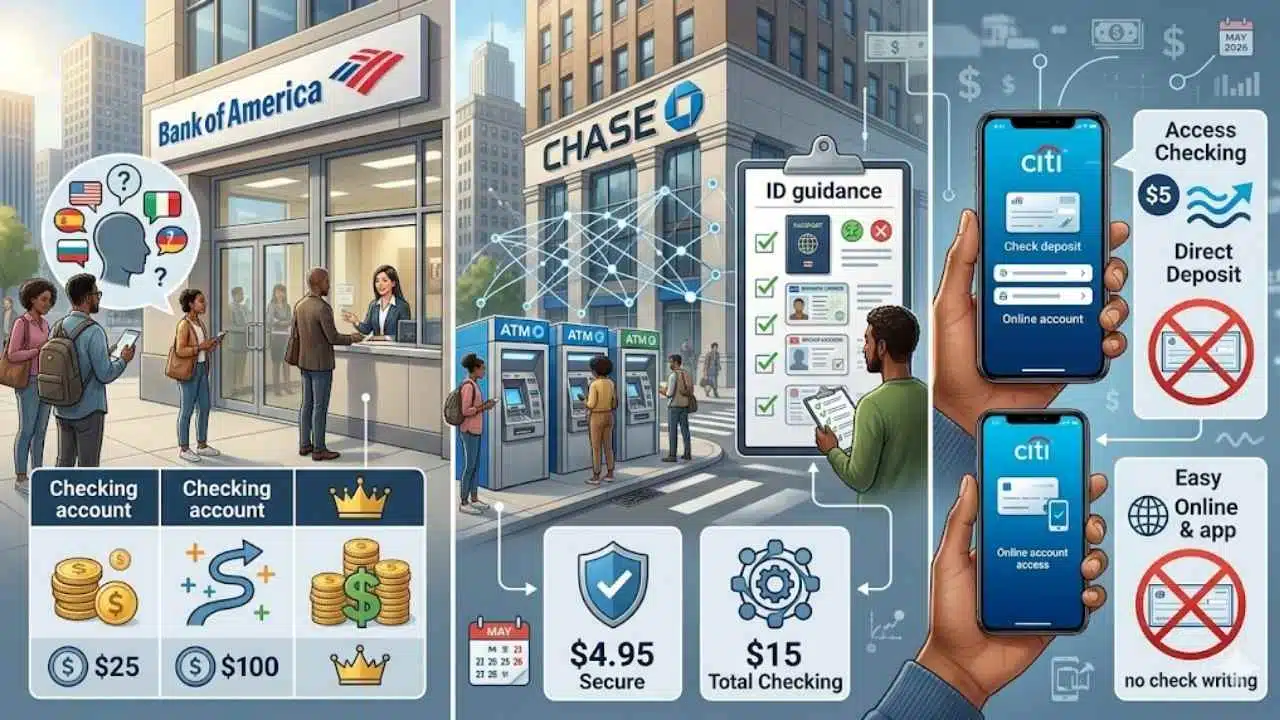
As of May 2026, large national banks still give the clearest in-person path for most readers opening a personal bank account, while fintech companies tend to shine more on the business side. The best choice depends on whether you want branch support, a low monthly fee, or strong cross-border tools.
| Institution | Good fit for | Current entry-level option | What stands out |
| Bank of America | Non-residents who want branch support and multilingual help | Advantage SafeBalance Banking, $4.95 monthly fee | 206-language support, strong digital banking, simple starter accounts |
| Chase | Readers who want a huge branch and ATM network | Secure Banking, $4.95 monthly fee, or Total Checking, $15 monthly fee | Large network, good mobile app, clear ID guidance |
| Citibank | Readers who want a low-cost digital-friendly checking option | Access Checking, $5 monthly fee | Bank On-certified low-cost account, easy online and app access |
Bank of America
Bank of America is one of the more visible options for non-residents because it openly publishes a non-resident account page. It also gives you three main consumer checking choices through Bank of America Advantage Banking.
If you want the simplest start, Bank of America Advantage SafeBalance Banking has a $25 opening deposit and a $4.95 monthly fee. If you want more flexibility, Bank of America Advantage Plus Banking requires a $100 opening deposit and carries a $12 monthly fee that can be waived with a qualifying direct deposit of $250 or more or a $1,500 minimum daily balance.
Bank of America Advantage Relationship Banking is the premium option. It has a $100 opening deposit, a $25 monthly fee, and is better for readers who plan to keep higher balances and use more banking services.
JPMorgan Chase
Chase is a strong choice if branch access matters to you. Its public account pages highlight more than 14,000 ATMs and 5,000 branches, which is hard to beat if you travel often inside the United States.
For a simple low-fee option, checking account shoppers often start with Chase Secure Banking, which has a $4.95 monthly service fee and no minimum deposit to open. If you want a more traditional account, Chase Total Checking has a $15 monthly fee that can be waived with $500 in qualifying electronic deposits, a $1,500 daily balance, or other linked-balance options.
Chase also deserves credit for clear document guidance. Its current ID sheet tells non-U.S. citizens to bring a primary and secondary ID, original documents, and a full U.S. address, which makes planning much easier.
Citibank
Citibank can work well if you want a basic checking option with good app access and a lower monthly fee. Its current materials say Citi Access Checking is a low-cost account that meets Bank On national standards.
Citi’s current deposit agreement lists a $5 monthly service fee for Access Checking, usually waived with $250 in qualifying direct deposits. It also makes one limit very clear: Access Checking does not offer check writing, so it is better for card, ACH, and mobile-first users than for people who still need paper checks.
If that setup matches how you bank, Citi can be a practical pick. If you need regular check writing or more branch-heavy hand-holding, another account type may fit better.
Final Thoughts
Opening a U.S. bank account as a non-US resident is very doable, but it goes better when you choose the right account and show up with the right documents the first time.
Focus on four things: your passport, a second ID, proof of address, and your tax number plan. Then compare the monthly fee rules, not just the opening deposit.
If you want branch support, start with Bank of America, Chase, or Citi. If you mainly need digital payments or business banking, look at fintech companies too, then pick the bank account that matches how you will actually use your money.
Frequently Asked Questions (FAQs) About Opening a US Bank Account as a Non-Resident
1. What documents do I need to open a bank account as a non-US resident?
You need a valid identity document, a second photo ID, proof of address, and a tax ID or foreign tax number if you have one. Some banks also ask for an employment letter or an initial deposit.
2. Can I open a bank account without visiting the U.S.?
Yes, many online banks let you open an account from abroad, with scanned documents and video ID checks. Some big banks still require you to visit a branch, so check bank policies first.
3. Do I need a Social Security Number to open an account?
No, most banks accept a tax ID or other ID instead, but if you have an SSN they may ask for it. Rules vary by bank and state.
4. How do I pick the right bank for a nonresident account?
Compare fees, minimum deposit, and international transfer fees, read reviews, and call customer support with direct questions. Read the fine print, that is where rules and fees like to hide.