Your phone buzzes. Your email pings. You try to focus on your work, but your brain keeps jumping from one thing to another. Does that sound familiar? Most people struggle with this exact problem every single day. You sit down to do something important, yet distractions pull you away every few minutes. Your work takes twice as long, and the quality drops.
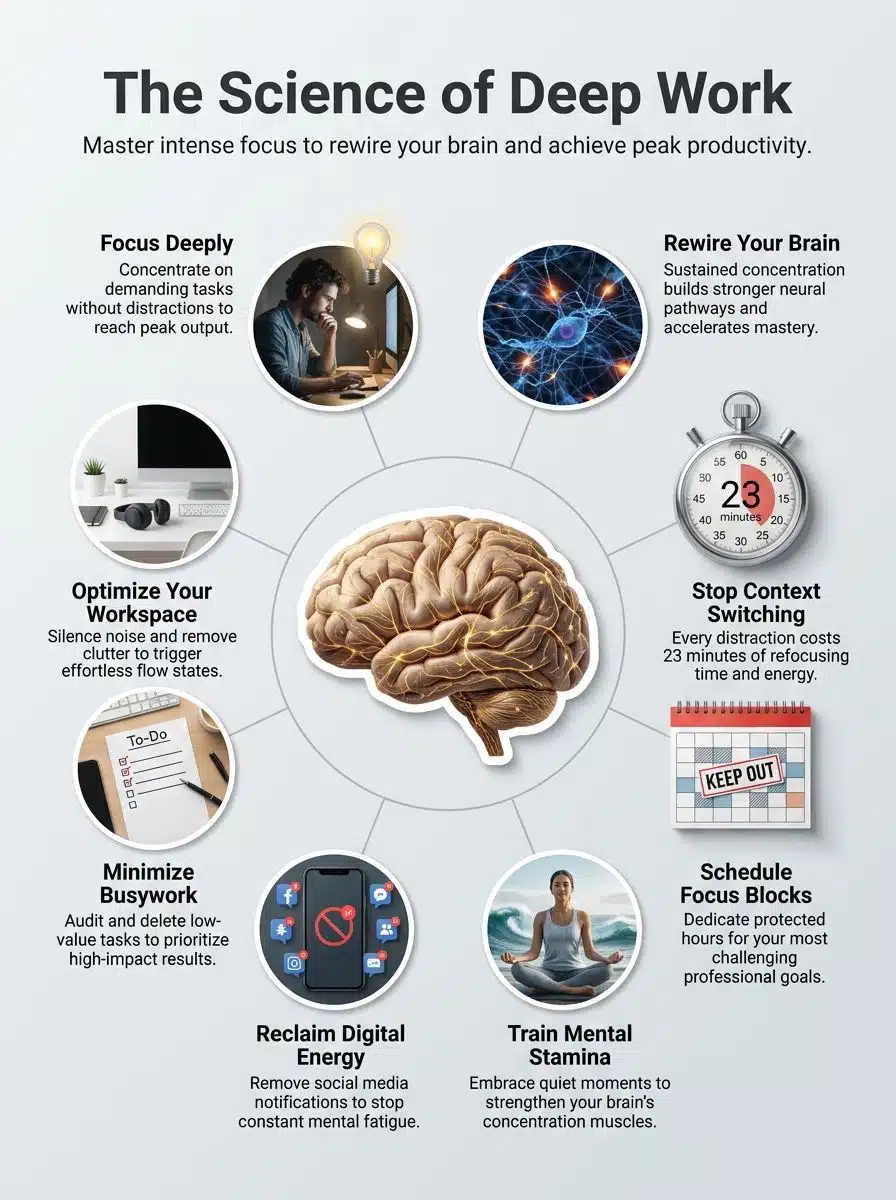
This is the real cost of shallow work, and it drains your energy fast. I found a secret that changed everything for me, and it is called the science of deep work. Here is a crazy fact I learned. A study from UC Irvine found that it takes your brain about 23 minutes to refocus after an interruption.
That means each distraction costs you real time and mental power. The good news is that the science of deep work offers a clear path forward. So grab a cup of coffee, and let us go through it together.
What is Deep Work?
Deep work means focusing intensely on hard tasks without interruptions. You shut out distractions and give your full mental energy to something that matters. A fascinating 2009 Stanford University study by Dr. Clifford Nass showed that chronic multitaskers actually perform worse on memory and organization tests because their brains cannot filter out irrelevant information. Deep work provides the exact opposite experience.
Definition of deep work
Georgetown University professor Cal Newport coined the term deep work. Focus and concentration form the backbone of this concept. It requires performing cognitively demanding tasks with full attention, zero distractions, and maximum intensity for extended periods.
- Full attention: You engage completely with challenging material. You push past surface-level thinking to reach genuine mastery.
- Zero distractions: You shut out notifications, emails, and the constant buzz of shallow tasks. You might even put your smartphone in a completely different room.
- Extended periods: You sit for 90 minutes working on a single task, completely ignoring the outside world.
Shallow work operates on the opposite end of the spectrum. These are routine tasks that demand little mental energy. They include checking emails, attending unnecessary meetings, or scrolling through social media. You can perform shallow work while half-asleep, but deep work demands your full cognitive capacity.
The difference matters tremendously. Deep work builds real skills, solves complex problems, and produces output that actually moves the needle.
The ability to perform deep work is becoming increasingly rare at exactly the moment it is becoming increasingly valuable in our economy. – Cal Newport
Concentration acts as your most valuable asset in today’s distraction-filled world. Productivity skyrockets when you commit to extended periods of uninterrupted focus on one challenging task.
Deep vs. shallow work
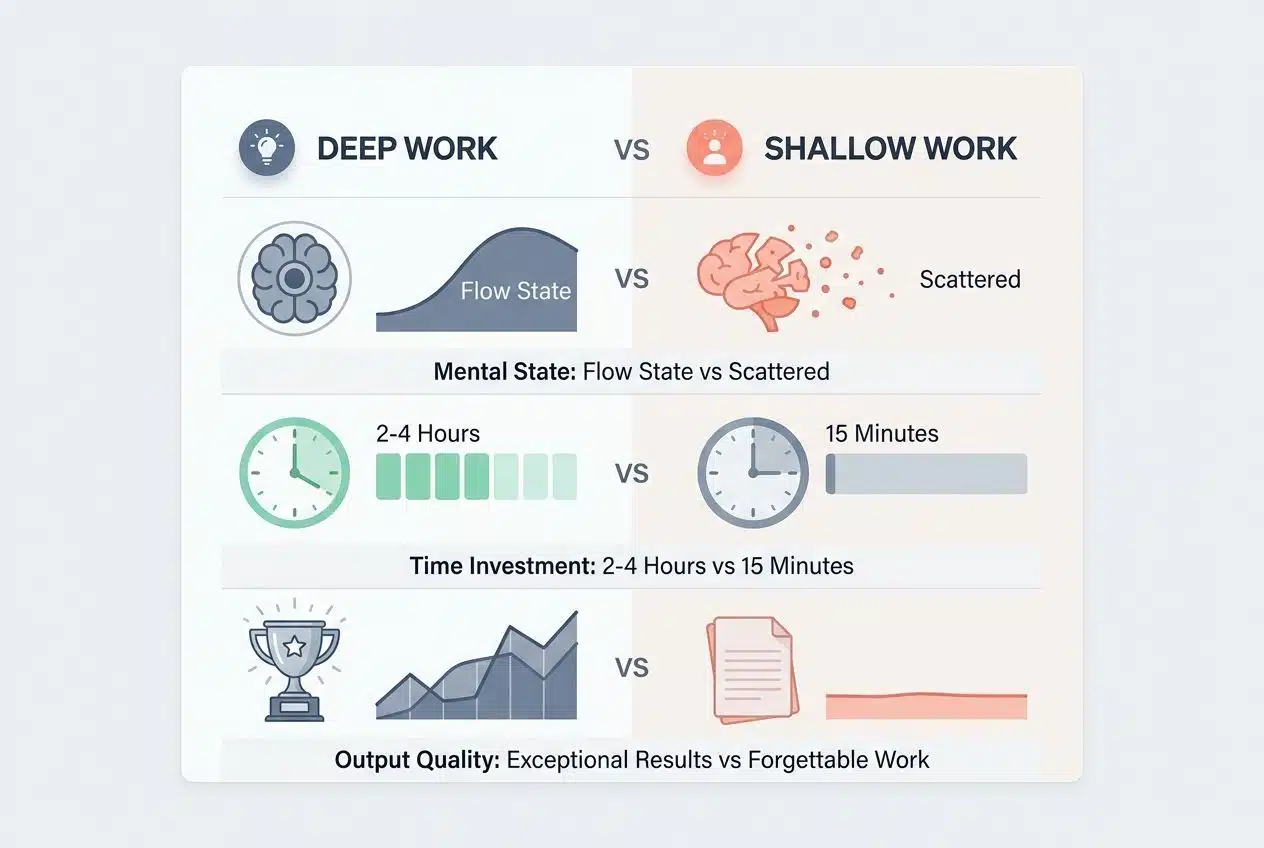
Deep work and shallow work operate on completely different wavelengths. Understanding the gap between them shapes how you spend your time. For example, a 2024 study by Drexel University’s Creativity Research Lab found that real creative flow requires a letting go of self-monitoring, which you can only achieve in deep work.
| Aspect | Deep Work | Shallow Work |
|---|---|---|
| Definition | Professional activity performed in a state of distraction-free concentration that pushes your cognitive abilities to their limit. | Logistical tasks completed while distracted; these activities tend to be easy to replicate and add little value to your skill set. |
| Common Tools Used | Pen and paper, blocking apps like Freedom, or specialized software like Adobe Premiere. | Slack, Microsoft Teams, Gmail, and social media platforms. |
| Mental State | You enter flow state. Your brain fires on all cylinders. Distractions vanish. Time disappears. | Scattered attention dominates. Your mind jumps between tasks. Context-switching drains your energy. Interruptions feel constant. |
| Cognitive Demand | Requires your full mental bandwidth. You tackle complex problems. Your prefrontal cortex works hard. | Minimal cognitive lift needed. Email management, scheduling, and status updates fit here. Your brain operates on autopilot. |
| Output Quality | Produces exceptional results. Writing, coding, research, and strategic thinking yield meaningful breakthroughs. | Generates adequate but forgettable work. Tasks get done. Real impact stays elusive. |
| Skill Development | Strengthens neural pathways. Your brain forms new connections. Expertise actually grows. | Stagnates your abilities. Repetitive tasks teach nothing new. Growth halts. |
| Time Investment | Demands lengthy, uninterrupted blocks. Two to four hours minimum for meaningful progress. | Fits into fragmented schedules. Fifteen-minute bursts suffice. Feels productive despite minimal substance. |
| Energy Cost | Drains mental resources significantly. Recovery and rest matter. Burnout looms if balance slips. | Creates deceptive fatigue. You feel busy yet unfulfilled. Mental exhaustion hits without real accomplishment. |
| Real World Example | A software engineer writing complex algorithms for three hours straight, phones silenced, door closed. | The same engineer is responding to Slack messages, attending meetings, and updating project spreadsheets throughout the day. |
Most people spend their careers swimming in shallow waters, mistaking busyness for productivity. The real magic happens in the depths of concentrated work.
The Science Behind Deep Work
Your brain rewires itself when you focus intensely on challenging tasks. It builds stronger neural connections that make future work easier. This physical change in your brain explains why deep work feels hard at first, but gets smoother the more you practice it.
Business professor Dr. Sophie Leroy coined the term attention residue in 2009. She discovered that when you switch from one task to another, a piece of your attention remains stuck on the previous task. Deep work eliminates this residue completely.
The role of focus and flow
Focus acts like a spotlight on your brain. It narrows your attention to one task, blocking out distractions that pull you away from what matters. Flow is that magical state where you lose track of time and work feels effortless.
Your mind enters deep concentration, and productivity skyrockets. Scientists call this the flow state, a cognitive condition where challenge and skill align perfectly. Focus builds the foundation, and flow is the reward you get when focus becomes sustained.
Flow is being completely involved in an activity for its own sake. The ego falls away. Time flies. Every action, movement, and thought follows inevitably from the previous one, like playing jazz. – Mihaly Csikszentmihalyi
These two forces work together to strengthen your mind. Mastery emerges from repeated focus and flow cycles. Distraction interrupts this process, forcing your brain to restart its concentration efforts repeatedly.
How deep work strengthens neural pathways
Your brain works like a muscle that grows stronger with use. Each time you engage in deep work, your neurons fire together repeatedly. This process is called synaptic strengthening.
Here is exactly how myelination works to build your skills:
- The Spark: You focus on a hard task, and your neural circuits fire.
- The Wrap: A fatty tissue called myelin wraps around these active nerve fibers.
- The Speed: This insulation allows brain signals to travel much faster and more efficiently, turning a hard task into a natural habit.
Your brain does not just store information. It actually rewires itself through this cognitive demand. The more you practice deep concentration, the more efficient your neural pathways become. Scientists have found that people who practice deep concentration show increased gray matter density in areas related to focus and attention. Your brain essentially becomes a better version of itself through consistent effort.
Benefits of Practicing Deep Work
When you practice deep work, your brain becomes a precision tool. It cuts through noise and produces remarkable results. This focused state transforms how you work, think, and grow.
Increased productivity
Your focus sharpens, and your output multiplies. Deep work transforms how much you accomplish in a single day. Let us look at the hard numbers behind why this matters so much.
- The Billion Dollar Problem: Forbes reported in 2025 that workplace distractions cost the US economy a staggering $650 billion annually.
- The Inbox Trap: According to a 2025 Zouct study, the average worker wastes 2.6 hours a day just managing their email inbox.
- The Switching Tax: Jumping between tasks can cause a 40 percent drop in productivity, according to the Journal of Experimental Psychology.
Deep work concentrates your mental energy on what truly matters. You finish projects faster, and your work quality improves. You eliminate these costly interruptions and enter a flow state where hours pass like minutes.
Enhanced creativity and problem-solving
Deep work creates the mental space where creativity flourishes. Your brain needs uninterrupted time to make unexpected connections between ideas. This happens most often during focused concentration.
If you are stuck on a problem, force yourself offline for a two-hour block. Creative breakthroughs rarely happen during distraction. They emerge from sustained engagement with challenging material.
Problem-solving skills sharpen dramatically through deep thinking sessions. The more time you spend focused on complex challenges, the stronger your neural pathways become. Your brain learns to tackle tough cognitive tasks with incredible efficiency.
Improved skill acquisition
Your brain builds stronger connections every time you practice deep work. Focused concentration activates your neural pathways, creating new mental highways. This makes complex tasks easier over time. Scientists call this neuroplasticity. Mastery does not happen by accident. It happens when you dedicate uninterrupted time to skill development.
Concentration matters because it allows your habits to solidify at a neurological level. Hours of distraction-free practice transform raw talent into real ability.
Shallow work keeps your skills stuck in neutral. You jump from email to chat to social media, never giving your brain enough time to absorb new information. Your performance improves dramatically when you stop multitasking and start committing to one thing completely.
Why Deep Work Matters in the 21st Century
Our phones buzz constantly, our emails pile up, and our attention spans shrink by the day. Deep work stands as your secret weapon against the noise.
The impact of distraction-free work on performance
Distraction-free work transforms how your brain performs. Your mind operates like a muscle, and focus strengthens it. The modern office environment makes this incredibly difficult.
- Constant Checks: Research shows the average person checks their smartphone 96 times a day.
- Shrinking Attention: Researchers note that the average attention span on a screen has plummeted to just 47 seconds.
- The Productivity Boost: People who block these interruptions see a massive leap in task completion speed and quality.
Distraction-free sessions reduce mental fatigue because your brain stops wasting energy switching between tasks. You finish work sooner, feel less exhausted, and maintain better performance.
How deep work drives innovation and creativity
Focus and concentration create the mental space where real breakthroughs happen. Your brain forms new connections when you work deeply on complex problems. Deep work forces your mind to make unexpected leaps and see patterns others miss.
Here is how sustained focus builds innovation:
- Connection building: You hold multiple complex variables in your mind at once.
- Pattern recognition: You spot subtle trends that are completely invisible during shallow work.
- Creative endurance: You push past the initial frustration that makes most people quit.
Innovation emerges from hours of focused engagement with difficult material. J.K. Rowling famously checked into the Balmoral Hotel in Edinburgh just to finish the final Harry Potter book without daily distractions. She knew that her creativity needed room to breathe.

The Dangers of Shallow Work
Shallow work pulls your attention in too many directions. It leaves your brain scrambled and your output mediocre. You end up spinning your wheels instead of moving forward.
Reduced quality of output
Your work suffers when you bounce between tasks all day long. Shallow work fragments your attention, and your brain never settles into deep thinking. You produce surface-level results and miss important details. The financial and quality tradeoffs of shallow work become obvious when you measure the exact costs.
One freelance content writer tracked their billable hours and revision requests across two billing periods. During a baseline month characterized by fragmented work, they logged 120 billable hours with an average of 2.6 revisions per article, resulting in an effective hourly rate of $28. The following month, they switched to three two-hour deep work sessions daily. This shift reduced billable hours to 90 and dropped average revisions to 0.8 per article, raising their effective hourly rate to $43. The writer explained the impact: “Working deep meant fewer rewrites and higher rates for the same calendar time.”
Your efficiency plummets when you rely on shallow work. Over time, shallow work trains your mind to work poorly, making it harder to perform at your best when it actually matters.
Mental fatigue and burnout
Shallow work drains your mental battery fast. Jumping between emails, messages, and tasks forces your brain to switch gears constantly. This switching costs real energy. By afternoon, you feel exhausted even though you accomplished little of substance. This leads directly to burnout.
- A National Crisis: A 2025 Gallup study found that 66 percent of US employees reported experiencing some level of burnout.
- The Email Trap: Using your email inbox as a daily to-do list guarantees you will feel overwhelmed and fatigued by 2 PM.
- The Solution: Building habits around deep thinking protects your mental health and keeps you performing at your best.
Cal Newport’s 4 Core Rules of Deep Work
Cal Newport is a computer science professor who created four core rules that transform how people work. These rules act as your roadmap to escape the distraction trap.
1. Work deeply
Working deeply means you focus your full attention on cognitively demanding tasks for extended periods. Your brain enters a state of flow, and your productivity skyrockets.
To achieve this, many professionals use software to lock themselves out of distractions.
- Use a Blocker: Tools like the Freedom app allow you to block specific websites and apps across all your devices simultaneously.
- The Premium Investment: The app costs around $39.99 a year, making it a highly affordable investment for better focus.
- The Time Reward: Freedom users report gaining an average of 2.5 hours of productive time every single day.
Your brain needs this uninterrupted space to tackle complex problems. By committing to deep work habits, you build the discipline and mental stamina needed for sustained success.
2. Embrace boredom
Boredom is not your enemy. It is actually your brain’s best friend. Your mind needs downtime to process information, consolidate memories, and build neural pathways.
When you sit with nothing but your thoughts, your brain enters a state of deep thinking. Your brain activates the Default Mode Network, which is essential for creative problem-solving.
Many people fear quiet moments, so they scroll through their phones constantly. The next time you are waiting in line, resist the urge to pull out your phone. Just stare out the window and let your mind wander.
Social media platforms drain your focus like water through a sieve. Every notification pulls your attention away from deep work.
Your brain cannot build strong neural pathways when it jumps between apps every few minutes. Dropping social media entirely, or at least limiting it to specific times, frees up mental energy for work that matters.
The productivity gains appear almost immediately once you cut social media loose. Your concentration strengthens, your output improves, and your mastery accelerates.
4. Drain the shallows
Quitting social media clears your mental space, but you still need to eliminate other shallow tasks. Draining the shallows means cutting out low-value work. You must audit your schedule and identify tasks that produce minimal results. Here are a few ways to drain the shallows:
- Batch your emails: Check your inbox only twice a day, like at 11 AM and 4 PM.
- Group your meetings: Stack all your calls on Tuesdays and Thursdays to leave your other days completely open.
- Delegate the busywork: Hand off repetitive administrative tasks to an assistant or use automation tools.
Draining the shallows is not about working less. It is about working smarter by eliminating what does not matter.
How to Build a Deep Work Routine
Building a deep work routine requires you to structure your day with intention. Carve out blocks of time where distractions simply cannot reach you.
Time-blocking for focus
Time-blocking splits your day into dedicated chunks for specific tasks. This productivity method transforms scattered effort into laser-focused work sessions.
- Assign specific hours to deep work activities and protect those blocks fiercely.
- Start with shorter time blocks, like 90 minutes, and expand as your focus muscles grow stronger.
- Schedule your most important work during your peak hours when your mental sharpness is highest.
- Place all shallow work into separate blocks away from your deep work sessions.
- Use a visual calendar, like Google Calendar, to map out your time-blocking structure.
- Build transition time between blocks so your mind can reset and recharge.
- Communicate your schedule to colleagues so they respect your focus windows.
- Track which time blocks produce your best work to optimize your future scheduling.
- Treat interruptions during deep work blocks as absolute emergencies only.
- Adjust your blocks monthly based on what actually works for your personal routine.
To see time-blocking in action, consider a mid-size design agency team that recently restructured its schedule. The eight-person group adopted 90-minute protected deep work blocks for feature prototyping. After four weeks, their average uninterrupted session length rose from 12 minutes to 78 minutes. Project turnaround time dropped from 10 days to six days.
Creating an optimal work environment
Your physical space shapes your cognitive performance more than you might realize. A thoughtfully designed workspace removes friction and lets your brain focus.
- Clear your desk of clutter, keeping only the tools you actively use.
- Control the lighting in your area by using warm LED bulbs to reduce eye strain.
- Adjust the temperature to a cool range between 68 and 72 degrees Fahrenheit for optimal alertness.
- Eliminate background noise by using premium noise-canceling headphones, like the Sony WH-1000XM5.
- Invest in an ergonomic chair and desk setup that supports proper posture.
- Position your workspace completely away from high-traffic areas.
- Use plants or nature imagery in your work area to reduce stress.
- Establish a visual boundary marker, like a closed door, to signal you are busy.
- Keep your smartphone in another room or locked inside a desk drawer.
- Stock your space with water and healthy snacks, like almonds, to maintain stable blood sugar.
A field observation of a remote research analyst demonstrates this perfectly. Working at a cluttered desk yielded 1.3 completed analysis tasks per day. A minimalist setup with noise-canceling headphones reached 3.1 tasks daily. The analyst reported that putting their phone in another room changed everything.
Managing energy and breaks effectively
Your workspace sets the stage, but your energy levels determine whether you actually perform. Managing your mental resources prevents afternoon burnout.
- Track your energy patterns throughout the day to find your peak focus hours.
- Take short breaks every 60 to 90 minutes to prevent diminishing returns on your focus.
- Step away from your desk completely during breaks to let your mind rest from the screen.
- Eat protein-rich snacks before your sessions to prevent energy crashes.
- Hydrate consistently throughout the day to maintain your cognitive function.
- Practice the Pomodoro Technique by working in focused 25-minute sprints followed by five-minute breaks.
- Protect your mornings for your most demanding and complex work.
- Avoid multitasking between tasks during breaks, and opt for genuine rest instead.
- Schedule lighter administrative work for the afternoons when your energy naturally dips.
- Sleep seven to nine hours nightly to strengthen your neural pathways for the next day.
Real-World Examples of Deep Work
Professionals across all industries transform their careers by blocking out distractions. They commit hours to focused work, and the results speak for themselves.
Success stories from professionals
Many of the most successful people on the planet rely on intense concentration to achieve their goals.
- Bill Gates: Twice a year, Gates leaves his office for a “Think Week.” He isolates himself in a secluded cabin to read, research, and think deeply about the future without any digital distractions.
- Steve Jobs: Jobs famously took long, solitary walks to think through complex design challenges. He used this quiet time as a tool for creativity.
- J.K. Rowling: When writing the final Harry Potter novel, Rowling realized her home was too distracting. She rented a hotel room just to achieve the deep focus she needed to finish the series.
Applications for students and researchers
Students gain massive advantages when they practice deep work during study sessions. They build stronger neural pathways, which means their brains literally change shape as they learn.
A student tackling calculus problems with full attention absorbs the material much better than one scrolling through social media. This cognitive demand creates lasting memories and genuine skill acquisition.
Researchers rely on deep work to make breakthrough discoveries. Scientists who eliminate shallow tasks, like checking their email every ten minutes, produce far more innovative solutions. Mastery in any field requires this kind of sustained, uninterrupted engagement.
Wrapping Up
The science of deep work transforms how you produce results. This shift happens faster than you might expect. Your brain adapts to focused work through consistent practice. You build stronger neural pathways that support genuine mastery and rapid skill acquisition.
Productivity skyrockets when you eliminate distractions and commit to meaningful tasks. Success follows naturally when you prioritize depth over shallow engagement.
Start small by trying out time-blocking tomorrow morning. Create a distraction-free environment, and protect your energy through strategic breaks. Implement one strategy this week, and watch your workflow change for the better.
Frequently Asked Questions (FAQs) on The Science of Deep Work
1. What is deep work, and why does it matter?
Deep work is when you focus on a tough task without any distractions. Research shows you can finish quality work up to 40% faster when you’re fully focused, which means you learn faster and get more done in less time.
2. How does the science behind deep work change how we approach our jobs?
Studies show that when you practice deep work, your brain builds stronger neural pathways through a process called myelination. This wraps your nerve fibers and speeds up how you think and learn. That’s why people who work deeply tend to get sharper over time and stand out at their jobs.
3. Can anyone train themselves to do deep work?
Yes! Anyone can start with just 30-minute focused sessions and gradually build up to longer periods. Like learning any new skill, it gets easier with practice once you turn off notifications and set clear goals.
4. Why is avoiding multitasking important for deep work?
Research from Stanford University found that multitasking can reduce your productivity by up to 40% because your brain struggles to switch between tasks. When you focus on one thing at a time, you work faster and remember more.