


If you have ever wondered why hyper-casual games keep flooding the charts while other mobile games struggle to earn installs, the answer is usually not luck. These games remove friction fast. A player can understand the goal in seconds, try it without paying, and decide almost instantly whether it feels good.
This matters to any team building a mobile game in the US because cheap curiosity can still turn into real user acquisition, ad monetization, and even in-app purchases, if the design and the data stack work together. I’m going to walk you through what is still driving downloads, what changed in 2025, and how studios use tools like Unity, Appsflyer, Moloco, and ironsource to turn quick installs into a stronger business.
What Are Hyper-Casual Games?
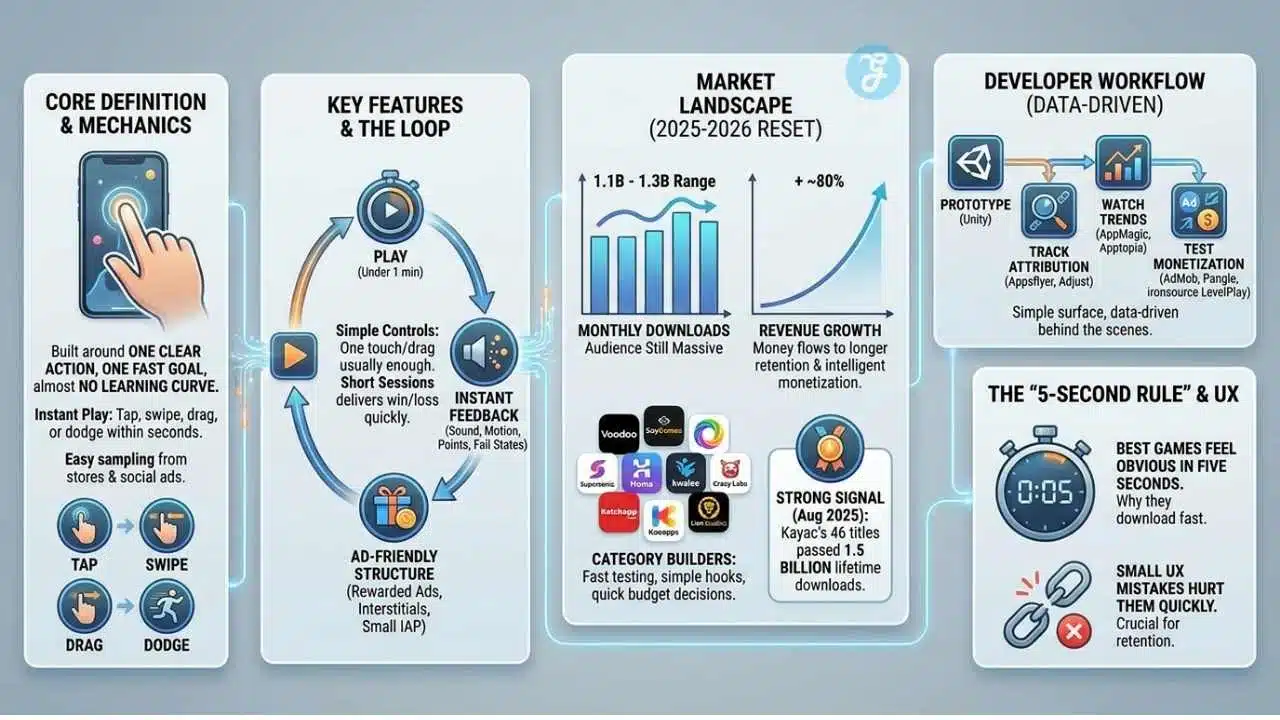
Hyper-casual games are mobile games built around one clear action, one fast goal, and almost no learning curve. You tap, swipe, drag, or dodge within seconds, which makes them easy to sample from the App Store, Google Play Store, or a short social ad.
In AppMagic’s 2026 landscape report, 2025 looks less like the end of the genre and more like a reset: monthly hypercasual downloads stayed in the 1.1 to 1.3 billion range while revenue grew by about 80%. That tells you the audience is still massive, but the money now flows to games that keep players around a little longer and monetize more intelligently.
Kayac added another strong signal in August 2025, saying its 46 hyper-casual titles had passed 1.5 billion lifetime downloads. Studios like Voodoo, SayGames, Rollic, Supersonic, Homa, Kwalee, Crazy Labs, Ketchapp, Kooapps, and Lion Studios built the category on fast testing, simple hooks, and quick decisions about what deserves more budget.
- Simple controls: One touch or one drag is usually enough.
- Short sessions: The game delivers a win, loss, or near miss in under a minute.
- Instant feedback: Sound, motion, points, and fail states tell players what happened right away.
- Ad-friendly structure: The loop naturally creates room for rewarded ads, interstitials, and small IAP offers.
The best hyper-casual games feel obvious in five seconds. That is why they download fast, and why small UX mistakes hurt them so quickly.
For developers, the workflow looks simple on the surface and very data-driven behind the scenes. Teams often prototype in Unity, track attribution with Appsflyer or Adjust, watch store trends with AppMagic or Apptopia, and test monetization through ad partners like AdMob, Pangle, and ironsource LevelPlay.
The Market Landscape for Hyper-Casual Games
The market for hyper-casual games is still huge, but it no longer rewards pure volume by itself. For US-focused teams, the real question is whether installs turn into repeat sessions, ad revenue, or small in-app purchases before user acquisition costs get too high.
Recent data from AppMagic, Adjust, and Moloco all point in the same direction: scale still matters, but efficiency matters more.
| Market signal | What recent data shows | What it means for your strategy |
|---|---|---|
| Download volume | AppMagic says hypercasual downloads stayed very high in 2025, at roughly 1.1 to 1.3 billion per month, even though yearly growth softened. | Do not build your plan on endless organic lift. Assume you will need paid traffic and stronger retention. |
| Revenue trend | The same AppMagic report says hypercasual revenue grew about 80% in 2025. | There is still money here, but the genre now favors games with deeper monetization and longer player life cycles. |
| Retention trend | AppMagic tracked year-over-year gains across the top 200 grossing hypercasual games, from about 3% better day 1 retention to 32% better day 365 retention. | Progression, light meta systems, and live updates are no longer optional if you want durable revenue. |
| Paid acquisition pressure | Adjust says the paid-to-organic ratio for hyper casual rose to 4.56 in 2025. | You need a user acquisition plan early, not after launch. |
| US value concentration | Moloco reported that the top 5% of US iOS high-value users generated 20% of global gaming revenue, even though they represented a tiny share of global installs. | In the US, optimizing for predicted value can beat chasing the cheapest CPI. |
That last point is easy to miss. Downloads often come from broad global audiences, but US players still punch far above their weight on monetization, especially on iOS.
- US: Focus on lifetime value, creative quality, and smart hybrid monetization.
- Europe: Good place to test mixed monetization and store page refinements.
- India, MENA, and LATAM: Strong for scale, creative testing, and lower-cost user acquisition.
- Global launch strategy: Localize ad hooks first, then localize the game economy after you see where retention holds.
Key Drivers Behind the Rise of Hyper-Casual Games
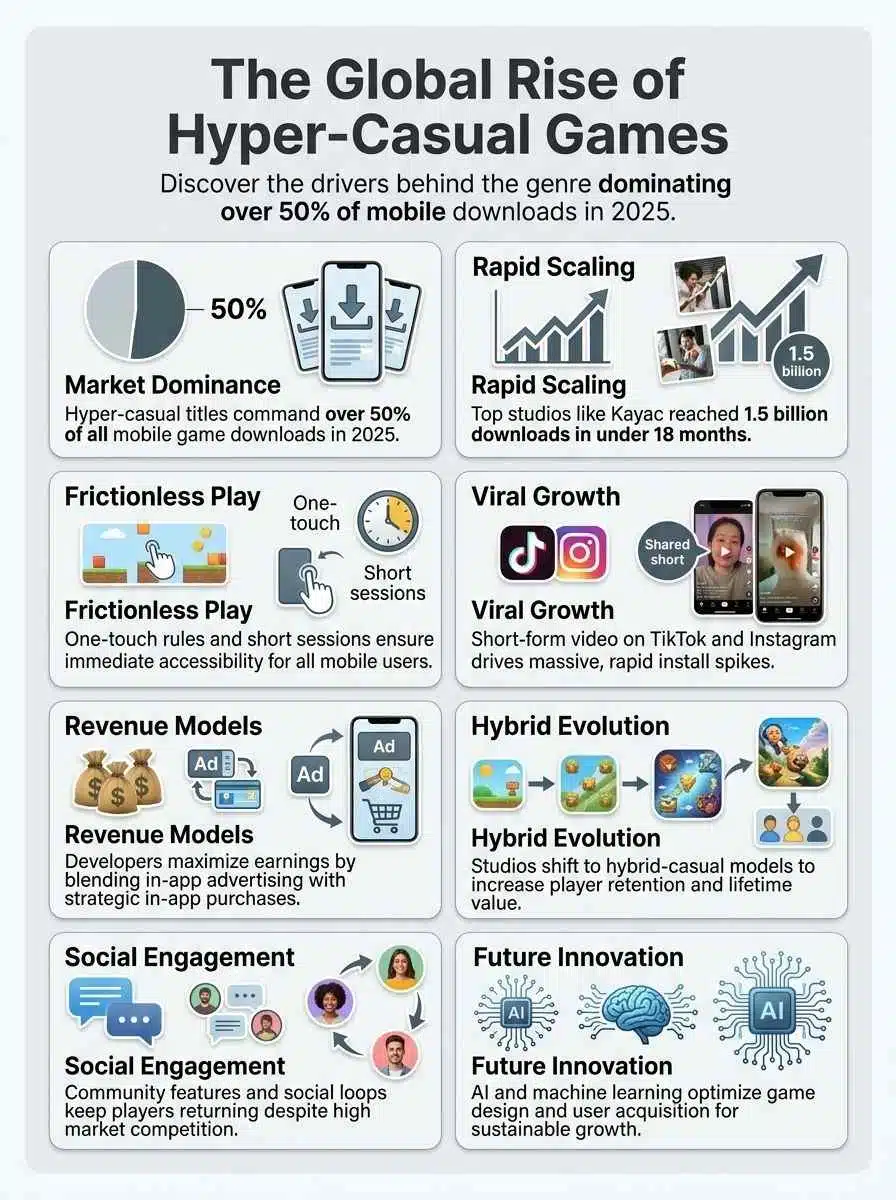
Hyper-casual games grew because they solve a very simple problem for players: boredom. They solve a very simple problem for developers, too, because they make it possible to test a mechanic, buy traffic, and learn fast before sinking months into full production.
Accessibility and Simplicity
The genre wins its first battle in the first few seconds. A player should know what to do before the tutorial even finishes, which is why games like Snake.io or Jelly Shift feel so easy to try.
Adjust’s 2026 mobile app trends report says average hyper-casual session length climbed 13% in 2025 to 21.56 minutes. That is a useful reminder that simple does not have to mean disposable, as long as the game gives fast feedback and a reason to replay.
- One clear verb: Move, dodge, merge, shoot, or collect.
- One visual promise: The player should see the fantasy right away.
- One fast restart: Losing should reset the round in a second or two.
- One clean reward loop: Coins, skins, upgrades, or progress should appear early.
This is also why quick prototyping matters so much in game development. Tools like Unity, Bolt visual scripting, and lightweight analytics let developers test whether a mechanic is fun before they spend heavily on art, live ops, or user acquisition.
Free-to-Play Model
Free-to-play lowers the first barrier to zero. That one choice is still a huge download driver in mobile gaming, because players can try the game without feeling trapped by a price tag.
The model has changed, though. AppsFlyer’s 2025 gaming data said hybrid monetization adoption surged 20% across the industry, and hypercasual reliance on hybrid monetization rose 39%, which means pure ad-only design is giving way to a smarter blend of IAA and IAPs.
AppMagic’s US App Store analysis adds a very practical detail here: many top-grossing hypercasual titles now rely on fail-triggered offers and hard-currency bundles priced roughly between $2 and $8. That price band is low enough to feel impulse-friendly and high enough to matter if the player already cares.
| Player moment | Best monetization fit | Why it works |
|---|---|---|
| First few sessions | Rewarded ads | Players keep control, and you monetize curiosity without forcing payment. |
| After a close loss | Revive or fail offer | The player already cares about the outcome, so conversion intent is higher. |
| After repeat engagement | Small hard-currency pack or no-ads offer | You monetize habit instead of interrupting discovery too early. |
Social Media Integration and Virality
Social platforms do not just advertise hyper-casual games, they shape how those games are designed. If the mechanic looks good in a five-second clip, the odds of a cheaper install usually improve.
TikTok’s US case study with Kwalee’s Hunt & Seek showed more than 43,000 Android installs and 46,000 SKAN installs in the first 14 days, and the game reached top-chart positions in markets including the US. That kind of result explains why short-form video still drives so much user acquisition in this category.
AppsFlyer’s 2025 creative report found that failure-to-success stories in hypercasual ads delivered 78% higher IPM while attracting 40% less spend than pure success stories on social and search. In plain English, showing the struggle can sell better than showing the perfect run.
- Hook the viewer in 3 to 6 seconds: TikTok’s creative guidance says the opening seconds do the heavy lifting.
- Test more than one angle: TikTok recommends 3 to 5 creatives per ad group, while Meta says Advantage+ app campaigns can work with up to 50 creatives.
- Show instant feedback: Scores, wrong choices, and near misses help viewers imagine playing.
- Keep the demo simple: Meta’s playable ad guidance says short tutorials work best, and two steps is a strong rule of thumb.
Monetization Strategies in Hyper-Casual Games
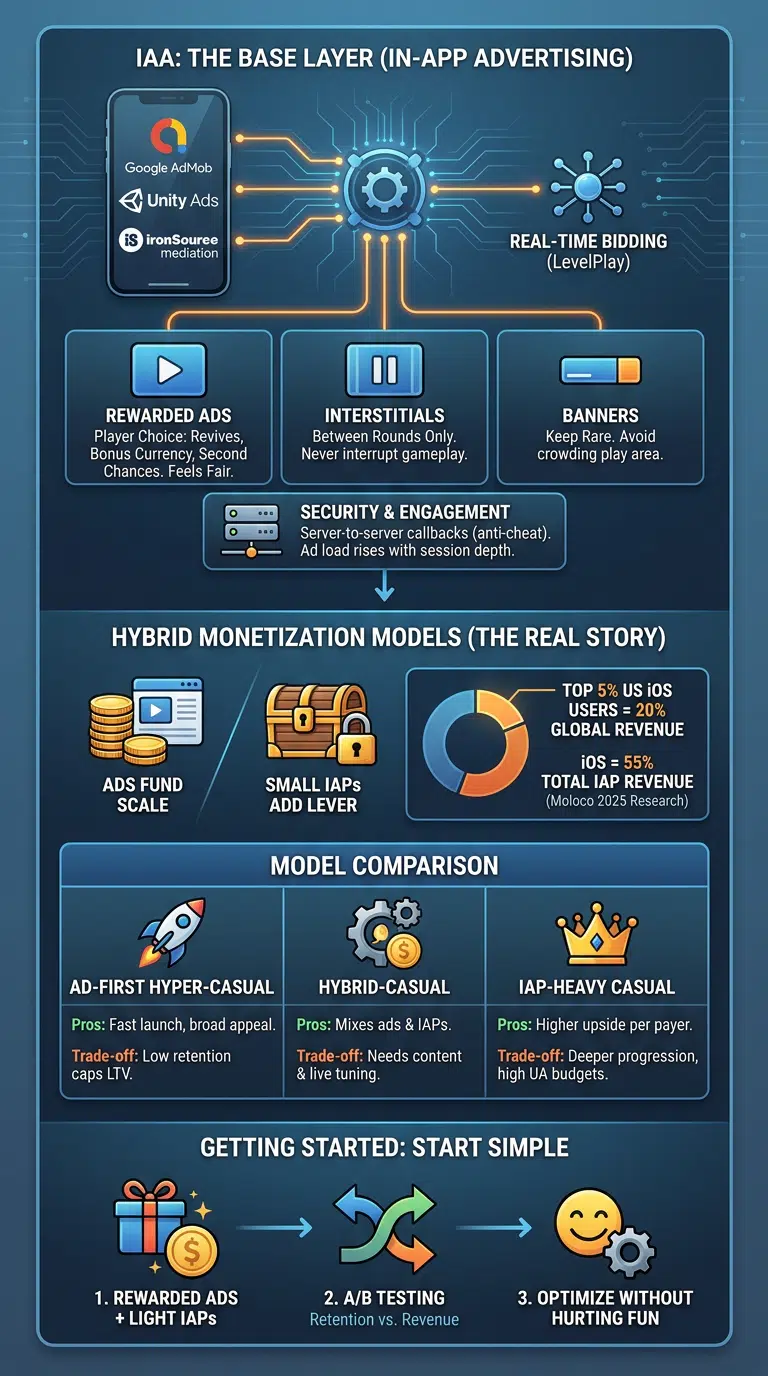
Hyper-casual teams still make most of their money through ads, but the strongest businesses no longer stop there. They use ad monetization as the base layer, then add carefully timed in-app purchases once players show real intent.
In-App Advertising (IAA)
IAA remains the quickest path from install to revenue. That is why developers still rely on Google AdMob, Unity Ads, and ironsource mediation inside many hyper-casual games.
Unity says LevelPlay in-app bidding lets multiple ad sources compete for each impression in real time, which helps you maximize revenue per impression and cuts down on manual waterfall tuning. That matters when margins are tight and CPI moves faster than your content roadmap.
Rewarded ads deserve special attention because they fit the genre. A short revive, a bonus multiplier, or an extra chance after failure feels fair in a short-session game, especially when the player chooses it.
- Use rewarded video for revives, bonus currency, or second chances.
- Use interstitials between rounds, never in the middle of player control.
- Keep banners rare if they crowd the play area or hurt user experience.
- Watch session depth so ad load rises with engagement, not before it.
Unity also recommends server-to-server callbacks for reward-based ads if your game has a backend. That protects you from fake completions and makes your reward economy much harder to exploit.
Hybrid Monetization Models
Hybrid monetization is the real story now. Ads still fund scale, but small IAPs give studios a second lever once the game proves it can hold attention.
Moloco’s 2025 research makes the business case clearly: the top 5% of US iOS high-value users generated 20% of global gaming revenue, and iOS accounted for 55% of total IAP revenue across the dataset. That is why publishers are willing to add deeper progression, special offers, and live events to games that started as pure hyper-casual concepts.
| Model | What it does well | Main trade-off |
|---|---|---|
| Ad-first hyper-casual | Fast launch, simple economy, broad appeal | Low retention can cap lifetime value fast |
| Hybrid-casual | Mixes rewarded ads, interstitials, and small IAPs | Needs more content, balancing, and live tuning |
| IAP-heavy casual | Higher upside per payer | Usually needs deeper progression and higher UA budgets |
If you are early, keep it simple. Start with rewarded ads and one or two light IAP hooks, then use A/B testing to see which layer actually lifts retention or revenue without hurting the fun.
The Shift From Hyper-Casual to Hybrid-Casual Games
This shift did not happen because studios got bored with hyper-casual design. It happened because the market rewarded games that kept the fast first session but added better reasons to return.
Why Developers Are Embracing Hybrid-Casual
AppMagic’s 2026 report says hypercasual revenue jumped in 2025 while downloads stabilized, and that is classic evidence of a category learning how to monetize better instead of merely buying more users. Hybrid-casual games sit right in that sweet spot.
You can already see the pattern in named titles. Pocket Champs and Mob Control ranked among AppMagic’s top-grossing hypercasual games of 2025, and Voodoo’s Hole.io added a progression layer in late 2024, a clear move from pure one-off play toward longer-term engagement.
Studios are not abandoning hyper-casual ideas. They are stretching those ideas into longer player journeys.
AppMagic also highlighted Block Puzzle as a breakout example of hybridization: revenue grew about 12 times while downloads grew about 1.9 times. That gap is exactly what publishers want, more value from each player, not just more players.
Key Features of Hybrid-Casual Games
- Stronger meta progression: Players still get short rounds, but now they also chase upgrades, unlocks, and goals that carry into tomorrow.
- Layered monetization: Rewarded ads, interstitials, special fail offers, and small IAP bundles work together instead of competing with each other.
- Remote tuning: Unity Game Overrides and Remote Config let developers change values, segment players, and run live A/B tests without a full rebuild.
- Cleaner experimentation: Unity recommends testing one change at a time when you run A/B tests, which makes it much easier to see whether the uplift came from economy, UX, or ad timing.
- Live ops support: Light events, limited-time rewards, and weekend challenges give players a reason to come back after the first install spike fades.
- Better retention hooks: Clubs, leaderboards, and simple community features give the game an identity beyond one funny mechanic.
This is why hybrid-casual games now appeal to publishers, advertisers, and analytics partners alike. They still scale like mobile games built for volume, but they behave more like products built for value.
Challenges in the Hyper-Casual Gaming Market
The category still looks easy from the outside. In practice, it is crowded, fast-moving, and brutally unforgiving if your creative or retention slips.
Saturation and Copycat Risks
Hyper-casual mechanics are quick to copy, so a hit can attract clones in days. That turns app store visibility, creative quality, and update speed into competitive weapons, not nice extras.
AppsFlyer’s 2025 creative report found that the top 2% of gaming creatives still absorbed 53% of total ad spend. If your video angle is average, the auction can bury you before the gameplay gets a fair test.
- Differentiate the fantasy: A familiar mechanic can still win if the art, theme, or fail state feels fresh.
- Differentiate the first ad: The ad is often your real first level.
- Differentiate the first minute: If the player sees the entire game in one round, clones can replace you easily.
- Differentiate the update pace: Small content drops can keep your version ahead of copycats.
There is also a practical ad-tech pitfall here. Unity discussion threads show a common mistake where ads work in the editor but fail on real devices because teams confuse Unity project IDs with LevelPlay game IDs, so always test monetization on actual hardware before you buy traffic.
User Retention Issues
Retention is still the hardest problem in hyper-casual games. Adjust’s 2026 report puts average 2025 hyper-casual retention at 27% on day 1, 8% on day 7, and 2% on day 30, which tells you how fast many players churn once the novelty fades.
The hopeful part is that top performers are doing better. AppMagic saw meaningful retention gains across the top-grossing end of the category, which suggests the genre is improving rather than collapsing.
- Get to the first win fast: Players should feel smart within the first session.
- Add a reason to return tomorrow: A chest timer, streak reward, or unlock path can be enough.
- Balance ads against frustration: If players feel punished after every loss, they will leave before you monetize them.
- Use cohort analysis: Firebase, Adjust, and Appsflyer can show exactly where sessions fall apart.
A small UX fix can move the curve more than a big art upgrade. In my experience, the teams that win here are the ones that treat onboarding, restart speed, and reward pacing as revenue features, because they are.
The Future of Hyper-Casual Games
Hyper-casual games are not going away. They are getting smarter, more segmented, and more connected to bigger acquisition and monetization systems.
Innovations in Game Design
AI and machine learning are changing the business side of game design first. Adjust is pushing AI-driven personalization and predictive LTV, while Moloco keeps stressing acquisition models that optimize for long-term value instead of raw install counts.
AppMagic’s 2026 report also shows revenue shifting toward Puzzle, Arcade, and Simulation, with titles like Color Block Jam, Screwdom, All in Hole, Pocket Champs, and Mob Control standing out among 2025’s top-grossing hypercasual leaders. That is a strong clue that puzzle-like loops with better retention hooks will keep growing.
- More hybrid puzzle design: Easy core loop, deeper upgrade path.
- More live tuning: Economies, ad load, and offers will change faster after launch.
- More creative testing: Playables, UGC-style video, and multiple hooks will matter as much as the game build.
- More value-based UA: Teams will buy fewer installs that perform better instead of more installs that disappear.
Expanding Platforms and Formats
Mobile stays at the center, but discovery is spreading across more formats. Playable ads, web demos, CTV, and cross-device measurement all give publishers more ways to find players before a store visit.
Unity Playworks is a good example of where things are heading. It lets teams create, customize, and test playable ads and interactive end cards from one dashboard, which is helpful when user acquisition depends on fast creative turnover.
CTV is worth watching too. Moloco’s US beta data says 66% of users who install after a CTV ad do so within 6 hours of exposure, which is why larger gaming advertisers are treating connected TV as a measurable performance channel instead of a branding-only experiment.
- Playable ads: Best when your mechanic feels good in a short demo.
- Web and HTML5 samples: Useful for quick discovery and friction-free testing.
- CTV: More realistic for portfolio studios that already know their value signals.
- Cross-device measurement: Helpful once your campaigns span mobile, PC, and TV screens.
Advanced User Acquisition Strategies
- Optimize for value, not vanity installs. Cheap CPI can look good in a dashboard and still lose money if the players never reach a second session.
- Refresh creatives constantly. If top creatives take most of the spend, stale ads become expensive very quickly.
- Use story arcs in ads. AppsFlyer’s hypercasual data suggests failure, tension, and recovery often outperform polished perfection.
- Test playables and short demos together. Unity and Meta both point to interactive previews as a strong way to attract higher-intent users.
- Segment your markets. Use broader regions for scale, then tune bids and offers differently for US iOS users with higher value potential.
- Measure post-install behavior early. Appsflyer, Adjust, and Moloco are most useful when they tell you which creative brought players who actually stayed, not just who clicked.
This is where smart user acquisition starts to look a lot like product work. The best advertisers, developers, and publishers are all reading the same signals and adjusting together.
Final Thoughts
Hyper-casual games still win because they solve the hardest part of mobile gaming, getting someone to care in the first few seconds. The difference now is that the best teams do more after that first tap.
They pair clean game design with sharper user acquisition, better ad monetization, and just enough progression to turn a quick install into a real player. If you are building your next mobile game, start with one strong core loop, test a few creatives, watch day 1 and day 7 retention closely, and add in-app purchases only after the session already feels good.
Frequently Asked Questions (FAQs) About Hyper-Casual Games
1. What are hyper-casual games?
Hyper-casual games are very simple mobile games with one clear mechanic, short play sessions, and easy controls, players can pick them up and play in seconds.
2. Why are downloads for hyper-casual games rising?
They are free and easy to learn, so people try them fast. Developers use advertisements and smart user acquisition to push games to many phones, and big audiences drive more installs. Short sessions and social sharing make downloads climb, players grab them like candy.
3. How do developers make money from hyper-casual games?
Monetization comes mostly from advertisements, and sometimes from paid items. High download counts raise ad revenue, so growth and monetization go hand in hand.
4. How can a studio get more downloads for a hyper-casual game?
Test ideas fast, use analytics and market research to learn what works, then iterate. Run focused user acquisition, polish the app store icon and description, and add social hooks to boost downloads.





















