

Do you ever wonder why certain little things set you off, while others leave you feeling completely numb? You might find yourself reacting strongly to minor frustrations, pushing people away, or feeling stuck in patterns you just cannot seem to break. These struggles often trace back to something deeper that happened long ago. The impact of childhood trauma is massive, which shapes adulthood. It changes how we think, feel, and act today in ways we rarely fully understand. I want to share a surprising fact with you.
A 2024 report from the CDC found that over 76 percent of high school students in the US have experienced at least one adverse childhood experience. The impact of these events reaches far beyond those early years. It literally rewires how our brains work and how we handle stress.
I am going to walk you through the connection between what happened to you as a child and who you are today as an adult. You will learn why you act the way you do, what happens in your brain during these moments, and most importantly, how to find real healing.
What is Childhood Trauma?
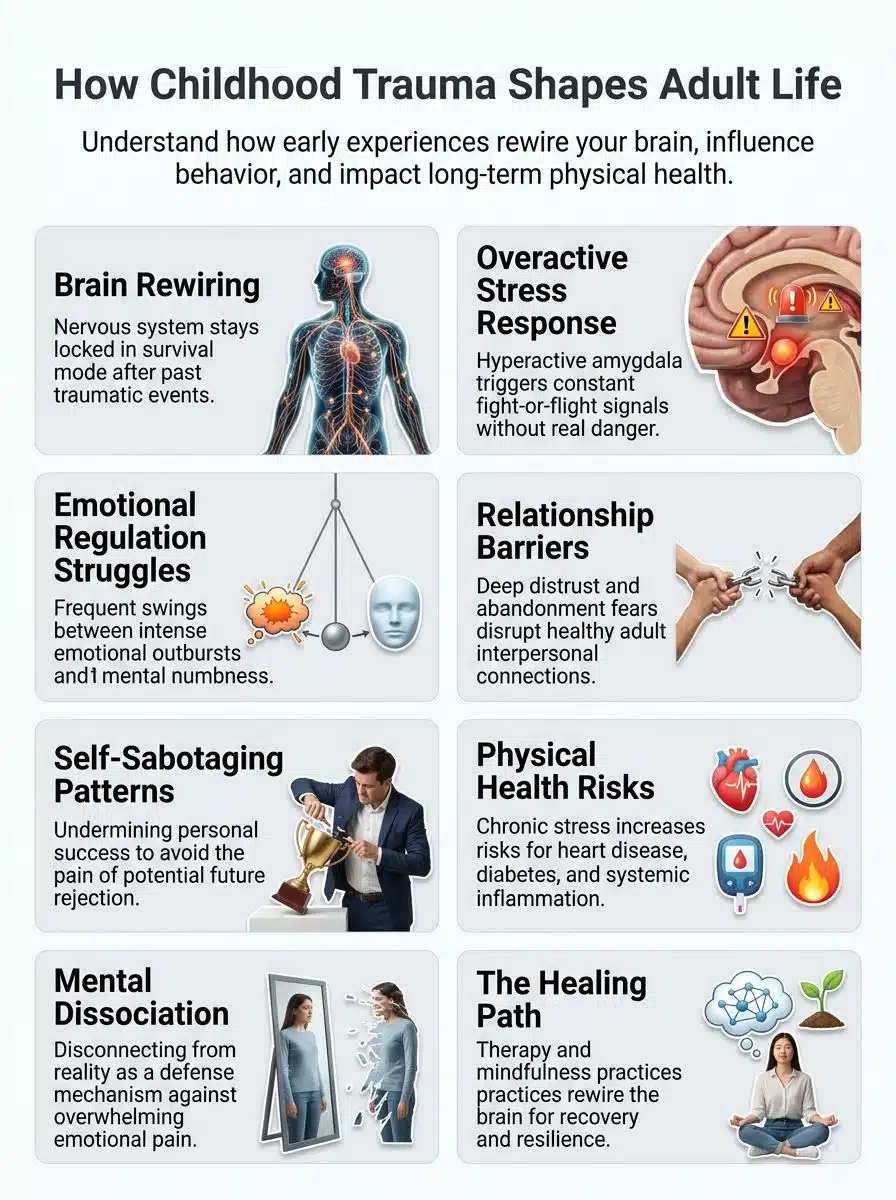
Childhood trauma refers to deeply distressing experiences that happen during a child’s early years. These events overwhelm a child’s ability to cope, leaving lasting marks on their developing mind and body.
Trauma can stem from a single catastrophic event, like a car accident or natural disaster. It can also build up over time through repeated harmful situations. A child’s brain is still growing and forming during these critical years.
The Centers for Disease Control and Prevention often calls these events Adverse Childhood Experiences, or ACEs. These traumatic experiences interrupt the natural development process. The child’s nervous system gets stuck in a state of high alert, treating the world as dangerous.
This altered state becomes their new normal, shaping how they see themselves and interact with others. Childhood trauma takes many forms, and each type leaves its own emotional scars.
- Abuse: This includes physical, sexual, and emotional harm.
- Neglect: Going without basic physical needs or emotional support.
- Household Challenges: Witnessing violence or growing up with family members who have substance use disorders.
These experiences teach children that the world is unpredictable and unsafe. The child’s attachment to caregivers gets disrupted, and their sense of identity becomes fragmented. Over time, these early wounds influence behavioral patterns in adulthood.
Common Types of Childhood Trauma
Childhood trauma takes many forms, and each one leaves its mark on how adults think, feel, and act. Kids experience harm in different ways, from facing abuse to enduring neglect or witnessing addiction in their homes.
Physical, Emotional, and Sexual Abuse
Abuse takes many forms, and each one leaves deep marks on a child’s developing mind. Physical abuse happens when a caregiver harms a child’s body through hitting, pushing, or other violent acts.
Emotional abuse cuts just as deep. It involves constant criticism, rejection, or threats that make a child feel worthless. Sexual abuse represents a serious violation of a child’s safety and trust, causing profound shame and confusion.
The scale of this issue is heartbreaking. Recent 2026 data from RAINN shows that over 63,000 children in the US are found or suspected to have suffered sexual abuse each year. These forms of abuse often occur together, creating a perfect storm of trauma that shapes how a child sees themselves and the world around them.
“Trauma is not what happens to you; it’s what happens inside you as a result of what happened to you.” – Dr. Gabor Maté
Survivors of abuse carry these experiences into adulthood, where the scars show up in unexpected ways. An adult who faced physical abuse might flinch at sudden movements or struggle with anger management, as their nervous system remains stuck in fight-or-flight mode.
Those who endured emotional abuse often battle anxiety and depression, constantly doubting their worth. Sexual abuse survivors frequently experience attachment issues, making it hard to trust partners or feel safe in relationships. These behavioral patterns do not simply vanish, as they become woven into how adults handle stress, conflict, and intimacy.
Emotional and Physical Neglect
Neglect cuts deep, even when no one raises a hand in anger. A child who goes without hugs, praise, or basic care learns that the world is cold and uncaring. Parents or guardians fail to provide food, shelter, medical attention, or emotional support, sending the message that the child does not matter.
Dr. Jonice Webb, a recognized psychologist, coined the term Childhood Emotional Neglect to describe this invisible pain. This type of trauma does not leave bruises you can see, but it carves invisible scars into a person’s sense of worth.
“Childhood emotional neglect is a failure to act. It is a parent’s failure to respond enough to a child’s emotional needs.” – Dr. Jonice Webb
Adults who experienced neglect often struggle with attachment issues, finding it hard to trust others or believe they deserve love. They may feel empty inside, like something crucial went missing during their childhood years. Emotional neglect teaches kids that their feelings do not count, so they grow up ignoring their own needs and pushing people away before anyone can hurt them.
Physical neglect leaves children hungry, sick, and unsupervised for long stretches. A kid left alone without proper meals, clean clothes, or medical care develops anxiety that sticks around into adulthood. These individuals often become hypervigilant, always scanning for danger because no one protected them when they needed it most.
Witnessing Violence or Addiction
Kids who see violence or addiction in their homes carry those images with them into adulthood. A child’s brain absorbs everything, and traumatic scenes get locked in like files on a hard drive.
The CDC’s 2024 Youth Risk Behavior Survey found that more than one in four US high school students live in a household affected by substance use or poor mental health. Witnessing a parent’s substance abuse or domestic violence teaches young minds that the world is unpredictable and unsafe.
These children often develop anxiety and depression that follow them into their adult years. Their nervous systems stay on high alert, always scanning for danger that might not even be there. Adults who grew up around addiction or violence struggle with behavioral patterns that echo their past.
They might push away people who care about them, or they might choose partners who repeat the same harmful cycles. Attachment issues surface because trust was broken early on. These individuals frequently turn to unhealthy coping mechanisms to manage the emotional scars from what they witnessed.
Impact of Childhood Trauma on Brain Development
Childhood trauma actually rewires your brain, changing how you handle stress and think about the world. Let us look at exactly what happens inside your head.

Alterations in Stress Response Systems
Trauma during childhood rewires how your brain handles stress. Your nervous system gets stuck in overdrive, like a car alarm that keeps blaring even after the threat passes. This happens because traumatic experiences teach your brain to see danger everywhere.
According to the Center on the Developing Child at Harvard University, toxic stress can physically damage the architecture of a developing brain. Your amygdala, the part that detects threats, becomes hyperactive. It sends out stress signals faster than normal, flooding your body with cortisol and adrenaline.
Over time, this constant state of high alert exhausts your system. Adults who experienced trauma often startle easily. Loud noises, unexpected touches, or certain smells can trigger intense panic in very physical ways.
- Hearts racing without a clear reason.
- Palms sweating during minor disagreements.
- Muscles tensing up automatically.
The stress response system that should protect you actually works against your well-being in adulthood. Your prefrontal cortex, the thinking part of your brain, gets overwhelmed by signals from your amygdala, making it hard to calm down once you are triggered.
Influences on Cognitive Development
Childhood trauma shapes how the brain develops and learns. Early stress changes the way children process information, remember facts, and solve problems. A child’s brain is still growing, so traumatic events can alter neural pathways and affect attention span.
Kids who face trauma struggle to focus in school, organize their thoughts, and plan for the future. Their working memory suffers, making it hard to hold information while completing tasks. These changes often stick around into adulthood, showing up as distinct challenges.
- Struggling to hold information in working memory.
- Jumping to conclusions without thinking things through.
- Finding it difficult to organize daily tasks and schedules.
Emotional stress from trauma also impacts executive function, which controls impulse control and planning abilities. The prefrontal cortex, responsible for reasoning and judgment, does not develop properly when a child lives in fear or pain.
This means adult survivors may struggle with impulse control or have trouble organizing their daily lives. School performance drops early on, confidence takes a hit, and these cognitive struggles follow people into their careers and relationships.
Emotional and Psychological Effects
Childhood trauma leaves deep marks on your emotional world, shaping how you feel, think, and respond to life’s challenges in ways that echo into adulthood.
Experiencing Anxiety and Depression
Anxiety and depression show up frequently in adults who faced trauma as children. These conditions do not just appear out of nowhere. They grow from the deep emotional wounds that childhood trauma creates.
A person’s brain gets rewired during traumatic events, making the nervous system stay on high alert. The CDC reports that preventing early adverse experiences could reduce the number of adults with depression by as much as 44 percent.
“The body keeps the score. If the memory of trauma is encoded in the viscera, in heartbreaking and gut-wrenching emotions, then the mind alone cannot heal it.” – Dr. Bessel van der Kolk
The body treats everyday situations as threats, triggering constant worry and fear. This hypervigilance exhausts the mind and body, leaving little room for peace or joy. Adults with this background often feel a heavy sadness that sticks around, even on good days.
Depression paired with anxiety creates a tough cycle that is hard to break alone. A person might feel anxious about their depression, then depressed about their anxiety, spinning in circles. These emotional health challenges affect how someone works, loves, and sees themselves.
Challenges in Emotional Regulation
Beyond anxiety and depression, trauma survivors struggle with emotional regulation. Their brains learned to react fast during scary moments, and that survival mode stays turned on. Adults who faced childhood trauma often swing between intense feelings and numbness.
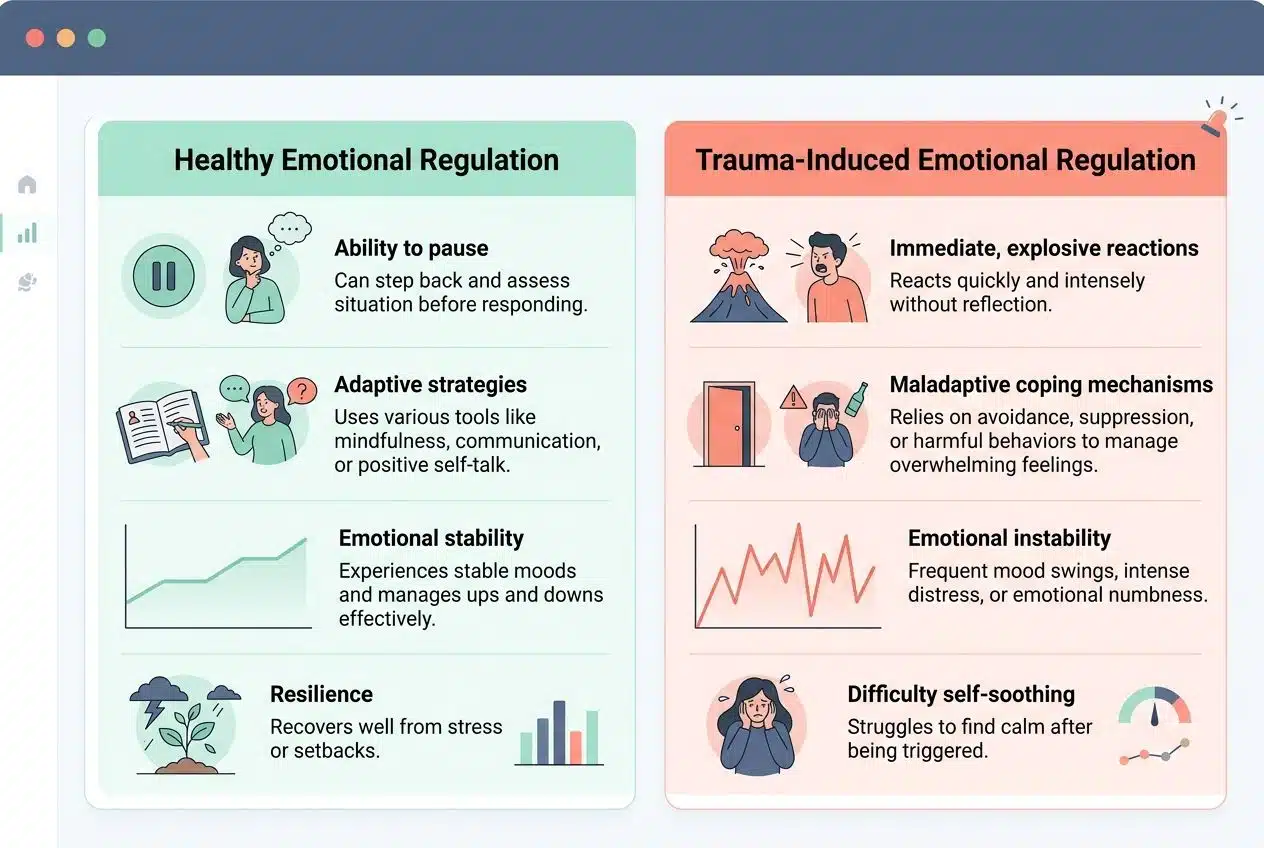
| Healthy Emotional Regulation | Trauma-Induced Emotional Regulation |
|---|---|
| Ability to pause before reacting to a frustrating situation. | Immediate, explosive reactions to minor inconveniences. |
| Feeling a wide range of emotions and letting them pass. | Getting stuck in extreme panic or feeling completely numb. |
| Self-soothing techniques work effectively during stress. | Traditional calming methods fail because the body is in survival mode. |
The brain’s stress response system never fully settled down after the trauma ended. Emotional regulation requires balance, but trauma disrupts that balance completely. Survivors find themselves unable to control their feelings, even when they desperately want to.
Childhood trauma creates deep attachment issues that ripple into adult relationships. People who experienced neglect or abuse often push loved ones away when things get close. They may freeze up during conversations about feelings, or they might lash out without meaning to.
Tendencies Towards Dissociation
Dissociation acts like a mental escape hatch. Your mind shuts down when trauma feels too big to handle. Adults who experienced childhood trauma often drift away from reality, almost like watching a movie of their own life instead of living it.
Dr. Dan Siegel, a clinical professor of psychiatry, explains this using the “Window of Tolerance.” When trauma pushes you outside this window, your brain might choose to freeze and disconnect as a survival tactic. This coping mechanism protected you as a kid, but it can cause real problems now.
You might lose chunks of time, feel numb, or watch yourself from outside your body. Dissociation is your brain’s way of saying that the current moment hurts too much. The trouble is, this defense mechanism sticks around into adulthood, making it hard to stay present in relationships, work, and daily tasks.
Dissociative episodes show up in different ways for different people. Some adults space out during stressful moments, while others feel completely disconnected from their emotions or surroundings. Your body stays in the room, but your mind takes a vacation, making emotional regulation incredibly tough.
Behavioral Consequences of Childhood Trauma in Adults
Trauma survivors often struggle with patterns that sabotage their own success, pushing away good things before others can hurt them first. Adults who experienced childhood trauma frequently make choices that feel safe in the moment but create bigger problems down the road.
Engaging in Risk-Taking or Avoidant Behaviors
Adults who experienced childhood trauma often swing between two extremes. They either chase danger or run from it. Some people engage in risk-taking behaviors, while others avoid situations that trigger their anxiety, even when avoidance hurts their careers or relationships.
These behavioral patterns develop because the brain learned to cope with danger during childhood. A 2025 study published in Health Affairs highlighted the immense toll of these behaviors, estimating the lifetime societal cost of ACEs-related poor health at 2.4 million dollars per affected person in the US.
- Engaging in reckless driving or extreme sports to feel a sense of control.
- Using substance abuse as a quick way to numb emotional pain.
- Skipping important medical appointments due to overwhelming anxiety.
The nervous system stayed in high alert mode, and now it pushes adults toward either confrontation or escape. Risk-taking can feel like a way to regain control, while avoidance feels like protection. Neither strategy actually heals the underlying emotional wounds.
Struggles in Relationship Maintenance
People who experienced childhood trauma often find intimate relationships hard to manage. They may push loved ones away just when things feel close or safe. Trust becomes difficult because their early experiences taught them that adults cannot be relied upon.
Psychologists often categorize these reactions into attachment styles, such as Anxious Attachment, where you constantly fear abandonment, or Avoidant Attachment, where you fiercely guard your independence to avoid getting hurt. Someone might sabotage a healthy relationship without even knowing why they do it.
Fear of abandonment drives many of their choices, so they create distance before anyone can leave them first. These behavioral patterns repeat like a broken record, playing the same song over and over in each new relationship.
Emotional regulation struggles make partnership maintenance feel like walking a tightrope without a net. A small disagreement can trigger an intense reaction because the nervous system has learned to see danger everywhere. Communication breaks down fast when someone cannot manage their emotions or express their needs clearly.
Patterns of Self-Sabotage and Self-Destructive Actions
Relationship struggles often lead to another painful cycle, which is self-sabotage. Trauma survivors frequently undermine their own success, sabotaging good opportunities before others can reject them first. This defensive strategy makes sense when you consider that the brain learned early on that safety meant staying small.
Adults who experienced childhood trauma often push away promotions, end promising relationships, or create conflict just when things go well. If you are wondering what this looks like in daily life, here are a few common signs:
- Arriving consistently late for important job interviews or meetings.
- Picking fights with a supportive partner right before a special event.
- Procrastinating on major projects until failure is almost guaranteed.
- Refusing to celebrate wins because you expect disaster to strike next.
They unconsciously believe that disaster will strike anyway, so they strike first. This behavioral pattern stems from deep emotional scars and serves as a protective mechanism, even though it causes real harm in the long run.
Physical Health Issues Linked to Childhood Trauma
Childhood trauma rewires your body’s stress system, making it stay on high alert long into adulthood. This constant state of alarm triggers inflammation, weakens your immune defenses, and opens the door to chronic diseases that stick around for years.
Higher Risk of Developing Chronic Diseases
Trauma survivors often face higher risks of chronic diseases throughout their adult lives. Their bodies carry the weight of past pain, and stress hormones stay elevated for years. Heart disease, diabetes, and autoimmune disorders strike trauma survivors at much higher rates than the general population.
For example, a major study published by researchers affiliated with the Lupus Foundation of America found that women who experienced severe childhood abuse had a nearly threefold greater risk of developing lupus as adults. This prolonged state of alert exhausts the immune system and damages vital organs.
- Autoimmune disorders like lupus or rheumatoid arthritis.
- Heart disease and unpredictable blood pressure fluctuations.
- Unexplained digestive issues and chronic fatigue.
Inflammation becomes a silent enemy for adults with trauma histories. Their nervous systems remain hyperactive, triggering inflammatory responses that fuel chronic illnesses. Cortisol levels spike and crash unpredictably, disrupting sleep, metabolism, and natural healing processes.
Effects on the Immune and Nervous Systems
Your nervous system acts like your body’s alarm system. Childhood trauma turns up the volume on this alarm, so it stays loud even when danger passes. Your body releases stress hormones like cortisol and adrenaline too often, and this constant flood wears down your defenses.
“The trauma is not the event itself, but rather the failure of the nervous system to process the event and return to a state of calm.” – Adapted from Somatic Experiencing principles
Dr. Stephen Porges explains this through the Polyvagal Theory, showing how trauma can actually impair the vagus nerve, which is responsible for calming the body down. Your immune system gets tired from fighting this invisible threat, meaning you catch colds more easily and infections linger longer than they should.
Your inflammation levels spike, which fuels chronic pain and illness. The nervous system stays stuck in fight-or-flight mode, leaving you exhausted and vulnerable. Your heart races without reason, your muscles tense up constantly, and your digestion suffers because your body thinks it should run, not rest.
Strategies for Healing and Recovery
Healing from childhood trauma takes real work, but people can absolutely move forward with the right support and tools. You will find that therapy, strong relationships, and daily practices create a solid path toward recovery and genuine peace.
Role of Therapy and Psychological Counseling

Therapy and psychological counseling work like a skilled mechanic fixing an engine that has been running rough for years. A trained therapist helps you understand how your childhood trauma shaped your brain, your emotional regulation, and your behavioral patterns.
Many professionals rely on Eye Movement Desensitization and Reprocessing, commonly known as EMDR, to help patients process deeply rooted memories. In fact, 2026 data shows that EMDR therapy has an 84 to 90 percent success rate in helping single-trauma victims no longer meet PTSD diagnostic criteria after just three sessions.
Through talk therapy, cognitive behavioral therapy, or EMDR, you gain tools to process painful memories, reduce anxiety, and break free from self-destructive actions. Your therapist creates a safe space where you can explore attachment issues, examine how trauma influences your relationships, and learn new coping mechanisms.
Professional counseling addresses the deep roots of your struggles rather than just treating the surface symptoms. Your mental health improves as you work through emotional scars and develop resilience for the future.
Creating and Maintaining Supportive Relationships
Supportive relationships act as a lifeline for trauma survivors, offering the emotional foundation needed to heal from childhood wounds. Strong connections with others help rewire your brain’s stress response and create safety in your daily life.
- Seek out people who listen without judgment, because trauma survivors need spaces where they can share freely.
- Choose relationships with individuals who respect your boundaries, as rebuilding trust requires people who honor your limits.
- Avoid relationships that trigger your anxiety or depression, because surrounding yourself with toxic people undoes your healing work.
- Participate in support groups where other survivors gather, since hearing similar stories reduces isolation.
- Practice vulnerability with safe people, which builds genuine connection and helps you develop healthier behavioral patterns over time.
Adoption of Mindfulness and Self-Care Practices
Mindfulness and self-care practices offer powerful tools for adults healing from childhood trauma. These techniques help rewire your brain’s stress response and build emotional resilience over time.
- Practice daily meditation to calm your nervous system and reduce anxiety symptoms, focusing on your breath for just five minutes a morning.
- Engage in journaling to process emotional scars and understand your behavioral patterns more clearly.
- Incorporate physical exercise into your weekly schedule to release tension stored in your body from past adversity.
- Create boundaries in your relationships to protect your emotional health and prevent re-traumatization.
- Spend time in nature regularly, as trees, water, and fresh air activate your body’s natural calming response.
Protecting your mental health means choosing what information enters your mind, so consider limiting news and social media exposure.
The Closing Thoughts
Healing from childhood trauma takes time, patience, and real effort, but your journey truly matters. Progress looks different for everyone, as some find their path through therapy while others lean heavily on supportive relationships. Attachment issues, anxiety, depression, and destructive behavioral patterns do not have to define your future. You possess the power to break these cycles, reshape your identity, and build a life that feels genuinely authentic.
The impact of childhood trauma is deep, but it is never the final chapter of your story. Emotional health improves when you take clear action, seek support, and commit to your own recovery. Interpersonal relationships flourish when you understand your emotional scars and work through them with real compassion for yourself. Coping mechanisms grow stronger with practice, and resilience develops naturally through facing challenges head-on.
Frequently Asked Questions (FAQs) on The Impact of Childhood Trauma
1. How does childhood trauma affect adult behavior?
Childhood trauma can reshape your stress responses, relationships, and trust patterns well into adulthood. According to a 2024 CDC study, adults who experienced four or more adverse childhood experiences are five times more likely to struggle with depression. Some folks might startle easily at loud sounds, while others avoid getting close to people.
2. Can early bad experiences change the way someone thinks later in life?
Yes, tough early experiences can rewire how your brain processes threat and safety. Research from Harvard’s Center on the Developing Child shows that chronic childhood stress can actually alter brain architecture, making you more alert to danger even when you’re safe.
3. Why do some adults struggle with emotions after rough childhoods?
When kids face scary moments without proper support, they miss out on learning healthy emotional regulation skills. As adults, they might swing between bottling up feelings and getting overwhelmed by small triggers because those old coping patterns stuck around.
4. Is it possible for someone to heal from childhood trauma and live well?
Absolutely! Therapies like EMDR (Eye Movement Desensitization and Reprocessing) have shown real success in helping people process past trauma and build new, healthier patterns. Healing takes time and support, but progress happens one step at a time.