


You probably know that feeling. You mess up at work, and your inner voice turns into a harsh critic. You stumble through a social situation, and you replay it over and over in your head. Most people treat themselves far harsher than they would ever treat a friend. This harsh self-judgment becomes a heavy weight you carry around. It drains your mental energy and makes anxiety and depression worse.
Here is a simple trick that worked for me: swap judgment for kindness. Research shows that people who practice self-compassion actually experience lower rates of depression. Treating yourself with kindness rewires how your brain handles stress.
The science of self-compassion shows that this is a powerful tool. It changes your mental wellness from the inside out. I am going to walk you through the exact steps I use, and I think you will be surprised at how easy it can be. So, grab a cup of coffee, and let’s go through it together.
What is Self-Compassion?
Self-compassion means treating yourself with the same kindness you would give a good friend. It involves speaking to yourself gently when things go wrong. You stop beating yourself up with harsh criticism.
Dr. Kristin Neff and Dr. Chris Germer are leading researchers in this field. They created the widely popular eight-week Mindful Self-Compassion program. Dr. Neff defines self-compassion as having three core parts: self-kindness, common humanity, and mindfulness.
Self-kindness means you offer yourself warmth and support during tough times. Common humanity means you recognize that struggle and failure happen to everyone. Mindfulness means you observe your pain without getting swept away by it.
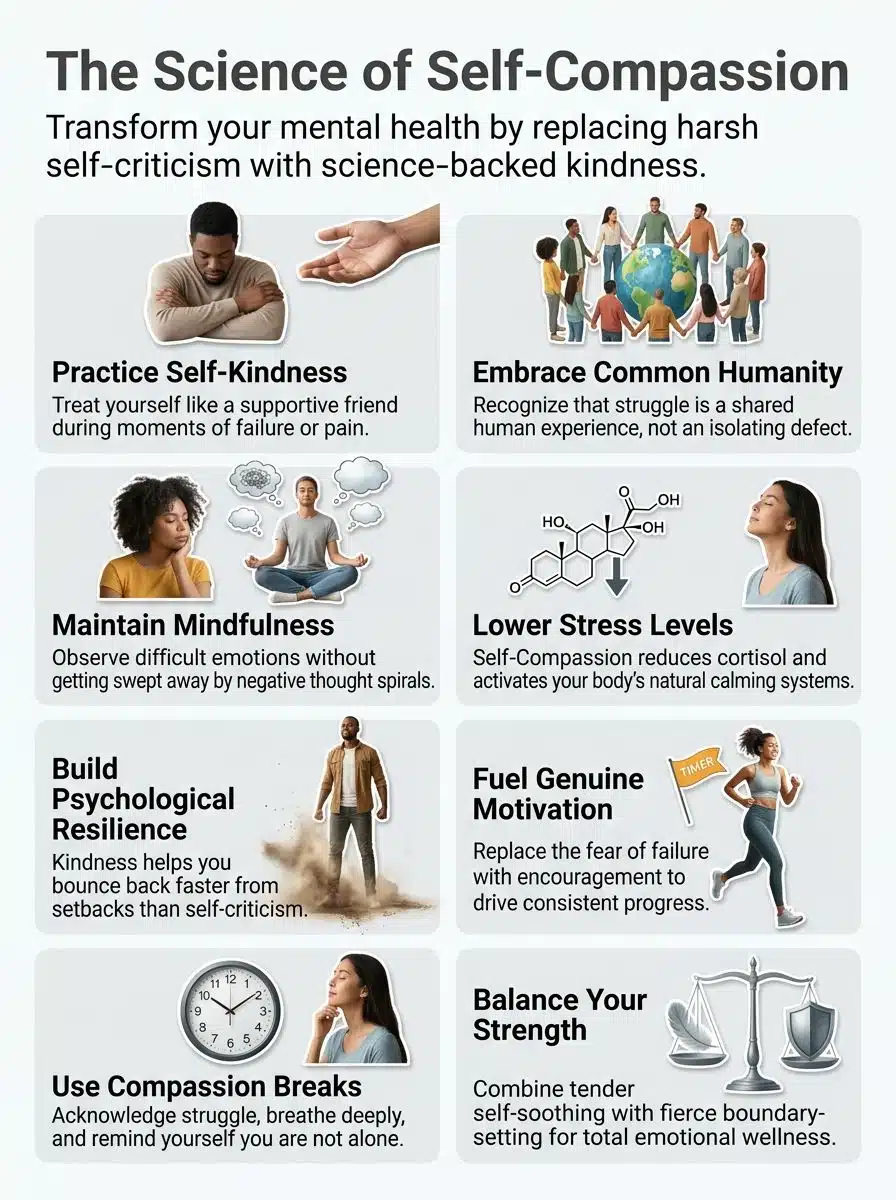
Self-compassion is not about feeling sorry for yourself. It is about treating yourself fairly and with care, especially when life gets messy.
These three elements create a powerful foundation for emotional well-being. In 2025, resources like “The Mindful Self-Compassion Workbook” became massive bestsellers in the US. People are actively looking for practical ways to accept themselves.
Self-compassion differs sharply from self-esteem. Self-esteem goes up and down based on your wins and losses. Self-compassion stays steady because it is not tied to achievement or comparison.
The Three Pillars of Self-Compassion
Self-compassion rests on three core foundations that work together. These pillars reshape your inner dialogue and help you move through life’s tough moments with genuine kindness.
Self-kindness vs. Self-judgment
Most people treat themselves like harsh critics instead of supportive friends. This divide between self-kindness and self-judgment shapes your entire mental health journey.
A late 2025 survey by Eagle Hill Consulting found that over half of the US workforce is currently burnt out. Practicing self-kindness is a direct antidote to this widespread exhaustion.
| Self-Kindness | Self-Judgment |
|---|---|
| You speak to yourself with warmth and understanding when things go wrong. Mistakes feel like learning opportunities rather than personal failures. | You attack yourself relentlessly over small setbacks. Errors transform into proof of inadequacy, and pain compounds. |
| Self-kind people bounce back faster from difficulties. Their nervous systems calm down more quickly after a highly stressful event. | Self-judgment increases anxiety significantly. Your stress response stays activated longer, keeping you in fight-or-flight mode. |
| You treat yourself like you would treat a struggling friend. Your motivation comes from caring about yourself, not from a fear of failure. | You treat yourself like an opponent deserving punishment. Motivation vanishes under the heavy weight of constant disapproval. |
Common Humanity vs. Isolation
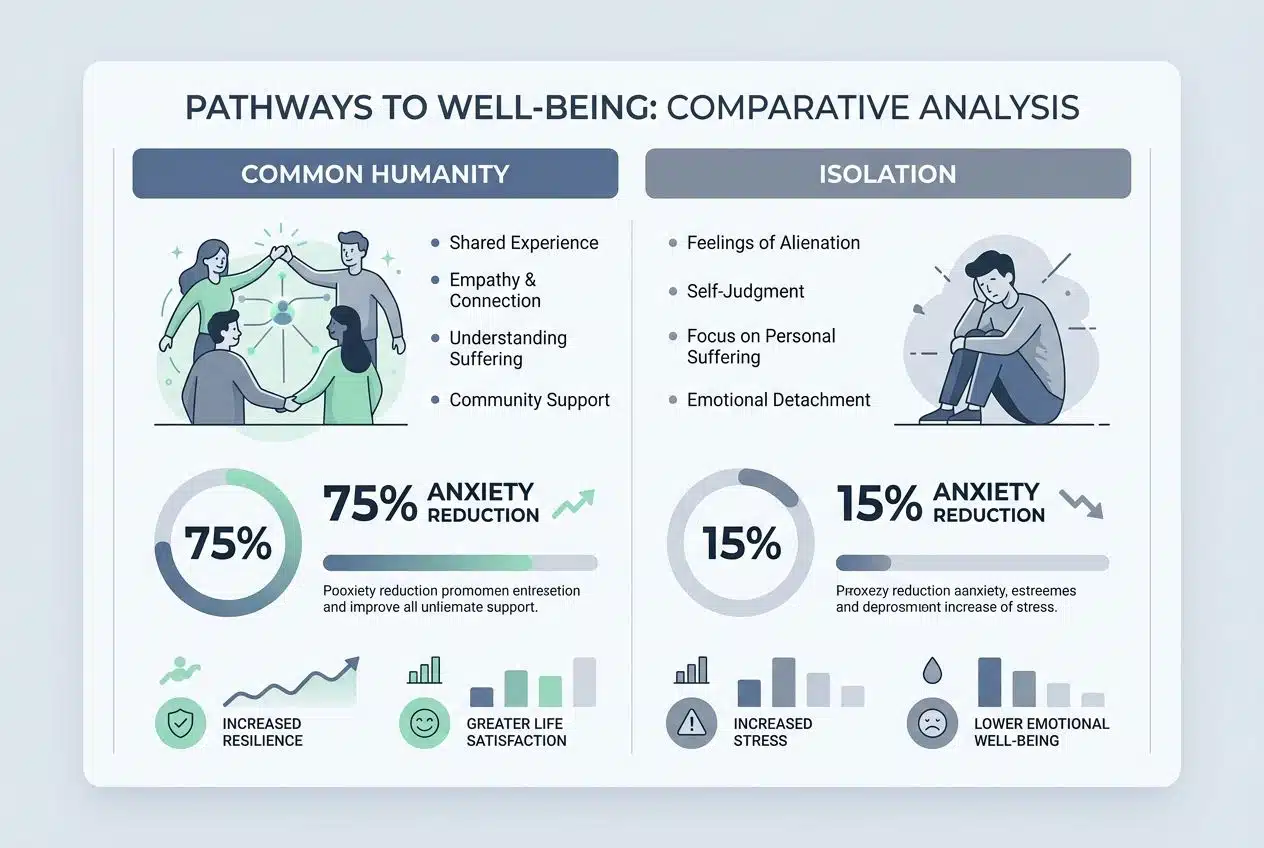
While treating yourself with kindness matters, recognizing that struggle connects you to others proves equally powerful. This second pillar shifts your focus from personal blame to shared human experience.
A November 2025 National Institutes of Health study looked at US doctoral students facing severe impostor syndrome. The researchers found that practicing self-compassion and recognizing common humanity weakened the link between impostor syndrome and anxiety by up to 75 percent.
| Common Humanity | Isolation |
|---|---|
|
|
|
|
Mindfulness vs. Over-identification
Mindfulness helps you observe your painful thoughts and feelings without getting stuck in them. Over-identification means you become tangled up in those emotions and lose perspective.
A great way to practice this is the STOP technique. You Stop, Take a breath, Observe your feelings, and Proceed wisely.
| Mindfulness | Over-identification |
|---|---|
| You notice difficult emotions as they arise. You create space between yourself and the feeling, letting it pass like a cloud. | You become the emotion itself. Your thoughts feel like absolute truth, and you merge with the pain. |
| You observe, “I am having the thought that I am not good enough.” You recognize it as just a thought, not a fact. | You think, “I am not good enough.” The thought defines your entire identity, and you believe it completely. |
| You observe your emotions without being controlled by them. This creates flexibility in how you respond. | Emotions control you completely. Your reactions feel automatic, unavoidable, and overwhelming. |
The Science Behind Self-Compassion
Research reveals that self-compassion rewires your brain and lowers stress hormones. It builds mental strength in ways that harsh self-criticism simply cannot match. Let’s look at what the latest data actually shows.
Research on mental health benefits
Scientists have studied self-compassion for years, and their findings paint a clear picture. People who practice self-kindness show significantly lower stress levels than those who judge themselves harshly.
A 2024 study of US undergraduate students by Cowand and colleagues revealed a fascinating biological benefit. The students who practiced self-compassion developed much healthier cortisol profiles. Cortisol is your body’s primary stress hormone.
When you treat yourself with tenderness, you literally change how your nervous system responds to difficulty.
- Your heart rate slows down naturally.
- Your breathing becomes deeper and more regular.
- Your muscles release built-up tension.
- Your body enters a healing parasympathetic state.
Connection to reduced anxiety and depression
Self-compassion acts like a biological shield against anxiety and depression. Your brain responds to gentle self-talk the same way it responds to comfort from a friend. The clinical evidence backing this up is incredibly strong right now.
A landmark 2025 review published in JAMA Psychiatry found that mindfulness and self-compassion interventions were just as effective as common anxiety medications.
When you stop beating yourself up over mistakes, your mind stops spiraling into worry and fear. You acknowledge your pain with kindness, which immediately interrupts the cycle of negative thinking.
Impact on resilience and emotional regulation
Resilience grows much stronger when you treat yourself with kindness during tough times. You bounce back faster from setbacks and failures.
In 2025, workforce mental health surveys revealed that unresolved depression and burnout cost US organizations around $210 billion annually. This massive loss comes from disengagement and emotional exhaustion. Self-compassion builds the psychological resilience needed to combat this specific type of burnout.
You learn to observe difficult feelings without getting swept away by them. Your nervous system settles down faster, and your mind clears.
Myths About Self-Compassion
Many people get self-compassion wrong. They think it works against them instead of for them. Let’s bust the biggest misconceptions that keep folks from treating themselves with the kindness they actually deserve.
Myth 01: It leads to laziness
People often fear that treating themselves kindly means they will stop trying. They worry it causes a drop in productivity.
Self-kindness actually fuels motivation. When you beat yourself up for mistakes, you drain your energy completely. A 2024 Slack study showed that employees who stepped back to take mindful, restorative breaks actually saw a 21 percent increase in productivity.
Here is how self-compassion drives better results:
- It removes the paralyzing fear of failure.
- It encourages you to try new, challenging things.
- It helps you recover from mistakes without wasting energy on shame.
- It builds sustainable habits instead of boom-and-bust work cycles.
Myth 02: It is self-indulgent or selfish
Many folks think self-compassion means you are being selfish, but that is just not true. Self-kindness actually fuels your ability to show up for others.
If you work in healthcare, teaching, or parenting, you face a high risk of compassion fatigue. You simply cannot pour from an empty bucket. Practicing self-kindness refills your own reserves so you can be a better partner, parent, and friend. It pushes you to grow and improve without letting yourself off the hook. You are simply choosing to be your own ally.
Myth 03: It undermines motivation
Harsh self-criticism drains your emotional well-being and leaves you exhausted before you even start. This is exactly why we see such alarming burnout rates today.

A 2025 workplace report showed that Gen Z employees are burning out 17 years earlier than the average American worker.
Relying on sheer panic and harsh self-judgment for motivation is a recipe for disaster.
Self-acceptance builds psychological resilience. You pursue your dreams with steadier focus because you are not paralyzed by perfectionism. Motivation thrives when you treat yourself like someone worth fighting for.
How to Practice Self-Compassion
Learning self-compassion takes practice, but you can start right now with simple exercises. You will discover that treating yourself with kindness during tough moments makes you much stronger.
Guided self-compassion exercises
Self-compassion exercises give your mind the tools it needs to heal from stress. These practical techniques help you build emotional wellness.
- The Self-Compassion Break: Dr. Kristin Neff recommends a fast, three-step process. You acknowledge the pain, recognize our shared humanity, and offer yourself kindness.
- The Loving-Kindness Meditation: Sit quietly and place your hand on your heart. Repeat phrases like “May I give myself the compassion I need” to activate your brain’s soothing centers.
- The Self-Compassion Letter: Write to yourself as you would to a close friend going through tough times. Read this letter whenever self-criticism creeps in, and you need emotional support.
- The Mindful Body Scan: Lie down and slowly move your attention from your head to your toes. Notice areas of tension without trying to fix them, treating your body with the care you would show a hurting child.
Balancing tender and fierce self-compassion
Compassion comes in two very different, but equally powerful, forms. You need both to build real psychological resilience.
| Tender Self-Compassion | Fierce Self-Compassion |
|---|---|
| Feels soft and soothing, like a warm blanket on a cold day. | Stands firm and strong, acting as a protective shield. |
| You speak to yourself gently when you mess up and offer comfort. | You push yourself to take action and set strict boundaries. |
| Example: Taking a quiet, mindful walk after a very stressful meeting. | Example: Declining a late-night work request to protect your sleep. |
| Helps you manage stress and reduce anxiety when life feels overwhelming. | Refuses to let you stay stuck in harmful patterns or toxic environments. |
Incorporating mindfulness techniques
Mindfulness techniques become your best friend in cementing these practices into daily life. They help you stay present and respond to yourself with greater self-kindness.
- Practice the STOP technique: When stress hits hard, stop what you are doing and take a breath. Observe your thoughts without criticism, then proceed with compassion.
- Use the RAIN method: Recognize what is happening and allow the experience to be there. Investigate with kindness, then nurture yourself with self-compassion.
- Label your emotions: During difficult moments, say, “I am feeling sadness right now.” This creates distance from the feeling and reduces its immediate power over you.
- Keep a mindfulness journal: Record moments of self-compassion throughout your day. This tracks your emotional health progress and reinforces positive psychology patterns.
- Try mindful walking: Focus on each step, the ground beneath your feet, and your breath. This combines physical movement with mental wellness naturally.
Benefits of Self-Compassion for Mental Health
When you treat yourself with kindness instead of criticism, your mind feels lighter. You build real strength to handle life’s tough moments.
Improved emotional well-being
Self-compassion transforms how you handle your emotions on a chemical level. Your brain releases more serotonin and oxytocin when you treat yourself with kindness.
These are the exact same chemicals that make you feel good during positive, connected moments with friends. This shift in your neurochemistry directly improves your emotional well-being.
You stop fighting yourself so hard. Instead of beating yourself up over mistakes, you acknowledge them with understanding. This acceptance creates space for genuine healing, and your mood lifts naturally. You will notice immediate benefits:
- Your stress levels drop significantly.
- Life satisfaction increases daily.
- You recover faster from unexpected setbacks.
Increased self-awareness and self-acceptance
Practicing self-compassion opens a door to much deeper self-awareness. You start noticing your patterns and triggers without harsh judgment.
This clarity acts like a mirror, showing you exactly how you think and feel. When you use self-compassion, you shift your brain activity away from the fear-driven amygdala.
You activate the prefrontal cortex instead, which handles clear, rational decision-making. You develop psychological resilience because you treat yourself like a good friend. Acceptance does not mean you stop growing, it just means you stop beating yourself up for being human.
Stronger coping mechanisms during challenges

Self-compassion gives you stronger tools to handle life’s tough moments. It breaks the automatic fight, flight, or freeze loop that stress triggers.
Instead of panicking when things go wrong, you treat yourself with kindness and understanding. This shift in approach helps your brain stay calm, so you can find real solutions.
You learn to acknowledge pain without drowning in it. You feel sadness without spiraling into depression. Your coping mechanisms become flexible and highly effective.
Final Words
You have learned that self-compassion rests on three powerful pillars. These are treating yourself with kindness, recognizing your shared humanity, and staying mindful.
Research shows these practices genuinely reduce anxiety and depression. They boost your resilience and emotional health in real, measurable ways. Practicing self-kindness is the fuel that keeps you motivated.
Start small with one simple exercise today. Try the STOP technique, or speak to yourself like you would comfort a good friend. Your mental wellness depends on the relationship you build with yourself, and that relationship starts with choosing kindness over criticism every single day.
Frequently Asked Questions (FAQs)on The Science of Self-Compassion
1. What is self-compassion, and how does it help mental health?
Self-compassion means treating yourself with kindness when you’re struggling, just like you’d comfort a close friend. Dr. Kristin Neff’s research at the University of Texas shows it reduces anxiety and depression by calming your nervous system instead of triggering more stress.
2. How can I practice self-compassion every day?
Try the “self-compassion break” when you’re having a rough moment: put your hand on your heart and speak to yourself gently, like you’re talking to someone you care about. Even a few minutes of this can help you feel steadier.
3. Why do experts say self-compassion is better than just boosting confidence?
Self-esteem relies on success, so it drops when you fail, but self-compassion accepts imperfection and stays steady. A 2023 study published in Clinical Psychology Review found that self-compassion reduces anxiety by 26% more effectively than self-esteem boosting techniques.
4. Can learning about the science of self-compassion really change my mood?
Yes, the research backs this up clearly. A 2024 analysis of 79 studies found that people practicing self-compassion techniques showed significant drops in depression and anxiety. Most notice they feel calmer and recover from tough days faster within just a few weeks.






















