
The evolution of literacy instruction is increasingly tethered to the quality of real-time coaching provided during the drafting process. For institutions aiming to reduce the feedback loop without overburdening faculty, identifying the premier AI Writing & Essay Feedback Solutions means looking toward specialized independent developers. Unlike generic text generators, these American SMEs focus on instructional integrity, guiding students toward better composition and critical thinking while maintaining rigorous academic standards.
Establishing a reliable framework for writing support requires a strict evaluation of how these intelligent systems interact with the student’s original voice.
How We Selected Our 10 Best Writing & Essay Feedback Solutions
Identifying the most effective composition architecture required strict filtering to separate pedagogical tools from automated ghostwriters. We focused entirely on independent American studios that adapt rapidly to the changing technical demands of modern school districts and universities.
-
Geographic Baseline. Operated and headquartered strictly within the United States as independent entities.
-
Independence. Verified as independent SMEs or specialized non-profits to guarantee agile customer support and transparent data policies.
-
Instructional Integrity. Proven focus on provide formative feedback and coaching rather than simply generating or rewriting text.
-
Data Security. Complete adherence to FERPA and COPPA regulations, ensuring student writing remains protected and is not used for external model training.
Understanding these core requirements helps identify exactly which platforms are equipped to handle the rigorous daily demands of academic writing and assessment.
Evaluating the Top 10 AI Writing & Essay Feedback Solutions
The following independent studios and specialized organizations are actively reshaping how academic institutions deliver personalized feedback on the written word. Here is our curated breakdown of the standout developers driving composition innovation today.
Starting with platforms that emphasize critical thinking ensures that the technology supports, rather than replaces, the student’s intellectual labor.
1. Packback
Operating out of Chicago, Illinois, Packback provides an AI-driven “instructional assistant” designed to improve student curiosity and writing quality. Their Packback Deep Dives platform uses a proprietary AI to provide students with real-time feedback on their essays before they submit them. The system evaluates the strength of their thesis, the quality of their supporting evidence, and the overall flow of their argument.
Best for:
-
University faculty wanting to scale personalized, high-level feedback on student arguments and critical thinking.
Why We Chose It:
-
The AI acts as a digital coach, nudging students to cite more credible sources and refine their thesis statements during the drafting phase.
-
It provides instructors with a “curiosity score” and detailed analytics on student engagement with the writing process.
Things to consider:
-
The platform is built for argumentative and academic writing rather than creative or purely technical documentation.
The 2026 Edge:
-
Advanced source-credibility algorithms that alert students if they are citing outdated or academically unverified materials in their draft.
Providing structured instruction for younger learners requires platforms that focus on the mechanics of building a sentence.
2. NoRedInk
Headquartered in San Francisco, California, NoRedInk provides a comprehensive writing platform that builds student confidence through adaptive instruction. The software uses AI to identify a student’s specific grammatical and structural weaknesses, delivering personalized lessons and real-time feedback on their writing. It allows teachers to create structured writing cycles with automated prompts and peer review cycles.
Best for:
-
K-12 English Language Arts departments needing a systematic, data-driven approach to improving student composition skills.
Why We Chose It:
-
The platform allows teachers to align writing assignments directly with specific state standards and common core rubrics.
-
The AI adapts the difficulty of the feedback and lessons based on the student’s individual progress over time.
Things to consider:
-
It is a highly structured environment that may feel too restrictive for advanced university-level creative writing.
The 2026 Edge:
-
Expanded diagnostic tools that automatically group students into small-group intervention clusters based on their writing errors.
Democratizing high-quality writing feedback requires non-profit initiatives focused on equitable access.
3. Quill.org
Based in New York City, Quill.org is a non-profit educational SME that provides free, AI-powered writing tools for students. Their platform focuses on “sentence combining” and diagnostic writing, using AI to provide immediate feedback as students attempt to turn fragmented thoughts into complex, logical sentences. It is widely used in Title I schools to bridge literacy gaps.
Best for:
-
Middle and high school educators in underserved districts looking for high-impact, evidence-based writing interventions.
Why We Chose It:
-
The open-access model ensures that every student, regardless of district funding, has access to immediate writing coaching.
-
The feedback is remarkably precise, showing students exactly how a change in punctuation or conjunction changes the meaning of their sentence.
Things to consider:
-
The platform is focused on sentence-level mechanics and does not yet evaluate multi-page essay structure.
The 2026 Edge:
-
New collaborative writing modules that allow the AI to facilitate real-time, peer-to-peer sentence editing sessions.
Effective feedback often comes from peers, but managing that process requires specialized analytical infrastructure.
4. Eli Review
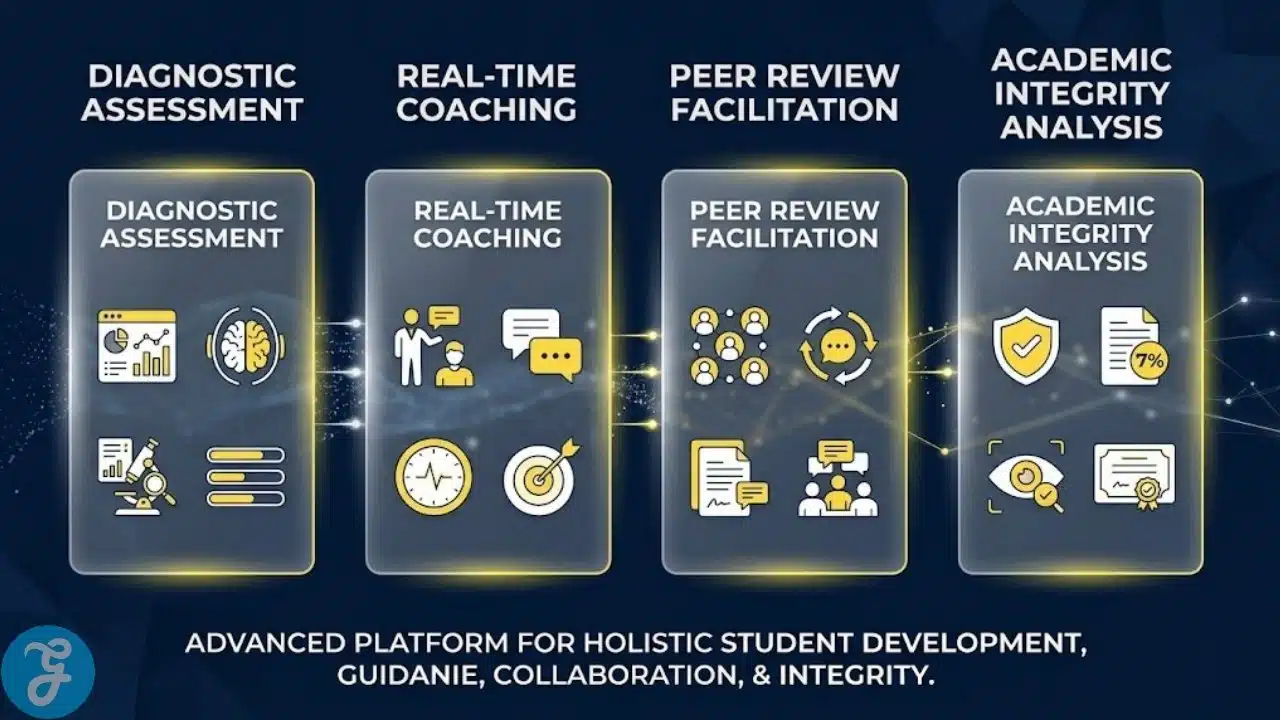
Located in East Lansing, Michigan, Eli Review was developed by writing researchers at Michigan State University. The platform uses AI and data analytics to improve the peer-review process. It doesn’t just grade the student’s essay; it evaluates the quality of the feedback they give to their peers, coaching students to become better editors and more critical readers of their own work.
Best for:
-
Writing-intensive university courses that utilize a heavy peer-review and revision-based pedagogy.
Why We Chose It:
-
It treats writing as a social and iterative process rather than a one-off assignment.
-
The analytics dashboards show teachers which students are giving helpful feedback and which are struggling to articulate critique.
Things to consider:
-
It requires a significant shift in how an instructor structures their course, prioritizing revision over final grading.
The 2026 Edge:
-
Automated “helpfulness” scoring for peer comments, allowing teachers to instantly identify the most effective student editors.
Ensuring clarity and professional tone is essential for students transitioning into the workforce.
5. Copyleaks
Based in Stamford, Connecticut, Copyleaks provides a highly advanced analysis engine designed to detect both traditional plagiarism and AI-generated text. Beyond detection, their platform provides students with feedback on their writing style and structure, helping them identify areas where they may have relied too heavily on external sources without proper synthesis.
Best for:
-
Academic integrity offices and research departments requiring high-fidelity verification of original thought.
Why We Chose It:
-
It is one of the most accurate AI-detection tools on the market, providing detailed probability maps for every sentence.
-
The platform includes a specialized “Source Code” detector for verifying the originality of programming assignments.
Things to consider:
-
The interface is highly focused on analysis and integrity rather than creative writing coaching.
The 2026 Edge:
-
“Plagiarism 3.0” technology that can detect if a student has simply used AI to “spin” or paraphrase stolen content.
Lightweight, browser-based tools offer immediate relief for students struggling with stylistic clarity.
6. Slick Write
Slick Write is an independent American developer providing a powerful, free web-based application that analyzes writing for stylistic flaws. It provides students with detailed statistics on their word choice, sentence length variety, and the use of passive voice. It is a highly effective tool for students who need to self-edit their essays before a final submission.
Best for:
-
Individual students and freelance tutors looking for a fast, no-cost way to analyze writing style and clarity.
Why We Chose It:
-
The platform provides incredible data visualization, including a “flow” graph that shows the rhythmic variety of sentences.
-
It requires zero account setup, making it one of the most accessible self-editing tools for students.
Things to consider:
-
It does not save document history and lacks the collaborative features of enterprise-grade platforms.
The 2026 Edge:
-
Integrated “vocabulary diversity” heat maps that show students exactly where they are being too repetitive.
Developer-focused writing solutions offer a unique approach to technical and academic documentation.
7. Sapling
Operating out of San Francisco, California, Sapling provides a specialized AI writing assistant designed for high-stakes professional and academic communication. Their platform integrates directly into various web browsers and enterprise tools, providing real-time feedback on tone, grammar, and structural consistency.
Best for:
-
Graduate students and research assistants who need to maintain a high level of formal technical accuracy in their correspondence.
Why We Chose It:
-
The platform excels at maintaining professional tone in casual digital environments like email or internal campus chats.
-
It provides a highly accessible API, allowing university IT departments to embed the feedback engine into their own custom portals.
Things to consider:
-
It is built for professional efficiency and lacks the gamified pedagogical tools found in K-12 platforms.
The 2026 Edge:
-
Advanced “concision” filters that automatically highlight wordy academic jargon for simplified rephrasing.
Professional editing services are increasingly utilizing AI to provide faster, more affordable feedback.
8. Wordvice
Based in Palo Alto, California, Wordvice combines AI-powered editing tools with a network of professional human editors. Their AI Writing Assistant provides instant feedback on grammar, style, and academic tone, while their “human-in-the-loop” model allows students to escalate their essays to professional editors for deep, qualitative feedback.
Best for:
-
Graduate students and international scholars preparing complex manuscripts for publication in academic journals.
Why We Chose It:
-
It provides a “safety net” by allowing students to move from automated AI feedback to professional human review within the same platform.
-
The AI is specifically tuned for academic and research-oriented writing, understanding the nuances of formal citations.
Things to consider:
-
The human editing component involves additional costs beyond the baseline AI subscription.
The 2026 Edge:
-
Automated “Journal Matching” that analyzes an essay and suggests the best academic publications based on the content and style.
Supporting student writing at scale requires platforms that integrate directly with the student’s existing help-seeking behaviors.
9. Hemingway Editor
Based in the United States, Hemingway Editor is a focused application that highlights “wordy” and complex sentences. It uses a color-coded system to show students exactly where their writing has become too dense or difficult to read. It encourages the use of active verbs and the elimination of unnecessary adverbs, pushing students toward more forceful, direct prose.
Best for:
-
Journalism students and creative writers who need to prune their prose for maximum impact and clarity.
Why We Chose It:
-
The interface is legendary for its simplicity, removing all distractions and focusing entirely on the readability of the text.
-
It provides a real-time readability grade, helping students target their writing to a specific audience level.
Things to consider:
-
It is a style tool only; it does not check for factual accuracy, plagiarism, or complex grammatical rules.
The 2026 Edge:
-
AI-powered “Simplicity Suggestions” that provide three different ways to rephrase a sentence marked as “hard to read.”
Scholarly writing requires specialized feedback that understands the rigors of scientific and technical publication.
10. Trinka AI
Operating out of San Francisco, California, Trinka AI is a writing assistant built specifically for academic and technical writing. It goes beyond basic grammar to provide feedback on technical phrasing, formal tone, and the correct usage of specialized terminology in fields like medicine, engineering, and law.
Best for:
-
Medical students and engineering majors who need to ensure their lab reports and technical papers meet professional standards.
Why We Chose It:
-
It includes a specialized “Technical Language” filter that prevents the AI from suggesting “simple” words for precise professional terms.
-
The platform provides deep analysis of academic tone, flagging sentences that are too informal for professional publication.
Things to consider:
-
The interface is designed for professional scholars and may be intimidating for younger students.
The 2026 Edge:
-
Automated “Grant Alignment” checks that evaluate if a research proposal matches the specific language and requirements of a funding body.
Examining these distinct providers collectively provides a clear perspective on the digital infrastructure available to modern educators.
An Overview Of AI Writing & Essay Feedback Solutions
Reviewing these varied digital environments side by side helps administrators clarify their institutional priorities and choose the tool that best fits their specific pedagogical goals.
Overview Comparison Table
Comparing these specific metrics highlights the structural differences between mechanical grammar checkers and deep pedagogical coaches.
| SME Developer | Headquarter Location | Core Focus Area | Primary Function |
| Packback | Chicago, IL | Critical Thinking | Argumentative Coaching |
| NoRedInk | San Francisco, CA | K-12 Composition | Adaptive Writing Cycles |
| Quill.org | New York, NY | Sentence Mechanics | Diagnostic Intervention |
| Eli Review | East Lansing, MI | Peer Feedback | Writing Process Analytics |
| Grammarly | San Francisco, CA | General Assistance | Tone and Clarity |
| Writer | San Francisco, CA | Institutional Voice | Style Guide Governance |
| Copyleaks | Stamford, CT | Originality Analysis | Integrity and Detection |
| Slick Write | USA based | Stylistic Statistics | Visual Style Analytics |
| Sapling | San Francisco, CA | Professional Tone | Real-Time Technical Support |
| Wordvice | Palo Alto, CA | Scholarly Publishing | AI Feedback + Human Editing |
| Chegg Writing | Santa Clara, CA | Citation Management | Integrated Writing Lab |
| Hemingway | USA based | Prose Readability | Concision and Clarity |
| Paperpal | San Francisco, CA | Scientific Research | Journal Publication Prep |
| Jasper | Austin, TX | Project Architecture | Long-Form Writing Sidekick |
| Trinka AI | San Francisco, CA | Technical Accuracy | Specialized Professional Writing |
Evaluating these diverse administrative tools naturally leads to our primary recommendations for specific institutional use cases.
Our Top 3 Picks and Why?
Narrowing down the field highlights three developers making exceptional contributions to the composition landscape. Packback stands out by focusing entirely on the “why” of an essay, utilizing AI to coach students on critical thinking and argumentative rigor before they submit. NoRedInk provides an unparalleled K-12 solution by gamifying the mechanics of writing, ensuring that students build a solid foundational understanding of grammar and structure. Finally, Eli Review delivers a unique, research-backed approach by focusing on the “human loop,” using AI to improve how students give and receive feedback, which is the ultimate key to long-term writing growth.
Selecting the right digital infrastructure requires balancing the technical capabilities of the software with the actual needs of the teaching staff.
How to Choose the Right AI Writing & Essay Feedback Solutions by Yourself?
Implementing a new writing environment successfully means finding a platform that aligns with your specific pedagogical philosophy and budget constraints.
-
Determine the Pedagogical Goal. Decide if you need to fix foundational grammar (Quill), improve stylistic clarity (Hemingway), or enhance critical thinking (Packback).
-
Assess the “Coaching” vs “Generating” Balance. Ensure the platform is designed to provide feedback to the student rather than generating text for the student, to avoid academic integrity issues.
-
Verify Platform Integration. Confirm that the tool works natively inside the environments students already use, such as Google Docs, Microsoft Word, or Canvas.
-
Analyze the Data Privacy. Require the developer to provide a clear, legally binding agreement that student essays will not be used to train external, public-facing language models.
Applying this framework directly to your specific campus needs allows you to match the right developer to your university.
The Final Checklist
Running through this quick verification process guarantees you are adopting a secure, scalable platform.
-
Verify the developer complies entirely with federal regulations regarding student privacy and data handling.
-
Ensure the platform allows teachers to see the “history” of the AI’s suggestions to ensure the student is doing the actual work.
-
Test the platform’s ability to handle highly specific academic styles, such as MLA, APA, or Chicago formatting.
-
Confirm the developer provides dedicated training for faculty to help them interpret the AI’s feedback analytics.
-
Check that the software includes built-in bias mitigation to ensure the AI provides equitable feedback to all students.
Implementing these systems successfully requires a deep understanding of what the academic essay actually represents.
Synthesizing the Future of the Academic Essay
The sudden explosion of generative technology has led many to fear that the academic essay is a dying format. The uncomfortable truth is that relying entirely on AI Writing & Essay Feedback Solutions to “fix” student writing can actually lead to a homogenization of thought and a decline in individual voice. As institutions rush to implement automated grading and feedback, they risk turning the complex human act of writing into a sterile algorithmic transaction.
The future of composition instruction does not rely on building more powerful text generators to do the work for the student. It relies on utilizing these specialized digital coaches to remove the mechanical friction of drafting, allowing students to spend more time on the deep, messy work of developing original ideas. True intellectual growth happens when technology is used to amplify the student’s voice, not to replace it with a polished, synthetic substitute.
To further clarify the implementation of these digital systems, addressing common technical concerns is essential.
Frequently Asked Questions (FAQs) About AI Writing & Essay Feedback Solutions
Does using AI feedback count as plagiarism?
No, as long as the platform is designed as a formative coach. These specialized solutions highlight errors and suggest improvements, but they require the student to make the final editorial choice, ensuring the “intellectual labor” remains with the human author.
Can these platforms detect if a student used AI to write the essay?
Most high-end writing solutions now include integrated “AI detection” nodes. These tools analyze the linguistic patterns of the text to provide a probability score, helping instructors identify documents that lack the typical variability of human writing.
How do these tools help students who speak English as a second language?
AI writing assistants are exceptionally powerful for ESL learners, providing real-time feedback on idiomatic phrasing, correct preposition usage, and formal tone that is often difficult for non-native speakers to master.
Will an AI ever be able to grade an essay as well as a human?
While AI can grade mechanics, structure, and citation accuracy with high reliability, it still struggles to evaluate the “soul” of an essay—the unique creative spark or emotional resonance that a human instructor can recognize. Most experts recommend using AI for the first 80% of the feedback, leaving the high-level conceptual grading to the human teacher.
Is it safe to put sensitive research into these AI platforms?
Institutional-grade SMEs provide “private cloud” environments. Unlike free public chatbots, these professional tools encrypt all data and legally guarantee that your research or student data will never be leaked or used to train public models.