Ireland sits at a fascinating turning point in how it generates and consumes power. The effects of a changing global climate are obvious, pushing the government to drastically rethink the national grid. Moving away from imported fossil fuels isn’t just an environmental choice anymore; it’s a matter of national security and economic stability. Right at the heart of this massive shift is the Ireland renewable energy target 2030, a legal commitment to source 80% of the country’s electricity from clean, natural resources by the end of the decade.
Hitting this target requires completely rewiring the country, tearing up the old rules of power generation, and building entirely new industries from scratch. It affects local towns, the job market, and your monthly electricity bill. If you want to grasp exactly how the nation plans to pull off this green revolution, we need to look at the details. Here are the fifteen most important facts and challenges driving this ambitious race against the clock.
The Core Strategy: What is the 80% Target?
Transforming a national power grid from fossil fuels to clean energy requires a rigid, legally binding strategy. The government hasn’t just picked a random number out of thin air; the strategy relies on strict carbon budgets and deeply researched engineering models. Understanding the foundations of this plan shows exactly why the country is moving so aggressively.
1. The Climate Action Plan Explained
The Climate Action Plan is the legal engine driving the entire green transition across the country. It doesn’t just offer suggestions; it mandates a strict 51% reduction in total greenhouse gas emissions across all sectors by 2030 compared to 2018 levels. Cleaning up the electricity grid carries the heaviest burden in this plan because it acts as the foundation for everything else.
For example, pushing people to buy electric cars or install home heat pumps only helps the environment if the electricity powering them comes from clean sources. The plan forces government departments to hit specific carbon budgets, and failing to meet these legally binding targets will result in massive financial fines from the European Union. It is a constantly evolving document, updated annually to patch holes and speed up progress where the country falls behind.
| Climate Action Plan Feature | Details & Impact |
| Legal Mandate | Binding 51% total emissions cut by 2030. |
| Sector Budgets | Strict carbon limits placed on transport, agriculture, and energy. |
| Annual Updates | The plan is revised every year to adjust to technological shifts. |
| Financial Penalties | Missing targets triggers heavy EU compliance fines. |
2. Why 80%? The Science and Policy Behind the Number
You might wonder why the government stopped at 80% and didn’t just aim for a 100% clean grid by 2030. The answer comes down to pure physics and grid stability. Wind and solar power fluctuate constantly based on the weather, and managing a national network on 100% variable energy right now would almost certainly cause rolling blackouts. Pushing to 80% pushes current technology to its absolute limit while keeping the lights on.
The remaining 20% acts as a necessary safety net, relying mostly on highly efficient natural gas plants that can fire up in minutes on dark, windless days. Energy experts agree that this 80/20 split is the smartest way to guarantee a secure power supply while waiting for advanced long-term storage technologies to become affordable enough to close that final 20% gap in the following decade.
| 80% Target Breakdown | Strategic Reasoning |
| The 80% Clean Share | Maximizes current wind and solar technology safely. |
| The 20% Fossil Backup | Prevents blackouts during calm, cloudy weather periods. |
| Grid Stability | Maintains synchronous inertia, keeping electricity flowing smoothly. |
| Future Proofing | Buys time for green hydrogen and deep battery storage to mature. |
Harnessing the Elements: Wind and Solar Power
Ireland has some of the wildest weather in Europe, which historically was a nuisance but is now its greatest economic asset. The plan leans heavily into capturing Atlantic winds and maximizing new solar technologies. Moving away from peat and coal means dotting the landscape and coastlines with modern infrastructure.
3. The Power of Onshore Wind
Onshore wind farms are the absolute workhorses of the current Irish renewable sector. The country currently operates roughly 5 gigawatts of onshore wind capacity, making it one of the best in the world at integrating wind into a small grid. To hit the 2030 milestones, developers need to push that number up to 9 gigawatts. Achieving this means two things: building new farms in suitable rural locations and “repowering” older sites.
Repowering involves tearing down older, smaller turbines built twenty years ago and replacing them with fewer, massive modern turbines that capture significantly more energy. It’s a delicate balancing act, as planners must constantly negotiate with local communities to minimize the visual impact and noise pollution while still securing enough windy real estate to meet the national quotas.
| Onshore Wind Factors | Current Reality & Future Goals |
| Current Capacity | Roughly 5 GW already installed. |
| 2030 Target Capacity | Needs to reach 9 GW to meet national goals. |
| Repowering Strategy | Upgrading old sites with massive, highly efficient modern turbines. |
| Community Impact | Requires careful planning to limit noise and visual disruptions. |
4. Unlocking Offshore Wind Potential
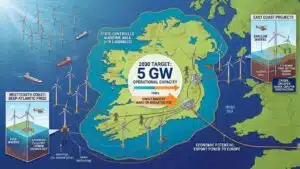
While land-based turbines are crucial, the open ocean is where Ireland can truly become an energy superpower. The state controls a maritime area roughly seven times the size of its landmass, battered by incredible, consistent winds. The immediate goal is to build out 5 gigawatts of offshore wind capacity by the end of the decade. Phase one projects are heavily concentrated off the east coast in the shallower waters of the Irish Sea, where conventional bottom-fixed turbines are easier and cheaper to construct.
However, the ultimate long-term prize sits off the west and south coasts in the deep Atlantic. Tapping into those deeper waters requires floating wind turbines, a newer technology that avoids driving steel piles into the seabed. Getting these massive oceanic projects built on time is the single biggest make-or-break factor for the 2030 target.
| Offshore Wind Strategy | Geographic Focus & Technology |
| Target Goal | 5 GW of operational capacity by 2030. |
| East Coast Projects | Shallow waters using standard fixed-bottom turbine designs. |
| West/South Coast | Deep Atlantic waters requiring advanced floating turbine technology. |
| Economic Potential | Sets the foundation for Ireland to export power to Europe. |
5. The Rise of Solar Energy in Ireland
Relying on solar panels in a country famous for endless rain might sound like a terrible joke, but modern solar technology has changed the game. Today’s photovoltaic cells don’t need blistering, direct sunlight to work; they simply need daylight, making them highly effective even on overcast Irish afternoons. The government recognized this shift and set an aggressive target of 8 gigawatts of solar capacity by 2030.
You can already see massive commercial solar fields covering hundreds of acres springing up across the sunnier southern and eastern counties. Additionally, thousands of individual homeowners, farmers, and business owners are installing panels on their roofs to dodge high electricity bills. Solar is the perfect partner for wind energy because the calmest days of the summer are usually the brightest, allowing solar to pick up the slack when the turbines stop spinning.
| Solar Energy Dynamics | Growth & Implementation |
| Technology Shift | Modern panels work efficiently in cloudy, diffuse daylight. |
| Target Capacity | 8 GW of installed solar power by the decade’s end. |
| Commercial Scale | Large-scale solar farms expanding in southern/eastern counties. |
| Rooftop Solar | Massive uptake by homeowners looking to cut monthly utility bills. |
Upgrading the Grid and Infrastructure
You can build all the wind farms in the world, but if the physical wires can’t carry the power, it’s useless. The national grid was built for a bygone era of centralized fossil fuel plants. Completely overhauling this network to handle scattered, weather-dependent power is an engineering nightmare that requires massive investment.
6. Modernizing the National Grid
EirGrid, the state-owned body responsible for managing the high-voltage electricity network, is currently executing a massive overhaul called the ‘Shaping Our Electricity Future’ roadmap. The traditional grid pushed power outward from a few giant coal and gas stations. Today, it must handle electricity surging into the system from thousands of random, scattered wind and solar sites.
This requires an eye-watering investment of around €18 billion out to 2030. Construction crews are frantically laying down hundreds of kilometers of new, high-capacity underground cables and upgrading overhead lines across the country. They are also building incredibly advanced smart substations capable of monitoring power flows digitally and routing electricity around bottlenecks in milliseconds to prevent the system from crashing during severe storms.
| Grid Modernization | Infrastructure Updates |
| The Challenge | Adapting to decentralized, multi-directional power flows. |
| Financial Investment | Roughly €18 billion allocated for upgrades up to 2030. |
| Physical Upgrades | Installing hundreds of kilometers of new cables and overhead lines. |
| Smart Substations | Digital monitoring to instantly balance volatile weather-based energy. |
7. The Role of Interconnectors
No island nation can survive solely on variable green energy without a physical connection to the outside world. Interconnectors act as giant underwater extension cords that plug the Irish power network directly into neighboring countries. Right now, Ireland shares power with the UK, but massive new projects are underway to diversify these lifelines. The Celtic Interconnector is a massive subsea cable currently being laid to connect the southern coast of Ireland directly to France, tapping the country into the massive European mainland grid.
When a storm hits the west coast and the turbines generate more power than the country can use, Ireland can sell that surplus to France. Conversely, when a high-pressure system creates a wind drought, grid operators can simply import nuclear or hydro power from Europe to keep the lights on without burning coal.
| Interconnector Projects | Function & Benefits |
| Current Setup | Existing connections primarily link the grid to the UK. |
| Celtic Interconnector | Direct subsea link to France and the wider EU energy market. |
| Energy Export | Allows the sale of excess wind power during severe storms. |
| Import Security | Provides backup power from Europe during windless periods. |
8. Energy Storage Solutions
Capturing electricity when it’s cheap and plentiful, and saving it for when demand is high, is the holy grail of a green power system. Because you can’t control when the wind blows, you must be able to store the output. Across the country, developers are building massive lithium-ion battery parks right next to major grid connection points. These battery banks soak up excess power generated in the middle of the night and release it back into the grid during the 5 PM evening rush when families start cooking and turning on the heating.
However, batteries only hold power for a few hours. For long-term storage, the government is heavily researching green hydrogen. This involves using surplus wind power to extract hydrogen gas from water, which can then be stored in massive tanks for months and burned in modified power plants during the winter without creating carbon emissions.
| Storage Technologies | Capabilities & Timelines |
| Lithium-Ion Batteries | Short-term storage to manage daily peak demand hours. |
| Grid Integration | Battery parks co-located with major substations for quick dispatch. |
| Green Hydrogen | Long-term, seasonal storage created from excess wind power. |
| Zero-Carbon Backup | Hydrogen can be burned in winter without greenhouse gas emissions. |
The Economic and Social Impact
Changing how a country generates its power fundamentally changes its economy. It creates entirely new career paths, redirects billions in national spending, and shifts power directly into the hands of local communities. The social acceptance of this transition is just as vital as the wind turbines themselves.
9. Job Creation in the Green Sector
The rush to hit these 2030 targets has sparked a massive hiring boom, creating an entirely new, highly skilled industrial sector. Engineering firms, environmental consultants, and heavy construction companies are desperately searching for talent. The offshore wind sector alone requires specialized maritime crews, marine biologists to monitor seabed health, and specialized underwater welders.
On land, upgrading the national grid requires thousands of trained electricians, heavy machinery operators, and project managers. Recognizing this shift, local technical colleges and universities are rapidly updating their curriculums to pump out graduates who are ready to step directly into these roles. These aren’t temporary gigs; they represent long-term, high-paying, sustainable careers that anchor a modern economy and cannot be easily outsourced overseas.
| Green Job Creation | Impacted Sectors & Roles |
| Engineering & Design | High demand for electrical, civil, and grid engineers. |
| Offshore Specialists | Requires maritime crews, underwater welders, and biologists. |
| Construction Trades | Massive need for electricians, cable layers, and machine operators. |
| Education Shift | Universities launching specialized degrees to feed the new industry. |
10. Community Investment and Microgeneration
In the past, massive energy infrastructure projects were dumped on rural communities with very little local benefit. New legislation aims to flip that dynamic, ensuring towns actually want green projects nearby. Developers building new wind and solar parks are now legally required to pay a percentage of their profits into community benefit funds. These local funds are used to upgrade sports clubs, renovate community halls, and improve local infrastructure.
On an individual level, the government rolled out the microgeneration scheme. This allows ordinary homeowners, schools, or farmers who install solar panels to sell their unused electricity back to the national grid. It fundamentally changes the relationship people have with power, turning everyday consumers into active, paid energy producers and giving them a vested financial interest in the green transition.
| Community Benefits | Programs & Outcomes |
| Community Benefit Funds | Developers must pay into local pots based on energy generated. |
| Local Infrastructure | Funds go directly to rural sports clubs, schools, and town halls. |
| Microgeneration Scheme | Citizens can legally sell excess rooftop solar back to the grid. |
| Consumer Shift | Turns passive bill-payers into active, profitable energy producers. |
11. The Cost of the Transition
There is no avoiding the fact that rewiring a nation carries a staggering, eye-watering price tag. Between building specialized ports for offshore wind, subsidizing onshore development, and the massive €18 billion grid upgrade, the total bill will easily stretch into the tens of billions over the coming years. This capital comes from a mixture of state budgets, European grants, and massive private corporate investments. Naturally, consumers worry that these upfront construction costs will result in permanently higher monthly utility bills.
However, economists argue that the long-term math heavily favors the green transition. Right now, Ireland bleeds billions of euros every year importing oil and gas from volatile overseas markets. By generating power locally using free wind and sunshine, the country detaches its economy from global fossil fuel price spikes, eventually leading to much cheaper, more stable household energy bills.
| Financial Impact | Costs vs. Savings |
| Upfront Capital | Tens of billions required for grid upgrades and turbine construction. |
| Funding Sources | Mix of private investment, state budgets, and EU green grants. |
| Import Deficit | Current system wastes billions annually on foreign gas and oil imports. |
| Long-term Stability | Free natural fuel (wind/sun) protects consumers from global price shocks. |
Overcoming the Roadblocks
Despite the massive budgets and political support, reaching the 2030 finish line is incredibly difficult. Real-world logistical nightmares, global competition, and domestic red tape constantly threaten to derail the timeline. If the country doesn’t solve these specific roadblocks quickly, the targets will be missed.
12. Planning and Permitting Delays
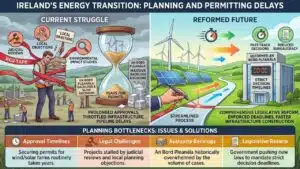
If you ask any energy developer what keeps them awake at night, they will point directly to the Irish planning system. Securing the legal permits to erect a wind turbine, build a solar farm, or run a high-voltage cable can take several grueling years. Projects routinely get bogged down in the court system due to local objections, complex environmental impact studies, or endless judicial reviews.
The national planning authority, An Bord Pleanála, has historically struggled with massive case backlogs and slow decision-making, throttling the pipeline of necessary infrastructure. The government is frantically trying to push through comprehensive planning reforms to slash red tape and enforce strict timelines on decisions. Without a dramatically faster, more streamlined legal process, developers simply won’t have enough time to actually construct the sites before the decade ends.
| Planning Bottlenecks | Core Issues & Solutions |
| Approval Timelines | Securing permits for wind/solar farms routinely takes years. |
| Legal Challenges | Projects stalled by judicial reviews and local planning objections. |
| Authority Backlogs | An Bord Pleanála historically overwhelmed by the volume of cases. |
| Legislative Reform | Government pushing new laws to mandate strict decision deadlines. |
13. Supply Chain Bottlenecks
Ireland doesn’t exist in a vacuum; it is competing against the rest of the planet for the exact same green technology. The entire European Union, North America, and Asia are all racing toward aggressive climate goals simultaneously. This creates a ruthless, cutthroat global market for raw materials and hardware. There is a severe global shortage of the massive, specialized installation vessels required to build offshore wind farms.
Furthermore, the prices of steel, copper, and the rare earth metals needed to manufacture solar panels and batteries are climbing steadily. These brutal supply chain constraints force project managers to constantly revise their budgets and delay construction schedules. To survive, the state and private developers are being forced to sign massive procurement contracts years in advance just to ensure the turbines actually arrive at Irish ports when needed.
| Supply Chain Risks | Global Market Pressures |
| Global Competition | Every major economy is buying the same green hardware simultaneously. |
| Vessel Shortages | Severe lack of specialized ships needed to build offshore turbines. |
| Material Costs | Rising prices for steel, copper, and rare earth metals for panels. |
| Procurement Strategy | Forcing developers to lock in massive contracts years in advance. |
14. Balancing Energy Demand from Data Centers
Ireland is a massive global hub for big tech, serving as the European home for some of the world’s largest digital corporations. These companies require enormous data centers to keep the internet running, and those buildings consume astonishing amounts of power for server processing and cooling systems. Currently, data centers consume roughly 20% of all the electricity generated in the country, and that figure is projected to rise sharply.
This creates a severe headache for grid operators: they essentially have to build massive new wind and solar farms just to feed the tech sector’s growth, making it incredibly difficult to clean up the power supply for ordinary homes. To combat this, regulators are implementing strict rules, forcing major tech companies to sign corporate power purchase agreements to fund their own green energy parks, ensuring they don’t drain the public grid.
| Data Center Impact | Energy Drain & Regulation |
| Energy Consumption | Tech sector uses roughly 20% of the entire national power supply. |
| Growth Trajectory | Power demand from server farms is rising faster than general public use. |
| Grid Strain | Forces operators to build extra green sites just to feed tech expansion. |
| Corporate Rules | Tech giants forced to fund their own renewable projects to offset use. |
Looking Ahead: The Final Stretch
The year 2030 is a critical milestone, but it is not the finish line. Planners, engineers, and politicians are already looking past the end of the decade to figure out how to completely eliminate fossil fuels from the island once and for all. Closing that final 20% gap requires moving beyond current tech and embracing the future.
15. What Happens After 2030?
Hitting the 80% mark will prove that a modern, industrialized nation can successfully run its economy primarily on the weather. But what happens on day one of 2031? The strategy immediately shifts toward tackling the final, most difficult 20% of the grid, aiming to retire the last of the natural gas backup plants. This post-2030 era will heavily rely on the commercial maturity of deep-water floating offshore wind, tapping into the limitless power of the outer Atlantic.
It will also see the massive scale-up of the green hydrogen economy, where clean gas is used to fuel heavy freight transport, cargo shipping, and massive industrial factories that batteries cannot run. The ultimate, legally binding goal is to reach a completely net-zero economy by 2050. If the country plays its cards right, it will transition from being highly vulnerable to imported fuels to becoming a wealthy, major exporter of clean electricity to the rest of Europe.
| Post-2030 Milestones | Future Tech & Ultimate Goals |
| Closing the 20% Gap | Retiring the final natural gas backup plants. |
| Deep Atlantic Wind | Commercial rollout of massive floating turbine arrays. |
| Hydrogen Economy | Using green gas to decarbonize heavy industry and freight. |
| Net-Zero by 2050 | Total climate neutrality and major energy exports to Europe. |
Final Thoughts
The aggressive push to hit the Ireland renewable energy target 2030 is arguably the most complex and critical national infrastructure project since the foundation of the state. You can visually see the massive scale of this ambition in the towering turbines rising off the eastern coast, the sprawling solar farms covering the southern fields, and the thousands of miles of heavy copper being buried underground. It is undoubtedly an expensive, messy, and politically difficult process. Roadblocks like a sluggish planning system, cutthroat global supply chains, and the ravenous power demands of the tech sector make the timeline incredibly tight.
However, the momentum pushing the country away from imported, dirty fossil fuels is completely unstoppable at this point. By finally harnessing the raw power of the Atlantic wind and totally overhauling how the grid operates, the nation is building a cleaner, cheaper, and fundamentally self-reliant future. The political choices made and the cables laid down over the next few years will dictate the country’s economic and environmental survival for the next century.
Frequently Asked Questions (FAQs) About Ireland Renewable Energy Target 2030
1. Why does the government use 2018 as the baseline for emission targets?
The year 2018 is used because it represents the last stable year before major European Union and national climate policies shifted drastically, and before the pandemic skewed energy usage data. It gives policymakers a clear, pre-intervention starting line to measure the strict 51% reduction required by 2030.
2. Are there any plans to build nuclear power plants to hit the target?
No. Irish law strictly prohibits the use of nuclear fission for generating electricity on domestic soil. The entire decarbonization strategy relies exclusively on wind, solar, hydro, and battery storage. While the country imports some nuclear-generated electricity via interconnectors from France and the UK, no plants will be built in Ireland.
3. What is the Renewable Electricity Support Scheme (RESS)?
RESS is a state-run auction program designed to financially de-risk green energy development. Developers bid to build projects, and the government guarantees a fixed minimum price for the electricity they generate over a set number of years. This ensures that banks will finance the massive upfront construction costs without fearing market crashes.
4. How do Large Energy Users (LEUs) fit into the future grid?
Large Energy Users, primarily big tech data centers and heavy pharmaceutical manufacturing plants, draw massive amounts of power. Under new national guidelines, the government is encouraging the creation of green energy parks where these LEUs must locate directly beside major wind or solar farms, stopping them from clogging up the older parts of the public grid.
5. Will floating offshore wind turbines be ready before the 2030 deadline?
While some small-scale pilot projects might deploy sooner, commercial-scale floating wind farms are widely considered a post-2030 technology. The immediate strategy relies on traditional, fixed-bottom turbines in the shallower waters of the Irish Sea to hit the crucial 5-gigawatt target by the end of the decade.