

Australia has completely rewritten the rulebook on how everyday people generate and consume power. When you walk down a suburban street in almost any state, you see dark blue and black panels covering the roofs of everyday homes. What started as an environmental initiative is now a pure financial decision for millions of households. People check their screens over 150 times a day to read emails or scroll social media, and increasingly, they use those same devices to monitor their real-time power generation apps.
If you want to understand how the national grid is changing, you need the right information about rooftop solar Australia right now. The market moves fast as government policies shift, battery technology improves, and the financial returns change year by year. This guide breaks down the exact reality of the market in 2026.
Global Leadership and Adoption Rates
We are seeing a massive decentralized power shift where neighborhoods generate vast amounts of electricity exactly where it gets used. This takes the pressure off old transmission lines and traditional power plants. Understanding how widely these panels are accepted gives you a clear picture of where the Australian solar industry is heading.
1: Australia Leads the World in Per Capita Uptake
No other country installs residential power systems at the rate Australians do across the board. When you look at the amount of capacity installed per person, the nation sits comfortably at the top of the global rankings, easily outpacing countries across Europe and North America. This happens because of a perfect storm of ideal environmental and economic conditions. You have an absolute abundance of sunshine combined with historically high retail electricity prices that make generating your own power incredibly tempting.
Strong early government incentives made initial adoption highly attractive, building a massive foundation of skilled local installers. Today, this global leadership means that other countries constantly look to the local market as a real-world testing ground for managing decentralized energy grids on a massive scale. As of early 2026, the sheer volume of panels pushing power into the local grid during daylight hours breaks new records almost every single month.
| Uptake Metric | Current 2026 Status |
| Global Position | Number one for per capita residential installations |
| Primary Drivers | High sunshine hours and expensive retail electricity |
| Market Maturity | Highly established local installer networks |
| Global Impact | Acts as a testing ground for decentralized grids |
2: Over 35% of Australian Homes Have Solar Panels
The volume of neighborhood installations across the country is staggering to witness firsthand. A confirmed source statistic shows that exactly 35% of all suitable residential dwellings across the country now have a system actively producing power. In specific sunny suburbs, especially across regional South Australia and Queensland, that localized percentage climbs much higher and often crosses the halfway mark. Having panels on your roof is no longer the exception for homeowners; it is rapidly becoming the absolute standard for property ownership.
Buyers looking for new homes increasingly expect energy-efficient features to be bolted onto the property from day one. Entire new housing developments are now constructed with panels pre-installed before the paint even dries on the walls. This deep market penetration forces energy retailers to completely rethink how they bill customers and manage their daily power distribution networks.
| Household Penetration | Data Point |
| National Average | 35% of suitable homes have active systems |
| Leading States | South Australia and Queensland |
| Real Estate Trend | Standard inclusion in new housing developments |
| Retailer Impact | Forces complete redesign of traditional billing |
3: System Sizes Have Dramatically Increased
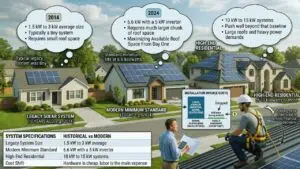
If you bought panels ten years ago, your typical system was tiny, usually around one or two kilowatts of maximum output. Today, the standard minimum size for a brand new residential installation sits at 6.6 kilowatts, which requires a much larger chunk of roof space. Many households with large roofs and heavy power demands push well beyond that baseline, installing massive residential systems of 10 kilowatts or more.
The manufacturing cost of the physical panels dropped so much over the last decade that the bulk of your invoice now covers labor, premium inverters, wiring, and scaffolding. Because the fixed costs of getting the crew to your house are high, installers almost always recommend maximizing your available roof space from day one. Adding an extra five panels during the initial build is cheap, whereas paying a crew to return three years later for an upgrade is a terrible financial decision.
| System Specifications | Historical vs Modern |
| Legacy System Size | 1.5 kW to 3 kW average |
| Modern Minimum Standard | 6.6 kW with a 5 kW inverter |
| High-End Residential | 10 kW to 15 kW systems |
| Cost Shift | Hardware is cheap, labor is the main expense |
The Financial Mechanics and Government Support
The math behind getting panels on your roof relies entirely on understanding government support and the current state policies. Federal mechanisms lower your upfront costs, while the rates energy companies pay you determine your ongoing daily savings.
4: The Rebate System Drops Upfront Costs
A massive reason for the ongoing installation boom is the financial support handed out by the federal government. The Small-scale Renewable Energy Scheme gives you an immediate upfront discount on the cost of buying and installing your hardware. Your installer calculates this specific discount based on the total size of your system and your geographic location zone, then instantly removes it from your final quote.
Without this straightforward mechanism, the barrier to entry would remain far too high for the average working family to afford. It works by generating technology certificates that the installer sells on your behalf, so you never have to deal with complicated tax returns to get your money. However, the value of this discount drops slightly on the first of January every single year, and the entire federal scheme is legally scheduled to vanish completely by 2030.
| Financial Incentive | Key Details |
| Scheme Name | Small-scale Renewable Energy Scheme (SRES) |
| How It Works | Point-of-sale discount applied by the installer |
| Calculation Method | Based on system size and geographic zone |
| Phase Out Schedule | Reduces yearly until ending completely in 2030 |
5: Feed-in Tariffs Are Dropping Rapidly
A decade ago, retail energy companies paid a massive premium to households that sent their excess electricity back into the grid. These high feed-in tariffs meant early adopters literally received checks in the mail rather than paying quarterly power bills. Today, that situation is completely reversed across the entire country. Because millions of homes flood the local grid with cheap electricity during the middle of the day, the wholesale value of that electricity drops to almost zero.
Retail companies slashed their feed-in tariffs accordingly to protect their own profits. The modern financial benefit of rooftop solar Australia has nothing to do with selling power back to the grid for a profit. Your primary goal is consuming the exact power you generate inside your own home so you can entirely avoid buying expensive retail electricity from the grid.
| Grid Export Value | Market Shift |
| Historical Tariffs | Extremely high, often over 40 cents per kWh |
| Current 2026 Tariffs | Very low, ranging between 2 and 5 cents per kWh |
| Wholesale Reality | Midday oversupply drops power value to zero |
| Strategy Shift | Exporting power is no longer profitable |
6: Payback Periods Average Three to Five Years
Even with retail feed-in tariffs hitting rock bottom, the actual return on your initial investment remains incredibly strong. For a standard household that takes the time to run heavy appliances smartly, a quality 6.6-kilowatt system usually pays for itself in under five years. Just as taking a warm shower 1-2 hours before bed drops your core temperature for optimal thermoregulation and deep sleep, timing your heavy power usage during peak midday sun ensures optimal financial health for your bank account.
You set your washing machine, dishwasher, and electric vehicle chargers to run automatically at noon when your roof is blasting out maximum free energy. Once that short payback period finishes, the electricity you generate and use during the day is essentially free for the remaining twenty-year lifespan of the hardware.
| Investment Math | Typical 6.6kW Scenario |
| Average Payback Time | 3 to 5 years depending on usage habits |
| Core Strategy | Shifting heavy appliance usage to midday |
| Lifespan Value | 15 to 20 years of free daytime electricity |
| Automation Benefit | Timers maximize savings without manual effort |
The Rise of Home Battery Storage
Because households get paid practically nothing for exporting power during the afternoon, they desperately need a way to save that power for the dark evening hours. Storing your own energy fundamentally changes your relationship with power companies.
7: Battery Storage is the Next Major Growth Area
Homeowners heavily research ways to capture their excess daytime generation to use at night when household energy rates hit their absolute peak. Installing a heavy lithium battery pack builds complete personal energy sovereignty, totally shielding your family from sudden retail price hikes and annoying local grid blackouts. The federal and state governments know this hardware fixes grid congestion, which is why massive new funding blocks push batteries into the mainstream right now.
With the latest hardware iterations offering ten-year warranties and massive cycle counts, buyers finally feel confident making the purchase. The industry is currently watching a massive surge in sales, and experts expect nearly all new panel installations will include a matched storage unit by the end of the decade as manufacturing prices slowly drop.
| Battery Storage | Market Reality |
| Primary Purpose | Capturing midday solar for evening consumption |
| Consumer Benefit | Energy sovereignty and blackout protection |
| Hardware Lifespan | Modern units feature 10-year reliable warranties |
| Market Projection | Standard inclusion for all new systems by 2030 |
8: Virtual Power Plants Are the Future
The next brilliant stage of the renewable energy Australia transition securely links thousands of individual home batteries together through cloud software. This digital network creates a Virtual Power Plant that acts exactly like a traditional spinning turbine generator. Retailers send you an invitation to join these programs with your new battery. When the national grid needs sudden emergency power to prevent a frequency collapse, the retailer instantly draws a tiny amount of electricity from all connected home batteries at the exact same split second.
You get compensated with ongoing monthly bill credits or a massive upfront discount on your initial battery purchase in exchange for giving them this access. This clever technology completely turns your quiet suburban house into an active, paid participant in the national electricity grid.
| Virtual Power Plants | How They Operate |
| Core Concept | Networking thousands of home batteries via cloud |
| Grid Function | Provides instant emergency power during shortages |
| Homeowner Reward | Monthly bill credits or upfront hardware discounts |
| System Control | Fully automated by the energy retailer |
Grid Impact and Market Challenges
Pushing millions of unpredictable small power generators onto an old grid originally built for large coal plants creates intense engineering friction. You need to understand these network challenges because they dictate the local rules for your installation.
9: The Grid Struggles with Daytime Oversupply
The absolute success of residential panels creates a massive daily headache for the national market operator. During mild sunny days in spring and autumn, base energy demand is incredibly low because nobody needs air conditioning, but solar generation hits its highest peak. The human body uses the glymphatic system to cleanly flush waste from the brain while you sleep, but the national energy grid has absolutely no automatic overnight clearing mechanism for excess daytime power.
The grid simply cannot swallow all the electricity being pushed into it. To stop neighborhood transformers from blowing up and causing localized blackouts, states now strictly require remote shut-off switches on all brand new inverters. This allows the local network operator to temporarily dial down your household exports until the emergency passes.
| Grid Oversupply | Technical Issues |
| Peak Threat Times | Mild, sunny days in Spring and Autumn |
| Infrastructure Issue | The grid cannot store or clear the excess power |
| Regulatory Solution | Mandatory remote shut-off capability on inverters |
| Consumer Impact | Temporary limits on your ability to export power |
10: Renters Face High Barriers to Entry
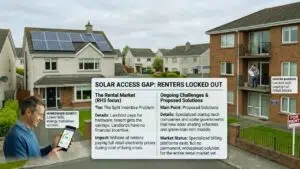
Homeowners happily reap the daily rewards of cheap electricity, but renters are almost entirely locked out of this national transition. Property landlords have absolutely no financial incentive to spend five thousand dollars installing panels when the renting tenant gets one hundred percent of the benefit through lower energy bills. This creates a deeply frustrating split incentive problem that leaves millions of renters paying full retail electricity prices during a cost of living crisis.
State governments and specialized startup tech companies constantly trial new solar sharing schemes and green-loan rent models to bridge the gap. While specialized billing platforms allow landlords to sell rooftop power to their tenants at a slight discount, a truly permanent, wide-scale fix for the rental market remains completely unsolved.
| The Rental Market | Ongoing Challenges |
| The Split Incentive | Landlord pays for hardware, tenant gets the savings |
| Tenant Penalty | Forced to pay full peak retail electricity rates |
| Proposed Solutions | Specialized landlord-tenant billing platforms |
| Market Status | No permanent, widespread solution exists yet |
Quality, Maintenance, and Property Value
Treating your heavy roof installation like a cheap throwaway commodity is a fast track to long-term financial loss. The hardware needs to survive decades of terrible weather to guarantee your financial returns.
11: Installations Increase Property Value
Extensive real estate data proves that highly energy-efficient homes sell much faster and command stronger market prices at auction. Smart property buyers know the daily cost of living keeps climbing, making a house that guarantees tiny electricity bills incredibly attractive. When an accredited local crew installs tier one panels professionally, the system functions as a major physical asset permanently attached to the property.
Real estate agents heavily feature large panel setups in their marketing brochures because it immediately signals low running costs to young families. However, a cheap twenty-year-old system with a broken inverter that is nearing the end of its life does not add any value, as the buyer knows they will have to pay a removal fee.
| Property Value | Real Estate Impact |
| Buyer Appeal | Massive drawcard for buyers facing high living costs |
| Marketing Value | Heavily featured in property listings and brochures |
| Asset Quality | High-end systems add direct dollar value to the home |
| Depreciation | Very old systems offer zero value to new buyers |
12: Quality Matters More Than Ever Before
The current market absolutely drowns in competing brands of glass panels and electronic inverters. Choosing the absolute cheapest quote you find on social media usually leads to terrifying safety headaches and broken promises. Extreme summer weather, heavy humidity, and coastal salt mist destroy low-quality plastics and thin wiring in a matter of years.
You should strictly demand proven Tier 1 manufactured panels and highly rated European or premium Asian inverters for your setup. A cheap, poorly sealed system that stops working after three years is a terrible financial move that wipes out your savings. A premium, slightly more expensive setup generates completely free power for decades without a single complaint or breakdown.
| Hardware Quality | Buying Rules |
| Panel Standards | Only accept Tier 1 recognized manufacturers |
| Inverter Selection | Stick to premium European or high-end Asian brands |
| Weather Threat | UV radiation and salt mist destroy cheap components |
| Long-term Math | Premium gear prevents expensive future replacements |
13: Maintenance is Minimal but Vital for Safety
Many people mistakenly think these massive electrical setups are completely set-and-forget appliances. While they definitely have no moving physical parts to lubricate, ignoring routine maintenance creates serious safety hazards on top of your house. Heavy dust, baked-on bird droppings, and wet leaves block the glass cells and severely drop your daily power generation.
More importantly, the plastic isolator boxes and electrical wiring sitting on your hot roof slowly degrade over time due to intense UV exposure. The national clean energy council strongly advises hiring a licensed solar electrician to inspect and test the wiring connections every three to five years to totally prevent roof fires and water ingress.
| System Maintenance | Safety Requirements |
| Cleaning Needs | Remove dust, leaves, and bird droppings annually |
| Electrical Degradation | UV exposure damages plastic isolators over time |
| Professional Inspection | Hire an electrician every 3 to 5 years for testing |
| Major Risk | Neglected wiring creates severe roof fire hazards |
How to Choose the Right System for Your Home?
Jumping into the market for rooftop solar Australia requires looking closely at your daily habits and electricity bills. Getting the basic sizing and hardware choices right on day one guarantees maximum financial returns over the next twenty years. You have to match the hardware output on the roof directly to the people living inside the house.
First, grab your last four quarterly electricity bills and look at the daily graphs. You need to know exactly how many kilowatt-hours you consume and exactly when you consume them. If you work from home and run the air conditioning all day, a massive panel setup with no battery perfectly covers your needs. If the house sits completely empty until five in the evening, you absolutely must look at installing a home battery or putting your water heater and dishwasher on strict midday timers.
Second, heavily verify your chosen installation company. You cannot claim any federal financial incentives unless your installer holds active, valid accreditation. Look for established, local businesses that have operated in your specific town for at least five years to ensure they will actually answer the phone if you have a warranty claim later.
Final Thoughts
The massive shift happening across the grid right now is one of the most incredible structural changes of our generation. Everyday households are entirely driving this change from the ground up. By leveraging smart new technology and government rebates, you take hard control of your household bills while cutting your personal emissions footprint.
Network export rules and state feed-in tariffs will absolutely keep shifting as the grid gets more crowded, but the core financial logic of making your own power remains incredibly solid. Take your time, buy premium hardware from locals, and track your daily usage. The future of rooftop solar Australia remains incredibly bright for any household willing to make the smart investment today.
Frequently Asked Questions (FAQs) About Rooftop Solar Australia
1. What happens to the Australian battery rebate in May 2026?
The Cheaper Home Batteries Program switches to a strict tiered structure in May 2026. You get a full 100 percent factor rebate for your first 14 kilowatt-hours of capacity, 60 percent for the next 14 kilowatt-hours, and it scales down from there. The actual dollar value of the rebate also drops every six months, meaning families who install early secure a much better financial discount.
2. Can my energy company legally turn off my home solar panels?
Yes, in several states, new local regulations require your system inverter to feature a remote shut-off capability. If the local grid gets totally overwhelmed with excess daytime power on a mild, sunny afternoon, the local network operator can temporarily pause your system from exporting power to prevent entire suburban blocks from experiencing blackouts.
3. Do I really need a home battery right now?
A battery is not strictly mandatory to save money, but current 2026 pricing and rebates make it the smartest move available. Because feed-in tariffs pay almost nothing, exporting your power is practically useless. A battery captures your midday sun so you can run your heavy oven, lights, and television at night without paying massive peak retail rates to your provider.
4. How do Virtual Power Plants actually work?
You sign a digital agreement with your retail energy provider allowing them temporary remote access to your home battery. During severe local grid shortages, they discharge a tiny amount of power from thousands of customer batteries at the exact same time. You get compensated with ongoing monthly bill credits or a massive upfront cash discount on your hardware purchase.
5. What happens if my solar installer goes out of business?
This remains a major issue across the local industry. If the sales company that sold you the system shuts down, your workmanship installation warranty vanishes entirely. However, your actual hardware warranties for the physical panels and the inverter remain with the global manufacturer. You can hire a brand new local electrician to process a warranty claim directly with the hardware manufacturer on your behalf.






















