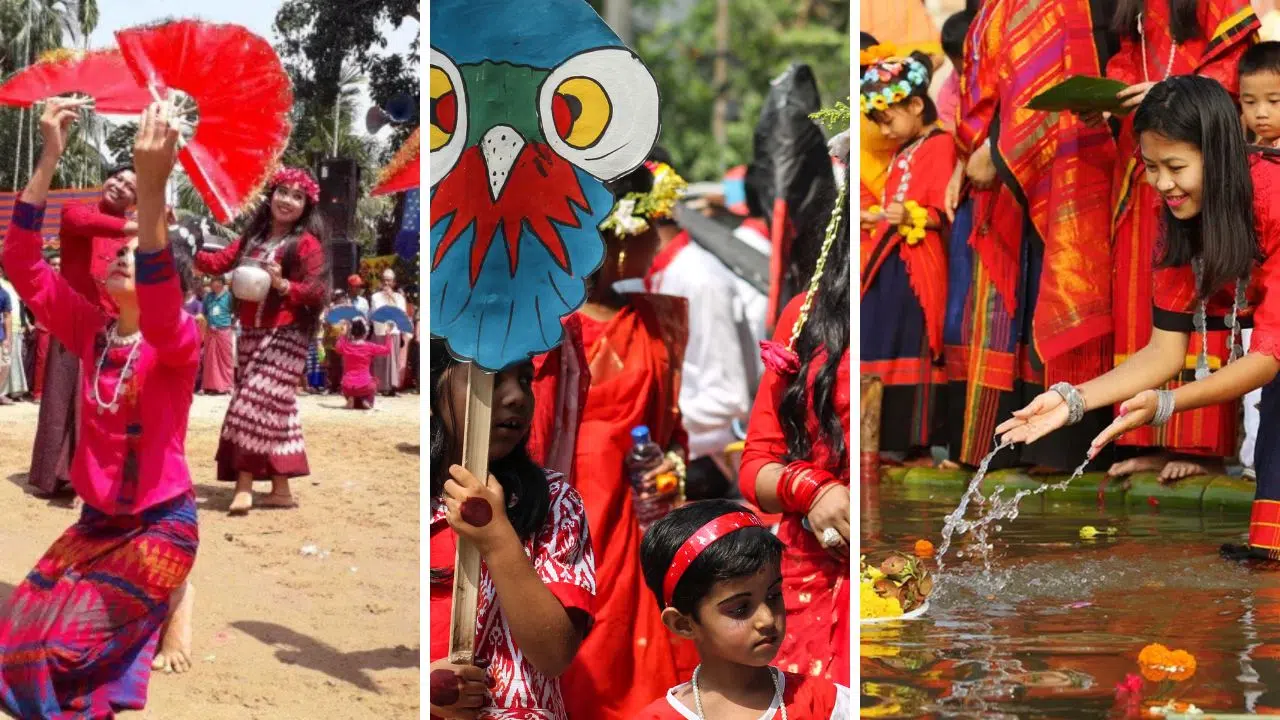
Every year, sometime around the middle of April, something quietly extraordinary happens across Bangladesh and the Indian state of West Bengal. Millions of people — Bengali, Chakma, Marma, Tripura, and more — step outside into the warm spring air and say goodbye to the old year. They clean their homes, put on new clothes, gather with family, and welcome what comes next.
They are all celebrating the same moment. But they are not all celebrating it the same way.
This is the story of one new year told through many voices. It is a story about how different communities — shaped by their own histories, beliefs, and landscapes — have each found a way to mark the same turning of the calendar with something uniquely their own.
Who Celebrates the Bengali New Year When in 2026
| Festival | Community | Date(s) |
|---|---|---|
| Pohela Boishakh | Bengali (Bangladesh) | April 14, 2026 |
| Pohela Boishakh / Noboborsho | Bengali (West Bengal, India) | April 15, 2026 |
| Phul Biju | Chakma (CHT, Bangladesh) | April 12, 2026 |
| Mul Biju | Chakma (CHT, Bangladesh) | April 13, 2026 |
| Gojjepojje | Chakma (CHT, Bangladesh) | April 14, 2026 |
| Sangrai | Marma (CHT, Bangladesh) | April 12–14, 2026 |
| Boisuk / Baisu | Tripura (CHT, Bangladesh) | April 12–14, 2026 |
| Chankran | Mro (CHT, Bangladesh) | April 13–14, 2026 |
| Bishu | Tanchangya (CHT, Bangladesh) | April 12–14, 2026 |
Note: The Mesha Sankranti moment — when the sun enters Aries — occurs at 9:39 AM on April 14, 2026. Bangladesh marks this as New Year's Day directly; West Bengal observes the following sunrise (April 15) per traditional astronomical convention.
The Bengali Calendar Behind Pohela Boishakh 2026
Before we talk about the festivals, it helps to understand the calendar behind them.
The Bengali calendar, known as the Bangabda, is a solar calendar tied to the movement of the sun. The new year begins when the sun enters the zodiac sign of Aries — an astronomical moment called Mesha Sankranti. This typically happens around April 14 or 15 each year.
The calendar’s origins are layered and genuinely contested. One widely cited account credits Mughal Emperor Akbar, whose royal astronomer Fathullah Shirazi introduced a revised calendar in 1584 CE — using 1556 (the year of Akbar’s coronation) as its base year — to align tax collection with the agricultural harvest cycle in Bengal. However, many historians push back on this account. Inscriptions carved into two ancient Shiva temples in Bengal carry clear references to the Bangabda that predate Akbar’s era by centuries.
King Shashanka of ancient Bengal, who came to power around 594 CE, is credited by a number of scholars as the true originator of the Bengali calendar. Nobel laureate Amartya Sen has noted that while traces of Akbar’s Tarikh-e-Ilahi survive in the modern Bengali calendar, the calendar itself predates the Mughals. The honest answer is: no one knows for certain. What is clear is that the calendar was shaped by many hands across many centuries.
What is clear is that over centuries, this calendar became something far more than a tool for collecting taxes. It became the backbone of Bengali cultural identity — and the foundation for several of South Asia’s most vibrant New Year celebrations.
Pohela Boishakh 2026: The Bengali New Year in Bangladesh and India
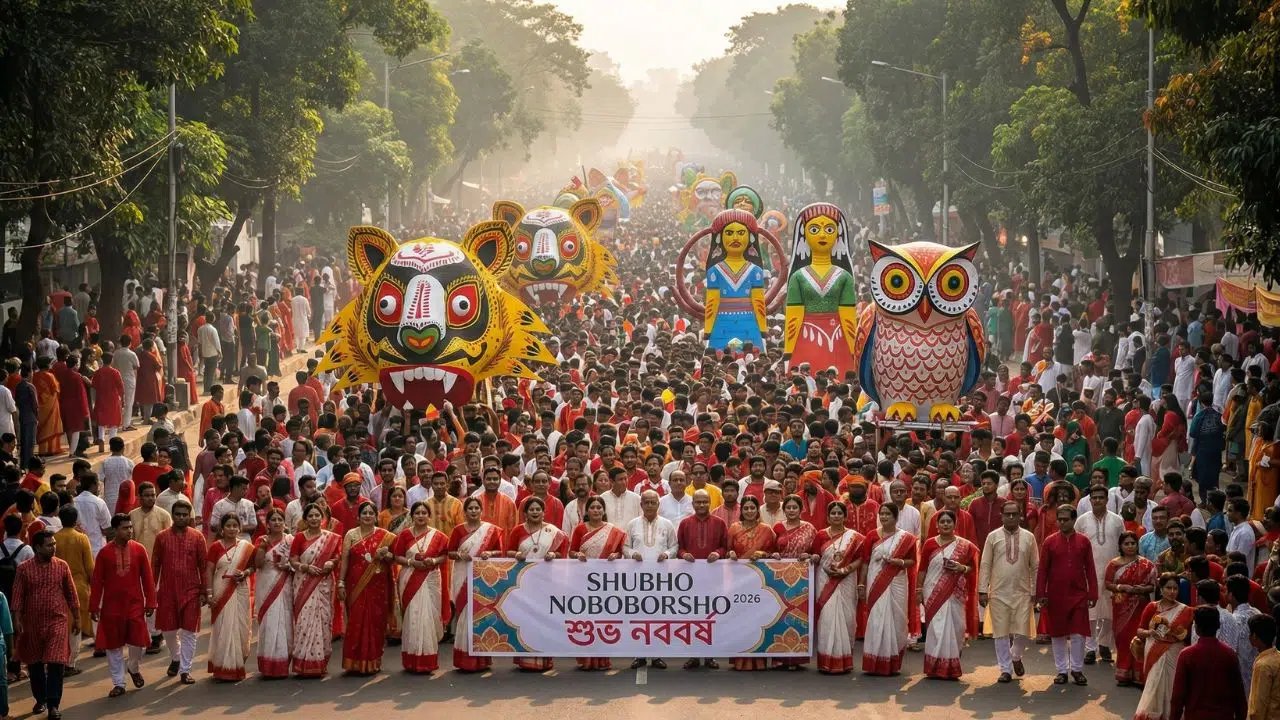
In Bangladesh, Pohela Boishakh 2026 falls on Tuesday, April 14 — a national public holiday. In West Bengal, India, the celebration falls on Wednesday, April 15 (due to a difference in how the two regions calculate the Sankranti moment — Bangladesh follows a fixed reformed calendar, while West Bengal uses traditional astronomical calculations). The Mesha Sankranti moment itself — when the sun enters Aries — occurs at 9:39 AM on April 14, 2026. Since this falls after sunrise, West Bengal observes the new year on the following sunrise, hence April 15.
Pohela Boishakh — pohela meaning “first” and Boishakh being the first month of the Bengali year — is the most widely celebrated secular festival in Bengali culture. What makes it truly remarkable is who celebrates it. Hindus, Muslims, Buddhists, and Christians all participate. It belongs to no single religion. It belongs to everyone who calls themselves Bengali.
How the Day Unfolds
The celebrations begin before sunrise. In Dhaka, Bangladesh, thousands gather at Ramna Batamul — a large open ground shaded by a massive banyan tree — where the cultural organization Chhayanaut leads the crowd in singing Rabindranath Tagore’s iconic song, “Esho He Boishakh” (Come, O Boishakh). The melody rises into the morning sky as the first light breaks. There is something deeply moving about standing in a crowd of thousands, all singing together in the dark, waiting for a new year to arrive.
As the sun comes up, the city comes alive. Women dress in white sarees with red borders, adorned with flower crowns. Men wear white panjabis. Red and white are the colors of the day — colors that speak of purity, energy, and a fresh start.
Later in the morning, the grand New Year procession takes over the streets. Organized by the Faculty of Fine Arts at the University of Dhaka, it features enormous paper-mâché masks, giant effigies of animals, and bold artwork that reflects themes of courage and resistance to evil. Originally launched in 1989 as Ananda Shobhajatra during the anti-authoritarian movement of that era, it was renamed Mangal Shobhajatra in 1996 after democracy was restored.
In 2016, UNESCO inscribed Mangal Shobhajatra on its list of Intangible Cultural Heritage of Humanity — a recognition that what happens on the streets of Dhaka on Pohela Boishakh is not just a local tradition. It is a piece of world heritage. In 2025, Dhaka University’s Faculty of Fine Arts renamed the procession once more to Barshabaran Ananda Shobhajatra, returning to the spirit of its original title — though its UNESCO-recognized legacy and its soul remain entirely unchanged.
Throughout the day, fairs called Boishakhi Mela spring up across the country. There is folk music, crafts, street food, and the sound of drums. Families visit each other. Merchants open new account books in a tradition called Halkhata, offering sweets to customers as they start fresh financial records for the new year.
And of course, there is food. Breakfast might be panta ilish — fermented rice soaked in water, eaten with fried hilsa fish, dried fish, pickles, and green chillies. It is a meal that connects city people to their rural roots, a humble dish turned into a symbol of identity.
Bengali New Year 2026 in West Bengal, India
Across the border in West Bengal, the celebration shares many of the same traditions but carries its own distinct flavor. The month of Boishakh is considered an auspicious time for weddings. Cultural programs fill theaters like Rabindra Sadan and Nandan. At Jorasanko Thakurbari — the ancestral home of Rabindranath Tagore in Kolkata — dawn breaks to the sound of community singing.
Perhaps nowhere is Pohela Boishakh celebrated more beautifully in India than at Visva-Bharati University in Shantiniketan. Here, students dressed in saffron and white perform an open-air sunrise ceremony — a tradition that Tagore himself began. The surrounding trees, the early morning light, and the music create an atmosphere that feels almost timeless.
In both countries, the greeting of the day is the same: “Shubho Noboborsho” — Happy New Year.
Boisabi Festival Bangladesh: Where Three Indigenous New Years Become One
Now travel south and east, into the green hills of the Chittagong Hill Tracts (CHT) in southeastern Bangladesh — a region of forested mountains, winding rivers, and extraordinary cultural diversity.
Here, three indigenous communities celebrate their own New Years around the same time as Pohela Boishakh. Their festivals are different in name, ritual, and tradition. But in recent decades, they have begun to celebrate together — and that shared celebration has a name of its own: Boisabi.
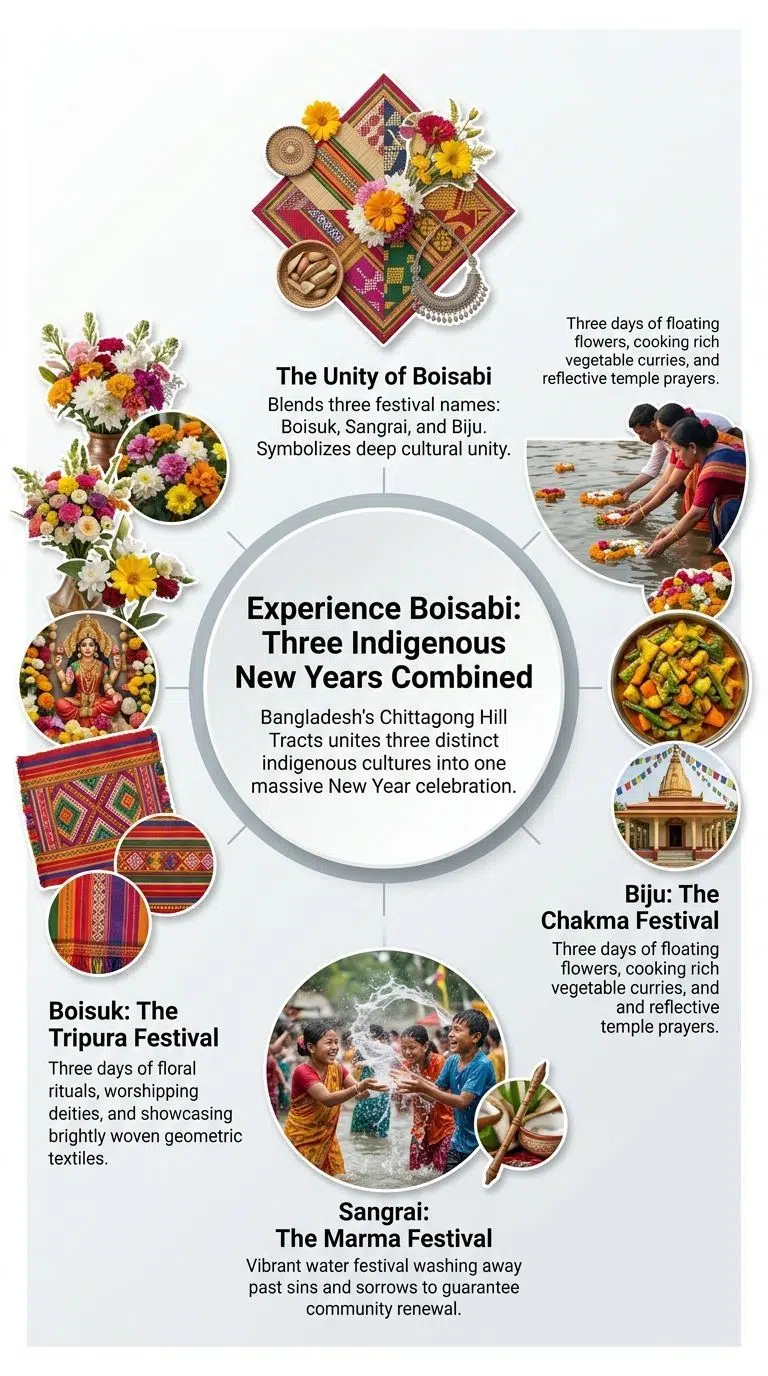
The word “Boisabi” is not a translation. It is a combination — Boi from Boisuk (Tripura), Sa from Sangrai (Marma), and Bi from Biju (Chakma). It is, quite literally, a word built out of unity.
Boisabi is celebrated from Sunday, April 12 to Tuesday, April 14, 2026 — spanning the last two days of Chaitra (the final month of the Bengali year) and the first day of Boishakh. Each community brings something distinct to the celebration.
Biju: The Festival of the Chakma People
The Chakma are the largest indigenous community in the Chittagong Hill Tracts, concentrated mainly in Rangamati. Their New Year celebration is called Biju, and it unfolds over three meaningful days.
Day One — Phul Biju (Flower Biju): This is the last day but one of the outgoing year. Before sunrise, young girls go to rivers, canals, and springs and float flowers on the water. It is a quiet, beautiful act — an offering to the natural world, a prayer for blessings as the year closes. Homes are cleaned thoroughly and decorated with flowers. The message is simple: clear out the old, make space for the new.
Day Two — Mul Biju (Main Biju): This is the last day of the year — the most festive of the three. Families cook large quantities of a traditional dish called pajon, a rich mixed vegetable curry made with dozens of different ingredients. The more ingredients, the better the flavor — and the more auspicious the new year. Neighbors share food with each other. Elders are visited and given gifts. There is singing, dancing, and traditional games.
Day Three — Gojjepojje (New Year’s Day): The first morning of the new year is observed with prayer at the local pagoda (Buddhist temple). People wear new clothes. The atmosphere is calm and reflective — a deliberate contrast to the exuberance of the day before.
What strikes you about Biju is how intentional it is. Each day has a purpose. Cleansing. Celebrating. Reflecting. It is a New Year that asks you to slow down and be present.
Sangrai: The Festival of the Marma People
The Marma community, found largely in Bandarban and Cox’s Bazar, are followers of Buddhism. Their New Year celebration is called Sangrai, and it shares deep roots with similar festivals across Southeast Asia.
In Thailand, it is Songkran. In Myanmar, it is Thingyan. In Cambodia, it is Chaul Chnam Thmey. All of them share one unforgettable tradition: the water festival.
During Sangrai, young Marma men and women drench each other with water — from buckets, from water guns, from cups. It sounds simple. But there is real meaning behind it. Water washes away the sins and sorrows of the past year. Every splash is a small act of cleansing and renewal. The laughter that comes with it is the sound of a community releasing the weight of the year gone by.
At Puraton Rajar Math in Bandarban, Marma and Rakhaine communities gather every year for the water festival, drawing crowds of locals and visitors alike. The event stretches over several days, with traditional dances, music, and rituals adding depth to the celebration.
The Rakhaine people, who have cultural and linguistic ties to the Marma and trace their roots to Arakan in Myanmar, celebrate a similar festival called Jolkeli — also centered on water play. The similarities between these communities reflect centuries of shared history along the rivers and hills of southeastern Bangladesh.
Boisuk: The Festival of the Tripura People
The Tripura community (also called Tripuri) in the Chittagong Hill Tracts celebrate their New Year through a festival called Boisuk (sometimes spelled Baisu). While smaller in international profile than Biju or Sangrai, Boisuk is rich in its own layered traditions.
The festival spans three days, each with its own name and character:
Hari Baisu — The first day, marked by visiting the elderly and collecting flowers and leaves that will be used in rituals.
Boisuma — The middle day, the most celebratory. Traditional music, dance, and communal feasting take center stage. The Garia deity is worshipped for prosperity and health.
Baisu Katal — The final day, which marks the official start of the new year. It is a time for prayer, reflection, and setting intentions for the months ahead.
Traditional Tripuri clothing — brightly woven fabrics with geometric patterns — gives the celebrations their distinctive visual identity. The weavings are among the finest textile traditions in all of Bangladesh.
Beyond the Big Three: Other Voices of the Hill Tracts
The Chakma, Marma, and Tripura are the three communities most associated with Boisabi, but they are not the only ones celebrating.
The Mro people call their New Year Chankran, named after a wild flower — the Changkran — that blooms in the forests of the CHT in mid-April. For the Mro who follow the Krama religion, this flower is a sacred herald of the new year. Traditional cakes made from binni (glutinous) rice are prepared, and the forest itself becomes part of the ceremony.
The Tanchangya people celebrate Bishu, which shares many elements with Biju but carries distinct Tanchangya songs, dances, and rituals. For Tanchangya young people living away from home for education or work, Bishu is a powerful anchor to their roots.
Each of these communities adds another thread to the tapestry of mid-April celebrations across Bangladesh.
It is worth pausing to note just how many people across Asia mark a new year in mid-April.
In Tamil Nadu, it is Puthandu. In Kerala, it is Vishu. In Assam, it is Bihu — a celebration so vibrant it has gained national recognition across India. In Manipur, it is Cheiraoba. In Nepal, it is the start of the Nepali New Year. In Sri Lanka and Myanmar, it is the Sinhala and Tamil New Year and Thingyan respectively. In Thailand, it is Songkran. In Cambodia, it is Chaul Chnam Thmey. In Laos, it is Boun Pi Mai.
All of these fall in the same window: the sun entering Aries, the end of the harvest season, the cusp of a new agricultural cycle. Long before clocks and digital calendars, human beings across Asia looked at the same sky, felt the same change in the air, and decided: this is when the year begins.
Pohela Boishakh, Biju, Sangrai, Boisuk — they are all local expressions of a deeply ancient, continent-wide impulse to mark time and celebrate renewal.
What Makes These Festivals Different and What Unites Them
If you set these celebrations side by side, the differences are real and worth honoring.
Pohela Boishakh is a secular, nationalistic festival — deeply tied to Bengali language and identity, expressed through art, music, and the shared public spaces of cities and towns. It is, at its heart, a celebration of being Bengali.
Biju is intimate and family-centered, shaped by Buddhist philosophy and Chakma community values. It moves from the personal (floating flowers at dawn) to the communal (sharing food with neighbors) to the spiritual (prayer at the pagoda).
Sangrai is joyful and expressive, rooted in Theravada Buddhist tradition and connected to a wider Southeast Asian cultural sphere. Its water festival is one of the most viscerally fun expressions of New Year celebration anywhere in the world.
Boisuk is quieter and more ritual-focused, drawing on animist and Hindu-Buddhist traditions specific to the Tripura people. It weaves together prayer, community, and craft in a way that is distinctly its own.
And yet — stand back and look at all of them at once, and what you see is one story told in many languages.
Every one of these celebrations involves cleaning the home and the self. Every one involves new clothes as a symbol of a fresh start. Every one involves food shared with others. Every one involves some form of prayer or gratitude — whether to the river, to the deity, to the sun, or to the community itself. Every one asks: what do you want to carry forward, and what are you willing to leave behind?
Pohela Boishakh 2026: A Living, Evolving Tradition
The communities that celebrate these festivals are not frozen in the past. They are living, changing, and adapting.
In Dhaka, Pohela Boishakh has grown into a massive urban event, with commercial fairs, social media countdowns, and fashion brands releasing special Boishakh collections. Critics sometimes worry that the festival is losing its rural roots in the glitter of city celebration. Others argue that change is simply what living traditions do — they grow with the people who practice them.
The recent renaming of the iconic New Year procession from Mangal Shobhajatra to Barshabaran Ananda Shobhajatra sparked passionate national debate in 2025 — a reminder that these festivals are not museum pieces. They are living conversations about identity, politics, and belonging.
In the Chittagong Hill Tracts, young people who have moved to Dhaka or abroad for education and work find creative ways to celebrate Biju and Sangrai far from home. Campus celebrations, community gatherings, and social media keep the traditions alive across distance.
What endures, in every case, is the meaning underneath the rituals. The desire to start fresh. The need to connect with people you love. The quiet hope that the year ahead will be kinder than the one before.
Final Thought
There is a beautiful kind of wisdom in the fact that so many different communities, with different languages, different beliefs, and different histories, have all independently arrived at the same conclusion: the middle of April is a good time to pause, to reflect, and to begin again.
They did not need to agree on the details. They did not need the same food, the same music, or the same prayers. What they needed — what we all need — was a moment set apart from ordinary time. A threshold to cross. A door to walk through.
Pohela Boishakh, Biju, Sangrai, Boisuk — these are all different doors. But they all open onto the same thing: a new year, full of possibility, waiting to be lived.
Shubho Noboborsho. Happy New Year.