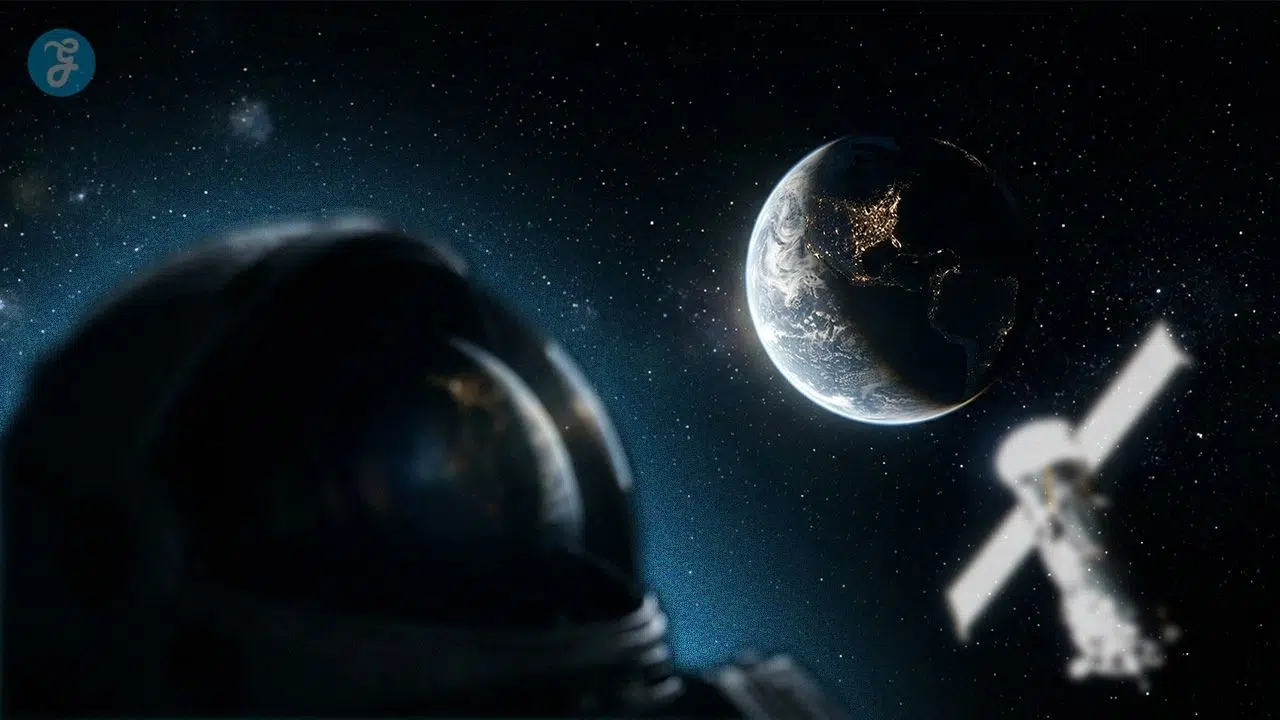
The Artemis II Earthset photograph captured by the crew of the Orion spacecraft is a defining image of our generation. Captured on April 6, 2026, as the capsule swung around the lunar far side, this stunning visual arrives at a moment when humanity feels more fragmented than ever. We are living through an era defined by intense geopolitical friction, resource competition, and ideological divides. Yet, looking at that fragile blue crescent setting behind the desolate, crater-pocked lunar horizon, the rigid boundaries we fight over vanish into the cosmic dark.
The image offers a profound contrast to our terrestrial struggles. It forces a necessary pause, demanding that we reevaluate our priorities on a planet that appears so incredibly small and vulnerable against the vastness of deep space.
The Mission Parameters of The Artemis II Earthset
Before we can truly appreciate the philosophical weight of this historic photograph, we must first ground ourselves in the monumental technological achievements that made it possible. The mission parameters highlight exactly what it took to put human eyes back in a position to witness such a spectacle. Here is a comprehensive overview of the key mission details that led to this defining moment.
| Mission Parameter | Factual Details |
| Launch Date | April 1, 2026 |
| Spacecraft | NASA Orion Capsule |
| Earthset Capture Date | April 6, 2026 |
| Photographic Equipment | Nikon D5 DSLR camera with an 80-400mm lens |
| Crew Members | Commander Reid Wiseman, Pilot Victor Glover, Mission Specialist Christina Koch, Mission Specialist Jeremy Hansen |
| Lunar Proximity | 4,067 miles above the lunar surface during closest approach |
| Maximum Distance from Earth | 252,756 miles |
| Splashdown Date | April 10, 2026, in the Pacific Ocean off the coast of San Diego |
With these concrete facts established, we can begin to unpack the layers of meaning embedded within this single frame of our home planet. The context of the image is just as important as the pixels themselves, especially when viewed through the lens of our current global climate.
Analyzing the Artemis II Earthset For a Fractured World
This photograph does not exist in a vacuum. It was transmitted back to a world grappling with intense regional conflicts, economic rivalries, and environmental anxieties. By examining the stark realities of deep space exploration alongside our terrestrial challenges, we can find a powerful narrative of unity.
The Technical Reality of the Lunar Far Side
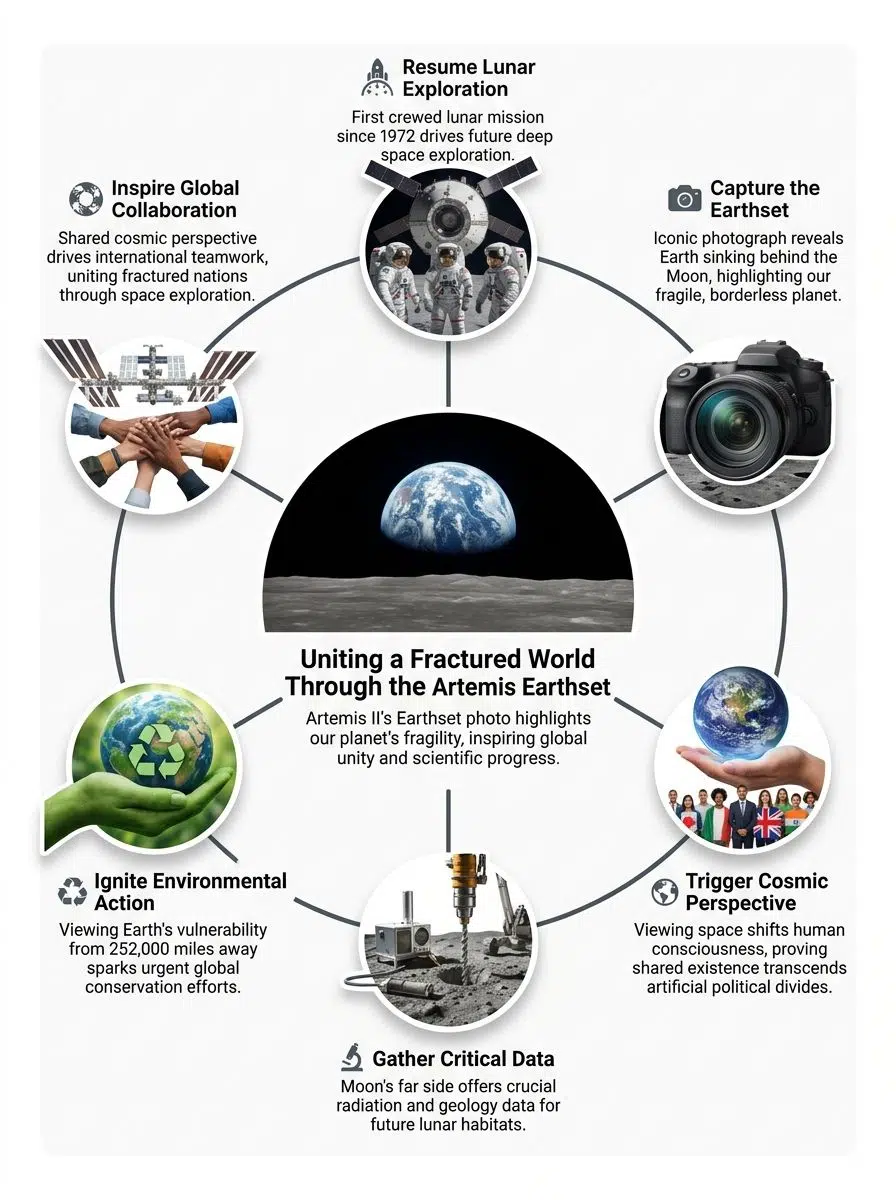
The sheer difficulty of capturing this image is a testament to human ingenuity. For the first time since December 1972, humans traveled beyond low Earth orbit, crossing the void to reach the Moon. Commander Reid Wiseman, Pilot Victor Glover, Mission Specialist Christina Koch, and Canadian Space Agency astronaut Jeremy Hansen ventured farther from Earth than any human beings in history, surpassing the distance record set by the Apollo 13 crew in 1970.
The photograph was taken during a highly critical phase of the mission. As the Orion spacecraft swung around the lunar far side, the crew prepared for a planned 40-minute communications blackout. In those final moments of contact with Earth, the astronauts looked out the window and saw our vibrant planet slipping behind the terraced edges of the lunar Ohm crater.
Rather than relying on automated satellite feeds or robotic sensors, Commander Wiseman used a standard Nikon D5 camera to capture the moment. This makes the photograph a deeply human artifact. It is not just a collection of sensor data, but a record of what a human eye witnessed from a quarter of a million miles away. The swirling clouds over Oceania and the deep blue hues of the Pacific Ocean stand in absolute contrast to the gray, lifeless dust of the lunar surface.
The technical precision required to put those astronauts in that specific location at that specific time highlights what we can achieve through focused, collaborative scientific endeavor. It sets a high benchmark for what humanity is capable of when we align our vast technical resources toward discovery rather than destruction.
This staggering technical achievement highlights the absurdity of how we often apply our technological advancements back on Earth. While we can send humans to the far side of the Moon, we continue to use our most advanced systems to enforce borders and wage wars.
A Stark Contrast to Middle Eastern Defense Doctrines
When you look at the smooth, uninterrupted curve of the Earth in the photograph, the absence of borders is striking. From that distance, there are no lines drawn in the sand, no fortified walls, and no territorial disputes. This visual reality stands in fierce opposition to the complex and often rigid defense doctrines currently dominating the Middle East.
For decades, the region has been defined by complex alliances, proxy conflicts, and heavily militarized borders. Nations invest billions of dollars into advanced missile defense systems, drone warfare capabilities, and strategic deterrence frameworks to protect lines on a map that are entirely invisible from space.
The contrast is both sobering and disheartening. On one hand, we have the cooperative triumph of the Artemis II mission, and on the other, we have deeply entrenched terrestrial conflicts fueled by historical grievances and territorial anxiety. The shifting defense strategies in the Middle East, characterized by rapid militarization and precarious peace agreements, represent a massive expenditure of human capital and resources.
These are resources that could otherwise be directed toward global challenges like climate mitigation, poverty alleviation, or further scientific exploration. The photograph serves as a silent critique of our geopolitical priorities.
It reminds us that the security we seek through armed deterrence is ultimately fragile when viewed against the backdrop of our isolated, singular home. If we can navigate the lethal radiation and freezing vacuum of deep space to safely return four astronauts to the Pacific Ocean, we surely possess the intellectual capacity to navigate regional diplomacy.
The geopolitical friction extends far beyond regional defense strategies. The image also forces us to confront the global economic rivalries that threaten to destabilize our collective future.
Rethinking the US-China Energy Competition
Our planet, hanging alone in the dark, is a closed system with finite resources. This inescapable reality makes the escalating energy competition between the United States and China seem incredibly short-sighted. We are currently embroiled in what many analysts call the Green Tech Cold War.
Both superpowers are racing to secure dominance over critical mineral supply chains, advanced battery manufacturing, and next-generation renewable energy technologies. While the transition to green energy is essential for our survival, the zero-sum approach to this transition risks creating new geopolitical fault lines.
The Artemis II Earthset photograph provides a vital perspective check. The swirling atmosphere visible in the image does not recognize economic spheres of influence. Carbon emissions and climate patterns flow freely across the globe, affecting every nation regardless of its economic output or technological prowess.
When we view Earth as a solitary oasis, the idea of hoarding resources or monopolizing green technology for nationalistic gain appears fundamentally flawed. We are all passengers on the same fragile spacecraft. A failure in our global climate system will not spare the victor of the Green Tech Cold War.
To secure a sustainable future, we must move away from aggressive economic competition and embrace cooperative energy policies. The technological innovations required to combat climate change should be shared globally, not weaponized for strategic advantage. The photograph demands a shift in our economic paradigms, urging us to view planetary resources as a shared inheritance rather than a prize to be won.
This necessary shift in perspective is not just a matter of policy. It requires a profound psychological awakening on a global scale, mirroring the experience of the astronauts themselves.
The Modern Overview Effect and Collective Identity
In 1968, the Apollo 8 astronauts captured the iconic Earthrise photograph, which dramatically altered human consciousness. It showed us the beauty and fragility of our planet, helping to catalyze the modern environmental movement. Today, the Artemis II crew has delivered a modern equivalent, and its potential impact on our collective identity is immense.
Astronauts who view the Earth from space frequently report experiencing the Overview Effect. This is a cognitive shift characterized by a profound feeling of awe, a deep understanding of the interconnectedness of all life, and a renewed sense of responsibility for taking care of the environment.
We desperately need a massive, global dose of the Overview Effect. In our highly digitized, hyper-connected modern society, we are paradoxically more isolated and polarized than ever before. We curate our news feeds to reinforce our existing biases, retreating into ideological echo chambers that amplify our differences.
The photograph of our world setting behind the Moon cuts through this digital noise. It provides a unifying, undeniable truth. We all share the same origin, the same atmosphere, and the same ultimate fate.
The digital age, for all its faults, also provides the mechanism for this image to spark a rapid, global conversation. Unlike in 1968, the Earthset photograph was instantly beamed to billions of smartphones, tablets, and computers across the globe. It has the power to serve as a visual anchor for a new, collective identity. By internalizing the reality presented in the image, we can begin to dismantle the psychological barriers that prevent us from cooperating on a global scale.
The challenge now is to translate this moment of awe into sustained, collaborative action. Space exploration itself provides the blueprint for how we might achieve this.
Deep Space Exploration as a Blueprint for Unity
The success of the Artemis program is not merely a triumph of American engineering. It is a powerful demonstration of international cooperation. NASA did not return to the Moon alone. The inclusion of Canadian Space Agency astronaut Jeremy Hansen on the crew highlights the collaborative nature of modern space exploration.
The European Space Agency provided the European Service Module, a critical component that powered and propelled the Orion spacecraft throughout its 10-day journey. This mission proves that our most ambitious goals are best achieved when nations pool their resources, expertise, and vision.
This collaborative model must be applied to our terrestrial challenges. The international partnerships forged for deep space exploration require a foundation of trust, transparency, and shared risk. If we can negotiate complex international agreements to build space stations and explore the lunar surface, we can certainly apply those same diplomatic skills to address climate change, pandemic preparedness, and global economic inequality.
The International Space Station has long served as a shining example of adversaries working together in orbit. The Artemis Accords aim to extend that peaceful cooperation to the Moon and beyond.
We must bring that spirit of cooperative exploration back down to Earth. The skills we develop to survive in the hostile environment of space are the exact skills we need to thrive on our home planet. We need rigorous science, clear communication, mutual reliance, and an unwavering commitment to the common good.
How Artemis II Earthset Compares to the Iconic Apollo 8 Earthrise Image
Fifty-eight years separate two photographs that completely changed our perspective. Yet, both capture the exact same truth about our fragile home.

| Aspect | Apollo 8 Earthrise (1968) | Artemis II Earthset (2026) |
|---|---|---|
| Perspective Shift | Earth rises above the lunar horizon, revealing a bright jewel against the dark. | Earth is descending behind the Moon, offering a fresh mirror of that same view. |
| Historical Context | First crewed lunar mission. It sparked the global environmental movement. | First crewed lunar flyby in decades. It reignites that message for our current era. |
| Visual Impact | Challenged human perspective on scale and our place in the universe. | Highlights our borderless nature and the shared fragility of our ecosystems. |
| Psychological Effect | Triggered a profound emotional response about our shared human existence. | Counteracts social divides by showing visual proof of our unity. |
Both images work as mirrors reflecting humanity back to itself. The cosmos cares absolutely nothing for our imaginary lines.
The Artemis II ‘Earthset’: A Reminder of Earth’s Fragility
Astronauts who travel this far experience a psychological shift called the Overview Effect. Seeing the planet from space permanently changes the astronaut experience.
NASA astronaut Christina Koch experienced this directly during the Artemis II flight. She noted how clearly you can see the thin layer of gas keeping us alive.
“You see the thin blue line of the atmosphere… you don’t see borders, you don’t see religious lines, you don’t see political boundaries. All you see is Earth and you see that we are way more alike than we are different.”
That quote gives the chills. This incredible piece of celestial photography cuts through the noise of daily arguments. It highlights the hard truth that we all depend on the exact same oceans and land.
Finally: A Lingering Reflection on Our Singular Home
The historic mission of April 2026 has given humanity a priceless gift. The photograph brought back by Reid Wiseman, Victor Glover, Christina Koch, and Jeremy Hansen is a stark reminder of our true place in the universe. We are not a collection of rival nations competing for dominance on an endless landscape.
We are the fragile custodians of a tiny, breathtakingly beautiful sphere suspended in an infinite void. The challenges we face, from regional defense doctrines to global energy transitions, are entirely of our own making. They are solvable if we choose to adopt the perspective offered by the men and women who have looked back at us from the far side of the Moon.
The Artemis II Earthset is not just a picture of where we live. It is a profound, urgent mandate for how we must learn to live together.