
Deciding between the Subclass 189 and Subclass 190 is the most significant fork in the road for skilled professionals eyeing Australian permanent residency in 2026. As the Department of Home Affairs continues to refine its “Tiered Priority” system, the distinction between being “independent” and “nominated” has shifted from a matter of preference to a matter of mathematical survival.
How We Selected Our 6 Best Australia Skilled Independent Visa 189 vs 190 Facts
To curate this list, we analysed the 2025–26 permanent migration planning levels, which remain set at 185,000 places, alongside the latest quarterly invitation data from SkillSelect. Our selection focuses on the operational realities of 2026, including the diverged occupation lists, the impact of state-specific residency obligations, and the “priority processing” tiers that currently dictate grant speeds for offshore and onshore applicants alike.
The 6 Most Essential Australia Skilled Independent Visa 189 vs 190 Facts for 2026
Success in the current migration cycle depends on your ability to match your professional profile with the right subclass. While the 189 offers total freedom, the 190 often provides the only realistic path for those outside of critical healthcare or teaching roles.
1. The Independence Factor vs. State Residency Obligations
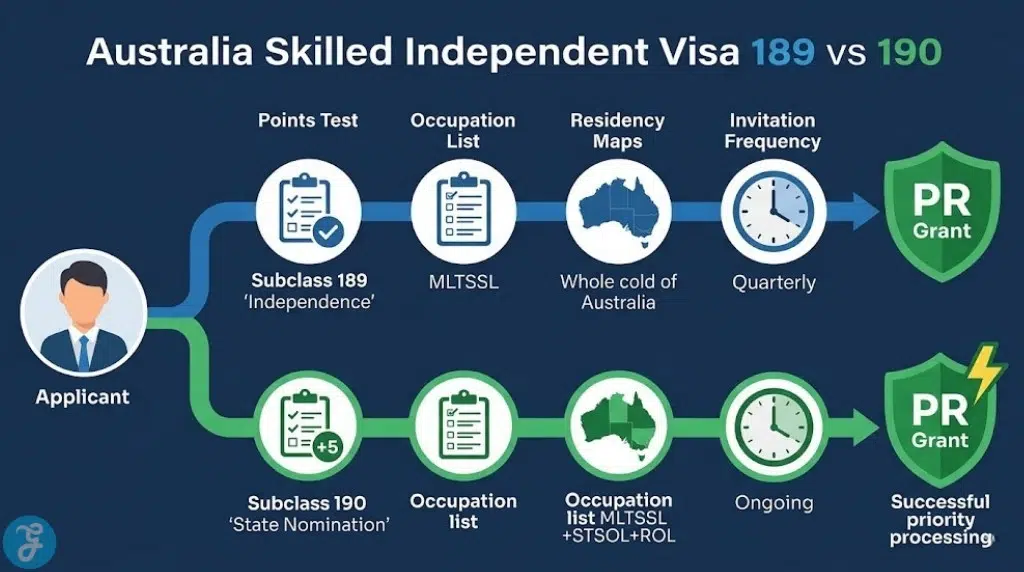
The primary structural difference remains the level of geographical freedom. The Subclass 189 is a “Skilled Independent” visa, meaning you can live, work, and study anywhere in Australia from day one. In contrast, the Subclass 190 requires a nomination from a specific state (such as NSW or Victoria), which carries a mandatory commitment to live and work in that state for at least the first two years of your residency.
Best for: Applicants with job offers in multiple states or those who value total relocation flexibility.
Why We Chose It:
-
It defines the post-grant lifestyle and legal obligations of the migrant.
-
It highlights the “social contract” between the nominee and the sponsoring state.
-
It remains the single biggest reason why high-points earners still target the 189.
Things to consider: While the two-year residency is a moral obligation, breaching it can complicate future citizenship applications or family sponsorship.
2. The 5-Point Bonus “Gap-Filler” Advantage
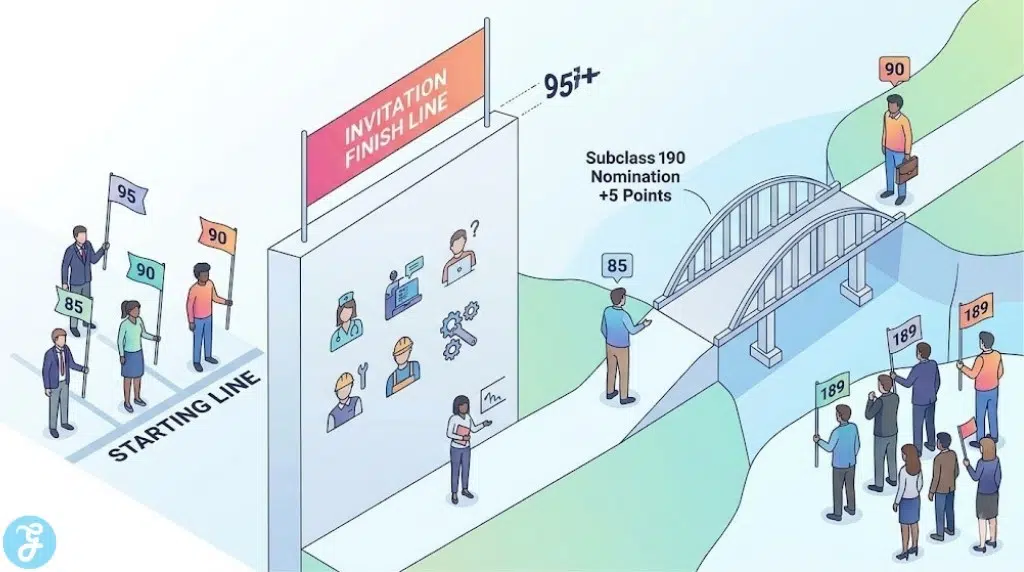
In the competitive 2026 landscape, a 5-point difference can be the barrier between an “Invitation to Apply” (ITA) and your EOI expiring. The Subclass 190 provides an automatic 5-point bonus to your total score once you receive state nomination. For professionals in ICT or Engineering, where the “Independent” cut-offs often hover at 95+ points, this state-sponsored boost is frequently the only way to reach a competitive threshold.
Best for: Applicants stuck at 85 or 90 points who have already maximised their English and experience scores.
Why We Chose It:
-
It provides a tangible mathematical leg-up in a crowded points-test system.
-
It allows candidates with “modest” scores to compete with 189 “whales.”
-
It reflects the 2026 trend of states actively “buying” talent by lowering the points barrier.
Things to consider: You only receive these points after the state approves your nomination, not when you first lodge your Expression of Interest.
3. Quarterly 189 Rounds vs. Ongoing State Invitations
For the 2025–26 program year, the federal government has formalised quarterly invitation rounds for the Subclass 189. This creates a predictable but high-pressure window every three months. Conversely, Subclass 190 invitations are state-driven and occur on a much more fluid basis—often bi-weekly or monthly—allowing for a more “continuous” chance of selection throughout the year.
Best for: Candidates who want a more frequent “roll of the dice” rather than waiting for quarterly federal rounds.
Why We Chose It:
-
It dictates the timing and strategy of your EOI updates and English test sittings.
-
It shows the difference between a “national pool” and “regional demand” cycles.
-
It highlights the current 2026 operational shift toward state-led migration.
Things to consider: Missing one quarterly 189 round in 2026 means a mandatory three-month wait for the next federal opportunity.
4. Occupation List Diversity: MLTSSL vs. STSOL
The Subclass 189 is strictly limited to the Medium and Long-term Strategic Skills List (MLTSSL), focusing on roles like Nursing, Teaching, and specialized Engineering. The Subclass 190, however, opens the door to the Short-term Skilled Occupation List (STSOL) and the Regional Occupation List (ROL), supporting hundreds of roles in marketing, HR, and business that are otherwise ineligible for independent PR.
Best for: Professionals in niche industries or “short-term” roles that are excluded from the national long-term lists.
Why We Chose It:
-
It is the only pathway to permanent residency for many essential service roles.
-
It allows states to address local economic gaps that the federal list misses.
-
It showcases the 2026 shift toward “specialised” rather than “general” migration.
Things to consider: Each state maintains its own “Priority List,” so your occupation may be eligible in Western Australia but closed in New South Wales.
5. The Tiered Priority System of 2026
Invitations for the Subclass 189 are now governed by a Tiered Priority Stack. Tier 1 (Healthcare) and Tier 2 (Teaching and Trades) are invited at much lower points (65–75) and processed faster. Tier 3 and 4 roles (General Professional and ICT) are currently facing “points inflation,” often requiring 100+ points for a 189 invitation, making the 190 pathway much more viable for general professionals.
Best for: Non-healthcare professionals who are struggling to compete with “fast-tracked” priority sectors.
Why We Chose It:
-
It explains the “points paradox” where a 65-point nurse gets PR while a 95-point accountant does not.
-
It reflects the 2026 federal focus on the “Care Economy” and housing construction.
-
It helps applicants set realistic expectations based on their specific industry tier.
Things to consider: If you are in a Tier 3 or 4 occupation, relying solely on the 189 in 2026 is a high-risk strategy.
6. Grant Processing Speed and Priority Status
While both are permanent visas, Subclass 190 applications are often given a “priority” flag in the processing queue because the applicant has already been vetted by a state government. In the 2026 cycle, many 190 grants are being issued within 6 to 8 months, while non-priority 189 applications in the “General Pool” can sometimes languish for over a year.
Best for: Onshore applicants with expiring temporary visas who need a PR grant quickly to maintain work rights.
Why We Chose It:
-
It addresses the 2026 focus on clearing state-sponsored backlogs.
-
It provides a “faster” path to the security of permanent residency.
-
It highlights the hidden “efficiency bonus” of getting a state to vouch for your skills.
Things to consider: The time it takes to secure the state nomination (4–12 weeks) must be added to the total processing timeline.
Comparing Your 2026 Australian PR Options
To effectively apply the Australia Skilled Independent Visa 189 vs 190 logic to your own profile, you must understand how the points and location rules interact with your specific career. The table below provides a quick reference for the 2026 program settings.
2026 Subclass Comparison Table
The following data represents the current planning levels and rules for the 2025–26 fiscal year.
| Feature | Subclass 189 (Independent) | Subclass 190 (Nominated) |
| 2025-26 Places | 16,900 | 33,000 |
| Extra Points | 0 | +5 (State Bonus) |
| Residency Rule | No restrictions | 2 Years in Nominating State |
| Invitation Type | Federal Quarterly Rounds | State-Led Ongoing Rounds |
| Occupation List | MLTSSL Only | MLTSSL + STSOL + ROL |
| Priority Sector | Healthcare, Teaching, Trades | State-Priority Roles |
Our Top 3 Picks and Why?
Of the factors discussed, the 5-Point Bonus, Occupation List Diversity, and Tiered Priority are the most critical. These three pillars dictate whether you will actually receive an invitation in 2026. Unless you are a nurse or a teacher (Tier 1/2), the independence of the 189 is often a “paper benefit” because the points required are simply too high. The 190 pathway remains the most realistic bridge to PR for the majority of the professional workforce.
Applicant’s Guide: Choosing Your PR Pathway in 2026
Developing a personal migration framework requires an honest assessment of your “independent” points versus your “nominated” potential. Use the logic below to standardise your decision-making.
The Selection Framework:
-
Identify Your Tier: Are you in Health, Education, or Trades? If so, the 189 is your primary target. If you are in Tech, Business, or Finance, the 190 is your likely only option.
-
Calculate the “95-Point Gap”: If you cannot reach 95 points without help, lodge EOIs for every state that has your occupation on their list to capture the 190 bonus.
-
Assess Your Location: If you are already living in a state like WA or QLD, the 190’s residency requirement is a “zero-cost” trade-off since you are already there.
Decision Matrix (Table):
Use this matrix to determine which subclass should lead your EOI strategy.
| Choose Subclass 189 if… | Choose Subclass 190 if… |
| You are in a Tier 1 or 2 priority sector. | You need the +5 points to stay competitive. |
| You want total freedom to move for work. | Your occupation is “Short-term” (STSOL). |
| You have a score of 95+ independently. | You are already settled in a specific state. |
The Final Checklist: 5-point Audit for Your 2026 EOI
-
Have you checked your occupation’s current “Tier” on the Home Affairs website?
-
Is your English test result “Superior” (IELTS 8 / PTE 79) to secure 20 points?
-
Have you checked the “Date of Effect” on your EOI for tie-breaker purposes?
-
Do you have a valid Skills Assessment that covers the next 12 months?
-
Have you lodged separate EOIs for both 189 and 190 to maximise your chances?
Securing Your Permanent Place in Australia
The 2026 migration cycle is no longer about just “qualifying”; it is about positioning. By understanding the nuances of the Australia Skilled Independent Visa 189 vs 190, you can move away from “hoping” for an invitation and start a standardised strategy that targets the right subclass for your sector. Whether you choose the freedom of the 189 or the state-supported reliability of the 190, staying informed on quarterly trends is the best way to ensure your Australian dream becomes a permanent reality.