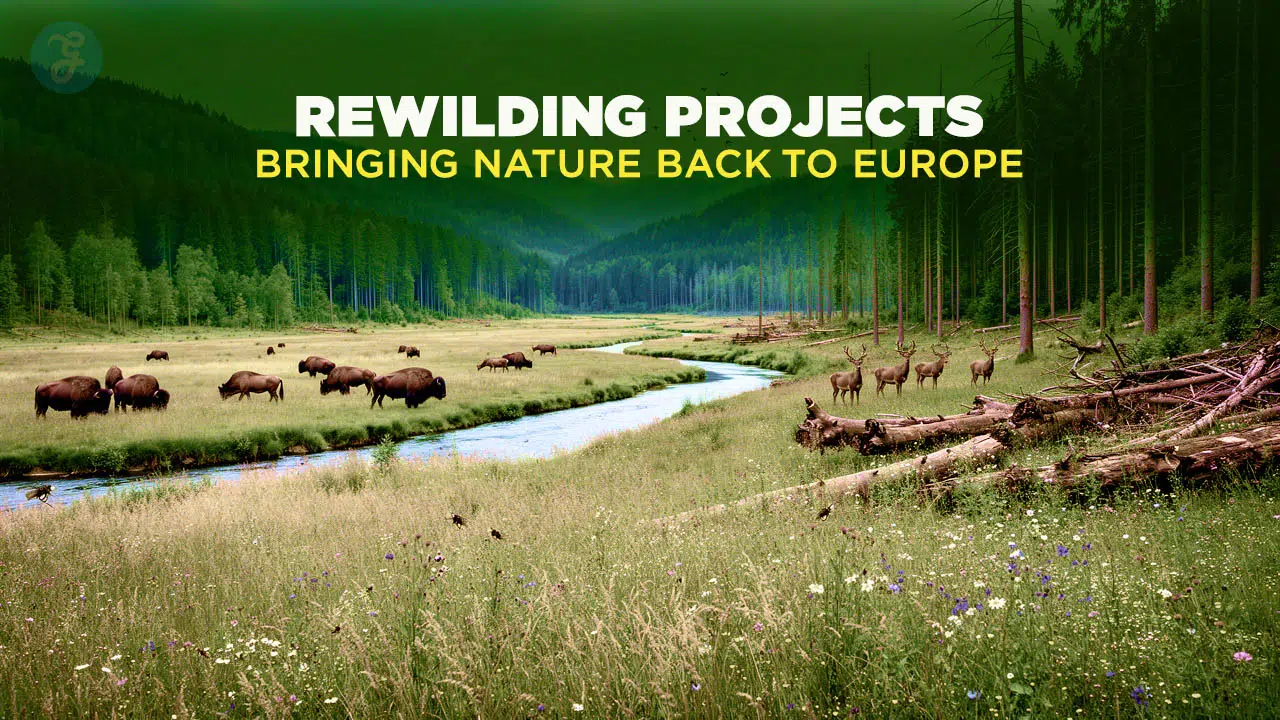
Have you ever walked through a city park and wished for something more than manicured lawns—perhaps wild animals, free-flowing rivers, or forests that feel truly ancient? Many of us have noticed that our local landscapes, while pretty, often lack the vibrant hum of real wilderness. Farms, roads, and expanding cities have squeezed nature into smaller and smaller corners across Europe.
But there is good news. A powerful movement is growing to change this.
Across the continent, experts and communities are working together on rewilding projects that don’t just protect nature—they let it take the lead again. From beavers building dams in forgotten channels to bison roaming free after centuries of absence, the wild is making a comeback.
This guide walks you through exactly how these projects are healing the land and, surprisingly, how they benefit people just as much as wildlife. It also highlights the specific places where this transformation is happening and how you can experience it firsthand.
So grab a cup of coffee and explore how Europe is rediscovering its wild side.
What is Rewilding?
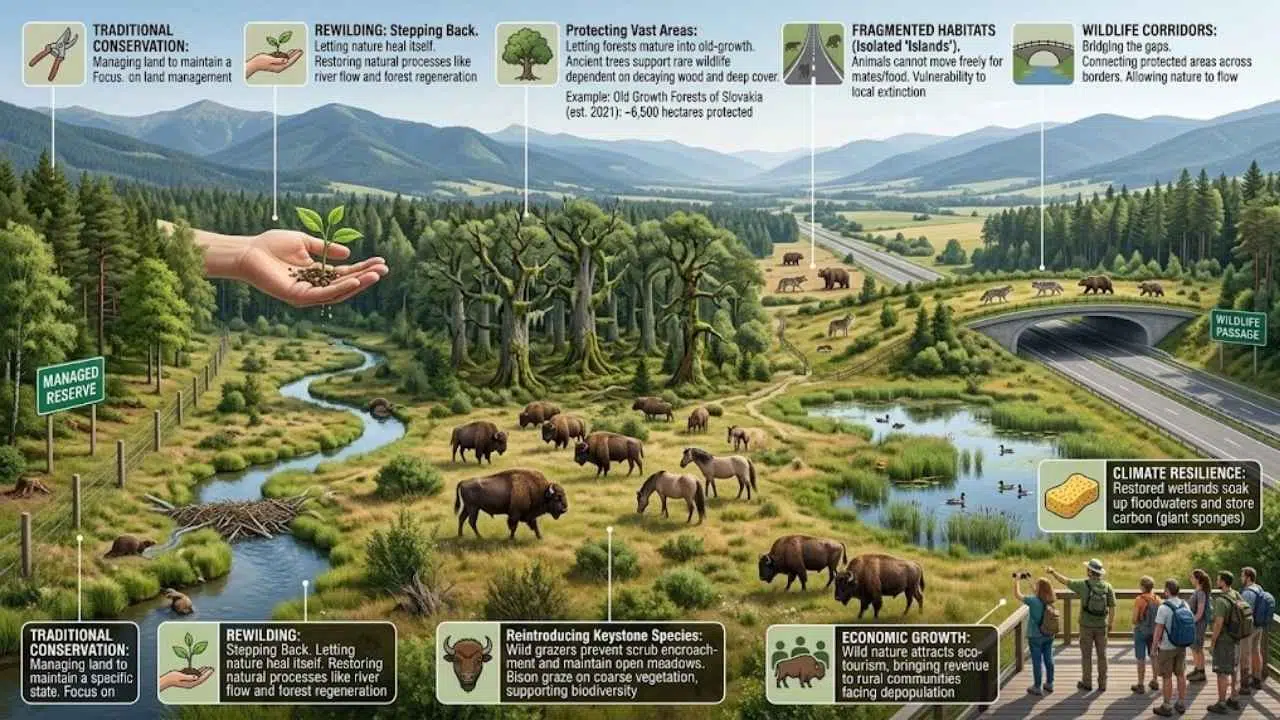
Rewilding is distinct from traditional conservation. While conservation often focuses on managing land to keep it a certain way, rewilding is about stepping back and letting nature do the heavy lifting.
Definition and goals of rewilding
At its core, rewilding means letting nature heal itself. It focuses on restoring healthy ecosystems by creating wild, biodiverse spaces where natural processes—like river flow or forest regeneration—can happen without human interference. The goal isn’t to create a museum of nature, but a self-sustaining system that adapts and grows on its own.
In Europe, this often involves two main strategies. First, reintroducing “keystone species” like large grazers (wild horses, bison) to abandon farmland. These animals graze on coarse grass and shrubs, which naturally stops dense forests from overtaking open meadows. Second, it involves legally protecting vast areas to let them mature into old-growth forests.
For example, the “Old Growth Forests of Slovakia” reserve, established in late 2021, now protects nearly 6,500 hectares of ancient woodland across 76 different sites. This legal status ensures these trees can grow for centuries undisturbed, supporting rare wildlife that relies on decaying wood and deep forest cover.
Importance of rewilding in Europe
Nature across Europe is facing a critical turning point. Many wild areas have shrunk, creating isolated “islands” of nature where animals like bears and wolves cannot move freely to find mates or food. This fragmentation makes species vulnerable to local extinction.
Rewilding projects bridge these gaps. By restoring protected areas and connecting them with “wildlife corridors,” we allow nature to flow across borders again. A prime example is the Wilder Parks initiative, which expanded in 2025 to include 10 frontrunner parks—such as the Parc national de l’Entre-Sambre-et-Meuse in Belgium. These parks are adopting rewilding principles to boost biodiversity and climate resilience.
The benefits are tangible and immediate:
- Climate Resilience: Restored wetlands act as giant sponges, soaking up floodwaters and storing carbon.
- Safer Travel: Wildlife corridors reduce road accidents by giving animals safe passage under or over busy highways.
- Economic Growth: Wild nature attracts eco-tourism, bringing new revenue to rural communities that have struggled with depopulation.
Key Rewilding Projects in Europe
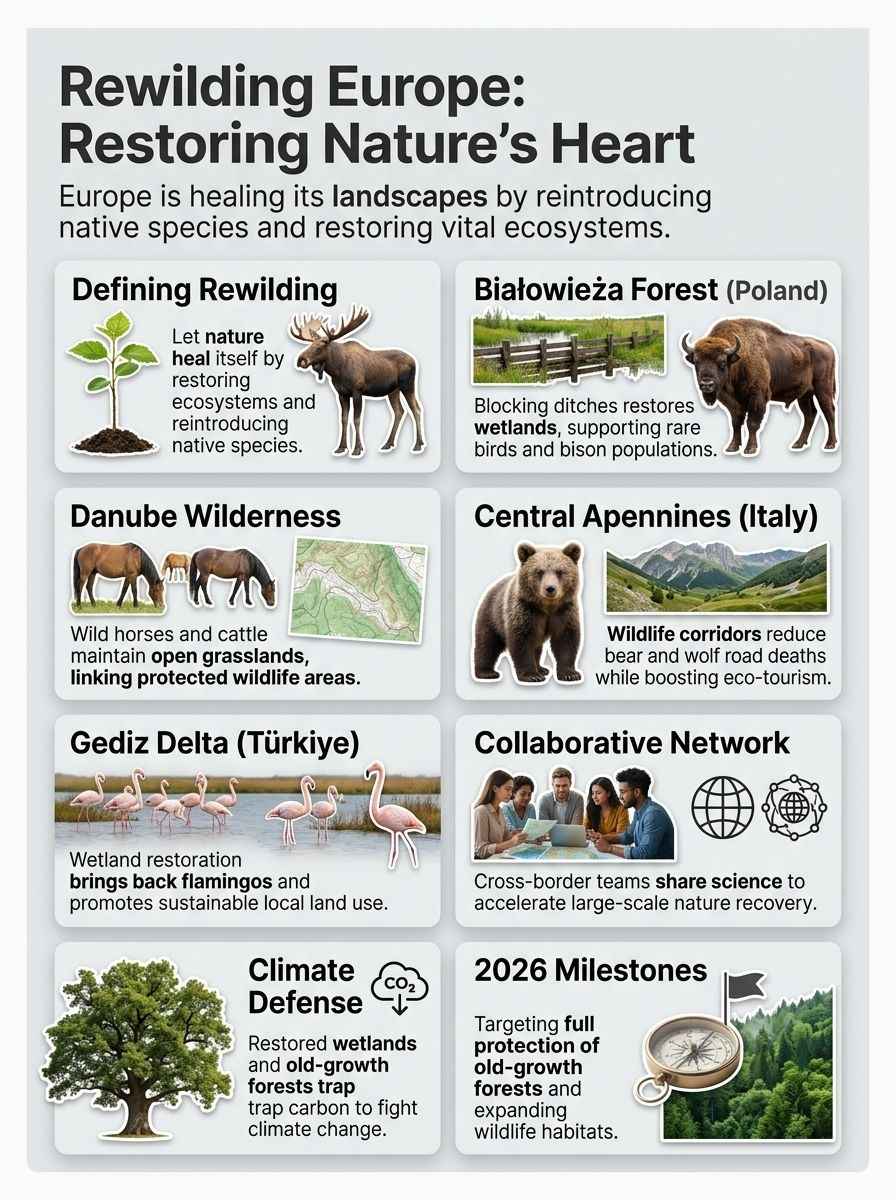
These projects breathe life back into wild places, weaving new hope for nature. Each one paints a bold brushstroke on Europe’s canvas, showing what is possible with care and vision.
Bringing water back to Białowieża Forest (Poland)
The Białowieża Forest is one of the last remnants of the primeval forest that once covered the European plain. However, past attempts to drain the land for agriculture left scars on the landscape. The “Bring Back Water” project has been instrumental here, restoring over 4 kilometers of the Salomienka River and revitalizing nearly 3,200 hectares of wetlands.
Crews have blocked old artificial ditches, allowing water to stay on the land rather than draining away. This simple action has turned dry ground back into lush, spongy wetlands. As the water returns, so do the frogs, rare insects, and birds that depend on these wet habitats.
Insider Tip: If you want to see the famous European bison here, plan your trip for winter. Local guides know that bison leave the deep forest in snowy months to forage on the hay provided in open meadows near villages like Budy. It is the most reliable time to spot them and see their tracks clearly.
Reviving the Slovak-Hungarian Danube Wilderness
The Danube River is Europe’s artery, but for years, its banks were tamed and straightened. Now, the LIFE WILD island project is undoing that damage. In 2025, a major milestone was reached at Klížska Nemá in Slovakia, where engineers began removing stone groynes (artificial barriers) to let the river flow naturally again. This creates new gravel islands that are perfect nesting grounds for birds.
Rewilding groups are also using natural grazers to manage the land. In the marshlands near Marcelová, water buffalo have been introduced to graze down invasive reeds. This keeps the water open and sunlit, which is crucial for native fish and amphibians.
| Project Feature | Traditional Management | Rewilding Approach |
|---|---|---|
| River Banks | Reinforced with stone/concrete | Groynes removed to form natural islands |
| Vegetation Control | Mechanical mowing/chemicals | Grazing by water buffalo & wild horses |
| Goal | Fast water transport | Biodiversity & flood protection |
Restoring the wild heart of Italy (Central Apennines)
In the rugged Central Apennines, the Marsican brown bear is the star of the show. With only about 60 to 90 bears remaining, they are critically endangered. Rewilding efforts here focus on “coexistence corridors”—safe paths that allow bears to travel between protected parks without running into conflict with humans.
The Rewilding Apennines team has been working with local communities to create “Bear Smart” towns. This involves installing electric fences around beehives and orchards and providing bear-proof waste bins. These measures have drastically reduced bear-human conflicts.
Verifiable “Insider” Tip:
Many wildlife enthusiasts recommend visiting in late spring (May-June) or early autumn (September). During these times, bears are most active—either feeding on fresh sprouts after hibernation or fattening up on Ramnus berries before winter. You can join a “Bear Watching” tour that supports local conservation, ensuring your money helps protect the bears you see.
Bringing life back to the Gediz Delta (Türkiye)
The Gediz Delta is a bird paradise right next to the bustling city of İzmir. It recently celebrated a massive victory: a proposal to build a mega-bridge across the delta was permanently dropped in early 2026 following legal action by conservationists. This saved crucial feeding grounds for thousands of birds.
Restoration here is hands-on. Teams have built a specific artificial breeding island that now hosts one of the largest colonies of Greater Flamingos in the Mediterranean. In the 2025 breeding season alone, over 13,000 flamingo chicks were born here.
Local communities help keep the area healthy through sustainable land use. Traditional fishermen and salt collectors work alongside conservationists to maintain the delicate balance of salt and fresh water that the birds need.
Visitor Tip: For the best views without disturbing the wildlife, head to the “Degaj” area in the southern part of the delta. Arrive at sunrise. The light hitting the shallow waters creates a stunning pink reflection from the thousands of flamingos feeding there.
The Role of the European Rewilding Network
The European Rewilding Network brings people and groups together, lighting the way for nature’s big comeback. It proves that we can achieve more when we share our knowledge.
Supporting large-scale restoration efforts
The network acts as a knowledge hub for rewilding initiatives across the continent. In March 2025, the network reached a historic milestone: it now has 100 active members across 29 different countries. These members manage over 5 million hectares of land, sharing data on everything from river restoration to introducing bison.
One of their key tools is the European Wildlife Comeback Fund, which provides quick grants to help release animals. This fund has supported the release of lynx, vultures, and wild horses, boosting biodiversity in areas that had fallen silent. By connecting small local projects with international funding and expertise, the network ensures that a success in Portugal can teach lessons to a team in Poland.
Promoting collaboration across countries
Nature doesn’t recognize borders, and neither does the network. Many projects, like the restoration of the Oder Delta, span across the German-Polish border. Teams from both nations work side-by-side to reintroduce grazers and create wildlife corridors that link habitats seamlessly.
The network also organizes webinars and site visits. For instance, the team managing the Old Growth Forests of Slovakia (that 6,500-hectare reserve) regularly exchanges findings with forest managers in Romania and Ukraine. They discuss how to protect these ancient woodlands from illegal logging and climate stress. This kind of teamwork sparks big changes for biodiversity and environmental sustainability all over Europe.
Benefits of Rewilding in Europe
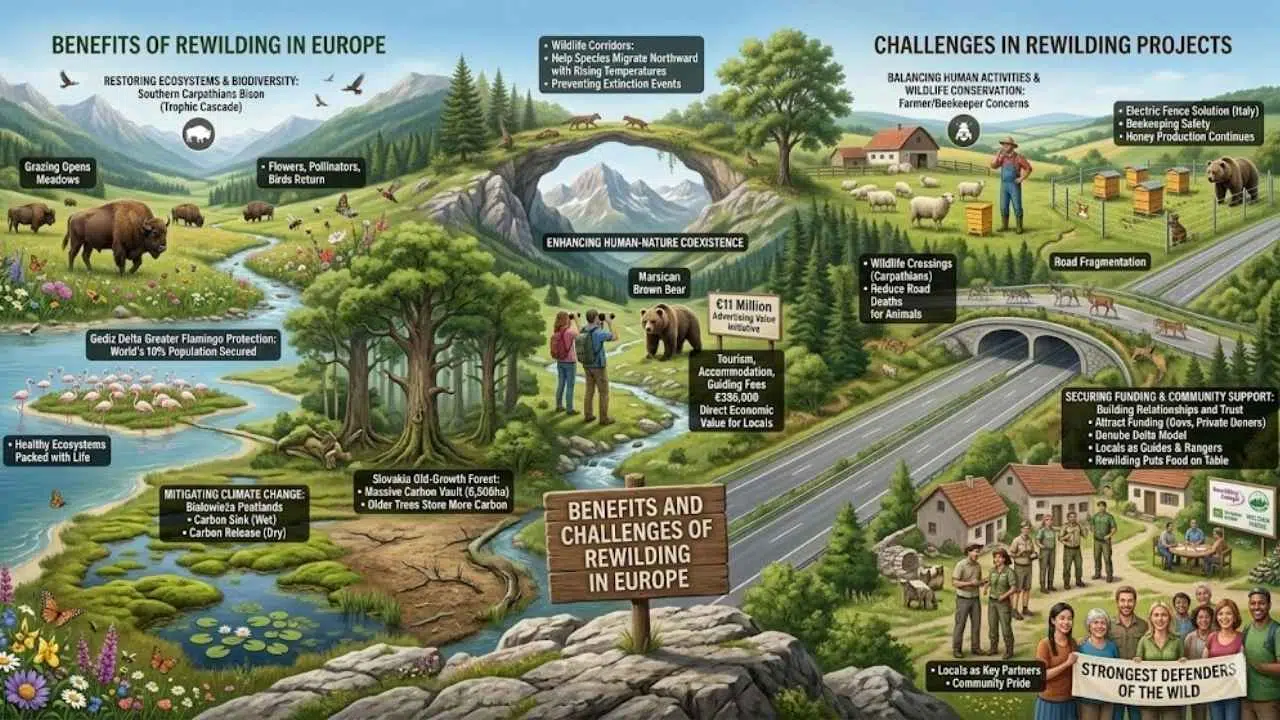
Rewilding projects breathe fresh life into Europe’s landscapes, bringing new hope for nature lovers. But beyond the beauty, there are hard numbers that show why this matters.
Restoring ecosystems and biodiversity
When we let nature lead, life returns at an astonishing rate. In the Southern Carpathians, the reintroduction of bison has created a ripple effect. Their grazing opens up meadows, which allows flowers to bloom, which attracts pollinators, which feeds birds. It is a “trophic cascade” in action.
In the Gediz Delta, the protection of the breeding island has secured the future of nearly 10% of the world’s Greater Flamingo population. These restoration projects create healthy ecosystems packed with life. As nature heals itself, populations of keystone species stabilize, making the entire web of life more resilient to disease and weather shocks.
Mitigating climate change
Rewilding is one of our most effective tools against climate change. Healthy peatlands, like those being restored in Białowieża, are incredibly efficient carbon sinks. A wet peatland locks carbon in the soil forever; a dry, drained one releases it into the air.
Similarly, the 6,500 hectares of protected old-growth forest in Slovakia act as a massive carbon vault. Older trees store significantly more carbon than young plantations. By protecting these areas, we aren’t just saving trees; we are actively cooling the planet. Wildlife corridors also help species migrate northward as temperatures rise, preventing extinction events caused by climate shifts.
Enhancing human-nature coexistence
Living closer to nature brings real economic benefits. In the Central Apennines, a 2023 study found that the Marsican brown bear generates an advertising value equivalent of €11 million for the region. People come from all over the world just for a chance to see them.
This translates into real income for locals. In just two years, the Rewilding Apennines initiative generated over €386,000 in direct economic value for local communities through tourism, accommodation, and guiding fees. It turns out that a live bear is worth far more to the local economy than a dead one.
Challenges in Rewilding Projects
Of course, bringing back the wild isn’t always easy. Some folks worry about sharing space with wild animals or changing old ways. Money can be tight, and not everyone in town is ready to welcome new neighbors—especially the furry ones.
Balancing human activities and wildlife conservation
As cities grow and farms spread, conflicts can arise. Farmers naturally worry about wolves near their sheep or bears near their beehives. The solution lies in practical support, not just rules. In Italy, the distribution of electric fences to beekeepers has been a game-changer, allowing honey production to continue safely alongside bear populations.
Roads are another major challenge. Europe is covered in asphalt, which fragments habitats. However, projects like the wildlife crossings in the Carpathians have shown that simple infrastructure changes can reduce road deaths for animals like lynx and wolves. It requires careful planning and money, but the technology exists to make our roads safer for everyone.
Securing funding and community support
Securing money for rewilding projects takes teamwork. Groups like Rewilding Europe launched the Wilder Parks initiative to help protected areas attract funding for ecosystem restoration. They link with governments, private donors, and local partners to fund wildlife corridors and large-scale ecosystems.
But money doesn’t buy trust. Building relationships with local communities is the most critical step. If locals feel ignored, projects fail. Successful initiatives, like those in the Danube Delta, involve locals as guides, boat captains, and rangers. When the community sees that rewilding puts food on the table and pride in their hearts, they become the strongest defenders of the wild.
Future of Rewilding in Europe
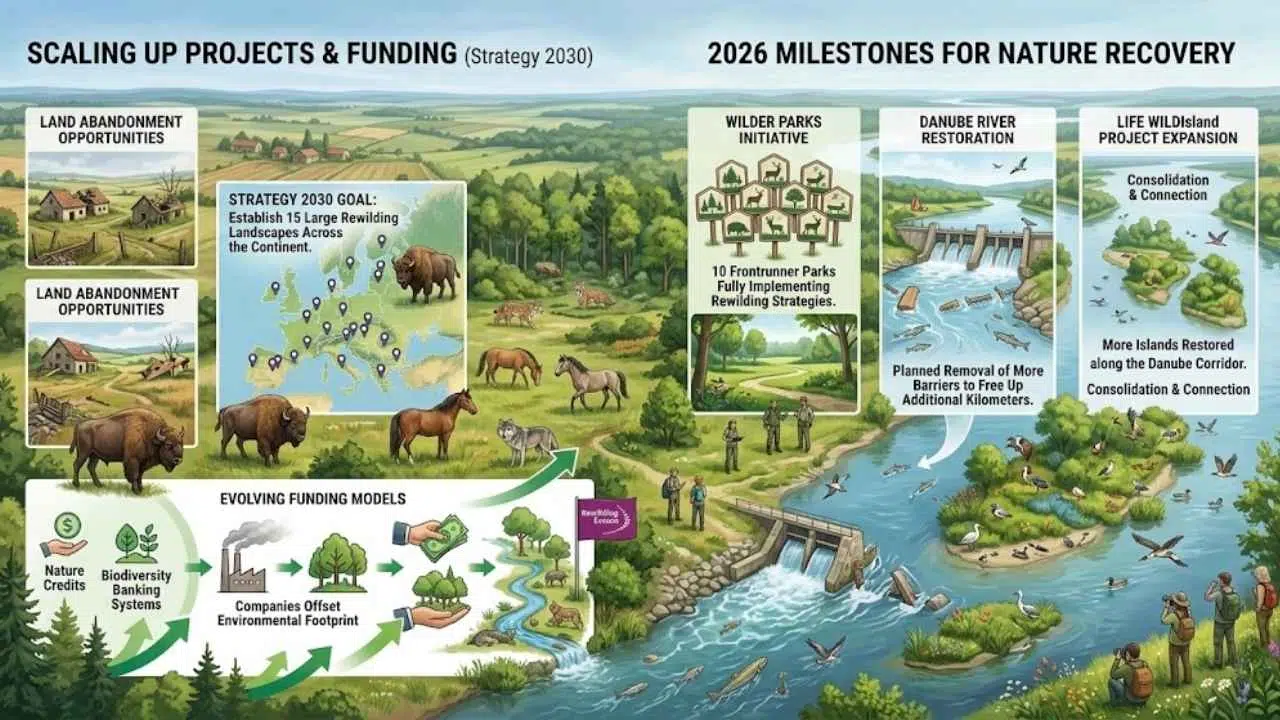
Big changes are on the horizon, with more land and wild places coming back to life. Keep your eyes peeled for exciting updates as experts work hard, breathing new hope into nature’s story across Europe.
Scaling up projects and funding
The ambition for the next decade is huge. Rewilding Europe has set a “Strategy 2030” goal to have 15 large rewilding landscapes across the continent. This involves expanding existing success stories and finding new areas where land abandonment offers a chance for nature to return.
Funding models are evolving too. New “nature credits” and biodiversity banking systems are being tested, which could allow companies to invest in rewilding projects to offset their environmental footprint. This could unlock millions of euros for habitat restoration in the coming years.
2026 milestones for nature recovery
Looking ahead to 2026, the focus is on consolidation and connection. The Wilder Parks initiative aims to have its 10 frontrunner parks fully implementing their rewilding strategies. In the Danube, the removal of more barriers is planned to free up additional kilometers of river flow.
By 2026, we also expect to see the results of the “LIFE WILD island” project’s expansion, with more islands restored along the Danube corridor. These milestones are stepping stones toward a wilder, more resilient Europe where nature is not just a visitor, but a permanent resident.
Final Thoughts
Rewilding projects in Europe are doing more than just saving trees; they are restoring a sense of wonder to our continent. From the return of the bison to the free-flowing Danube, these efforts prove that nature is resilient if we just give it a little space.
You don’t need to be a scientist to be part of this. Whether it’s supporting eco-tourism by visiting these wild places, buying “bear-friendly” honey, or just spreading the word, every action counts.
Why not plan a trip to see one of these rewilding success stories yourself? You might just find that in helping nature recover, you recover a little bit of your own wild spirit too.