Life gets incredibly busy, and it is entirely too easy to rush through the day without pausing to appreciate the good things happening right in front of us. If you often feel overwhelmed, anxious, or just disconnected from your own thoughts, putting pen to paper might be the exact mental reset you need.
Journaling is not just about keeping a diary anymore; it is a proven method to ground yourself, process your emotions, and actively train your brain to notice the positive aspects of your life. Whether you are a seasoned writer who loves filling blank pages or someone who barely has five minutes to spare before rushing out the door, finding the right layout makes all the difference. In this comprehensive guide, we will walk through the absolute best journals for gratitude and mindfulness available right now, exploring what makes each one unique, the science behind why they work, and how you can actually stick to a journaling habit this time around without giving up after the first week.
Why You Need a Gratitude and Mindfulness Journal?
You might be wondering if writing things down actually changes anything in your day-to-day routine or if it is just another wellness trend. The short answer is yes, because a dedicated practice forces you to intentionally slow down and shift your perspective away from daily stressors and endless to-do lists. Instead of spiraling into what went wrong today, you carve out a quiet, offline space to acknowledge what went right, no matter how small or seemingly insignificant that positive moment was.
This active shift in focus is exactly why the best journals for gratitude and mindfulness have become staple tools recommended by therapists and wellness coaches everywhere. They provide a tangible, screen-free environment to decompress, process your complex emotions, and physically disconnect from the constant digital noise that keeps our nervous systems in a state of high alert.
The Science Behind Journaling and Mental Health
Psychologists and cognitive behavioral researchers have spent years studying the profound effects of gratitude on the human brain, and the results are incredibly encouraging. Regularly noting things you are thankful for is linked to a significant, measurable increase in overall happiness and life satisfaction. When you sit down and practice gratitude, your brain actually releases dopamine and serotonin, which are the crucial neurotransmitters responsible for making you feel good and regulating your mood.
Over time, this simple daily habit can physically rewire your neural pathways, training your brain to naturally look for the positive instead of defaulting to its evolutionary bias toward stress and negativity. Furthermore, mindfulness journaling asks you to observe your current emotions without judging them, a practice that actively helps lower cortisol levels and reduces your baseline anxiety over the long term.
| Brain Function | Impact of Journaling | Long-Term Result |
| Neurotransmitter Release | Boosts dopamine and serotonin naturally. | Higher baseline of happiness and mood stability. |
| Amygdala Regulation | Calms the fear center of the brain. | Reduced reactivity to sudden daily stressors. |
| Neural Pathway Wiring | Strengthens positive thought patterns. | Brain defaults to optimism rather than negativity. |
Key Benefits of Daily Reflection
Taking just a few quiet moments each day to reflect offers a wide range of tangible benefits that extend far beyond the ink on the page. People who consistently use gratitude and mindfulness journals frequently report much better sleep quality because they are emptying their anxious, racing thoughts onto paper before bed rather than ruminating on them in the dark.
It also dramatically improves your self-esteem; when you stop comparing your behind-the-scenes life to everyone else’s highlight reel and start appreciating your own unique journey, your confidence naturally grows and solidifies. Finally, a regular reflection practice builds deep emotional resilience, teaching you to accept that while you cannot control every chaotic event that happens in the world, you have complete control over how you process, frame, and respond to those events.
| Area of Life | Immediate Benefit | Compounding Long-Term Benefit |
| Sleep Hygiene | Empties racing thoughts before bed. | Deeper, more restorative sleep cycles. |
| Self-Esteem | Shifts focus to personal achievements. | Reduced imposter syndrome and social comparison. |
| Emotional Resilience | Provides a safe space to process anger or sadness. | Faster recovery from setbacks and daily frustrations. |
What to Look for in the Perfect Journal?

Not all journals are created equal, and the exact notebook that works perfectly for your best friend might feel like an absolute chore for you to fill out. Before you pick one from our list, you need to consider your personal habits, your aesthetic preferences, and what you realistically have the time and energy for in your current season of life.
Buying a beautifully designed notebook is only the first step; finding a functional format that aligns with your brain’s natural workflow is what actually guarantees you will use it. You should carefully evaluate the interior layout, the physical paper weight, and the overall daily time commitment required before making a purchase so you do not end up with another empty book on your shelf.
Guided Prompts vs. Unstructured Pages
If staring at a completely blank page gives you instant writer’s block, you absolutely need to start with a guided journal to build your confidence. These options provide specific, targeted questions, inspirational quotes, and structured fill-in-the-blank sections that completely take the guesswork out of the reflection process. You just open the book, follow the instructions, and answer the questions without having to overthink what you should be writing about today.
On the other hand, if you prefer brain-dumping your messy thoughts, drawing sketches, or writing long, expressive paragraphs about your day, an unstructured or dot-grid notebook will give you the total creative freedom you crave without fencing you into a rigid daily box.
| Journal Style | Core Advantage | Ideal User Profile |
| Guided Prompts | Removes the friction of deciding what to write. | Beginners, busy people, and those prone to writer’s block. |
| Unstructured Pages | Offers infinite space for customized self-expression. | Artists, seasoned writers, and creative thinkers. |
| Hybrid Layouts | Combines light guidance with plenty of blank space. | People who want gentle structure but room to vent. |
Time Commitment and Layout
You have to be brutally honest with yourself about your daily schedule and your actual energy levels before committing to a new routine. If you are an extremely busy parent or a professional working long hours, a journal that requires twenty minutes of deep introspective writing every morning will likely end up gathering dust on your nightstand by Wednesday.
Look for five-minute or one-sentence journals that fit seamlessly into a hectic, unpredictable routine without causing you extra stress. Conversely, if you want to use journaling as a longer, luxurious weekend wind-down activity, look for comprehensive workbooks that offer deeper emotional check-ins, extensive weekly reviews, and detailed habit trackers.
| Time Commitment | Recommended Format | Best Time of Day to Use |
| 1 to 5 Minutes | One-sentence journals or short bulleted lists. | First thing in the morning or right before sleep. |
| 10 to 15 Minutes | Guided prompt journals with morning and evening sections. | During a morning coffee break or evening wind-down. |
| 30+ Minutes | Unstructured pages for deep, reflective brain dumps. | Slow weekend mornings or dedicated weekly self-care blocks. |
Quality of Materials
Do not underestimate how much the tactile, physical experience of journaling impacts your desire to actually do it every day. The quality of the paper matters immensely, especially if you enjoy using fountain pens, heavy markers, or dark-ink gel pens; always look for thick, bleed-proof paper rated at 100gsm or higher to prevent annoying ghosting.
The cover material is also surprisingly important for habit formation. A beautiful linen, soft vegan leather, or heavily textured cover can make the journal feel like a special, premium item, which subtly and psychologically encourages you to pick it up and treat the practice as a luxury self-care experience rather than a homework assignment.
| Material Feature | Why It Matters | What to Look For |
| Paper Weight (GSM) | Prevents ink from bleeding through to the other side. | 100gsm to 120gsm for a smooth, thick writing experience. |
| Binding Type | Determines if the book lays completely flat while writing. | Sewn binding or spiral bound for maximum comfort. |
| Cover Material | Enhances the tactile joy of picking up the book daily. | Linen, cloth, or high-quality vegan leather. |
Top 10 Best Journals for Gratitude and Mindfulness
Here is our carefully curated list of the top options available right now to help you build a much healthier, more resilient mindset. We have purposely included a diverse mix of quick daily logs, deep emotional workbooks, and beautiful aesthetic choices to ensure you can find your absolute perfect match. When researching and testing the best journals for gratitude and mindfulness, we heavily weighed user reviews, clinical and psychological backing, material quality, and the overall effectiveness of the prompts. Whether you just want a quick morning check-in or a serious deep dive into your emotional well-being, one of these ten exceptional options will fit seamlessly into your lifestyle.
1. The Five Minute Journal by Intelligent Change
This is arguably the most famous and highly recommended gratitude journal on the global market, boasting millions of dedicated users worldwide, and for very good reason. It is explicitly designed for people who want all the psychological benefits of journaling but feel they have absolutely no extra time to spare in their overloaded schedules.
The layout remains identical every single day, which purposefully creates a comforting, frictionless routine that relies entirely on the proven principles of positive psychology. In the morning, you quickly answer three prompts focusing on gratitude and daily intentions, and at night, you return to list the day’s highlights and lessons learned, making it incredibly straightforward and highly effective for absolute beginners.
| Feature | Details |
| Time Required | 5 minutes a day (split morning and night). |
| Layout Style | Highly structured, repetitive daily prompts. |
| Best For | Absolute beginners and busy professionals. |
2. The Give Yourself Kindness Journal
If you want to move far beyond simple surface-level gratitude and truly dig into deep, healing self-compassion, this is an exceptional, expert-backed choice. Highly recommended by clinical psychologists and leading mental health figures, this beautifully bound journal focuses heavily on emotional awareness, self-worth, and silencing your harsh inner critic.
Instead of repeating the exact same prompts every day, it offers ninety days of completely unique, thought-provoking questions so your brain never gets bored or goes onto autopilot. It also features a specialized emotional awareness tool on every single page that helps you safely identify and name your complicated feelings without judging them, actively helping you avoid the trap of toxic positivity.
| Feature | Details |
| Time Required | 10 to 15 minutes a day. |
| Layout Style | 90 days of unique, changing prompts. |
| Best For | People battling anxiety, burnout, or low self-esteem. |
3. The 6-Minute Diary by UrBestSelf
Brilliantly combining the brevity of quick daily journaling with the robust structure of a personal development planner, this diary asks for exactly three minutes of your time in the morning and three minutes at night. With millions of copies sold globally and translated into multiple languages, it is an absolute powerhouse in the holistic wellness space.
What truly sets it apart from the competition is the extensive, incredibly detailed introductory section that thoroughly explains the science of habit-building, neuroplasticity, and positive psychology before you even write your first entry. Alongside the daily gratitude prompts, it includes a weekly habit tracker and a weekly routine review to keep you actively moving forward toward your personal goals.
| Feature | Details |
| Time Required | 6 minutes a day (split morning and night). |
| Layout Style | Repetitive daily prompts with weekly reflection check-ins. |
| Best For | Goal-oriented individuals who love tracking data and habits. |
4. Good Days Start With Gratitude
This is a fantastic, highly accessible, and budget-friendly option that strips away all the complicated extras and focuses purely on the simple act of thankfulness. It is structured as an easy 52-week guide that provides a weekly inspirational quote, a dedicated space to write down just three things you are thankful for each day, and a weekly checkpoint to briefly reflect on your overall progress.
The sheer simplicity of the design is undoubtedly its greatest strength, as it removes all pressure to perform or write lengthy essays. It is incredibly lightweight, completely unintimidating, and perfect for anyone who just wants to dip their toes into the practice of daily appreciation without committing to a heavy, expensive hardcover book.
| Feature | Details |
| Time Required | 2 to 3 minutes a day. |
| Layout Style | Minimalist 52-week guide with three daily bullet points. |
| Best For | Anyone on a strict budget wanting a no-frills experience. |
5. Start Where You Are by Meera Lee Patel
For the visual thinkers, artists, and creative souls, this beautifully interactive journal is a massive, much-needed breath of fresh air in a market heavily saturated by rigid lists and checkboxes. It is much less about writing daily bullet points and far more about exploring your complex inner landscape through stunning watercolor illustrations, inspiring hand-lettered quotes, and open-ended, thought-provoking prompts.
You absolutely do not have to fill this out every single day to get value from it; instead, you can simply pick it up whenever you need a moment of profound calm or a sudden spark of creative inspiration. It actively encourages mindfulness through artistic expression, asking you to map out your chaotic thoughts and draw your feelings without worrying about perfection.
| Feature | Details |
| Time Required | Varies widely based on your creative flow. |
| Layout Style | Unstructured, art-heavy pages with open-ended creative prompts. |
| Best For | Visual thinkers, artists, and highly creative personalities. |
6. Papier Daily Wellness Journal
If desk aesthetics and beautiful design are a major priority for you, Papier offers some of the most stunning, highly customizable covers on the entire stationery market today. Inside the beautiful exterior, the wellness journal provides a highly structured but incredibly gentle approach to daily health, allowing you to carefully track both your mind and your body in one convenient place.
It gives you ample, dedicated space to log your daily intentions, the specific things you are grateful for, your meals, your daily water intake, and your overall sleep quality. It effectively and beautifully bridges the gap between a traditional mindfulness diary and a physical health tracker, helping you see the undeniable connection between your physical habits and your mental state.
| Feature | Details |
| Time Required | 5 to 10 minutes throughout the day. |
| Layout Style | Structured sections for mind, body, and daily gratitude. |
| Best For | People who want to track physical and mental wellness together. |
7. Mål Paper Daily Gratitude Journal
Minimalists and design enthusiasts will absolutely fall in love with this sleek, highly understated option from the experts at Mål Paper. The brand focuses entirely on the principles of Scandinavian simplicity and absolute clarity, offering an uncluttered, distraction-free layout that actively promotes a calm mind the second you open the cover.
The prompts are incredibly straightforward, focusing heavily on setting clear morning intentions and writing brief evening reflections without any extra, unnecessary fluff. Because the interior design is so clean and free of distracting graphics, heavy lines, or loud colors, it allows your own personal words and private thoughts to completely take center stage on the page.
| Feature | Details |
| Time Required | 5 minutes a day. |
| Layout Style | Clean, minimalist, uncluttered daily entries. |
| Best For | Minimalists and professionals wanting a chic desk aesthetic. |
8. The Happiness Project One-Sentence Journal
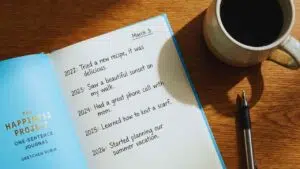
Created by the wildly popular bestselling author Gretchen Rubin, this unique journal completely eliminates the intense pressure of writing long, poetic entries that so often deter busy people from journaling. You literally only have to write one single sentence a day, making it the absolute lowest-barrier entry to daily mindfulness currently available on the market.
The sheer genius of this specific journal is its fascinating five-year format, where each page represents a specific day of the year, featuring five small sections stacked on top of each other. As the years quickly pass, you write your new daily sentence directly below the previous years, creating a fascinating, effortless time capsule of your evolving thoughts, memories, and moments of gratitude.
| Feature | Details |
| Time Required | 1 minute a day. |
| Layout Style | 5-year format requiring only one line per day. |
| Best For | People who hate writing long paragraphs or lack free time. |
9. Ink + Volt Gratitude Journal
Ink + Volt is primarily known across the world for producing high-quality productivity and corporate tools, and their specific take on a gratitude journal brings that exact same level of sharp focus and execution to mental wellness. It is purposefully designed as a highly focused 60-day sprint, making it a truly great short-term commitment to help pull you out of a deep mental rut or survive a season of unusually high stress.
Alongside the standard daily prompts, it includes unique weekly challenges explicitly designed to help you express your gratitude outwardly to others. These challenges include actionable tasks like writing a sincere thank-you note to a coworker, calling an old friend, or doing a random, unexpected act of kindness in your community.
| Feature | Details |
| Time Required | 10 minutes a day. |
| Layout Style | 60-day sprint format with actionable outward challenges. |
| Best For | Action-oriented people wanting to improve their relationships. |
10. Q&A a Day: 5-Year Journal
This is an incredibly fun, highly engaging, and totally unique twist on traditional mindfulness and daily self-reflection practices. Instead of repeatedly asking you what you are grateful for every single day, this specific journal provides a highly specific, totally unique question for every single day of the calendar year. The engaging questions range widely from deep, philosophical inquiries about your core values to light, quirky, and highly observational questions about your current environment.
Like the one-sentence journal, it conveniently tracks your daily answers over a five-year period on a single page, making it incredibly rewarding to see how your mindset, your priorities, and your primary sources of happiness naturally evolve and shift over time.
| Feature | Details |
| Time Required | 1 to 2 minutes a day. |
| Layout Style | A unique daily question tracked over 5 years. |
| Best For | Tracking personal growth and changing mindsets over half a decade. |
How to Build a Sustainable Journaling Habit?
Buying a beautiful, expensive journal is always the easy part of the process, but actually opening it every single day is where the vast majority of people struggle and ultimately fail. If you genuinely want to make this new habit stick long enough to see the profound mental health benefits, you absolutely need a realistic, entirely friction-free strategy.
Motivation will inevitably fade after the first week of excitement wears off, so you must rely heavily on simple daily systems and environmental cues to keep yourself on track. By setting your physical environment up for guaranteed success, you take the exhausting decision-making process out of the equation entirely.
Start Small
You must not force yourself to write a perfectly formatted, emotionally deep full page on day one of your new journey. If you only have the mental energy to write a single word or a messy bullet point about a genuinely good cup of coffee you had that morning, that completely counts as a success. The primary, overarching goal here is building daily consistency, not achieving literary perfection or writing a bestselling memoir.
Give yourself full, guilt-free permission to be messy, to have terrible handwriting, and to keep your entries incredibly brief when you are exhausted. Once the basic daily habit is deeply formed and hardwired in your brain, you can naturally and easily expand on your thoughts when you have more time and energy.
| Strategy Phase | Actionable Advice | Psychological Benefit |
| Week 1 | Write only one sentence or word per day. | Lowers the barrier to entry so you do not procrastinate. |
| Week 2 | Allow messy handwriting and spelling errors. | Defeats perfectionism and the inner critic. |
| Week 3 | Slowly add a second sentence if you feel like it. | Naturally scales the habit only when you feel ready. |
Stack Your Habits
The absolute most scientifically effective way to adopt any new daily routine is to securely attach it to an existing one, a highly proven psychological concept known as habit stacking. If you already drink a hot cup of tea or coffee every single morning without fail, physically place your journal and a favorite pen right next to your mug the night before.
Tell yourself firmly that while the water is boiling or the coffee is brewing, you will simply write down three quick things you are thankful for. By tightly linking the new, fragile behavior to something you already do on complete autopilot, you completely remove the heavy need for daily willpower or motivation.
| Existing Habit | New Journaling Action | Why It Works |
| Brewing Morning Coffee | Write three things you are looking forward to today. | Uses the idle waiting time productively. |
| Brushing Teeth at Night | Write one good thing that happened in the last 12 hours. | Anchors the reflection to a non-negotiable hygiene task. |
| Shutting Down Work Laptop | Write one work-related win for the day. | Creates a clear mental boundary between work and home life. |
Final Thoughts
Taking firm control of your daily mental well-being absolutely does not require a massive, exhausting life overhaul or hours of silent meditation every single day. By simply dedicating just five quiet minutes a morning to honestly writing down your thoughts, you can drastically shift your entire life perspective and build an impenetrable fortress of emotional resilience.
We highly recommend trying out one of the best journals for gratitude and mindfulness mentioned in the comprehensive list above, as they provide the exact, proven structure and gentle guidance needed to make this incredible habit finally stick. Choose the specific format that best fits your current lifestyle, leave it sitting right next to your morning coffee, and watch how quickly your daily mindset transforms for the better.