Ever type a question into Google and get results that feel like they’re from a different planet? You ask something simple, but the answers are totally off. It’s frustrating when you just need a quick fix. Here’s the thing: search engines have changed. Google now uses Semantic Search to figure out what you mean, not just what you type. It looks at the intent behind your words.
In this guide to Semantic Search Explained: Writing For Context, Not Just Keywords, I’ll show you how to write for this new reality. You’ll learn simple ways to connect with readers and rank better at the same time.
What is Semantic Search?
Semantic search is like a librarian who knows you personally.
If you ask a traditional search engine for “chips,” it might show you potato snacks or computer parts. A semantic engine looks at who you are and what you asked before. If you just searched for “salsa,” it knows you want a snack.
This technology helps computers understand the intent and meaning behind human language. It moves beyond simple word matching to deliver answers that actually make sense.
Definition and principles
Semantic search tries to understand natural language the way humans do. It uses intent recognition to figure out why someone is searching.
Google has been building this capability for years. It started with the Hummingbird update in 2013 and has grown into a massive system. Today, Google’s Knowledge Graph holds over 54 billion entities and 1.6 trillion facts. This allows the search engine to connect “Barack Obama” to “Michelle Obama” without you ever typing her name.
It matches queries based on concepts. If you search for “best way to stay cool,” semantic search knows you might want an air conditioner or a cold drink, even if you didn’t type those words.
Importance of understanding context and intent
Context is everything. Without it, search engines are just matching letters. For example, the word “crane” is tricky. Are you looking for a bird or a construction machine? Contextual understanding solves this. If your previous search was “birdwatching tips,” the engine shows you the animal.
This shift drives huge value for businesses. A 2024 report found that e-commerce sites using semantic search saw a 5% increase in revenue simply because customers found what they wanted faster. Intent recognition makes sure a shopper looking for “cheap running gear” doesn’t see expensive dress shoes.
Concept matching also helps with synonyms. You can search for “sneakers,” “kicks,” or “trainers,” and the results will still lead you to running shoes.
How Does Semantic Search Work?
This technology relies on three main pillars. It learns from mistakes and gets smarter every day.

Natural Language Processing (NLP)
Natural Language Processing (NLP) allows computers to read text and understand the grammar and sentiment behind it. It’s the brain of the operation.
Google’s BERT model, launched in 2019, was a huge leap forward. It reads words in relation to the words around them, rather than one by one. More recently, Google introduced MUM (Multitask Unified Model), which is 1,000 times more powerful than BERT. MUM can understand information across 75 different languages at once.
For instance, if you search “can I hike Mt. Fuji with these shoes” and upload a photo, MUM can analyze the image and the text to give an answer. It breaks down the sentence to find the core question.
Words are free; it’s how you use them that helps you rank.
Machine Learning (ML)
Machine Learning (ML) is how the system improves itself. It spots patterns in data that no human could ever find.
Every time you click a result, or skip one, the system learns. If thousands of people search for “troubleshooting” and click on a video guide, the system learns that “troubleshooting” often means “I want a video.”
These models process 15% of daily searches that Google has never seen before. Without ML, the search engine would fail on these new, unique questions. It uses past success to guess what will work for new queries.
Semantic understanding and vector embeddings
This is where things get really cool. Computers don’t read words; they read numbers. Vector embeddings turn words into mathematical coordinates on a giant 3D map. Words with similar meanings are placed close together on this map.
- Close Together: “King” and “Queen” sit right next to each other.
- Far Apart: “King” and “Cabbage” are on opposite sides of the map.
- Concept Linking: “Paris” relates to “France” in the same direction that “Tokyo” relates to “Japan.”
This allows the search engine to understand that a “car” is semantically close to an “automobile” and a “vehicle.” It doesn’t need an exact keyword match because the math tells it the concepts are related.
Semantic Search vs Traditional Search Methods
Old search engines were like a game of “Go Fish.” You had to guess the exact card the other person held. Semantic search is different. It’s like a conversation where the other person finishes your sentences.
Keyword search vs semantic search
It helps to see the difference clearly. Here is how the old way compares to the new way.

| Keyword Search (The Old Way) | Semantic Search (The New Way) |
|---|---|
|
|
Lexical search vs semantic search
Lexical search is the technical name for matching exact words. It’s rigid and often fails when we speak naturally.
| Feature | Lexical Search | Semantic Search |
|---|---|---|
| How It Works | Scans for literal text matches. Like using “Ctrl+F” on a document. | Uses NLP and vector analysis to find relationships between ideas. |
| The “So What” | Great for finding a specific error code or exact product part number. | Essential for answering questions like “why is the sky blue?” |
| Example | Query: “plant” -> Results: “plant” (noun), “plant” (verb). | Query: “plant” -> Results: Gardening tips, local nurseries, botany. |
| Personalization | None. Everyone gets the same result. | Highly personalized based on your past behavior. |
| Best Use Case | Legal documents or exact phrase searches. | Shopping, research, and casual browsing. |
Contextual search vs semantic search
Contextual search is a specific slice of the semantic pie. It focuses heavily on the “where” and “when.” If you search for “pizza” at 10 AM, you might get recipes. If you search for “pizza” at 7 PM on a Friday, you get delivery options. That is contextual search in action.
Starbucks uses this brilliantly in their app. It suggests cold brews on hot days and warm lattes on rainy mornings. It uses your immediate environment to guess what you need right now.
Importance of Semantic Search
Why does all this tech matter to you? Because it saves you time and frustration.
Delivering More Relevant Results
Google handles 8.5 billion searches every day. If the results were bad, we would stop using it. Semantic capabilities mean you don’t have to speak “robot” anymore. You can ask, “What is that song that goes na na na?” and actually get an answer. The engine connects the vague lyrics to the entity “Land of 1000 Dances” or “Hey Jude.”
Improving User Experience
When results are relevant, users stay happier. Bounce rates drop. People find answers in seconds rather than minutes.
For businesses, this is critical. If your content answers the user’s actual question, not just the keywords they typed, they trust you. You become the authority. That trust leads to sales, subscriptions, and loyal readers.
Benefits of Semantic Search
The benefits go far beyond just “better results.” This technology is changing how we interact with the web entirely.
More accurate and relevant results
Accuracy is the main goal. Semantic search reduces the “noise” in your results. If you search for “Java,” the engine uses the context of your recent history. Are you a coder? You get programming tutorials. Are you a travel buff? You get info on the Indonesian island. Are you just tired? You get coffee shops.
This precision saves millions of hours of human time every year.
Enhanced user experience
Voice search is the biggest winner here. Over 50% of global searches are now done via voice. When you talk to Siri or Alexa, you don’t use keywords. You speak in full sentences. “Hey Google, where can I buy a battery for my watch nearby?” Semantic search breaks this complex sentence down into intent (buy), object (watch battery), and location (nearby).
This makes technology accessible to kids, the elderly, and anyone who struggles with typing.
Improved search personalization
Your search results are unique to you. The engine learns your preferences over time. If you frequently read vegan recipes, a search for “best burgers” will likely prioritize plant-based options for you. This creates a “helpful friend” vibe rather than a cold database interaction.
Netflix uses a similar semantic engine to recommend movies. It knows that if you liked “Inception,” you enjoy “Mind-Bending Thrillers,” not just “Movies with Leonardo DiCaprio.”
Real-World Applications of Semantic Search
You use this tech every day, probably without noticing it.
E-commerce: Enhancing product search accuracy
Online shopping has massively improved thanks to semantic understanding. It helps stores capture sales they used to lose.

- The “Zero Results” Fix: In the past, searching for “crimson sofa” on a furniture site might return zero results if the items were labeled “red couch.” Semantic search links “crimson” to “red” and “sofa” to “couch,” showing the right products.
- Walmart’s implementation: Walmart uses semantic vector search to understand that a customer searching for “dress for a wedding guest” needs something formal, not a sundress.
- Reduction in Cart Abandonment: When users find exactly what they want in the first few seconds, they are far less likely to leave the site.
Enterprise search: Streamlining internal data retrieval
Big companies have a problem: too many files. Employees spend hours looking for that one PDF from three years ago.
Enterprise tools like Elasticsearch and Algolia use semantic search to solve this. An employee can type “policy on working from home” and find the “Remote Work Guidelines 2024” document, even if the keywords don’t match perfectly.
This boosts productivity. Workers stop acting like archivists and get back to their actual jobs.
Academic research: Tools like Semantic Scholar
Research used to mean digging through dusty library cards. Now, AI does the heavy lifting. Semantic Scholar is a prime example. It’s a free, AI-powered research tool from the Allen Institute for AI. It has indexed over 225 million scientific papers.
It doesn’t just match titles. It reads the abstract and the citations. You can ask it to find papers that “support” or “contradict” a specific study. This helps scientists find relevant prior work instantly, speeding up the pace of discovery.
How to Optimize Content for Semantic Search
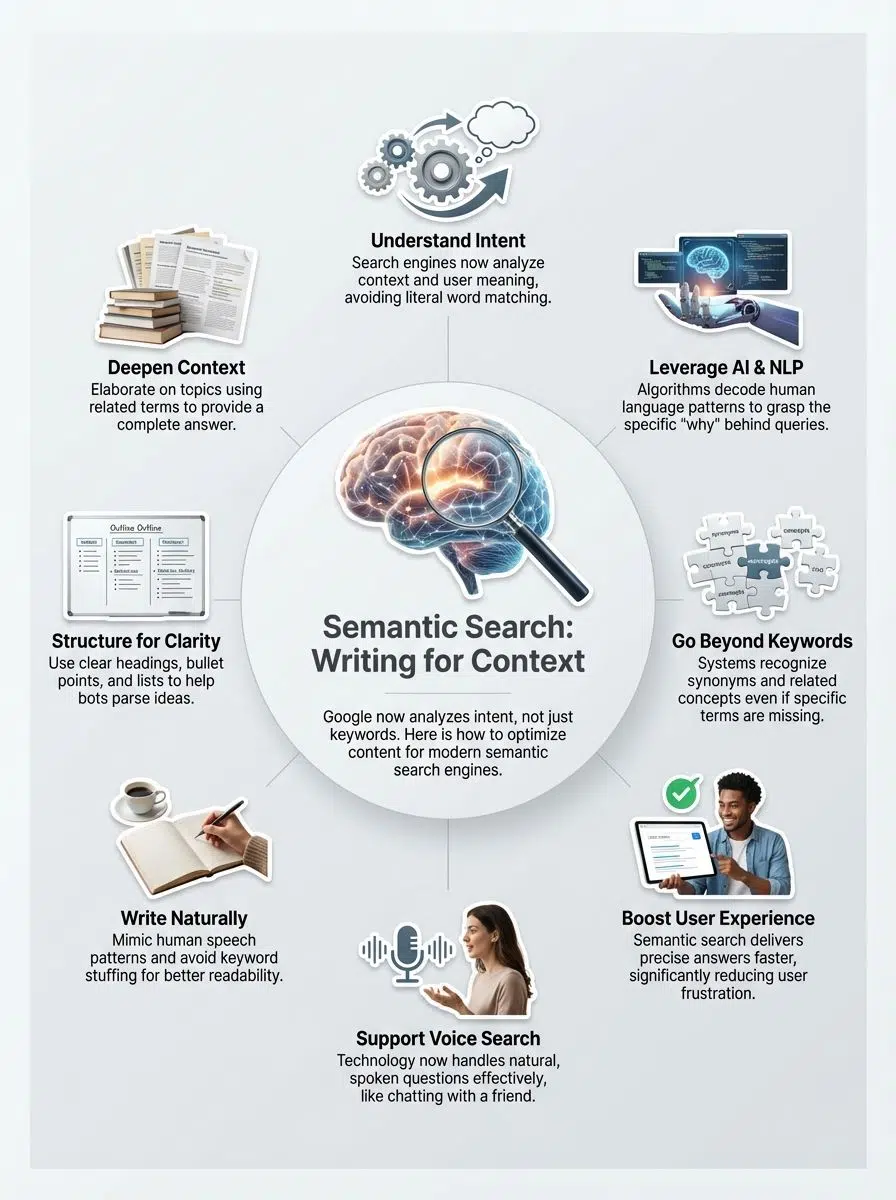
So, how do you write for this? You stop writing for robots and start writing for people.
Writing for context, not just keywords
Focus on the “Topic Cluster” model. Instead of writing ten random posts, write one massive “Pillar Page” that covers a topic broadly, and then link it to smaller articles that cover specific details.
For example, if you sell coffee, your pillar page is “The Ultimate Guide to Coffee.” Your cluster pages are “French Press vs. Pour Over,” “Best Beans for Espresso,” and “History of Arabica.” This structure tells Google you are an authority on the concept of coffee, not just the keyword.
Don’t stuff your primary keyword into every sentence. Use natural variations. If you are writing about “digital marketing,” naturally use terms like “online advertising,” “SEO,” “content strategy,” and “brand awareness.” Google calls these LSI (Latent Semantic Indexing) keywords, basically, words that frequently appear together.
Tools like Clearscope or MarketMuse can scan your draft and tell you which related topics you are missing. They help you paint a complete picture.
Structuring content for better semantic understanding
Make your content easy for machines to read. Use Schema Markup (structured data) code on your website.
Schema tells Google explicitly what your content is. You can use it to say, “This is a recipe,” “This is a product review,” or “This is a FAQ section.”
- Use FAQ Schema: Answer common questions directly. “People Also Ask” boxes are pure semantic gold.
- Use Clear Headings: Your H2s and H3s should form a clear outline of the topic.
- Answer Questions Simply: If the heading is “What is X?”, the first sentence should be “X is…”
Future of Semantic Search
We are just scratching the surface. The next few years will bring massive changes.
Advancements in AI and NLP
Generative AI is the next frontier. Google’s Search Generative Experience (SGE) is already changing the game.
Instead of giving you a list of links, the search engine reads the links for you and writes a custom answer. It synthesizes information from five different websites into one cohesive paragraph. This means your content needs to be fact-driven and original to be cited.
Expanding Use Cases Across Industries
Multimodal search is growing fast. This is the ability to search with video and text at the same time. Google Lens allows you to point your camera at a broken part on your bicycle and ask, “how do I fix this?” The system identifies the part visually and finds the repair manual textually.
We will see this expand into healthcare, where doctors can search patient records by symptoms and medical images simultaneously to find rare diagnoses.
The Bottom Line
Semantic search isn’t a fad. It is the foundation of the modern internet. People want answers that make sense. They don’t want to play guessing games with a search bar. By understanding context, intent, and meaning, search engines are finally becoming the helpful assistants we always wanted.
For you as a writer or business owner, the path is clear. Stop obsessing over exact match keywords. focus on answering real questions clearly and comprehensively. Use structured data, cover topics in depth, and write for humans first. If you do that, the algorithms will follow.
Ready to update your content strategy? Start by looking at your top posts and asking: “Does this answer the user’s real question?”