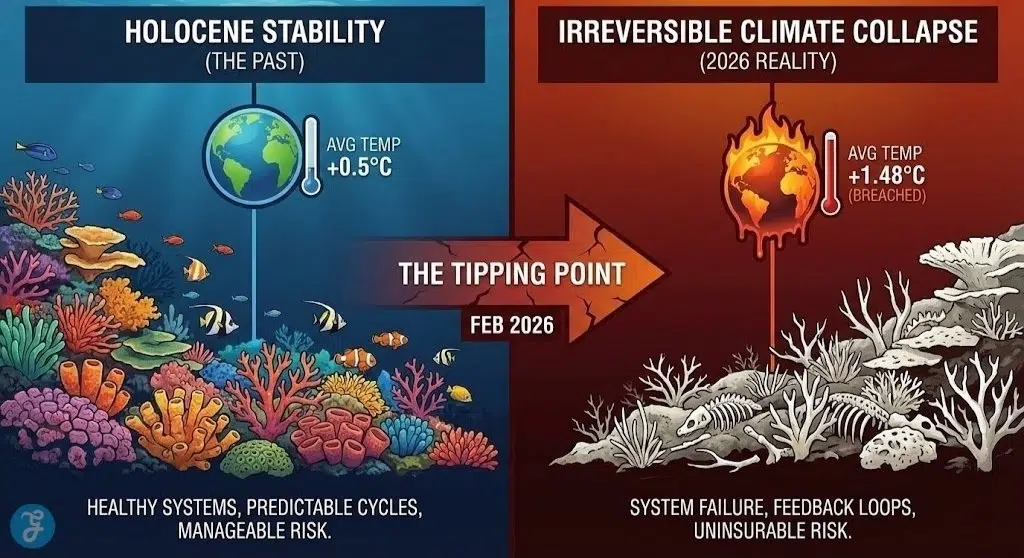
We are no longer “waiting” for climate change. As of February 2026, the scientific consensus has shifted from warning to witnessing. The second Global Tipping Points Report and fresh data from Nature Communications (February 10, 2026) confirm that warm-water coral reefs have officially crossed the threshold of widespread mortality. This is not just a loss of biodiversity; it is the first major Earth system tipping point to be breached. It serves as a grim signal that “irreversible planetary shifts” have already begun, moving us out of the Holocene stability and into a volatile, self-amplifying new reality.
The data for February 2026 confirms that we have officially moved beyond the realm of “prevention” and into the brutal reality of system failure. As the first major Earth system threshold—the thermal limit for warm-water coral reefs—is breached, the illusion that we can balance economic growth with planetary stability has finally shattered. We are no longer debating future scenarios; we are documenting the inaugural collapse of the modern environmental era. This shift marks the transition from a world of manageable risks to a state of self-amplifying chaos, where the ocean’s silence is the loudest warning we have ever received.
Why We Can No Longer Negotiate with a Melting Planet
The era of “polite climate concern” ended this morning. While our political leaders spent the last decade treating 1.5°C like a negotiable business target, the Earth’s systems simply stopped listening. Today, we are staring down the barrel of Irreversible Climate Collapse, and it’s time we stop pretending that a few more carbon credits or a “net-zero 2050” sticker will save us. We have overshot the runway, and the friction you’re feeling is the global economy starting to burn as we hit the grass. If you aren’t terrified, you haven’t been looking at the February 2026 temperature anomalies. The death of our reefs isn’t just a tragedy for the ocean; it’s the first domino in a cascade that will reshape every facet of human life.
February 2026: The Month the Oceans Stopped Recovering
On February 11, 2026, the international scientific community dropped a bombshell in the journal One Earth. The study, co-authored by researchers at the Potsdam Institute, synthesizes 16 critical Earth system components—from the Greenland Ice Sheet to the Boreal permafrost. Their conclusion? Ten of these sixteen systems are already in a state of self-amplifying destabilization. This isn’t a future risk; it’s a current event.
The data confirms that the ongoing global bleaching event—the fourth and most widespread on record—has affected 84% of coral reefs worldwide since 2023. We didn’t just touch the 1.5°C ceiling; we’ve set up a permanent residence in the attic. This is the “Hothouse Earth” trajectory we were warned about, and it is the primary driver of the Irreversible Climate Collapse we are witnessing in real-time.
How the Collapse of the “Blue Economy” Shatters Global Food Security
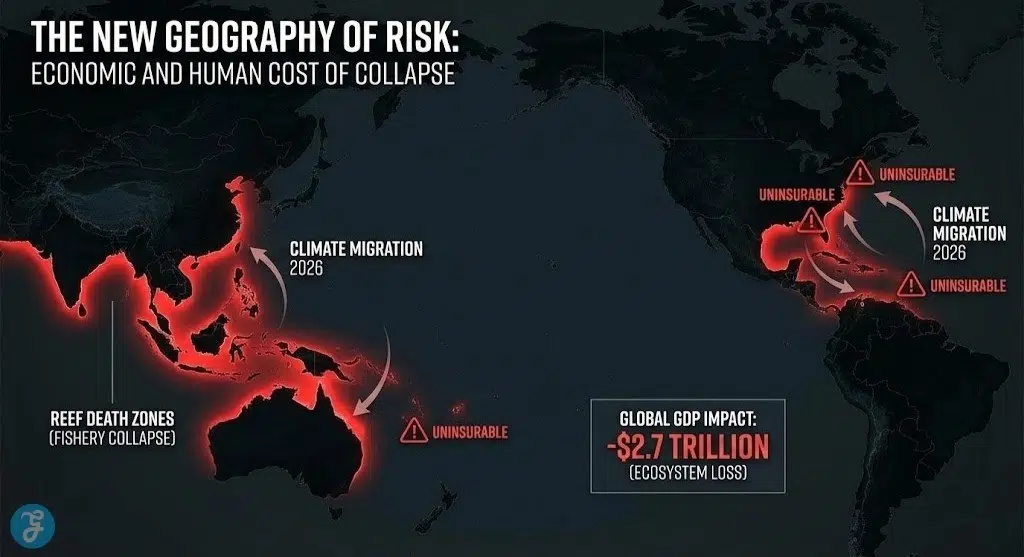
You might think a reef in the South Pacific has nothing to do with your grocery bill. You would be dangerously wrong. Over one billion people depend on coral reefs for protein, income, and coastal protection. As reefs turn to rubble, the “blue economy” doesn’t just slow down; it evaporates.
The collapse of these ecosystems is a “force multiplier” for global instability. When the fisheries fail, the resulting food security crisis will trigger migration patterns that dwarf anything seen in the 20th century. We are watching the primary protein source for a seventh of the human population vanish, and our current global food chains are utterly unprepared for the shock.
Why Your Coastal Real Estate Just Lost Its Only Defense
Coral reefs are the world’s most efficient, self-healing coastal infrastructure. They reduce wave energy by up to 97%, protecting over 100 million people from storm surges. Without them, every hurricane and cyclone hits the shore with 100% of its destructive power.
In early 2026, the insurance industry began a massive “redlining” of coastal properties. If your home or business relied on a natural reef barrier that is now 80% bleached, your premiums aren’t just going up—they are being canceled. We are witnessing the end of the dream of affordable coastal living as the natural defenses we took for granted turn into skeletal remains.
The Tipping Point Economy: Winners vs. Losers
The transition into a permanent climate crisis is not an equal-opportunity disaster. The 2026 data shows a widening chasm between those who can afford to adapt and those who will be consumed by the shift.
| Stakeholder | The 2020 Mitigation Strategy | The 2026 Tipping Point Reality | Strategic Impact |
| High-Latitude Nations | Cautious transition; focus on carbon taxes. | Agricultural expansion; sovereign wealth focused on sea walls. | Relative Gain: Canada/Nordics become the new food hubs. |
| Equatorial States | Seeking “Loss and Damage” payments. | State legitimacy erosion; mass displacement; infrastructure collapse. | Total Loss: Existential threat to national sovereignty. |
| Global Finance | Investing in “Green AI” and ESG reporting. | Declaring entire coastal zones “Uninsurable.” | Risk Reset: “Climate Default” becomes a standard credit rating. |
| The Tech Sector | Betting on “Green Bonds” and carbon markets. | Pivoting to “Extreme Adaptation” and “Closed-Loop” life support. | Strategic Pivot: Focus moves from “growth” to “resilience.” |
One Domino Down, Fifteen to Go
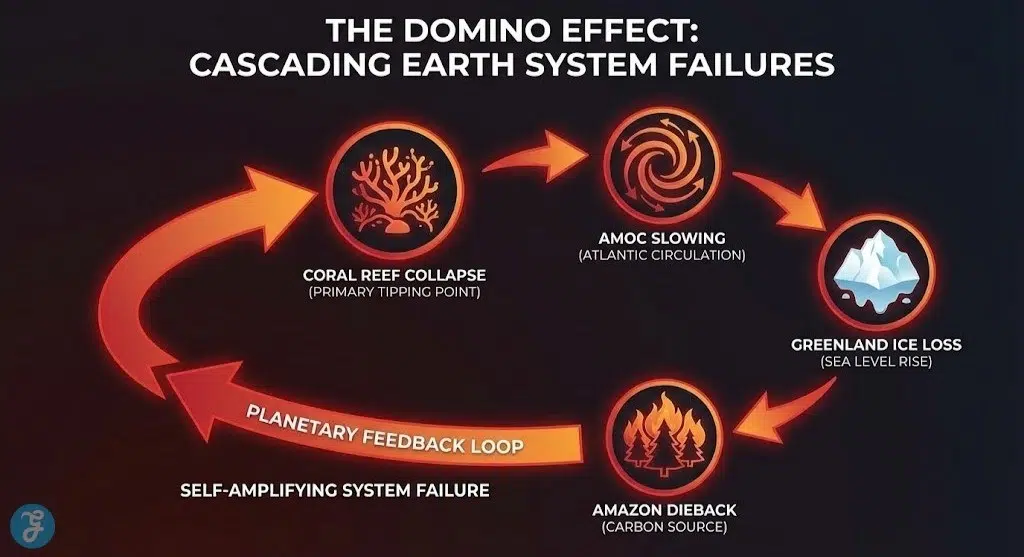
Tipping points are not isolated events; they are dominoes. The breach of the coral threshold accelerates the destabilization of other vital systems. The heat absorbed by a reef-less ocean is already contributing to the “critical slowing” of the Atlantic Meridional Overturning Circulation (AMOC).
As the AMOC slows, it disrupts the West African and Indian Monsoons, further destabilizing global agriculture. This is the definition of Irreversible Climate Collapse: a self-sustaining cycle where the failure of one system triggers the next, regardless of human intervention. We have officially moved past the point where “reducing emissions” is enough; we are now in a race to prevent a total systemic meltdown.
Why “Net-Zero” is a 2010 Solution to a 2026 Emergency
For years, policy makers promised we could “overshoot” 1.5°C and simply cool back down later. The reefs prove that was a lie. You cannot “cool down” an extinct species or a bleached ecosystem. The “temporary overshoot” is a trap that ignores the non-linear physics of Earth systems.
Once the permafrost thaws and releases billions of tons of methane, or the Greenland Ice Sheet passes its tipping point, “cooling the planet” won’t stop the collapse. To plan for an “overshoot” is to plan for Irreversible Climate Collapse. We must stop aiming for 2050 and start acting like the house is on fire today.
The Cost of Inaction? Now vs. Future Projections
What happens if we maintain our current trajectory of “aggressive-looking” but ultimately hollow climate policies?
| Metric | 2026 Baseline (Reef Breach) | 2035 Projection (Domino Path) | 2035 Projection (Radical Adaptation) |
| Global GDP Impact | -2.1% (Annual Loss) | -15% (Systemic Collapse) | -6% (Managed Transition) |
| Coastal Protection Costs | $50 Billion | $1.2 Trillion (Concrete Walls) | $400 Billion (Hybrid Resilience) |
| Insured Losses | $150 Billion | $600 Billion+ (Uninsurable) | $200 Billion (Resilience Funded) |
| Food Supply Volatility | 15% (Price Spikes) | 45% (Systemic Shortages) | 10% (Diversified Farming) |
Why Lab-Grown Coral is a Band-Aid on a Gaping Wound
There is a dangerous new argument circulating: that we can “rebuild” the reefs using 3D printing and heat-resistant lab-grown corals. This is scientific malpractice. The scale of Irreversible Climate Collapse is planetary; our restoration efforts are localized and cosmetic.
While these projects are noble, they are being used by the fossil fuel industry to suggest that we can “engineer” our way out of a systemic crisis without stopping extraction. The 2026 Potsdam Institute update is clear: unless we return the global temperature to ~1.0°C above pre-industrial levels, the thermal environment is now hostile to reef life. Lab-grown coral in a boiling ocean is just a more expensive way to watch things die.
The Global Leaders: Who is Actually Acting?
As the first domino falls, the world is splitting into those who are building lifeboats and those who are drowning.
| Entity | Primary Strategy | 2026 Status | Effectiveness |
| European Union | “Fortress Europe” + Infrastructure Resilience. | Aggressive Sea Wall construction; “Green Border” tariffs. | Moderate: High cost, but high resilience. |
| China | Dual Path: Renewables + Strategic Resource Control. | Domination of the Green Supply Chain; internal migration. | High: Prepared for a resource-constrained world. |
| United States | Fragmented; State-level resilience vs. Federal gridlock. | Coastal retreat in Florida; tech-led carbon capture. | Low: Political instability hampers long-term planning. |
| Small Island States | “Sovereignty in Exile” / Legal Vanguard. | Leading the moral argument for 1.0°C return. | Critical: The only voice for planetary justice. |
From Managed Retreat to an Emergency Cooling Economy
We have failed the first test. The reefs are gone. The roadmap for 2026 is no longer about “Net Zero”; it’s about survival and radical resilience.
-
Managed Coastal Retreat: We need a 50-year plan to relocate 600 million people from the world’s coastlines. This isn’t “giving up”; it’s basic logistics.
-
The War Economy for Energy: We need direct state-led mobilization to replace 100% of the fossil grid in 10 years, regardless of the fiscal deficit. Carbon taxes are a sedative; we need a surge.
-
Ecological Reparations: Wealthy nations that caused the overshoot must fund the digital and physical migration of those currently underwater. This is a debt, not a charity.
-
Positive Tipping Points: We must trigger the “Social Tipping Points” that make green technology not just “better,” but the only legal option for survival.
2026 Fact Sheet:
-
Global Average Temp (Jan 2026): +1.47°C (Highest on record).
-
Thermal Threshold for Reefs: Crossed at 1.2°C (Current: 1.48°C).
-
Mortality Rate: 51% of global reefs bleached/died between 2023–2025.
-
Ocean Heat Content: At “off-the-charts” levels for 36 consecutive months.
-
Atmospheric CO2: 424 ppm (Up from 419 ppm in 2024).
The End of Stability: Are You Ready to Lead the Evacuation, or Just Watch the Tide?
We are currently acting like passengers on the Titanic arguing about the quality of the dinner while the water is already at our knees. Irreversible Climate Collapse isn’t a theory anymore; it’s the atmospheric baseline. The death of the reefs is the first signal that the Earth’s systems are moving out of our control. We are now in a race to see if we can trigger “positive tipping points” in our society before the remaining systems follow the coral into the dark.
What Happens Next: Expect “Climate Emergency” declarations to become permanent state fixtures by 2027. The first major “Uninsurable Zone” in a G7 nation will likely be declared before the end of this year.
Will you keep ignoring the silence of the reefs, or is it finally time to act as if the house is on fire?